
AI SDRs promise to run the grind of outbound for you: build a list, research each account, write the email, and follow up while your reps sleep. The catch is that an AI SDR is only as good as the data and signals it acts on, so feed it a bad list and it just automates bad outreach faster.
But with new tools launching every quarter, how do you know which one is actually right for your team?
We compared 10 of the most talked-about AI SDR tools on autonomy, output quality, the data and research they act on, deliverability, and price, and ranked them on what they deliver rather than what they promise. One thing held true across every one: the data layer underneath the agent decides whether the outreach lands or embarrasses your brand.
Here's the shortlist, then a closer look at each one.
What is an AI SDR tool?
An AI SDR (sales development representative) is software that automates the outbound prospecting a human SDR would do: it finds and researches prospects, writes personalized messages, sends across email and sometimes LinkedIn, handles replies, and books meetings. Some run fully autonomously (autopilot), while others draft each step and wait for your approval (copilot). The best ones are only as strong as the target list and account research feeding them, which is why data quality matters as much as the agent that does the sending.
The 10 best AI SDR tools for 2026
| # | Tool | Best for | Pricing from | G2 rating |
|---|---|---|---|---|
| 1 | Clay | The data and research layer behind any AI SDR | Free, paid from $185/mo | 4.6/5 |
| 2 | Qualified (Piper) | Inbound pipeline for Salesforce teams | Quote-based | 4.9/5 |
| 3 | Reply.io (Jason AI) | AI SDR inside an established sequencer | AI SDR from $500/mo | 4.6/5 |
| 4 | Regie.ai | AI prospecting agents plus content | From $180/user/mo | 4.6/5 |
| 5 | Jeeva | Affordable autonomous outbound for SMBs | From $49/mo | 4.6/5 |
| 6 | Lindy | No-code AI agents for outreach and follow-up | Free trial, from $49.99/mo | 4.9/5 |
| 7 | AiSDR | A done-for-you managed AI SDR | From $250/mo | 4.7/5 |
| 8 | 11x (Alice) | Enterprise outbound at scale | Quote-based | 4.4/5 |
| 9 | Artisan (Ava) | All-in-one AI BDR with built-in data | Quote-based | 4.0/5 |
| 10 | Relevance AI | Building custom AI agents, including an AI BDR | Free, paid to $349/mo | 4.3/5 |
1. Clay
- Best forRevOps and GTM teams that want to feed any AI SDR an accurate list, research, and timing signals
- PricingFree plan, then Launch ($185/mo), Growth ($495/mo), and custom Enterprise
- What we likeClaygent AI GTM agents research the web, run workflows, and execute plays as the data and research brain behind any AI SDR, backed by waterfall enrichment across 200+ providers and Signals
Full disclosure: Clay is our product, and we put it first. The data and research layer behind AI SDRs is exactly what teams build on Clay. Here's what it does well and where it doesn't fit.
Clay approaches the AI SDR problem from the data side. Claygent AI GTM agents research the web, run workflows, and execute plays, so they build the accurate data and research an AI SDR needs to act on real information instead of guesses. Signals surface timing like job changes, funding rounds, and hiring, and waterfall enrichment across 200+ providers builds and verifies each contact, both feeding the agents underneath. Clay pairs with a sending agent rather than replacing it: it is the research brain that hands accurate inputs to whatever AI SDR does the outreach, and the finished record syncs back to Salesforce or HubSpot and re-runs as data changes.
Give your AI SDR data it can trust
Build, enrich, and research your target list in Clay before any agent sends, free.
What we like about Clay
- Claygent AI GTM agents research the web, run workflows, and execute plays, the research brain your AI SDR acts on, backed by waterfall enrichment across 200+ providers
- Claygent runs AI research on each account that no fixed data field can answer
- Signals surface job changes, funding, hiring, and web intent to time outreach
- Writes enriched records back to Salesforce and HubSpot and re-runs as data changes
- Pairs with any AI SDR or sequencer, so you improve the inputs without swapping your sender
Where Clay could be better
- It is not a sending agent, so you pair it with an AI SDR or sequencer to do the outreach
- You configure the research and data workflow yourself rather than deploying a prebuilt agent
- Credits are usage-based, so running research at scale needs a spend check
Why choose Clay? Every AI SDR needs a list, research, and signals to act on. Clay builds that layer, so the agent you run sends outreach based on accurate data instead of guesses.
Proof. Saviynt had 60% of its SDRs book more meetings using Clay MCP, adding $32.2M in pipeline.
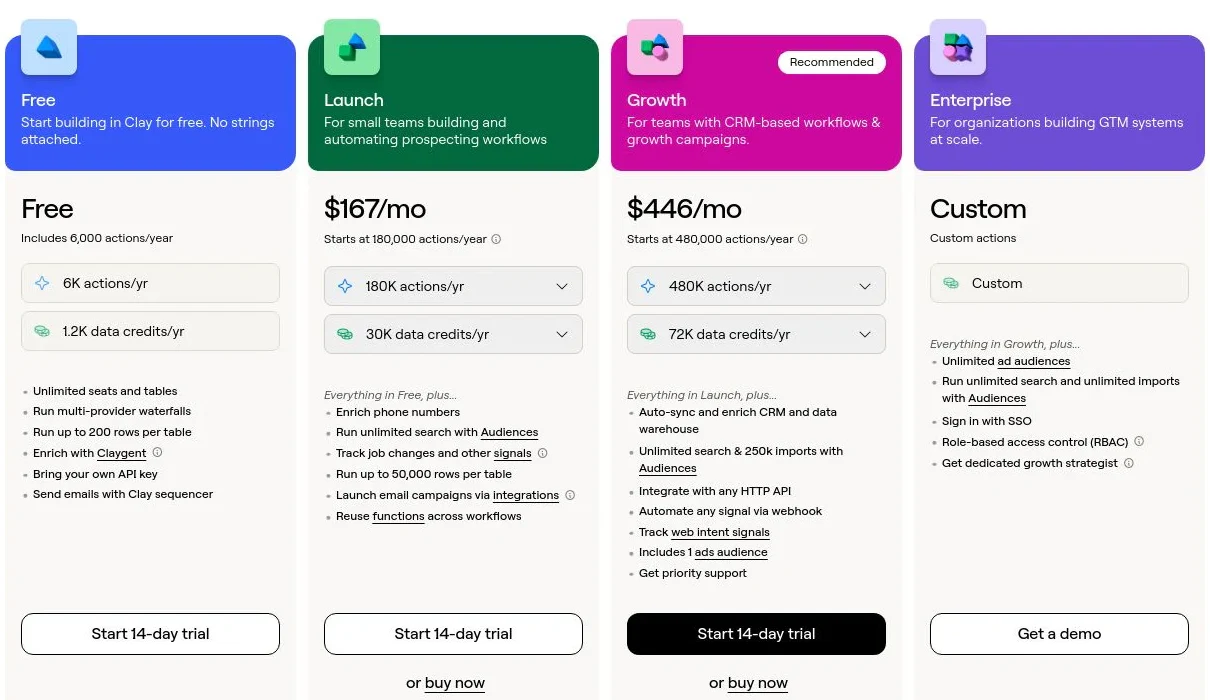
Clay pricing
- Free: $0/mo with 100 Data Credits, 500 Actions, unlimited seats and tables, multi-provider waterfalls, and Claygent
- Launch: starting at $185/mo with 2,500 Data Credits, 15,000 Actions, phone enrichment, and signal tracking
- Growth: starting at $495/mo with 6,000 Data Credits, 40,000 Actions, CRM auto-sync, and ads-audience pushes
- Enterprise: custom pricing with an annual commitment, 100,000+ Data Credits, unlimited Audiences, API access, SSO, and RBAC
Data Credits pay for the data itself and roll over; Actions pay for the platform work and reset monthly. Bring your own API keys and you skip Data Credits entirely. See Clay's pricing page for the full breakdown.
Clay reviews
- G2: 4.6/5 from 200+ reviews (G2)
2. Qualified (Piper)
- Best forenterprise Salesforce teams that want an inbound AI SDR working their website in real time
- Pricingquote-based, annual contracts
- What we likePiper engages site visitors live via chat, voice, and video, then books the meeting
Qualified's Piper is the standout inbound AI SDR. It watches your website, engages visitors in real time through chat, voice, and video, qualifies them, and books meetings straight onto a rep's calendar, then follows up by email. For a Salesforce-centric team whose pipeline problem is inbound traffic slipping away unworked, Piper turns anonymous visits into booked meetings without a rep on standby.
The focus is also the ceiling. Piper is inbound only, so there are no outbound sequences, no dialer, and no cold prospecting, and the product is built to run on top of Salesforce, which pushes the real cost up once the underlying stack is included.
What we like about Qualified (Piper)
- Live inbound engagement across chat, voice, and video on your site
- Qualifies and books meetings automatically onto rep calendars
- Deep native fit with Salesforce and existing marketing data
- The highest-adoption AI SDR on this list, with 4.9/5 from 1,400+ G2 reviews
Where Qualified (Piper) could be better
- Inbound only, so no outbound sequences, dialer, or cold prospecting
- Built to run on Salesforce, which adds to the total cost
- Premium, quote-based pricing that suits enterprise budgets more than small teams
Why choose Qualified (Piper)? The best pick when your pipeline gap is inbound and your stack lives in Salesforce.
Qualified (Piper) pricing
Qualified doesn't publish prices. Piper is sold on annual contracts quoted by pipeline volume and configuration, and third-party analyses commonly put Qualified deployments in the tens of thousands of dollars per year before the Salesforce stack it depends on. Get a quote on Qualified's pricing page for your exact setup.
Qualified (Piper) reviews
- G2: 4.9/5 from 1,400+ reviews (G2)
3. Reply.io (Jason AI)
- Best foroutbound teams that want an AI SDR inside an established multichannel sequencer
- PricingReply.io from $49/user/mo, AI SDR agent from $500/mo
- What we likeJason runs autopilot or copilot on top of a mature sending platform
Reply.io is a well-established sales engagement platform, and Jason is its AI SDR layer. Jason sources prospects, builds sequences, sends across email and LinkedIn, handles replies, and books meetings, and it works in two modes: Autopilot, where it runs the motion on its own, and Copilot, where it drafts each step and waits for your approval. Because it sits inside a mature sequencer, you get sending controls and deliverability tooling that newer standalone agents are still building.
The trade-off is that the AI SDR agent is priced separately from the core platform and scales by active contacts, so costs climb as your list grows. The G2 rating below reflects the Reply.io platform overall, since the standalone Jason AI listing is newer and thinner.
What we like about Reply.io (Jason AI)
- Jason runs full autopilot or a review-first copilot mode
- Multichannel across email and LinkedIn from one platform
- Deliverability and sequencing tools from an established sender
- Reply.io carries 4.6/5 from 1,500+ G2 reviews as a platform
Where Reply.io (Jason AI) could be better
- The AI SDR agent is priced on top of the core platform
- Pricing scales by active contacts, so costs rise with list size
- Output still needs review to keep messages from reading generic
Why choose Reply.io (Jason AI)? The pick when you want an AI SDR that lives inside a proven multichannel sequencer instead of a brand-new standalone agent.
Reply.io (Jason AI) pricing
Reply.io's core plans start around $49/user/mo for email and $89/user/mo for multichannel. The Jason AI SDR agent is priced separately, starting around $500/mo for 1,000 active contacts and rising with higher contact tiers, plus channel add-ons for LinkedIn and calls. See Reply.io's pricing page for current tiers.
Reply.io (Jason AI) reviews
- G2: 4.6/5 from 1,500+ reviews for the Reply.io platform (G2)
4. Regie.ai
- Best forsales teams that want AI prospecting agents alongside content generation
- Pricingfrom $180/user/mo, quote-based at scale
- What we likeAuto-Pilot agents that prospect and nurture, backed by strong content tooling
Regie.ai pairs autonomous prospecting agents with AI content generation. Its agents identify accounts, build and personalize sequences, and nurture prospects across channels, while the content side turns hours of email and sequence writing into minutes. Reviewers consistently call out the time savings on prospecting and the responsive customer success support, and it has the deepest G2 review base of the outbound-focused tools here.
The most common criticism is tone. Despite the personalization features, reviewers report the final AI copy can read robotic, and several flag stale job titles and wrong contact matches, which points back to the data feeding the agent. Pricing also skews toward larger budgets, with seat minimums and quote-based plans at scale.
What we like about Regie.ai
- Auto-Pilot and Co-Pilot agents that prospect and nurture
- Strong AI content generation for emails and sequences
- Responsive customer success reported across G2
- The largest G2 review base of the outbound AI SDR tools here
Where Regie.ai could be better
- Reviewers report AI copy that can read robotic
- Stale job titles and wrong contact matches show up in reviews
- Seat minimums and quote-based pricing skew to larger budgets
Why choose Regie.ai? The pick when you want prospecting agents and content generation in one platform with real adoption behind it.
Regie.ai pricing
Regie.ai's AI sales engagement plan starts around $180/user/mo with a seat minimum, and its higher tiers are quote-based, with reports of a flat annual model around $35,000/year for full deployments. Add-ons like the AI parallel dialer are priced separately. See Regie.ai's pricing page for current plans.
Regie.ai reviews
- G2: 4.6/5 from 1,480+ reviews (G2)
5. Jeeva
- Best forSMBs and startups that want affordable autonomous outbound
- Pricingfrom $49/mo
- What we likean accessible entry price for autonomous AI SDR outreach
Jeeva is one of the more approachable AI SDRs on price. It handles lead discovery, personalized outreach, and multichannel follow-up autonomously, and reviewers praise the ease of use and the time it saves on lead generation, with several reporting sharp cuts to prospecting costs versus hiring. For a small team that wants to test autonomous outbound without an enterprise contract, the entry tier is easy to start on.
The recurring friction is the credit model. Across tiers, reviewers report burning through credits faster than expected and find the per-action pricing hard to predict, and some flag billing surprises. As with any AI SDR, the quality of its output tracks the quality of the list and research feeding it.
What we like about Jeeva
- Affordable entry price for autonomous outbound
- Lead discovery, outreach, and follow-up handled automatically
- Easy to set up and use for small teams
- Reviewers report real time and cost savings on prospecting
Where Jeeva could be better
- Credit-per-action model is hard to predict and depletes quickly
- Reviewers report billing surprises and cancellation friction
- Output quality depends on the list and research it runs on
Why choose Jeeva? The pick when you want to try autonomous AI SDR outreach on an SMB budget.
Jeeva pricing
Jeeva's plans start around $49/mo for its entry tier, with a Growth tier near $119/mo and a Scale tier near $299/mo, all credit-based. Per-credit costs are not published, so size your volume before committing. See Jeeva's pricing page for current plans.
Jeeva reviews
- G2: 4.6/5 from 218 reviews (G2)
6. Lindy
- Best forteams that want to build no-code AI agents for outreach and follow-up
- Pricing7-day free trial, then from $49.99/mo
- What we likea no-code builder for AI agents that can run outbound, enrichment, and follow-up
Lindy is a no-code AI agent platform rather than a purpose-built SDR, and that flexibility is the appeal. You can build agents that enrich leads, send and reply to outreach, schedule meetings, and chain multi-step workflows, all without writing code. Reviewers repeatedly call out the ease of use and the intuitive setup, with ease of use cited as its strongest feature across the majority of G2 reviews, and it holds a 4.9/5 there.
Because it is general-purpose, you build the SDR motion yourself instead of getting one out of the box. The credit model can add up fast, complex actions like research or multi-step workflows use several credits each, and Lindy's Trustpilot presence skews negative on billing and support, a contrast worth weighing against its strong G2 score.
What we like about Lindy
- No-code builder for custom AI agents across outreach and follow-up
- Intuitive setup that non-technical users can run
- Chains multi-step workflows, not just single actions
- 4.9/5 on G2 with ease of use as the top-cited strength
Where Lindy could be better
- General-purpose, so you build the SDR motion yourself
- Credit costs climb fast on research and multi-step workflows
- Trustpilot reviews flag billing and support issues
Why choose Lindy? The pick when you want to build a custom AI SDR workflow yourself rather than buy a fixed one.
Lindy pricing
Lindy offers a 7-day free trial, then a Plus plan around $49.99/mo and a Business plan around $299.99/mo with 30,000 credits. Simple actions use about one credit each, while research or multi-step actions use several, and phone use is billed on top per minute. See Lindy's pricing page for current tiers.
Lindy reviews
- G2: 4.9/5 from 171 reviews (G2)
7. AiSDR

- Best forteams that want a done-for-you, managed AI SDR
- Pricingfrom $250/mo (Solo), Explore from $900/mo
- What we likea dedicated GTM engineer sets up campaigns and the agent personalizes from real-time signals
AiSDR leans into service. Each account gets a dedicated GTM engineer who helps configure campaigns and tune messaging, and the agent researches prospects and writes contextual first lines rather than mail-merging, drawing on hundreds of real-time signals per lead. For a team that wants an AI SDR up and running without building it themselves, the managed model shortens the path to a live campaign.
The catch is control and commitment. The Explore plan runs $900/mo on quarterly billing, which means a multi-thousand-dollar upfront commitment before you know if it fits your ICP, and power users report that the pre-built playbooks limit custom signal logic and branching. New accounts also need 30 to 60 days of warmup before hitting full sending capacity.
What we like about AiSDR
- Dedicated GTM engineer helps set up and optimize campaigns
- Personalization from hundreds of real-time signals per lead
- A managed model that gets you live without building it yourself
- 4.7/5 on G2, the highest score among the mid-tier outbound tools here
Where AiSDR could be better
- Quarterly billing means a large upfront commitment before proof
- Pre-built playbooks limit custom signal logic and branching
- New accounts need 30 to 60 days of warmup for full capacity
Why choose AiSDR? The pick when you want a hands-on, managed AI SDR rather than a build-it-yourself tool.
AiSDR pricing
AiSDR offers a Solo plan around $250/mo (month to month), an Explore plan at $900/mo on quarterly billing with 1,200 messages and lead credits, and a Grow plan at $2,500/mo, plus custom Enterprise. Annual billing cuts the higher tiers by roughly 20%. See AiSDR's pricing page for current plans.
AiSDR reviews
- G2: 4.7/5 from 76 reviews (G2)
8. 11x (Alice)

- Best forenterprise teams running high-volume outbound at scale
- Pricingquote-based, enterprise contracts
- What we likeAlice runs autonomous outbound end to end for large sending operations
11x's Alice is an autonomous AI SDR built for scale. It researches prospects, builds and sends multichannel sequences, and manages replies, and 11x pitches it as a full digital worker for large outbound operations. For an enterprise team that wants to push outbound volume well past what a human bench can cover, Alice is designed for that ceiling.
The trade-offs are cost and proof. 11x is enterprise-only with no self-serve signup, pricing is custom-quoted and reported to start in the tens of thousands per year, and independent case studies are still thin. Its G2 presence is limited, so ratings are based on a small number of reviews and should be weighed lightly.
What we like about 11x (Alice)
- Autonomous outbound built for high volume
- Multichannel research, sending, and reply handling in one agent
- Positioned for enterprise sending operations
- Backed by a well-funded, fast-moving vendor
Where 11x (Alice) could be better
- Enterprise-only, quote-based pricing with no self-serve option
- Reported entry cost runs into the tens of thousands per year
- Independent case studies and G2 reviews are still limited
Why choose 11x (Alice)? The pick when you are an enterprise team optimizing for outbound volume and can support a custom contract.
11x (Alice) pricing
11x does not publish pricing. Alice is sold on custom enterprise contracts quoted by outbound volume and scope, and third-party reports put deployments well into five figures per year. Contact 11x for a quote on its website.
11x (Alice) reviews
- G2: 4.4/5 from 32 reviews (ratings are limited given the small review base) (G2)
9. Artisan (Ava)
- Best forteams that want an all-in-one AI BDR with built-in contact data
- Pricingquote-based, annual contracts
- What we likeAva bundles a large contact database, email warmup, and sending in one platform
Artisan's Ava is an all-in-one AI BDR. It ships with a large built-in contact database, handles email warmup, and personalizes and sends outreach, so the pitch is one platform instead of a stack of point tools. Reviewers praise the clean onboarding and setup, and the guided flow makes it easy to launch a first campaign without technical work.
Results are polarized. Its G2 reviews split sharply between reps who see solid reply rates and reviewers who describe the AI output as poorly worded, and there are reports of setup and deliverability glitches. Pricing is quote-based on annual contracts, the track record is still short, and its G2 review base is small, so ratings here are limited.
What we like about Artisan (Ava)
- All-in-one AI BDR with a built-in contact database
- Handles email warmup and sending in one platform
- Clean onboarding and guided campaign setup
- One tool instead of stitching several point products together
Where Artisan (Ava) could be better
- Reviews are polarized on output quality
- Quote-based annual pricing with a short track record
- G2 review base is small, so ratings are limited
Why choose Artisan (Ava)? The pick when you want a single all-in-one AI BDR with data built in and can accept a shorter track record.
Artisan (Ava) pricing
Artisan does not publish transparent pricing. Ava is sold on annual contracts quoted by seats and volume, with reported entry points that vary widely, so plan to talk to sales and size a contract to your team. See Artisan's pricing page for details.
Artisan (Ava) reviews
- G2: 4.0/5 from 26 reviews (ratings are limited given the small review base) (G2)
10. Relevance AI

- Best forteams that want to build custom AI agents, including an AI BDR
- Pricingfree plan, then paid up to $349/mo, Enterprise custom
- What we likea multi-agent builder with thousands of tools, plus Bosh the AI BDR
Relevance AI is an AI agent platform, and outbound is one of the things you can build on it. Its best-known sales agent is Bosh, an AI BDR that researches prospects, runs personalized outreach, holds two-way conversations, and books meetings. With a large library of integration tools and a multi-agent approach, you can assemble specialized agents that run in tandem, and reviewers like how quickly they can stand agents up without heavy coding.
The flexibility comes with a learning curve and cost risk. Reviewers flag unpredictable credit consumption at scale, where an agent loop can drain a balance fast, and note a no-prorated-refund policy. Its G2 review base is small, so treat the rating as limited.
What we like about Relevance AI
- Multi-agent builder with a large library of tools
- Bosh the AI BDR handles research, outreach, and booking
- Quick to stand up agents without heavy coding
- Free plan to test before committing
Where Relevance AI could be better
- Learning curve to build a real outbound agent
- Unpredictable credit consumption at scale
- No prorated refunds, and a small, limited G2 review base
Why choose Relevance AI? The pick when you want to build custom AI agents and run outbound through Bosh rather than buy a fixed AI SDR.
Relevance AI pricing
Relevance AI offers a free plan with 200 Actions per month, paid team plans up to around $349/mo, and custom Enterprise pricing. The model runs on a split-meter usage system, so watch credit consumption as agents scale. See Relevance AI's pricing page for current tiers.
Relevance AI reviews
- G2: 4.3/5 from 21 reviews (ratings are limited given the small review base) (G2)
Which AI SDR tool should you choose?
Match the tool to your motion, not the other way around.
- The data and research layer behind any agent: Clay. It builds the list, research, and signals your AI SDR acts on, instead of guessing.
- Inbound pipeline on Salesforce: Qualified (Piper), if your gap is website traffic slipping away.
- AI SDR inside a proven sequencer: Reply.io (Jason AI), when you want deliverability tooling behind the agent.
- Prospecting agents plus content: Regie.ai, with the deepest review base of the outbound tools.
- Affordable autonomous outbound: Jeeva, for SMBs testing AI SDR on a budget.
- Build your own agent workflow: Lindy or Relevance AI (Bosh).
- Done-for-you managed setup: AiSDR.
- Enterprise volume: 11x (Alice), if the budget and scale fit.
- All-in-one AI BDR with data built in: Artisan (Ava).
If your list and account research are already accurate, a done-for-you agent is the fastest path to live campaigns. If the real problem is thin, stale, or missing data on the accounts that matter, fix the data layer first, because no agent can personalize outreach it has nothing to personalize with.
What is the best free AI SDR tool?
Most AI SDRs are not free, since sending outreach costs money. A few let you try before you pay: Relevance AI has a free plan (200 Actions a month) to build a first agent, Lindy offers a 7-day trial, and Jeeva's entry tier is low enough to test cheaply.
The one free plan that changes the outcome is the layer underneath the agent. Clay's free plan lets you build a real list, run a multi-provider waterfall, and research accounts with Claygent before you spend a credit, so the AI SDR you eventually pick has accurate inputs from day one. It is the best way to see coverage on your own accounts, not a vendor's demo list, before committing.
The catch with every free tier is credits. They're built for testing, not production, so treat them as a way to check quality on your own data before you choose.
Where AI SDRs are heading
For the last year, the AI SDR conversation has been about the agent: whose autopilot is smartest, whose copy is most human. That framing misses the point. In 2026, the teams pulling ahead are not the ones with the flashiest sender, they're the ones feeding their agent the best inputs. Two AI SDRs running the same playbook will land completely differently depending on whether the list is accurate, the research is real, and the timing signals are fresh.
Practically, that means start from the bottleneck rather than the brand name. If your problem is sending capacity, that reps can't work enough accounts, almost any autonomous agent here beats leaving pipeline on the table. If the problem is that your data is thin, stale, or missing on the accounts that matter, fix the data layer first, because a smarter agent just automates bad outreach faster. Pair the two: build and research the list where you have control, then let the agent send.
Whatever you shortlist, test it on your own data before committing a budget. The demo always looks perfect. Your accounts are the only ones that tell the truth.
A good AI SDR needs good data
Build the list, research, and signals your AI SDR runs on in Clay, free.
FAQ
What is an AI SDR and how does it work?
An AI SDR is software that automates outbound prospecting: it finds and researches prospects, writes personalized messages, sends across email and sometimes LinkedIn, handles replies, and books meetings. Some run fully autonomously on autopilot, while others draft each step and wait for your approval. Its output is only as good as the list and research feeding it.
Do AI SDRs replace human SDRs?
Not entirely. AI SDRs handle the repetitive volume work of prospecting and first-touch outreach well, which frees reps for higher-value conversations and complex deals. Most teams use them to scale coverage rather than to remove people, and a human still sets strategy, reviews output, and closes.
How much does an AI SDR cost?
It varies widely. Entry tools like Jeeva start around $49/mo, managed services like AiSDR start around $250/mo and rise to $900/mo or more, and enterprise agents like 11x, Qualified, and Artisan are quote-based and often run into the tens of thousands of dollars per year. Watch for credit and active-contact models that scale with usage.
What's the difference between an inbound and outbound AI SDR?
An inbound AI SDR like Qualified's Piper works your website traffic, engaging visitors in real time and booking meetings. An outbound AI SDR like Jason AI, Regie.ai, or 11x builds target lists and runs cold sequences. Some tools do one well, so match the tool to whether your gap is inbound or outbound.
Are AI SDR emails good for deliverability?
It depends on the tool and your discipline. Tools built on established sequencers offer warmup and sending controls, but high-volume autonomous sending under your domain carries real risk if the list is bad or the copy is generic. Verify contacts, warm up domains, and review output before scaling.
Do AI SDR tools integrate with HubSpot and Salesforce?
Most do. Qualified is built to run on Salesforce, and Reply.io, Regie.ai, AiSDR, and others sync with both HubSpot and Salesforce. Clay writes enriched records back to both and re-runs them as data changes, so the data your agent acts on stays current.
What data does an AI SDR need to work well?
An accurate contact list, verified emails and phone numbers, firmographic and technographic detail, real account research, and timing signals like job changes and funding. Feed an agent thin or stale data and it personalizes from nothing, which is why teams build the data layer in a tool like Clay before the agent sends.
Which AI SDR is best for a small team on a budget?
Jeeva has the most accessible entry price for autonomous outbound, and Lindy's low starting tier lets you build a custom agent. For the data layer underneath, Clay's free plan lets you build and research a real target list before you spend a credit, so whichever agent you pick starts with accurate inputs.