
Lead generation is the engine of every sales team, and it lives or dies on the quality of the leads underneath it. The right leads, reachable and well-matched to your ICP, turn into pipeline; thin or wrong ones just burn sends and drag down your domain.
But with tools for everything from contact databases to inbound capture to website-visitor de-anonymization, how do you know which one will actually fill your funnel?
We compared 10 lead generation tools on data coverage, sourcing model, CRM fit, and real user ratings, and ranked them on the pipeline they can genuinely create. The pattern that held throughout: a lead is only as good as the data behind it, so where a tool sources and how it verifies matters more than the logo.
Here's the shortlist, then a closer look at each one.
What is a lead generation tool?
A lead generation tool helps you find, capture, or create net-new leads: sourcing contacts from a database, capturing inbound demand, de-anonymizing website visitors, or automating outreach. What separates the good from the bad is the quality and coverage of the underlying data plus how cleanly leads flow into your CRM and sequences. The tools below range from contact databases to inbound capture to outbound engines.
The 10 best lead generation tools for 2026
| # | Tool | Best for | Pricing from | G2 rating |
|---|---|---|---|---|
| 1 | Clay | AI + waterfall enrichment to build lead lists | Free, paid from $185/mo | 4.6/5 |
| 2 | Apollo.io | All-in-one database + engagement on a budget | Free, from $49/user/mo | 4.7/5 |
| 3 | ZoomInfo | Enterprise B2B database + intent | Quote-based | 4.5/5 |
| 4 | HubSpot | Inbound lead capture + CRM | Free, paid tiers | 4.4/5 |
| 5 | Seamless.AI | Real-time contact discovery | Free, then quote-based | 4.4/5 |
| 6 | LinkedIn Sales Navigator | Social selling + lead lists | From $99.99/mo | 4.3/5 |
| 7 | Cognism | Phone-verified EU/UK lead data | Quote-based | 4.5/5 |
| 8 | Outreach | Enterprise outbound execution | Quote-based | 4.3/5 |
| 9 | Instantly | High-volume cold-email lead gen | Free trial, from $37/mo | 4.8/5 |
| 10 | Dealfront (Leadfeeder) | Website visitor de-anonymization (EU) | Free tier, from ~€99/mo | 4.3/5 |
1. Clay
- Best forRevOps and GTM teams building targeted lead lists with AI plus waterfall enrichment
- PricingFree plan, then Launch ($185/mo), Growth ($495/mo), and custom Enterprise
- What we likeTAM sourcing and Audiences build net-new lead lists from 200+ sources with ICP filtering
Full disclosure: Clay is our product, and we put it first. Building lead lists is one of the most common jobs teams run on it. Here's what it does well and where it doesn't fit.
Clay starts from the market itself. Its TAM sourcing and Audiences tools continuously pull and qualify net-new accounts from 200+ databases, filter them against your ICP, and keep the list current as new companies match. Waterfall enrichment then fills in the contact details behind each account, checking one provider after another so records land verified. Signals flag job changes, funding, and hiring, while Claygent researches criteria no static database holds. The finished list syncs to Salesforce or HubSpot and to your sequencer.
What we like about Clay
- TAM sourcing and Audiences build always-on lead lists from 200+ sources, filtered to your ICP
- Claygent researches criteria no database column holds
- Signals surface the accounts worth reaching now
- Audiences builds always-on lead lists across millions of records
- Writes leads back to your CRM and re-runs as data changes
Where Clay could be better
- You design the sourcing-and-scoring workflow rather than dropping in a ready-made capture form
- Inbound teams used to a simple form-and-CRM setup will spend time learning the canvas
- Credits are consumed as you source and enrich, so high-volume list building adds up
Why choose Clay? Every other tool pulls the leads that already exist in a database. Clay builds the lead list first, from 200+ providers, then enriches it.
Proof. Mistral AI sourced 25,000+ qualified global enterprise accounts in two weeks on Clay.
Build your lead list from 200+ sources
Run a real waterfall against your ICP and see the coverage, free.
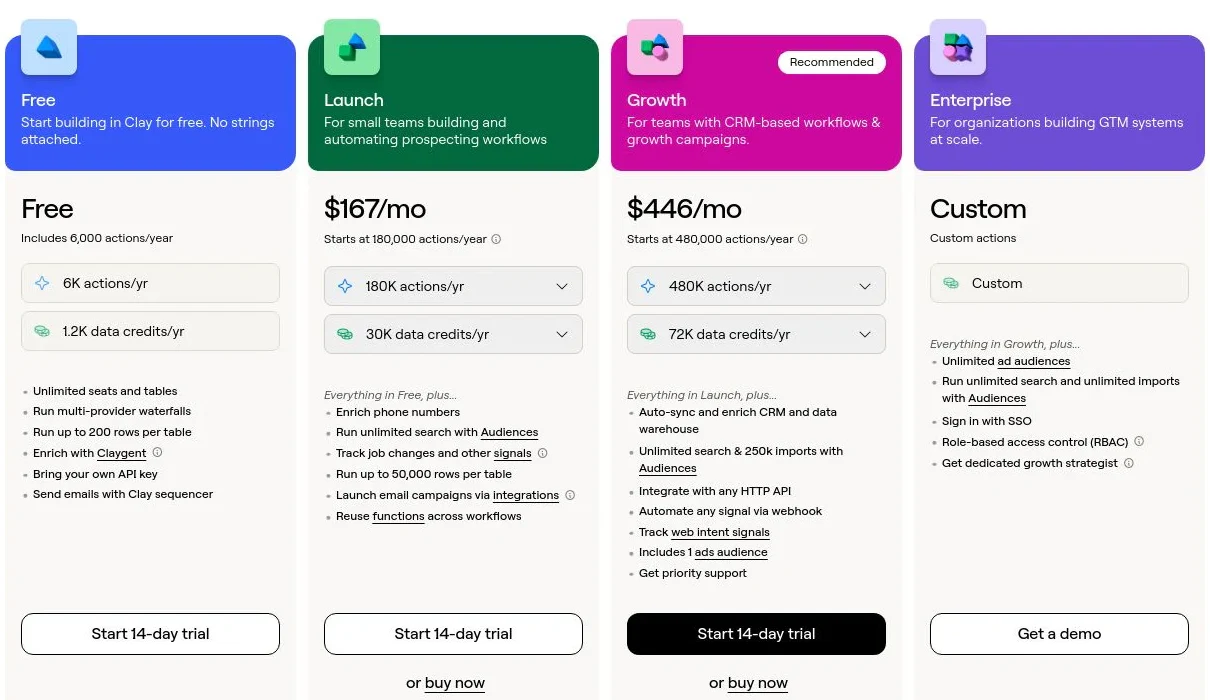
Clay pricing
- Free: $0/mo with 100 Data Credits, 500 Actions, multi-provider waterfalls, and Claygent
- Launch: from $185/mo with 2,500 Data Credits and 15,000 Actions
- Growth: from $495/mo with 6,000 Data Credits, 40,000 Actions, and CRM auto-sync
- Enterprise: custom, annual, with unlimited Audiences, API, SSO, and RBAC
See Clay's pricing page for the full breakdown.
Clay reviews
- G2: 4.6/5 from 200+ reviews (G2)
2. Apollo.io
- Best forSMB and mid-market teams wanting a database, enrichment, and sequences in one tool
- Pricingfree plan, then paid tiers from $49/user/mo (annual)
- What we likean all-in-one platform at an accessible entry price
Apollo pairs a large B2B contact database with a sales-engagement layer, so you can build a list and start sequencing without stitching two tools together. The generous free tier makes it a common first stop for founders and small teams.
The all-in-one model is also the catch. Data accuracy varies by region, and because Apollo also sends, deliverability depends on your own list hygiene.
What we like about Apollo.io
- Database, enrichment, and sequences in one tool
- A genuinely usable free tier
- Accessible per-seat pricing
- Good CRM and email integrations
Where Apollo.io could be better
- Accuracy varies by region, thinner outside North America
- Deliverability rides on your own hygiene
- Data depth trails the enterprise incumbents
Why choose Apollo.io? Best price-to-value all-in-one, database plus outreach without buying two platforms.
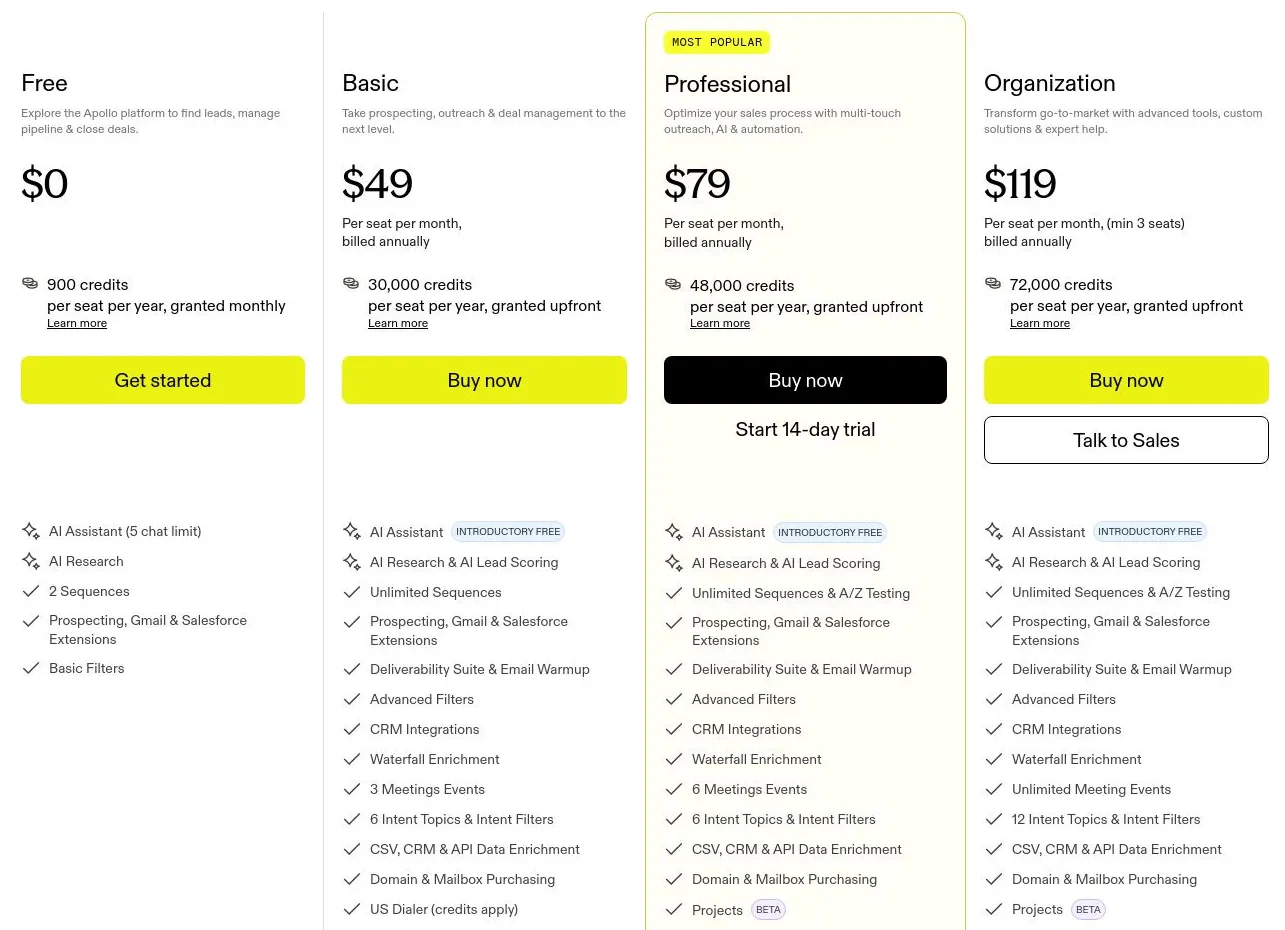
Apollo.io pricing
- Free: $0 with limited credits and core prospecting
- Basic: $49/user/mo (annual)
- Professional: $79/user/mo (annual)
- Organization: $119/user/mo (annual, 3-seat minimum)
See Apollo's pricing page for current limits.
Apollo.io reviews
- G2: 4.7/5 from 9,000+ reviews (G2)
3. ZoomInfo
- Best forenterprise teams needing the deepest B2B database plus intent
- Pricingquote-based, annual contracts
- What we likethe depth benchmark, with intent, org charts, and WebSights visitor ID
ZoomInfo is the database others are measured against, spanning roughly 14 million companies and 235 million professionals, layered with intent and org charts. For an enterprise team that needs broad coverage and buying intent in one place, it's the incumbent for a reason.
The cost shows up in more than the invoice: premium quote-based pricing, annual contracts, and coverage that thins in parts of EMEA.
What we like about ZoomInfo
- One of the largest verified B2B databases
- Intent and org charts in the same platform
- WebSights reveals which companies visit your site
- Deep CRM and sales-tool integrations
Where ZoomInfo could be better
- Premium, quote-based, annual contracts
- Accuracy strongest in North America
- Overkill for small teams
Why choose ZoomInfo? Uniquely good at enterprise-scale coverage and intent.
ZoomInfo pricing
ZoomInfo doesn't publish prices. Plans are quote-based on annual contracts, priced by seats and credits; third-party analyses put entry-level contracts around $15,000 per year. Get a quote on ZoomInfo's pricing page.
ZoomInfo reviews
- G2: 4.5/5 from 8,000+ reviews (G2)
4. HubSpot
- Best forinbound lead capture (forms, landing pages, chat) tied to a CRM
- Pricingfree CRM, then paid Marketing and Sales tiers
- What we likebest-in-class inbound capture with a native CRM and a huge ecosystem
HubSpot is the default for turning inbound interest into leads: forms, landing pages, chat, and email all feed a CRM that the rest of your stack plugs into. For teams whose pipeline starts with content and demand, it's hard to beat.
The catch is cost and scope. Prices climb quickly across hubs, and outbound contact data is a separate add-on (Breeze Intelligence).
What we like about HubSpot
- Strong inbound capture (forms, pages, chat)
- Native CRM the whole stack integrates with
- Large app marketplace
- Generous free CRM to start
Where HubSpot could be better
- Costs climb fast across hubs
- Outbound data is an add-on, not native
- Advanced features gated to higher tiers
Why choose HubSpot? The default when your lead gen is inbound-led and you want capture plus CRM in one place.
HubSpot pricing
Free CRM; paid Marketing and Sales Hub tiers scale by contacts and seats. See HubSpot's pricing page for current tiers.
HubSpot reviews
- G2: 4.4/5 from 12,000+ reviews (G2)
5. Seamless.AI
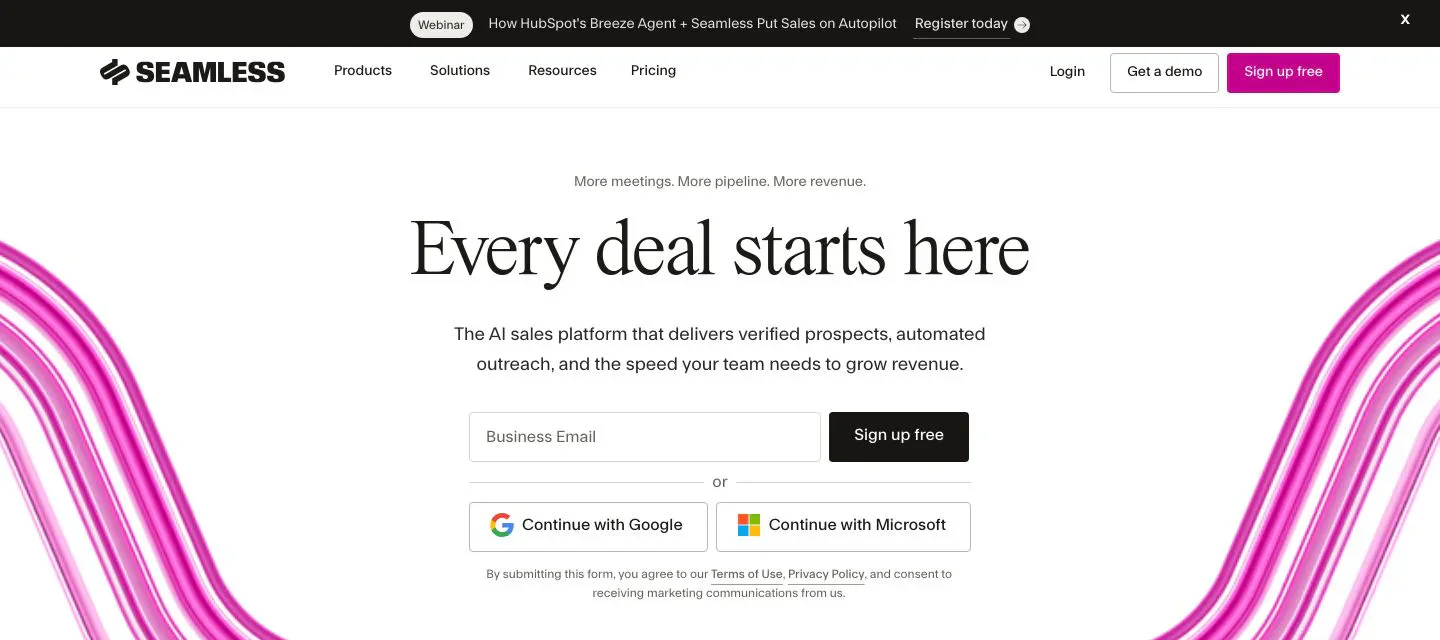
- Best forteams wanting real-time, search-engine-style contact discovery
- Pricingfree tier, then quote-based
- What we likea real-time engine that builds fresh lead lists on demand
Seamless.AI behaves more like a live search engine than a directory, assembling contacts on demand instead of pulling from a fixed database. It finds emails and phones, runs as a Chrome extension, and suits high-volume teams that need fresh leads on demand.
Real-time discovery is a strength and a risk: accuracy varies record to record, and the credit and upsell model means costs can climb.
What we like about Seamless.AI
- Builds lists on demand instead of from a static file
- Email and phone finder with a Chrome extension
- Buyer-intent add-ons
- Free tier to try it
Where Seamless.AI could be better
- Accuracy varies from record to record
- Credit and upsell model can raise costs
- Quote-based pricing with no clear public tiers
Why choose Seamless.AI? Builds fresh lead lists in real time instead of querying a static database.
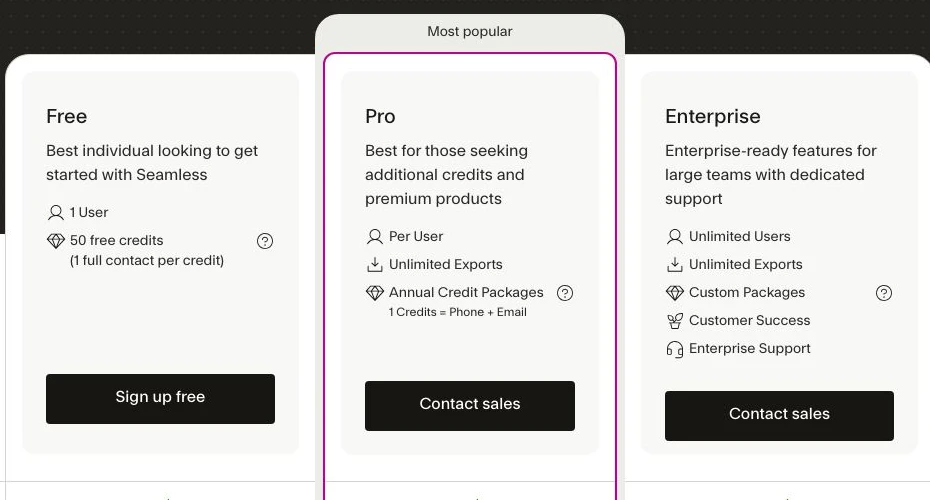
Seamless.AI pricing
Free tier with limited lifetime credits; Pro and Enterprise are custom-quoted annual contracts. Contact Seamless.AI on its pricing page.
Seamless.AI reviews
- G2: 4.4/5 from 5,000+ reviews (G2)
6. LinkedIn Sales Navigator
- Best forsocial selling, saved lead lists, and buyer signals off LinkedIn
- Pricingfrom $99.99/mo (Core, annual)
- What we likethe richest first-party professional graph with advanced filters
Sales Navigator taps LinkedIn's first-party professional data directly: advanced search, saved lead and account lists, and relationship and job-change signals. For research and social selling, nothing else has the same freshness.
It isn't a full outreach engine, though. There's no bulk email export, so most teams pair it with a data or sequencing tool.
What we like about LinkedIn Sales Navigator
- The freshest professional graph, first-party
- Advanced lead and account filters
- Saved lists and buyer signals
- InMail and relationship insights
Where LinkedIn Sales Navigator could be better
- No bulk email/phone export
- A research and list tool, not an outreach engine
- Per-seat cost adds up for big teams
Why choose LinkedIn Sales Navigator? The best source of fresh, first-party buyer signals and lists on LinkedIn.
LinkedIn Sales Navigator pricing
Core from $99.99/mo (annual); Advanced $149.99/mo; Advanced Plus quote-based. See the plan comparison.
LinkedIn Sales Navigator reviews
- G2: 4.3/5 from 2,000+ reviews (G2)
7. Cognism
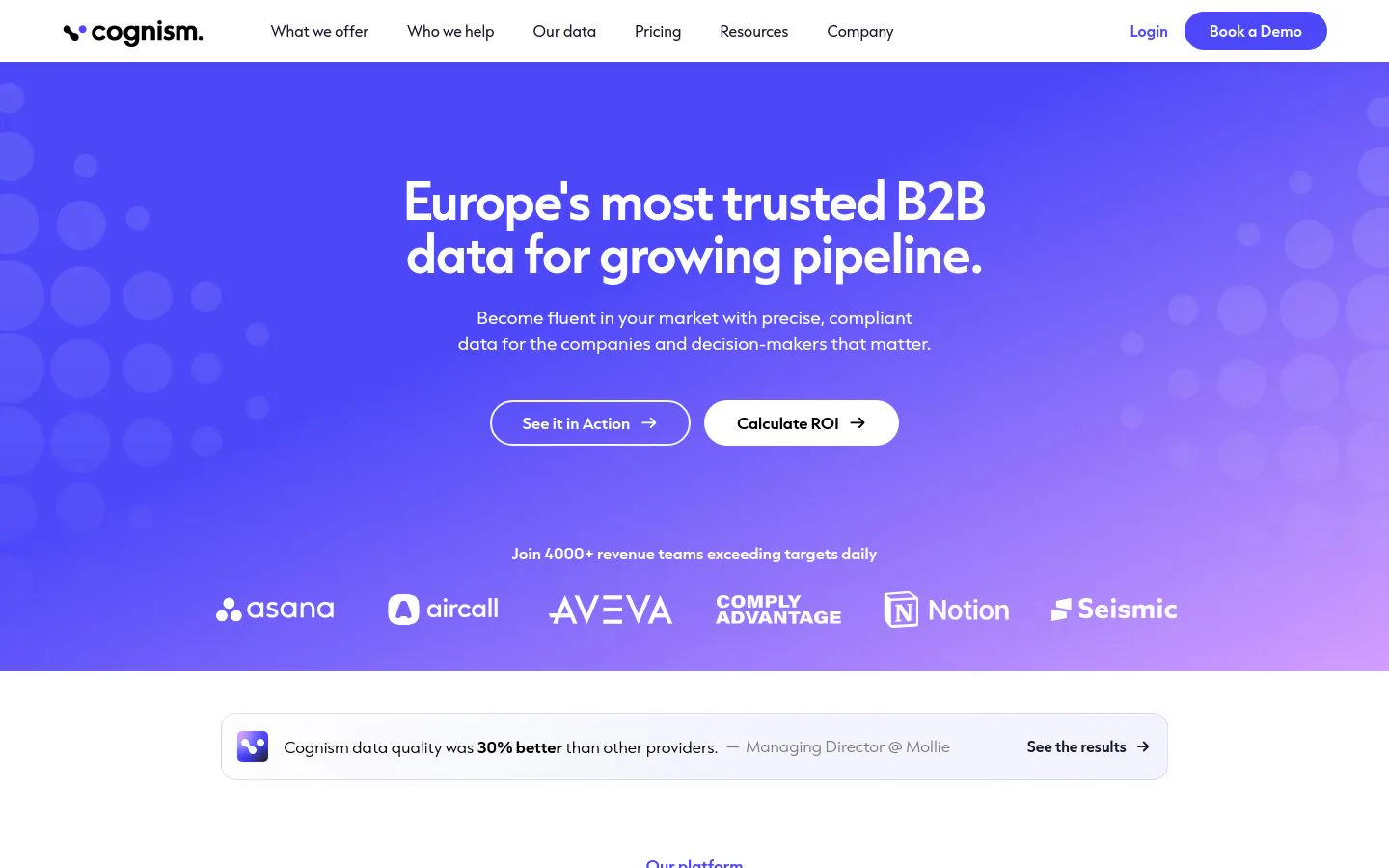
- Best forteams selling into the EU and UK that need phone-verified, compliant lead data
- Pricingquote-based
- What we likeDiamond Data-verified mobiles and a genuinely compliant EU/UK database
Cognism is built for European revenue: human-verified Diamond Data phone numbers, deep EU and UK coverage, and a GDPR posture that compliance-sensitive teams value. Leads enrich into Salesforce automatically.
Compared with US incumbents it's premium and quote-based, and its strength is regional, thinner than ZoomInfo in the US.
What we like about Cognism
- Human-verified phone numbers
- Deep, compliant EU and UK coverage
- Automatic Salesforce enrichment and intent
- Often unrestricted-view access
Where Cognism could be better
- Premium, quote-based, no public tiers
- US coverage thinner than incumbents
- Needs a sales conversation to size
Why choose Cognism? Wins on phone-verified, compliant EU and UK lead data.
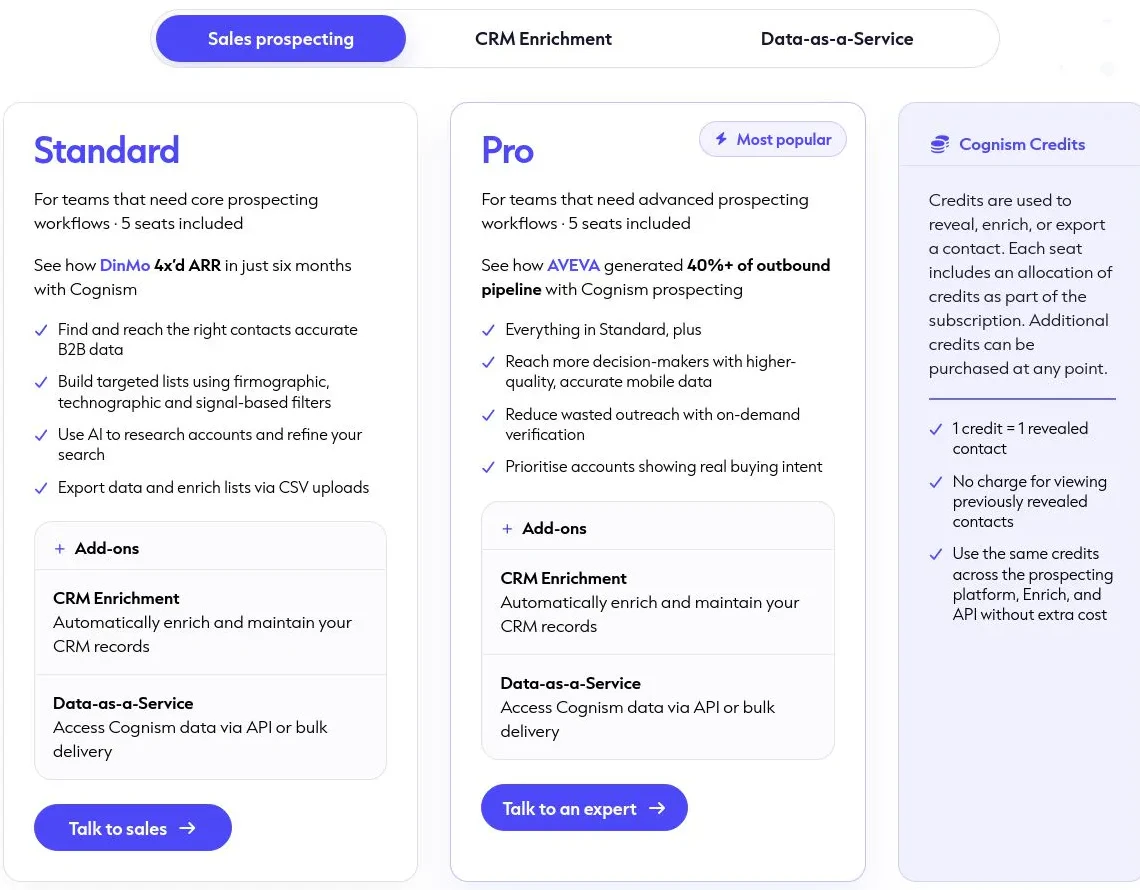
Cognism pricing
Quote-based, with Sales Prospecting packages plus add-ons. Start on Cognism's pricing page.
Cognism reviews
- G2: 4.5/5 from 1,300+ reviews (G2)
8. Outreach
- Best forenterprise teams executing outbound at scale
- Pricingquote-based
- What we likedeep sequences and rep-execution workflows
Outreach is a system of action: multi-step sequences, dialer, and deal and rep workflows that turn a list into booked meetings. For enterprise outbound teams, it's a category standard.
It's a system of action, not a data source, and enterprise pricing and complexity come with it.
What we like about Outreach
- Deep, flexible sequences
- Built-in dialer and task flows
- Deal and forecasting features
- Strong CRM integration
Where Outreach could be better
- Enterprise pricing and setup
- No native lead data; bring your own
- Heavier than SMB teams need
Why choose Outreach? The execution layer when you already have leads and need to work them at scale.
Outreach pricing
Quote-based, by seats and modules. See Outreach's pricing page.
Outreach reviews
- G2: 4.3/5 from 3,500+ reviews (G2)
9. Instantly
- Best forhigh-volume cold-email lead generation
- Pricingfree trial, then from $37/mo (annual)
- What we likeunlimited inboxes and warmup for scaled sending, plus a built-in lead database
Instantly is built for volume: unlimited email accounts, warmup, and a deliverability network, plus a built-in B2B lead database so you can source and send in one place. It suits teams running high-volume cold email.
Volume is the focus, so list quality is still on you; the best sending can't save bad data.
What we like about Instantly
- Unlimited inboxes and warmup
- Deliverability network
- Built-in lead database
- Accessible entry pricing
Where Instantly could be better
- Volume-first, so list quality still matters
- Data depth trails dedicated providers
- Best paired with strong verification
Why choose Instantly? The value pick for scaled cold-email lead gen with sending built in.
Instantly pricing
Free trial; Growth from $37/mo (annual), higher tiers by sending volume. See Instantly's pricing page.
Instantly reviews
- G2: 4.8/5 from 4,000+ reviews (G2)
10. Dealfront (Leadfeeder)
- Best forde-anonymizing website visitors, especially for EU markets
- Pricingfree tier, then from ~€99/mo (annual)
- What we liketurns anonymous traffic into company-level leads with strong EU coverage
Dealfront (which merged Leadfeeder and Echobot) reveals the companies visiting your site and pairs that with European B2B data, so inbound interest you'd otherwise miss becomes a lead. Its EU coverage and compliance are a real differentiator.
Signals are often company-level rather than person-level, so it's best paired with a contact-data tool.
What we like about Dealfront
- Website visitor de-anonymization
- Strong EU coverage and compliance
- Company-level intent signals
- CRM and Slack alerts
Where Dealfront could be better
- Company-level, not always person-level
- Best paired with a contact-data tool
- Pricing climbs with sales-intelligence add-ons
Why choose Dealfront? The pick for turning EU website traffic into leads.
Dealfront (Leadfeeder) pricing
Free tier; paid from ~€99/mo (annual); Sales Intelligence quote-based. See Dealfront's pricing page.
Dealfront (Leadfeeder) reviews
- G2: 4.3/5 from 700+ reviews (G2)
Which lead generation tool should you choose?
Match the tool to how you make pipeline.
- Build custom lists from many sources: Clay.
- All-in-one on a budget: Apollo.io.
- Deepest enterprise database and intent: ZoomInfo.
- Inbound capture plus CRM: HubSpot.
- Real-time discovery: Seamless.AI.
- Social selling and research: LinkedIn Sales Navigator.
- EU/UK phone-verified data: Cognism.
- Enterprise outbound execution: Outreach.
- High-volume cold email: Instantly.
- Website visitor de-anonymization: Dealfront.
What is the best free lead generation tool?
HubSpot's free CRM is the simplest way to capture and manage inbound leads. Apollo's free tier is the most generous all-in-one, giving you a database plus a few sequences. Instantly's trial gets you sending fast. For custom, AI-driven list building, Clay's free plan lets you run a multi-provider waterfall against your own ICP and see coverage before you spend a credit.
Where lead generation is heading
Lead gen used to be a numbers game: buy the biggest list, capture every form fill, and let volume do the work. That's fading. The teams building durable pipeline in 2026 care less about how many leads they can pull and more about whether each one is real, reachable, and a genuine fit, assembled from several sources and verified before it ever reaches a sequence.
Practically, the smart move is to work backward from where your funnel actually leaks. If you have no leads, a database or inbound capture is the fastest fix. If you have leads but they're low quality, fix the data layer before you scale sends, because no sender rescues a bad list.
Whatever you shortlist, run it against your own ICP before committing a budget. A coverage claim on a pricing page means little until you see it on the accounts you actually sell to.
Build a lead list that isn't half empty
Run a multi-provider waterfall against your ICP and see coverage before you spend a credit.
FAQ
What is lead generation and how do these tools help?
Lead generation is creating net-new prospects for your funnel. These tools help by sourcing contacts from a database, capturing inbound interest, revealing website visitors, or automating outreach, then routing those leads into your CRM.
What's the difference between inbound and outbound lead generation?
Inbound captures people who come to you (forms, content, chat); outbound proactively reaches a target list (email, calls, LinkedIn). Most teams run both, and several tools here specialize in one side.
How accurate is purchased or enriched lead data?
Accuracy varies by provider and region, and every database decays as people change jobs. The best approach runs more than one source and verifies at the point of use. Always test coverage on your own ICP before committing.
Do these tools integrate with HubSpot and Salesforce?
Most do. HubSpot is itself a CRM; Clay, Apollo, ZoomInfo, Cognism, and others sync to both HubSpot and Salesforce, and Clay writes leads back and re-runs them as data changes.
How is lead-gen pricing usually structured?
Commonly credits (per revealed contact), per-seat licenses, or usage tiers. Enterprise databases like ZoomInfo and Cognism are quote-based; sending tools price by inbox or volume.
Which tool is best for a small team on a budget?
Apollo's free and low tiers are hard to beat for all-in-one, HubSpot's free CRM for inbound, and Clay's free plan if you want to build and enrich a custom list before paying.