
Reps don't lose deals because they ran out of names. They lose them by spending the week on accounts that were never going to buy, and missing the one that just raised a round or posted the exact role your product supports. Sales intelligence is what closes that gap: it tells a rep who to reach and, just as important, when.
But with dozens of platforms all promising better data and sharper signals, how do you know which one actually surfaces the accounts worth your reps' time?
We compared 10 of the most widely used sales intelligence tools on data depth, buying signals, account research, and price, and ranked them on what they surface rather than what they promise. One thing held true across every one: a database alone is a phone book. What turns it into pipeline is the signal layer on top, the events and research that tell a rep this account, this week.
Here's the shortlist, then a closer look at each one.
What is a sales intelligence tool?
A sales intelligence tool combines three things: contact and company data (who works where, how to reach them), buying signals (funding, hiring, job changes, web and product intent that say an account is in-market), and account research (the context a rep needs to open a relevant conversation). The concept that separates a good tool from a glorified list is timing: the best platforms don't just tell you who a buyer is, they flag the moment that buyer is worth calling. Data answers who. Signals answer when.
The 10 best sales intelligence tools for 2026
| # | Tool | Best for | Pricing from | G2 rating |
|---|---|---|---|---|
| 1 | Clay | Signals plus AI account research | Free, paid from $185/mo | 4.6/5 |
| 2 | Apollo.io | All-in-one intelligence on a budget | Free, paid from $49/user/mo | 4.7/5 |
| 3 | ZoomInfo | Enterprise data plus intent | Quote-based | 4.5/5 |
| 4 | LinkedIn Sales Navigator | Real-time relationship and role signals | From ~$99/user/mo | 4.4/5 |
| 5 | Demandbase | Account intelligence plus intent | Quote-based | 4.4/5 |
| 6 | Cognism | Phone-verified EU/UK reach data | Quote-based | 4.5/5 |
| 7 | Lusha | Fast SMB contact intelligence | Free, then paid tiers | 4.3/5 |
| 8 | 6sense | Predictive intent and buying stage | Free tier, then quote-based | 4.3/5 |
| 9 | Clearbit (Breeze Intelligence) | HubSpot-native intelligence | Credit packs from $45/mo | 4.4/5 |
| 10 | Bombora | Dedicated third-party intent feed | Quote-based | 4.4/5 |
1. Clay
- Best forRevOps and GTM teams that want live buying signals plus AI account research telling reps who to reach and when
- PricingFree plan, then Launch ($185/mo), Growth ($495/mo), and custom Enterprise
- What we likecustom Signals flag the moment an account goes in-market, and Claygent researches each one the way a rep would
Full disclosure: Clay is our product, and we put it first. Building a signal-driven view of which accounts to work is one of the most common things teams do on Clay. Here's what it does well and where it doesn't fit.
Clay treats sales intelligence as a timing problem before a data problem. Signals watch for the events that mean an account is worth a call now, funding rounds, hiring spikes, leadership job changes, and first- and third-party web and product intent, and push those accounts to the top as they heat up. On each one, Claygent, an AI research agent, reads the web and answers the qualifying questions a data field never could, like whether a company just opened a role your product supports or shipped a feature that changes the pitch. Contact data comes from a waterfall across 200+ providers, so the verified email and phone are there when a rep is ready to reach out, and the whole picture syncs to Salesforce or HubSpot and re-runs as accounts change. The result is less a database to search than a running answer to which accounts, and why, this week.
See which accounts are in-market now
Track buying signals and research accounts against your own list, free.
What we like about Clay
- Signals surface funding, hiring, job changes, and web intent, so reps work accounts at the right moment
- Claygent runs AI account research that answers questions no fixed data field can
- Waterfall enrichment across 200+ providers puts verified email and phone behind every signal
- Scores and prioritizes accounts in real time, then syncs the ranked view to Salesforce and HubSpot
- Re-runs as accounts change, so the intelligence stays current instead of going stale after import
Where Clay could be better
- You design the signal logic and research prompts yourself rather than reading a prebuilt intent dashboard
- There's a ramp before the signal-to-outreach workflow is dialed in, more than a search-and-export tool
- It surfaces and researches signals rather than shipping a fixed, packaged intent score out of the box
- Credits are usage-based, so monitoring and researching large account sets needs a spend check
Why choose Clay? Every other tool hands you data and, at best, a canned intent score. Clay watches for the signal, researches the account behind it, and tells a rep exactly why to reach out now.
Proof. Coverflex prioritized 3M+ companies via intent signals on Clay and added 200+ demos a month.
Clay pricing
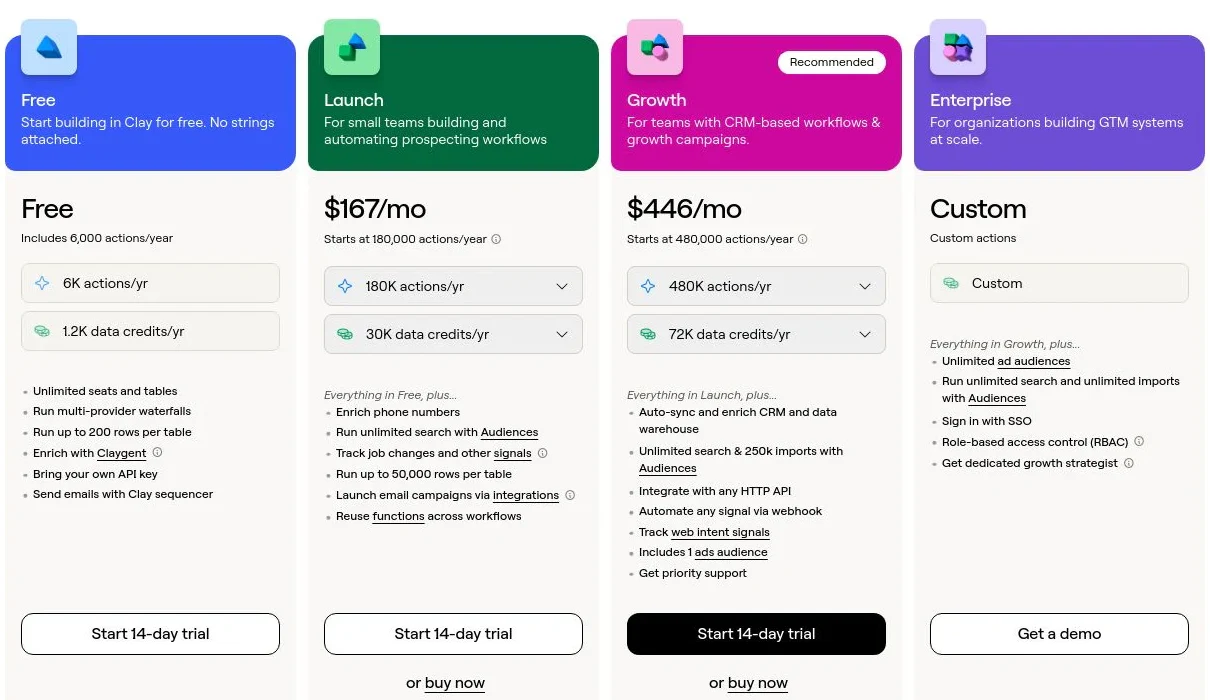
- Free: $0/mo with 100 Data Credits, 500 Actions, unlimited seats and tables, multi-provider waterfalls, Signals, and Claygent
- Launch: starting at $185/mo with 2,500 Data Credits, 15,000 Actions, phone enrichment, and signal tracking
- Growth: starting at $495/mo with 6,000 Data Credits, 40,000 Actions, CRM auto-sync, and ads-audience pushes
- Enterprise: custom pricing with an annual commitment, 100,000+ Data Credits, unlimited Audiences, API access, SSO, and RBAC
Data Credits pay for the data itself and roll over; Actions pay for the platform work and reset monthly. Bring your own API keys and you skip Data Credits entirely. See Clay's pricing page for the full breakdown.
Clay reviews
- G2: 4.6/5 from 200+ reviews (G2)
2. Apollo.io
- Best forSMB and mid-market reps who want a contact database, buying intent, and outreach in one affordable tool
- Pricingfree plan, then paid tiers from $49/user/mo (annual)
- What we likea large database with intent topics and signals bundled at an accessible price
Apollo is the most accessible way to get sales intelligence into a rep's hands. It pairs a large B2B contact database with buying-intent topics, job-change alerts, and account filters, so a rep can spot an in-market account, pull a verified email, and start a sequence without leaving the tool. The generous free tier makes it a common first platform for teams building an intelligence-driven motion on a budget.
The breadth is the trade-off. Apollo's intent signals are lighter and less predictive than a dedicated platform's, data accuracy varies by region, and because Apollo also handles sending, deliverability rides on your own list hygiene.
What we like about Apollo.io
- Contact database, buying-intent topics, and job-change signals in one tool
- Account and persona filters make it fast to build a working list
- A genuinely usable free tier and accessible per-seat pricing
- Sequencing and CRM sync built in, so a signal turns into outreach in one place
Where Apollo.io could be better
- Intent signals are lighter and less predictive than a dedicated intelligence platform's
- Data accuracy varies by region, thinner outside North America
- Deliverability depends on your own sending discipline since Apollo also sends
- Research depth on a given account is shallow next to an AI-research or enterprise tool
Why choose Apollo.io? Best price-to-value if you want a database, basic intent, and outreach as one intelligence tool.
Apollo.io pricing
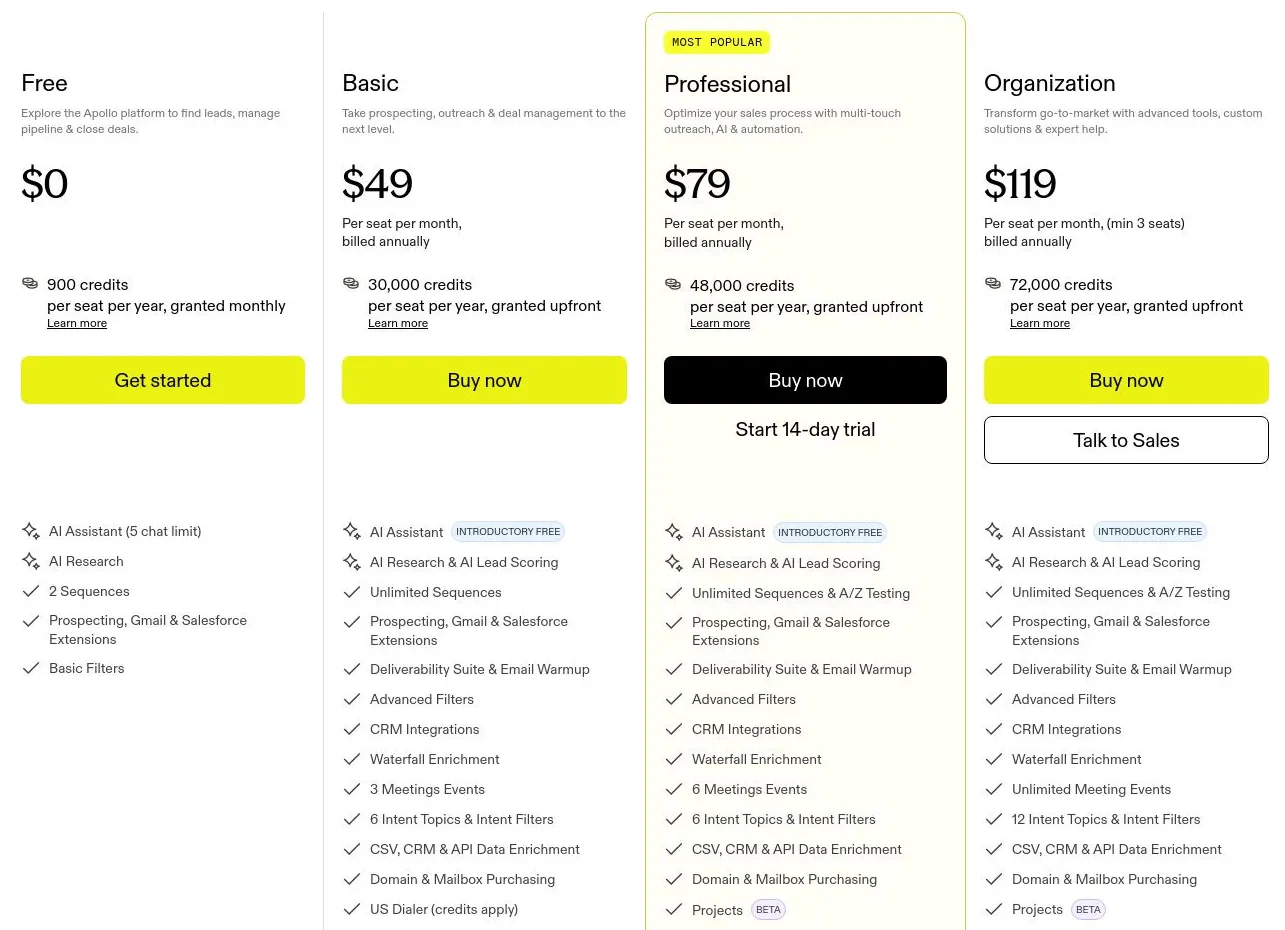
- Free: $0 with limited credits and core prospecting
- Basic: $49/user/mo (annual) with more credits and sequences
- Professional: $79/user/mo (annual) with advanced features and higher limits
- Organization: $119/user/mo (annual, 3-seat minimum) with the full feature set
Monthly billing runs higher than the annual rates shown. See Apollo's pricing page for current limits.
Apollo.io reviews
- G2: 4.7/5 from 9,000+ reviews (G2)
3. ZoomInfo
- Best forenterprise sales teams that want deep B2B data paired with intent and website-visitor signals
- Pricingquote-based, annual contracts
- What we likea large verified database layered with intent, org charts, and WebSights
ZoomInfo is the depth benchmark for sales intelligence. It pairs one of the largest verified B2B databases with intent data, detailed org charts, and WebSights website-visitor identification, so an enterprise rep can see an in-market account, map the buying committee, and pick the right entry point from one platform. Its intent draws on a large web co-op, and Workflows can trigger alerts when an account's intent spikes.
The cost shows up in more than the invoice. Pricing is premium and quote-based on annual contracts, intent sits as an add-on layer on top of the core seats, and accuracy is strongest in North America and thins out across parts of EMEA.
What we like about ZoomInfo
- One of the largest verified B2B databases, with deep org-chart mapping
- Intent data and WebSights visitor identification in the same platform
- Workflows fire alerts when an account's intent spikes
- Deep integrations across major CRMs and sales tools
Where ZoomInfo could be better
- Premium, quote-based pricing on annual contracts
- Intent is an add-on layer on top of core seats
- Accuracy is strong in North America and thins out in parts of EMEA
- Overkill and overpriced for small teams
Why choose ZoomInfo? Uniquely good at pairing enterprise-scale data with intent and org charts, the depth others are measured against.
ZoomInfo pricing
ZoomInfo doesn't publish prices. Plans (commonly Professional, Advanced, and Elite) are quote-based and sold on annual contracts, priced by seats and credits, with intent as an add-on. Third-party pricing analyses put entry-level contracts around $15,000 per year, rising with credits and add-ons. Get a quote on ZoomInfo's pricing page for your exact configuration.
ZoomInfo reviews
- G2: 4.5/5 from 8,000+ reviews (G2)
4. LinkedIn Sales Navigator

- Best forreps who work in LinkedIn and want real-time relationship, role, and account-update signals
- PricingCore from about $99/user/mo (annual), then Advanced and Advanced Plus
- What we likelive signals straight from the world's largest professional network, with warm-path mapping
LinkedIn Sales Navigator is the intelligence layer for the network reps already live in. It surfaces job changes, new roles, leadership moves, and company updates in real time, shows how your team is connected to a buyer so you can find a warm path in, and lets you build and save lead and account lists off LinkedIn's own data. For a rep deciding who to reach and how to get introduced, it's the closest thing to a live feed of the buying committee.
The trade-off is what it deliberately isn't. Sales Navigator is a research and relationship tool, not a data-export engine: it doesn't hand you bulk verified emails or phone numbers, it doesn't enrich your CRM on its own, and the intelligence stays inside LinkedIn unless you add a separate tool.
What we like about LinkedIn Sales Navigator
- Real-time job-change, role, and company-update signals from LinkedIn itself
- Relationship mapping shows warm paths into a target account
- Advanced lead and account search with saved lists and alerts
- InMail to reach buyers outside your network, with 50 credits a month per seat
Where LinkedIn Sales Navigator could be better
- No bulk email or phone export; it's research, not a contact-data source
- Doesn't enrich or sync to your CRM without a separate tool (CRM sync only on higher tiers)
- Data lives inside LinkedIn, so acting on a signal means switching tools
- Per-seat cost adds up across a full team
Why choose LinkedIn Sales Navigator? The best live source of relationship and role signals, and the warm path into an account, straight from LinkedIn.
LinkedIn Sales Navigator pricing
Sales Navigator is per seat, billed monthly or annually. Core starts around $99/user/mo on annual billing (higher month to month), Advanced runs about $159/user/mo and adds team features like CRM sync and reporting, and Advanced Plus is a custom quote for enterprise CRM integration. Every tier includes 50 InMail credits a month. See LinkedIn's plan comparison for current rates.
LinkedIn Sales Navigator reviews
- G2: 4.4/5 from 2,100+ reviews (G2)
5. Demandbase
- Best forenterprise teams that want account-level intelligence and intent feeding a coordinated sales motion
- Pricingquote-based, annual contracts
- What we likeaccount intelligence that blends first- and third-party intent with engagement history
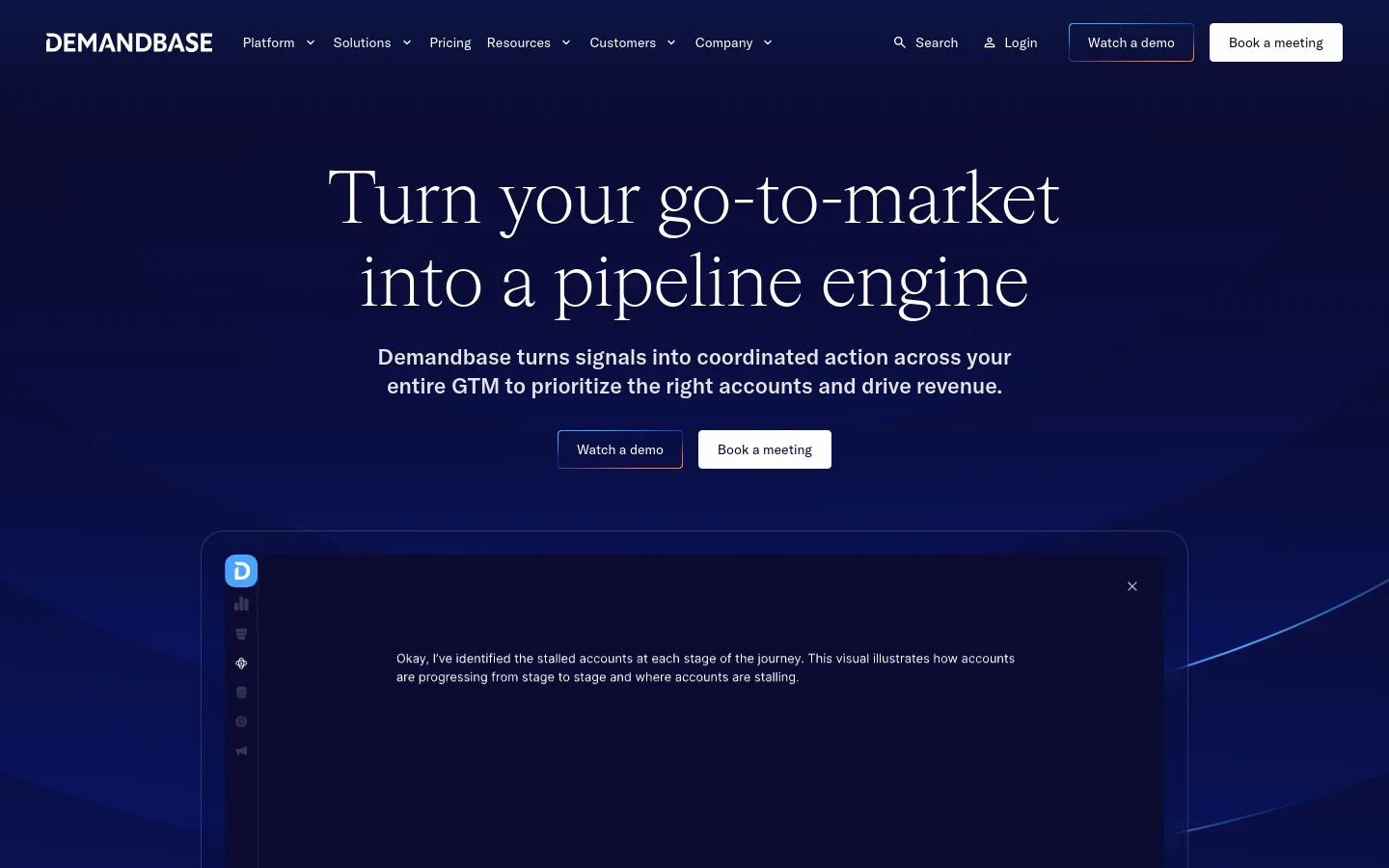
Demandbase One is built around account intelligence. It identifies and scores target accounts, blends first-party and third-party intent, and gives sales a single account view with engagement history and buying signals, so reps see which accounts are heating up and why before they reach out. For an enterprise team that wants its sales intelligence tied into advertising and orchestration under one roof, it's a category leader for a reason.
That completeness has a price. Demandbase is quote-based at the enterprise end, onboarding fees and per-seat costs stack on the platform license, and the breadth means a real ramp before a team reads the signals fluently.
What we like about Demandbase
- Account intelligence blends first-party and third-party intent into one score
- A unified account view with engagement history for sales
- Buying-stage and intent signals surface which accounts are in-market
- Strong CRM and marketing-automation integrations for acting on a signal
Where Demandbase could be better
- Quote-based, enterprise-level pricing with onboarding fees on top
- Per-seat costs stack on the base platform license
- The broad platform means a real ramp before reps use the intelligence fully
- Heavier than SMB and lean mid-market teams need
Why choose Demandbase? The pick when you want enterprise account intelligence and intent wired into a coordinated sales and marketing motion.
Demandbase pricing
Demandbase is quote-based. There's no free trial, and the base platform commonly starts around $20,000 to $45,000 per year for smaller deployments, with a separate onboarding fee and per-seat licensing beyond the included count. Add-on modules (advertising, sales intelligence, and AI agents) raise the total. Get a quote on Demandbase's pricing page for your configuration.
Demandbase reviews
- G2: 4.4/5 from 1,900+ reviews (G2)
6. Cognism
- Best forteams selling into the EU and UK that need phone-verified reach data plus intent
- Pricingquote-based
- What we likeDiamond Data phone verification, deep European coverage, and a strong GDPR posture
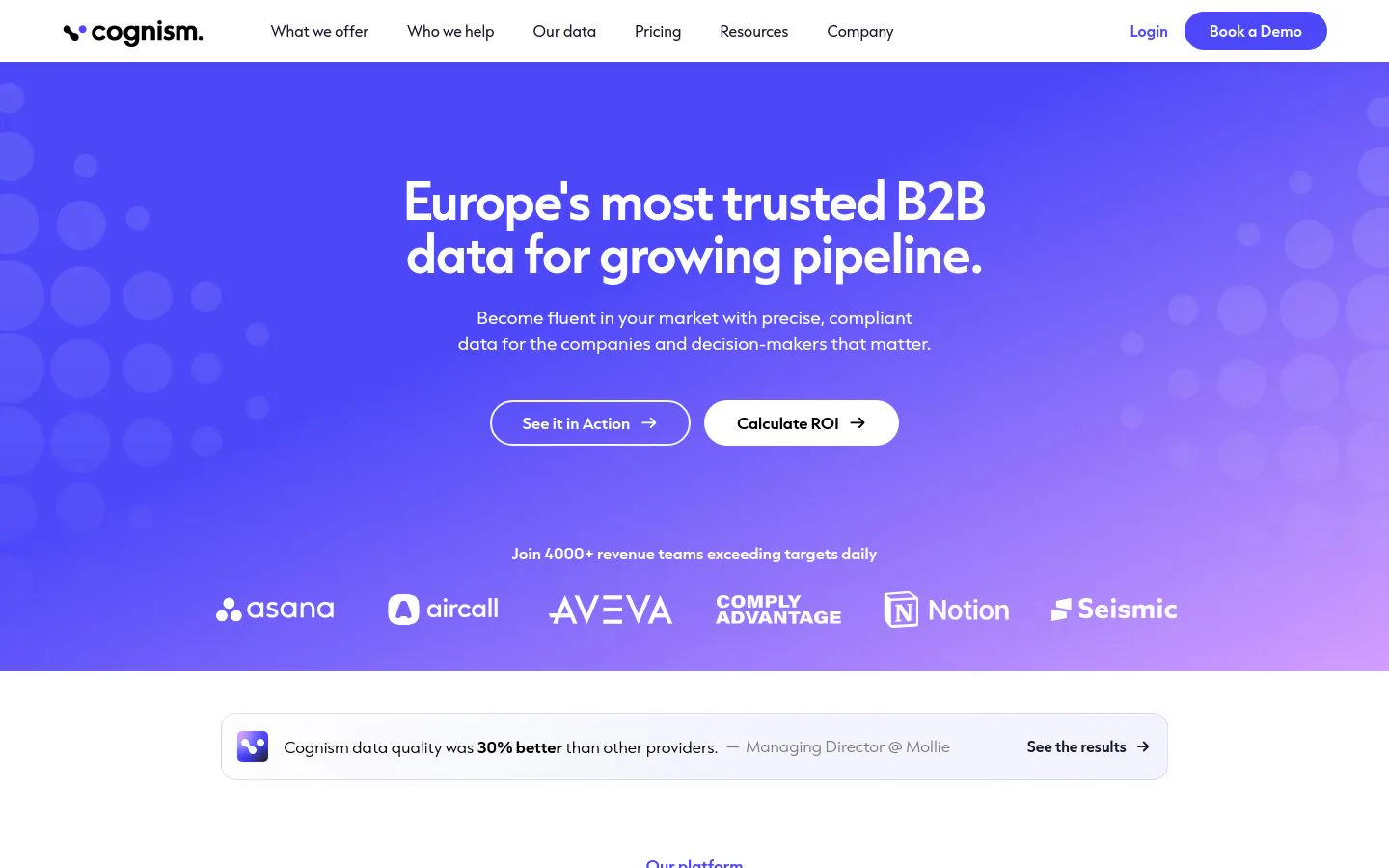
Cognism is sales intelligence built for European revenue teams. Its Diamond Data phone numbers are human-verified, its UK and EMEA contact coverage is deep, and Bombora-powered intent flags which accounts are researching your category, so reps know both how to reach a buyer and when the timing is right. Records enrich into Salesforce automatically, and its GDPR posture is a genuine differentiator for compliance-sensitive teams.
Compared with the US incumbents, it's a premium, quote-based product, and its strength is regional: coverage is strongest in the UK, EMEA, and DACH, and thinner than ZoomInfo in the US.
What we like about Cognism
- Diamond Data phone numbers are human-verified for accuracy
- Deep, compliant EU and UK coverage with a strong GDPR posture
- Bombora-powered intent flags accounts researching your category
- Unrestricted-view access on many plans, so seats aren't nickel-and-dimed
Where Cognism could be better
- Premium, quote-based pricing with no public tiers
- US coverage is thinner than the North American incumbents
- Intent is a licensed layer rather than a native predictive model
- Credit and seat structure needs a sales conversation to size
Why choose Cognism? Wins on phone-verified, compliant EU and UK reach data with intent, where other tools thin out.
Cognism pricing
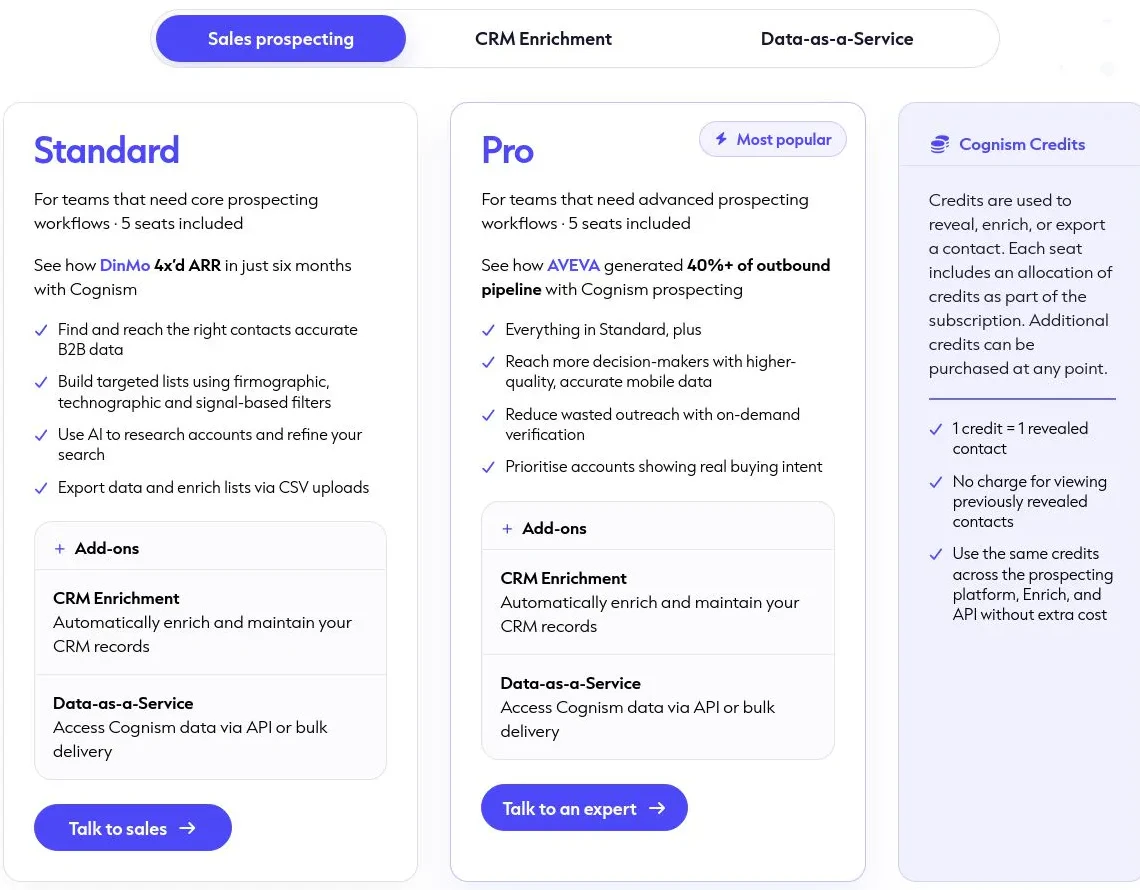
Cognism is quote-based. The pricing page lists Sales Prospecting packages (Standard and Pro) plus CRM Enrichment and Data-as-a-Service add-ons, all priced through sales. The model is credit-based, where one credit reveals one contact, with intent as an add-on. Talk to Cognism for a quote sized to your region and seats. Start on Cognism's pricing page.
Cognism reviews
- G2: 4.5/5 from 1,300+ reviews (G2)
7. Lusha
- Best forSMB reps who want fast, self-serve contact intelligence with job-change alerts
- Pricingfree plan (40 credits/mo), then paid tiers
- What we likea simple Chrome extension, quick time-to-value, and lightweight buyer signals
Lusha is the fastest way for an individual rep to get intelligence on a buyer. Its Chrome extension pulls a work email and direct-dial phone straight off a professional profile, and its intent and job-change alerts flag when a contact moves roles or an account starts showing buying signals, so a rep knows when to re-engage. For SMB sales teams that value speed over depth, it's live in minutes.
That simplicity has limits. Credit caps arrive quickly on lower tiers, the intent signals are lighter than a dedicated platform's, and the underlying dataset is thinner than the enterprise tools, so it's better for a rep's day-to-day lookups than for a whole-team intelligence layer.
What we like about Lusha
- Chrome extension pulls email and direct-dial phone off a profile in a click
- Job-change alerts flag when a known contact moves, a strong re-engagement signal
- Buyer-intent signals on paid tiers to time outreach
- Fast setup with a free plan and CRM sync, no training needed
Where Lusha could be better
- Credit caps arrive quickly on lower tiers
- Intent and research are lighter than a dedicated intelligence platform's
- The dataset is thinner than the enterprise tools
- Better for individual lookups than a team-wide signal layer
Why choose Lusha? Fastest self-serve contact intelligence for SMB reps who want reach data and job-change signals in a click.
Lusha pricing
Lusha offers a free plan with 40 credits per month, then paid Pro, Premium, and Scale tiers that add credits, job-change alerts, bulk enrichment, and team features. The model is credit-based (revealing an email costs one credit, a phone number more). Check Lusha's pricing page for current per-tier rates.
Lusha reviews
- G2: 4.3/5 from 1,500+ reviews (G2)
8. 6sense
- Best forenterprise revenue teams that want predictive intelligence on which accounts are in-market and where
- Pricingfree tier for sales intelligence, then quote-based
- What we likepredictive AI that scores buying stage, the sharpest answer to "when"
6sense is the tool built around timing. It combines anonymous web activity, third-party intent, and its own AI to predict which accounts are in-market and what buying stage they're in, then hands reps a prioritized, scored list so they call the accounts closest to buying first. For teams whose main question is which accounts to prioritize this quarter, the buying-stage model is the draw.
The depth comes with complexity. 6sense is quote-based at the enterprise end, the platform has a steep learning curve that RevOps teams spend weeks on, and the predictive scores are a model, so they need calibration against your own closed-won data before reps trust them.
What we like about 6sense
- Predictive AI scores account intent and buying stage, the sharpest "when" signal
- Combines anonymous web activity with third-party intent
- Prioritized, scored account list feeds reps directly
- Shared account view aligns marketing and sales
Where 6sense could be better
- Quote-based, enterprise-level pricing on annual contracts
- Steep learning curve before it generates value
- Predictive scores are a model, so they need calibration on your own data
- Contact data is lighter than a dedicated database, often paired with another tool
Why choose 6sense? Best predictive intelligence and buying-stage scoring for teams that need to know which accounts to work now.
6sense pricing
6sense offers a free tier for its sales intelligence with a limited number of credits, then moves to quote-based plans for its predictive and full-platform tiers. Third-party pricing analyses put the median buyer around $55,000 per year, with full-platform deployments running from roughly $100,000 into the six figures depending on modules and credits. Plans are annual. Get a quote on 6sense's pricing page for your configuration.
6sense reviews
- G2: 4.3/5 from 1,400+ reviews (G2)
9. Clearbit (HubSpot Breeze Intelligence)
- Best forHubSpot users who want enrichment and buyer-intent signals on the record
- Pricingcredit packs within HubSpot, from $45/mo for 100 credits
- What we likeintelligence and buyer intent where HubSpot reps already work
Clearbit, now HubSpot Breeze Intelligence, brings sales intelligence to the record inside HubSpot. It fills firmographic and technographic fields, shortens forms by enriching a visitor from just an email, and flags companies showing buying intent, so reps and marketers can spot in-market accounts and act on them without leaving the CRM. If your stack lives in HubSpot, the intelligence shows up on the contact automatically.
The value is tightly bound to that ecosystem. It's most worthwhile inside HubSpot, costs run on credit packs on top of a paid HubSpot plan, and its intent is lighter than a dedicated predictive platform's.
What we like about Clearbit
- Native to HubSpot, so enrichment and intent land on the record with no setup
- Buyer-intent signals surface in-market companies inside the CRM
- Real-time form shortening from just an email
- Firmographic and technographic fields kept fresh automatically
Where Clearbit could be better
- Most of the value requires living in HubSpot
- Credit-pack pricing on top of a paid HubSpot subscription
- Intent is lighter than a dedicated predictive intelligence platform
- The standalone Clearbit API and free tools were discontinued
Why choose Clearbit? The default if you live in HubSpot and want enrichment and buyer intent where your records already are.
Clearbit (HubSpot Breeze Intelligence) pricing
Breeze Intelligence is sold as credit packs on top of a paid HubSpot plan. Credits start around $45/mo (annual) for 100 credits and scale up in packs of 1,000 and 10,000. Your true cost depends on your HubSpot tier plus the credit volume you need. See HubSpot's Breeze Intelligence page for current credit-pack pricing. There's no standalone Clearbit plan anymore.
Clearbit (HubSpot Breeze Intelligence) reviews
- G2: 4.4/5 from 600+ reviews (G2)
10. Bombora

- Best forteams that want a dedicated third-party intent feed to tell the rest of the stack when an account is in-market
- Pricingquote-based, annual contracts
- What we likeCompany Surge intent built on a consent-based publisher co-op
Bombora is the pure signal layer many other tools are built on. Its Company Surge data draws on a co-op of publishers that share anonymized reader behavior, so you can see which companies are researching your category and feed that signal into your CRM, sales intelligence, and sequencing tools. It is the answer to "when" that a lot of platforms quietly resell, and because the data is consent-based, it's GDPR- and CCPA-compliant by design.
Bombora is a data source, not a platform reps work inside. Its signal is company-level, so you know an account is in-market but not which person is researching, refresh is weekly rather than real-time, and pricing is quote-based at the enterprise end.
What we like about Bombora
- Company Surge intent from a consent-based publisher co-op
- Compliant by design (GDPR and CCPA)
- Feeds intent into most major CRM, sales intelligence, and outreach tools
- The intent source many other platforms resell
Where Bombora could be better
- A data feed, not a platform reps research or reach out in
- Signal is company-level, not person-level
- Weekly refresh rather than real-time
- Quote-based pricing with no public tiers
Why choose Bombora? The pick when you want a dedicated, compliant intent feed to tell the rest of your sales stack when an account is in-market.
Bombora pricing
Bombora is quote-based with no public tiers. Third-party analyses put typical Company Surge contracts between roughly $25,000 and $80,000 per year, priced by the topics and coverage you need, with onboarding fees on some plans. Contact Bombora for a quote on its Company Surge page.

Bombora reviews
- G2: 4.4/5 from 160+ reviews (G2)
Which sales intelligence tool should you choose?
Match the tool to your situation, not the other way around.
- Signals plus AI account research on your own list: Clay. It's the only option here that watches for the signal, researches the account behind it, and tells a rep why to reach out now.
- Enterprise data plus intent: ZoomInfo, if the budget and North American focus fit.
- All-in-one on a budget: Apollo.io, when you want a database, basic intent, and outreach in one tool.
- Real-time relationship and role signals: LinkedIn Sales Navigator, for reps who work in LinkedIn and want warm paths in.
- Enterprise account intelligence and orchestration: Demandbase, when intelligence needs to feed a coordinated motion.
- Phone-verified EU/UK reach with intent: Cognism.
- Fast SMB self-serve intelligence: Lusha.
- Predictive buying-stage scoring: 6sense, when your main question is which accounts are in-market now.
- HubSpot-native intelligence: Clearbit (Breeze Intelligence), if your stack already lives in HubSpot.
- Dedicated intent feed for the rest of your stack: Bombora.
If your reps already know who to call and just need reach data, a database or a native tool is the fastest fix. If the real problem is that reps can't tell which accounts are worth this week, fix the signal layer first, because no contact list can tell a rep when to pick up the phone.
What is the best free sales intelligence tool?
If you want to test sales intelligence without paying, a few tools stand out. Apollo's free tier is the most generous all-in-one, giving you a database, intent topics, and a few sequences to try the full loop. 6sense offers a free tier for its sales intelligence to sample its account data. Lusha's free plan (40 credits a month) is the simplest way for a rep to pull contact data and job-change alerts.
For signal-driven intelligence, Clay's free plan is the one that lets you build a real workflow: track buying signals, run AI account research with Claygent, and enrich contacts against your own list before you spend a credit. It's the best way to see which of your actual accounts are in-market, not a vendor's demo list, before committing.
The catch with every free tier is limits. They're built for testing, not production, so treat them as a way to check signal quality on your own accounts before you choose.
Where sales intelligence is heading
For most of the last decade, sales intelligence meant renting the biggest database and hoping the right names were inside it. That model is quietly ending. The teams pulling ahead in 2026 aren't the ones with the most contacts, they're the ones treating intelligence as a timing engine: watching for the signal that an account is in-market, researching the context behind it with AI, and putting a verified contact in front of a rep at the exact moment it matters.
Practically, that means the smart move is to start from your bottleneck rather than the brand name. If reps can reach buyers but keep calling at the wrong time, an intent or predictive tool is the quickest win. If the real problem is that nobody can tell which of your accounts to work first, fix the signal-and-research layer before you buy another database, because more names won't help a rep who doesn't know which one to call.
Whatever you shortlist, test it on your own accounts before committing a budget. The demo always looks in-market. Yours is the only list that tells the truth.
Know who to call, and when
Track buying signals, research accounts with AI, and enrich contacts in Clay, free.
FAQ
What is sales intelligence and how does it work?
Sales intelligence combines contact and company data, buying signals, and account research so reps know who to reach and when. A tool matches records you have (or builds new ones), layers in signals like funding, hiring, job changes, and web intent, and surfaces the accounts worth a rep's time right now, then feeds that into the CRM or sequencer where the rep works.
What's the difference between a sales intelligence tool and a data provider?
A data provider sells you contacts and firmographics, the who. A sales intelligence tool adds the signal and research layer on top, the when and why, so a rep isn't just handed a list but told which accounts are in-market and what to say. Some tools do both; a feed like Bombora supplies only the signal for other platforms to act on.
What are buying signals, and why do they matter?
Buying signals are events that suggest an account is more likely to buy: funding rounds, hiring spikes, leadership changes, technology adoption, and web or product intent. They matter because timing drives reply rates. Reaching a buyer the week they raised a round or opened a relevant role lands far better than the same message sent cold a month later.
How accurate is sales intelligence data and intent?
Contact accuracy varies by provider and region, and every database decays as people change jobs, so the best tools verify at the point of use and run more than one source. Intent is a probability, not a certainty, and most third-party intent is company-level rather than person-level. Calibrate any signal against your own closed-won accounts before you trust it to prioritize a list.
Do sales intelligence tools integrate with HubSpot and Salesforce?
Most do. Clearbit (Breeze Intelligence) is native to HubSpot; ZoomInfo, Apollo, Cognism, Demandbase, 6sense, and others sync to both HubSpot and Salesforce. Clay writes enriched, signal-scored records back to both and re-runs them as accounts change, so the intelligence in your CRM stays current.
Which sales intelligence tools are best for GDPR and CCPA compliance?
Cognism is built around a strong GDPR posture and compliant EU and UK data, and Bombora's Company Surge is consent-based by design. Most enterprise tools support CCPA opt-out and DNC handling. If you sell into Europe, prioritize a provider with clear regional compliance and consent-based sourcing.
How is sales intelligence pricing usually structured?
Enterprise databases and intent platforms (ZoomInfo, Demandbase, 6sense, Bombora) are quote-based on annual contracts, often with intent as an add-on. Lighter tools like Apollo and Lusha publish per-seat or credit tiers with a free plan, LinkedIn Sales Navigator is per seat, and Clay separates the data cost from the platform cost so you pay for what you use.
Which sales intelligence tool is best for a small team on a budget?
For an all-in-one on a budget, Apollo's free and low tiers are hard to beat. For fast individual lookups, Lusha's free plan is a quick start. And if you want signal-driven intelligence, tracking buying signals and researching accounts, without paying up front, Clay's free plan lets you build and test a real workflow before spending a credit.