
Apollo.io put prospecting, enrichment, and sending in one affordable tool, and millions of reps start there. At some point, though, plenty of teams start shopping around.
Usually it comes down to a few honest limits. Data accuracy varies by region, and coverage often thins outside North America. Deliverability depends on your own list hygiene, since Apollo also handles sending. And its data depth on the biggest accounts trails the enterprise incumbents.
None of that makes Apollo a bad tool. It is still a fair all-in-one: a broad database, built-in sequences, and a genuinely useful free tier. The real question is fit, not fault.
But with so many alternatives promising better data or cleaner sending, how do you know which one actually fixes your problem?
We compared 10 of the most credible Apollo alternatives on data coverage, accuracy, deliverability, pricing, and real G2 ratings. We ranked them on what they return, not what they claim.
Here's the shortlist, then a closer look at each one.
What is an Apollo.io alternative?
An Apollo.io alternative is any tool that replaces one part of Apollo's stack: the contact database, the enrichment layer, or the sending engine. Some are broad platforms that do all three; others are specialists that beat Apollo at a single job, like EU phone data, email deliverability, or multi-source enrichment. The best choice depends on which piece of Apollo you've outgrown, because no single tool wins on database size, regional accuracy, and outreach at the same time.
The 10 best Apollo alternatives for 2026
| # | Tool | Best for | Pricing from | G2 rating |
|---|---|---|---|---|
| 1 | Clay | Waterfall enrichment across 200+ providers plus AI | Free, paid from $185/mo | 4.6/5 |
| 2 | ZoomInfo | Enterprise-grade database and intent | Quote-based | 4.5/5 |
| 3 | Instantly | Cold email deliverability and sending at scale | Paid from $37.60/mo | 4.8/5 |
| 4 | Seamless.AI | Real-time contact discovery | Free, then quote-based | 4.4/5 |
| 5 | Cognism | Phone-verified EU/UK data | Quote-based | 4.5/5 |
| 6 | RocketReach | Broad email and phone lookups | Paid from $33/mo | 4.4/5 |
| 7 | Lusha | Fast SMB self-serve lookups | Free, then paid tiers | 4.3/5 |
| 8 | UpLead | Verified data with accuracy guarantee | Free trial, paid from $74/mo | 4.7/5 |
| 9 | LeadIQ | LinkedIn prospecting and job-change tracking | Free, paid from $36/user/mo | 4.2/5 |
| 10 | Kaspr | LinkedIn contact data for EU teams | Free, paid from $49/mo | 4.4/5 |
1. Clay
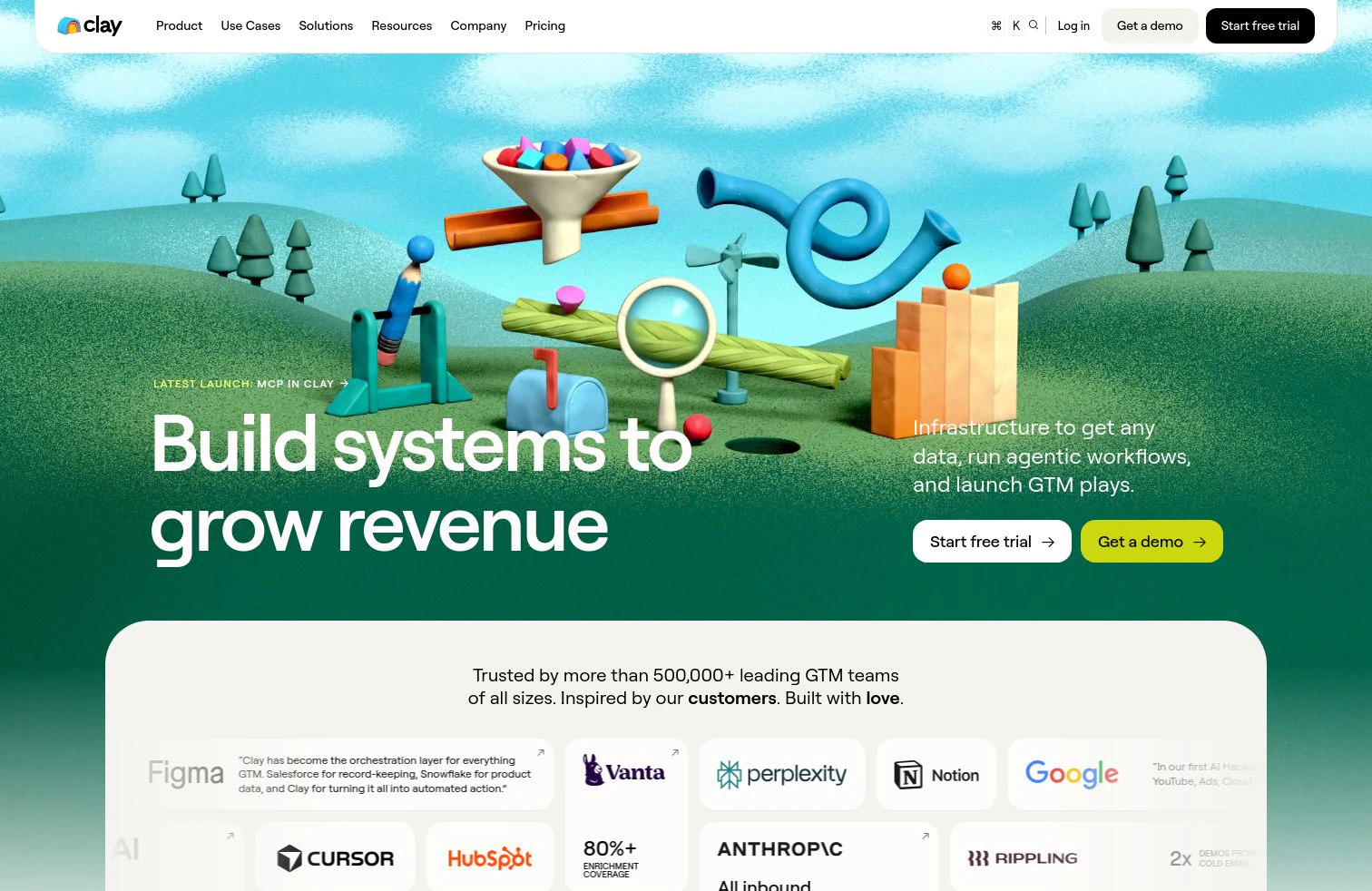
- Best forteams replacing a single-database tool with waterfall enrichment across 200+ providers plus AI research
- PricingFree plan, then Launch ($185/mo), Growth ($495/mo), and custom Enterprise
- What we likewaterfall enrichment that runs 200+ data providers so coverage isn't capped by one vendor
Full disclosure: Clay is our product, and we put it first. Swapping a single-database tool for a multi-provider waterfall is one of the most common reasons teams move to Clay. Here's what it does well and where it doesn't fit.
Clay attacks the exact thing that pushes teams off Apollo: coverage capped by one database. Instead of pulling contact data from a single source, Clay runs a waterfall across 200+ providers in sequence and stops at the first verified hit, so you pay once per record for the best available match. On top of that it layers Signals (job changes, funding, hiring, web intent) and Claygent, an AI research agent that answers questions no fixed field can, like whether an account ships a mobile app or mentions SOC 2. The finished record syncs back to Salesforce or HubSpot and re-runs as data changes.
Run a waterfall on your Apollo list
Export your Apollo contacts and see how much more coverage 200+ providers return, free.
What we like about Clay
- Waterfall enrichment across 200+ providers, so coverage isn't limited to one vendor's database
- Claygent runs AI research that a static contact record can't hold
- Signals surface job changes, funding, hiring, and web intent to time outreach
- Writes enriched records back to Salesforce and HubSpot and re-runs as data changes
- Clay Sequencer and CRM sync let you act on the data without exporting to a second tool
Where Clay could be better
- You design the enrichment workflow yourself, so it's less point-and-click than Apollo's turnkey setup
- Getting provider order and fallbacks right takes a bit of upfront work before coverage is dialed in
- Data Credits are usage-based, so heavy one-off runs need a spend check rather than a flat per-seat fee
Why choose Clay? Apollo hands you one database; Clay builds the record from 200+ sources first, then lets you research and act on it.
Proof. Anthropic hit 3x data enrichment coverage on Clay after consolidating several point vendors into one waterfall.
Clay pricing
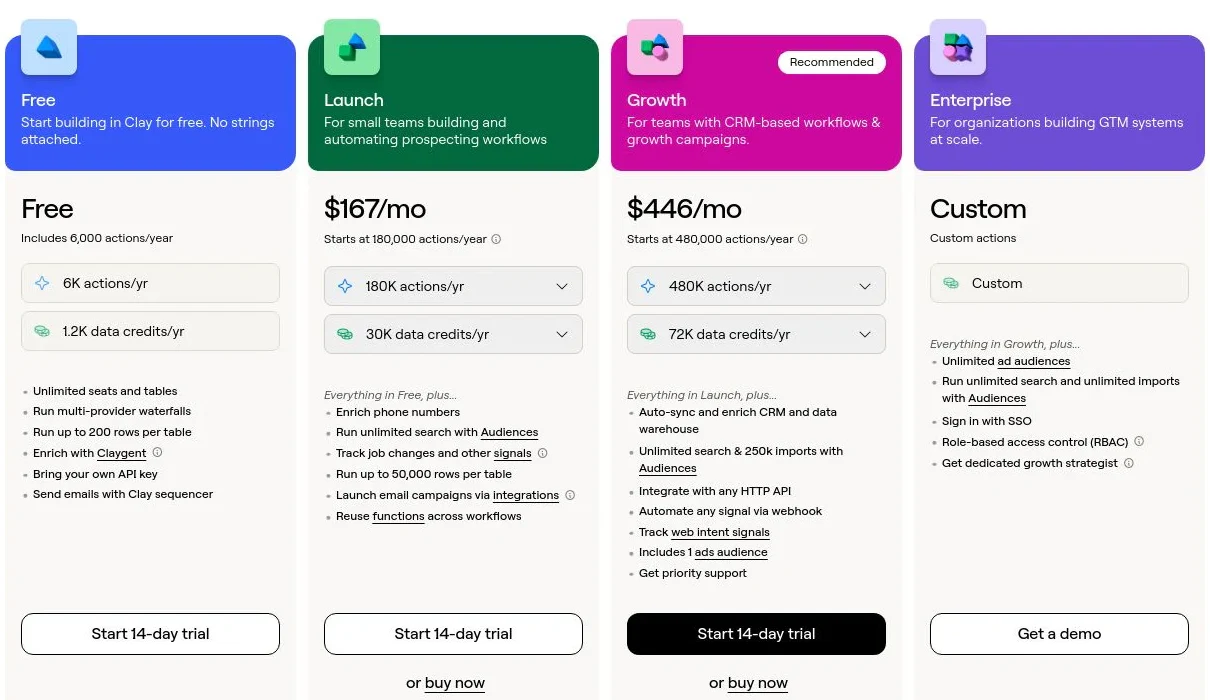
- Free: $0/mo with 100 Data Credits, 500 Actions, unlimited seats and tables, multi-provider waterfalls, and Claygent
- Launch: starting at $185/mo with 2,500 Data Credits, 15,000 Actions, phone enrichment, and signal tracking
- Growth: starting at $495/mo with 6,000 Data Credits, 40,000 Actions, CRM auto-sync, and ads-audience pushes
- Enterprise: custom pricing with an annual commitment, 100,000+ Data Credits, unlimited Audiences, API access, SSO, and RBAC
Data Credits pay for the data itself and roll over; Actions pay for the platform work and reset monthly. Bring your own API keys and you skip Data Credits entirely. See Clay's pricing page for the full breakdown.
Clay reviews
- G2: 4.6/5 from 200+ reviews (G2)
2. ZoomInfo
- Best forenterprise teams that want the deepest single B2B database plus intent
- Pricingquote-based, annual contracts
- What we likea large verified database with intent data and org charts built in
ZoomInfo is the depth benchmark, and the most common step up when Apollo's data feels thin on enterprise accounts. Its database spans millions of companies and hundreds of millions of professionals, layered with intent data, org charts, and WebSights visitor identification. For a team that needs broad coverage and buying intent in one platform, it's the incumbent for a reason.
The trade-off is cost and commitment. Pricing is premium and quote-based, contracts run annual, and coverage can vary by region, which international teams often find hard to justify against Apollo's flat per-seat price.
What we like about ZoomInfo
- One of the largest verified B2B databases available
- Intent data and org charts inside the same platform
- WebSights reveals which companies visit your site
- Deep integrations across major CRMs and sales tools
Where ZoomInfo could be better
- Premium, quote-based pricing on annual contracts
- Accuracy is strongest in North America and thins in parts of EMEA
- Heavier and pricier than most small teams leaving Apollo need
Why choose ZoomInfo? The upgrade when Apollo's data isn't deep enough for enterprise accounts and you need intent in the same place.
ZoomInfo pricing
ZoomInfo doesn't publish prices. Plans (commonly Professional, Advanced, and Elite) are quote-based and sold on annual contracts, priced by seats and credits. Third-party pricing analyses put entry-level contracts around $15,000 per year, rising with credits and add-ons. Get a quote on ZoomInfo's pricing page for your exact configuration.
ZoomInfo reviews
- G2: 4.5/5 from 8,900+ reviews (G2)
3. Instantly
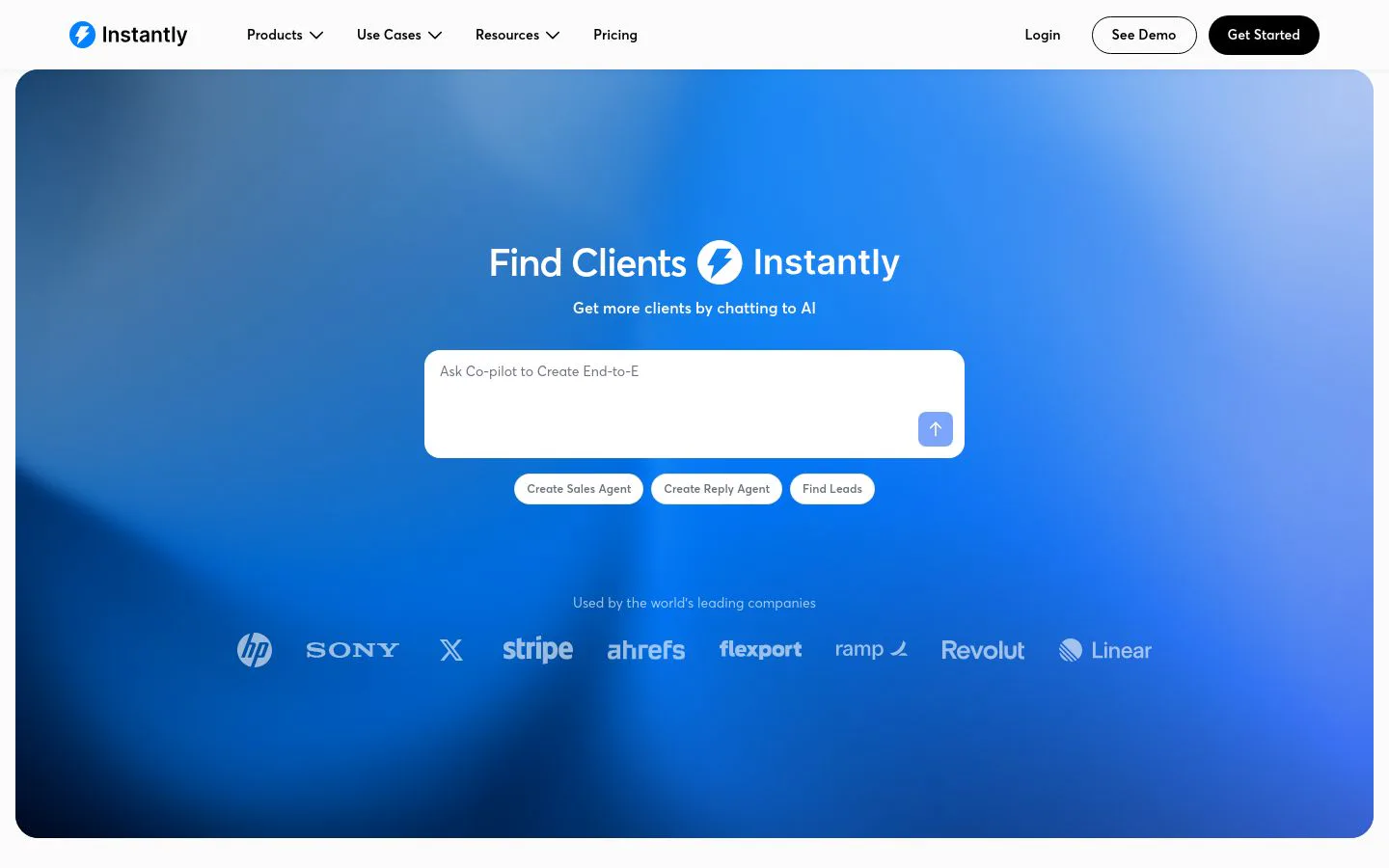
- Best forteams whose Apollo pain is deliverability, not data
- Pricingpaid from $37.60/mo (Growth, annual); lead database billed separately
- What we likeunlimited email accounts and warmup built for inbox placement at scale
If your Apollo complaint is that sends land in spam, Instantly attacks that directly. It's a cold email platform built around deliverability: unlimited sending accounts, automated warmup, inbox rotation, and a shared block list, plus a 450M+ lead database and AI agents added on top. For high-volume outbound where inbox placement is the bottleneck, it does the sending job better than a general prospecting suite.
The focus is also the boundary. Instantly is a sender first, so its lead database and enrichment are newer and less proven than Apollo's, and there's no dialer or phone-first workflow. Many teams pair its sending with a stronger data source.
What we like about Instantly
- Unlimited email accounts and warmup on every plan
- Deliverability features built in: inbox rotation, block list, bounce detection
- A 450M+ contact database and AI writing agents added to the platform
- Simple, published pricing that scales with sending volume
Where Instantly could be better
- Built for sending first, so its data layer is less proven than Apollo's
- No dialer or phone-first prospecting workflow
- The lead database is a separate subscription from the outreach plan
Why choose Instantly? The specialist when deliverability, not data, is the reason you're leaving Apollo.
Instantly pricing
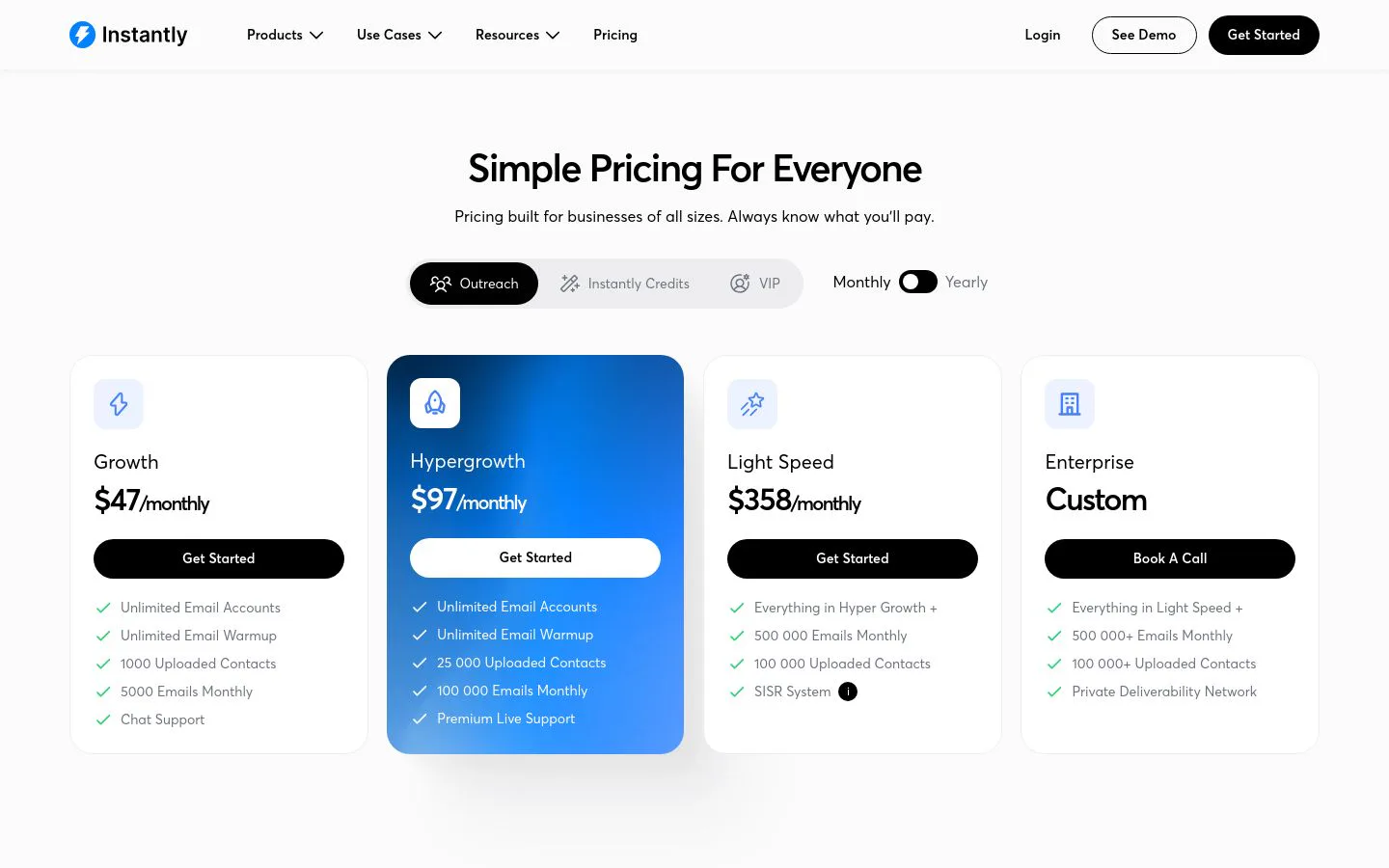
- Growth: $37.60/mo billed annually ($47 monthly) with unlimited accounts, warmup, and 5,000 emails a month
- Hypergrowth: $77.60/mo billed annually ($97 monthly) with 100,000 emails a month and 25,000 contacts
- Light Speed: from $286.30/mo billed annually for high-volume sending and private infrastructure
- Enterprise: custom
The B2B lead database and Instantly credits are sold as separate plans or bundles, so budget for both if you need data and sending. See Instantly's pricing page for current tiers.
Instantly reviews
- G2: 4.8/5 from 3,700+ reviews (G2)
4. Seamless.AI
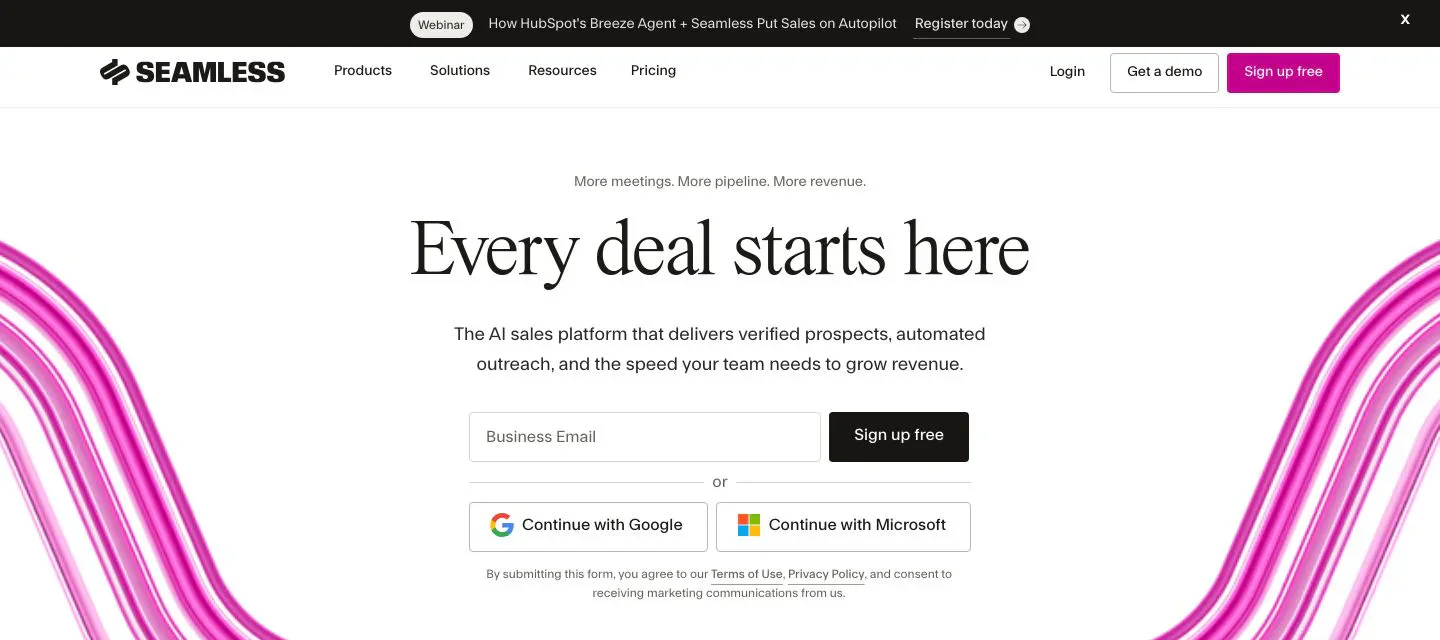
- Best forteams wanting real-time, search-engine-style contact discovery
- Pricingfree tier, then quote-based
- What we likea real-time engine that builds contact lists on demand
Seamless.AI works like a search engine for contacts, building lists in real time rather than querying a static database. It finds emails and phone numbers, runs as a Chrome extension, and offers buyer-intent add-ons, which suits high-volume prospecting teams that want fresh contacts on demand instead of Apollo's fixed database.
Real-time discovery is both the strength and the risk. Accuracy varies from record to record, and the credit and upsell model means costs can climb as usage grows. Verify what it returns before you send.
What we like about Seamless.AI
- Real-time engine builds lists on demand instead of querying a static database
- Finds emails and phone numbers with a Chrome extension
- Buyer-intent and other data add-ons available
- Free tier lets you try it before committing
Where Seamless.AI could be better
- Accuracy varies from record to record, so verify before sending
- Credit and upsell model can make costs climb
- Pricing is quote-based with no clear public tiers
Why choose Seamless.AI? Builds fresh contact lists in real time instead of reselling a static database like Apollo.
Seamless.AI pricing
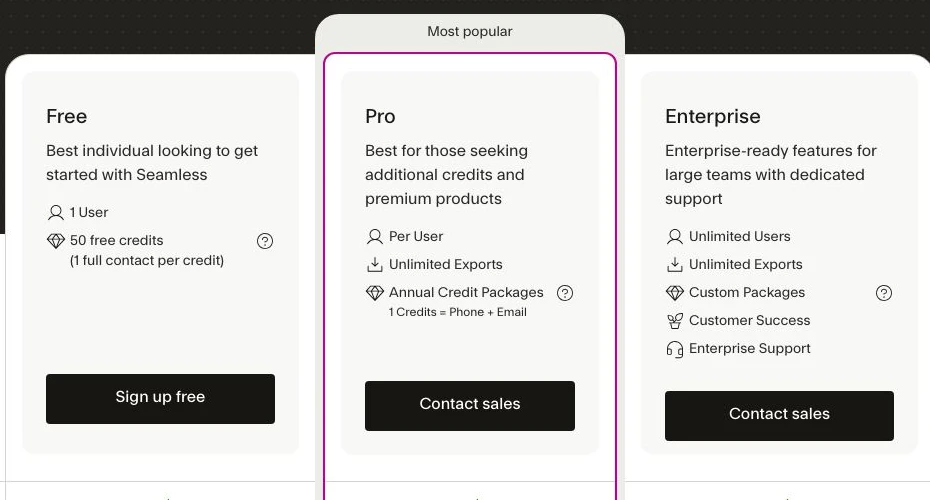
Seamless.AI is largely quote-based. There's a free tier with a limited number of lifetime credits, and Pro and Enterprise plans are custom-quoted annual contracts, often with a seat minimum. Contact Seamless.AI for a quote on its pricing page.
Seamless.AI reviews
- G2: 4.4/5 from 5,000+ reviews (G2)
5. Cognism
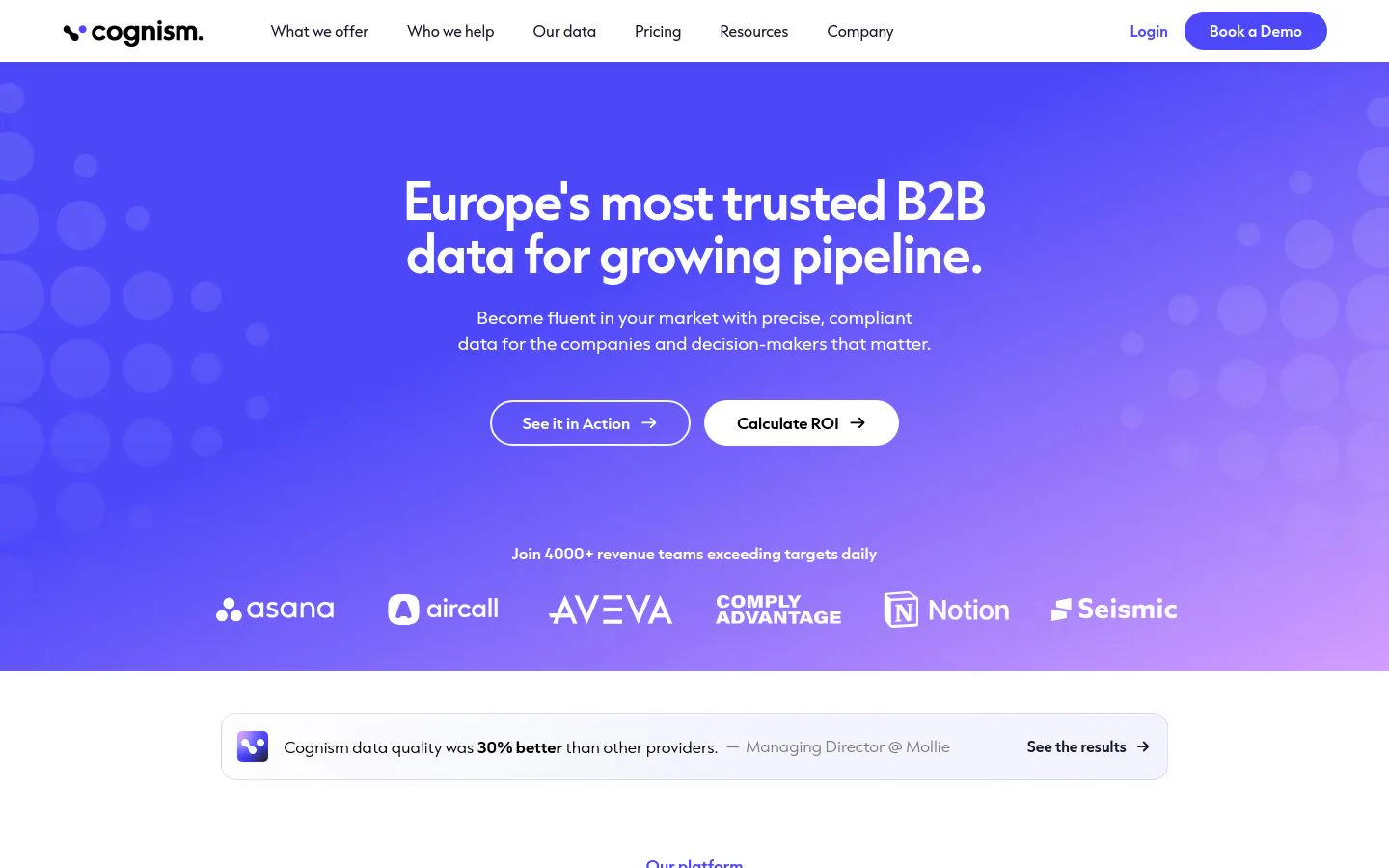
- Best forteams selling into the EU and UK that need phone-verified, compliant data
- Pricingquote-based
- What we likeDiamond Data phone verification and a strong GDPR posture
Cognism is the answer to Apollo's biggest gap: European data. Its Diamond Data phone numbers are human-verified, its EU and UK coverage is deep, and its GDPR posture is a genuine differentiator for compliance-sensitive teams. Records enrich into Salesforce automatically, and intent data helps prioritize the accounts worth a call.
Compared with Apollo it's a premium, quote-based product, and its strength is regional. Coverage is strongest in the UK, EMEA, and DACH, and thinner than the US incumbents in North America.
What we like about Cognism
- Diamond Data phone numbers are human-verified for accuracy
- Deep, compliant EU and UK coverage with a strong GDPR posture
- Automatic Salesforce enrichment and intent data
- Unrestricted-view access on many plans, so seats aren't nickel-and-dimed
Where Cognism could be better
- Premium, quote-based pricing with no public tiers
- US coverage is thinner than the North American incumbents
- Credit and seat structure needs a sales conversation to size
Why choose Cognism? The pick when you sell into Europe and Apollo's phone data and compliance don't hold up.
Cognism pricing
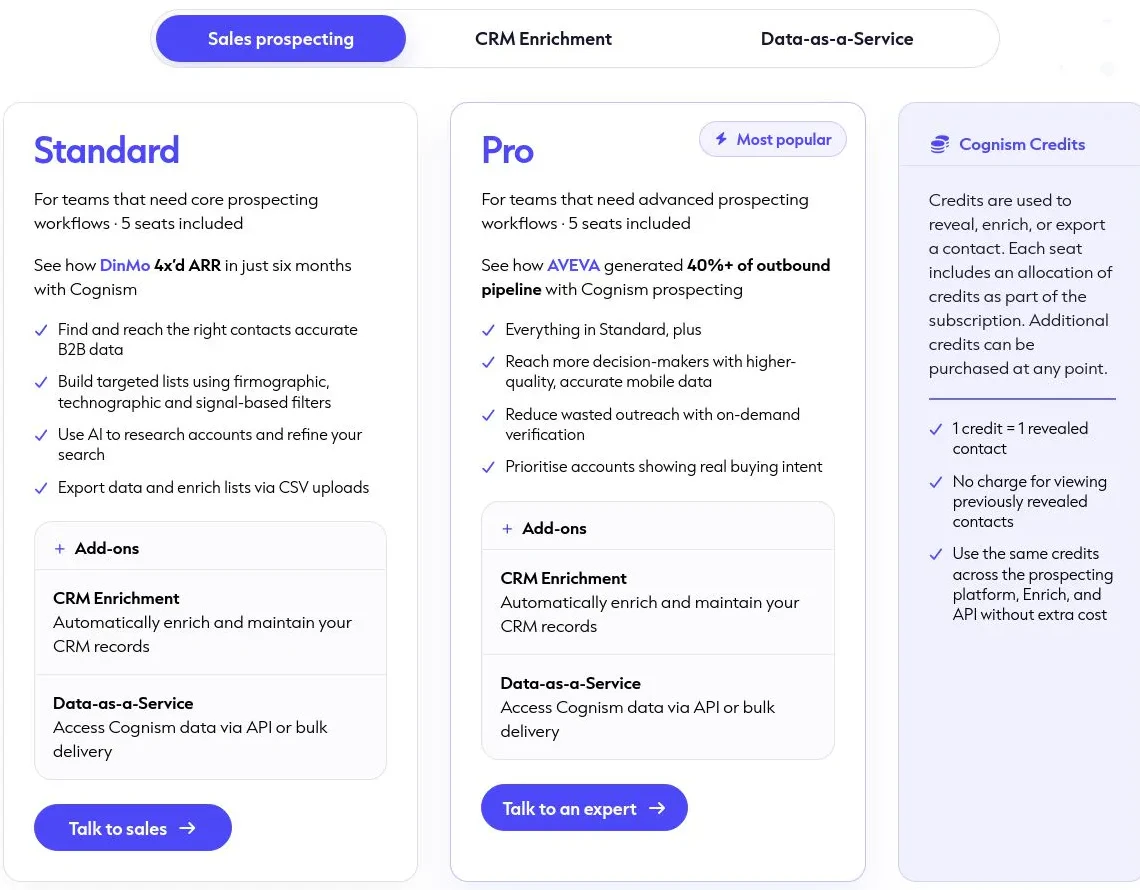
Cognism is quote-based. The pricing page lists Sales Prospecting packages (Standard and Pro) plus CRM Enrichment and Data-as-a-Service add-ons, all priced through sales. The model is credit-based, where one credit reveals one contact. Talk to Cognism for a quote sized to your region and seats. Start on Cognism's pricing page.
Cognism reviews
- G2: 4.5/5 from 1,300+ reviews (G2)
6. RocketReach
- Best forbroad, self-serve email and phone lookups across a large profile index
- Pricingpaid from $33/mo (Essentials, annual)
- What we likewide reach across 700M+ professionals with simple per-lookup plans
RocketReach is a straightforward lookup tool: give it a name or company and it returns emails, phone numbers, and social profiles from an index of more than 700 million professionals. For reps who want Apollo-style contact finding without a full platform commitment, its published, per-lookup plans are easy to start and easy to budget.
It's a finder, not a full prospecting suite. There's no native sequencing, and data accuracy (especially phone) can be inconsistent, so treat it as a contact-lookup layer rather than your entire outbound engine.
What we like about RocketReach
- Broad reach across 700M+ professional profiles
- Finds email, phone, and social links in one lookup
- Simple, published pricing tiers you can budget against
- Bulk lookups, an API, and CRM integrations on higher plans
Where RocketReach could be better
- Phone-number accuracy can be inconsistent
- No native sequencing or outreach engine
- Lower tiers are email-only, so phone data costs more
Why choose RocketReach? A simple, budgetable lookup tool when you want reach without buying a whole platform.
RocketReach pricing
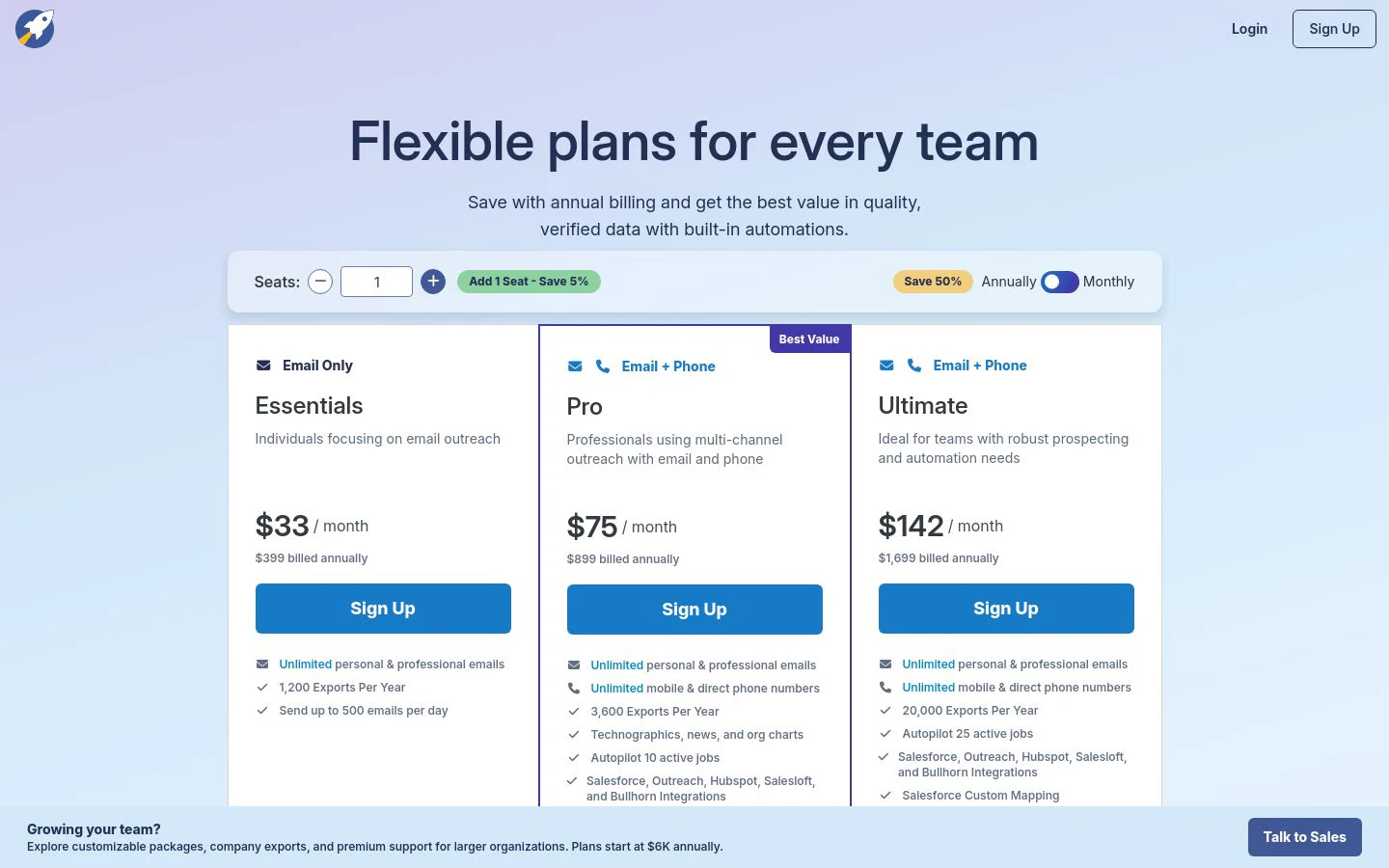
- Essentials: from $33/mo billed annually, email-only lookups
- Pro: from $83/mo billed annually, adds phone numbers and more lookups
- Ultimate: from $207/mo billed annually, highest lookup volume plus API access
- Custom: team and enterprise plans on request
Monthly billing runs higher than the annual rates shown. See RocketReach's pricing page for current lookup limits.
RocketReach reviews
- G2: 4.4/5 from 1,300+ reviews (G2)
7. Lusha
- Best forSMB reps wanting fast, self-serve contact lookups
- Pricingfree plan (40 credits/mo), then paid tiers
- What we likea simple Chrome extension and quick time-to-value
Lusha is the fastest way for an individual rep to grab contact data. Its Chrome extension pulls a work email and phone number straight off a professional profile, it handles bulk enrichment, and it syncs to your CRM. For SMB teams that find Apollo heavier than they need, it's live in minutes.
That simplicity has limits. Credit caps arrive quickly on lower tiers, and the underlying dataset is lighter than the enterprise platforms, so it's better for one-off lookups than for enriching a large TAM.
What we like about Lusha
- Chrome extension pulls email and phone off a profile in a click
- Fast setup with a free plan to start
- Bulk enrichment and CRM sync on paid tiers
- Simple enough that a rep needs no training
Where Lusha could be better
- Credit caps arrive quickly on lower tiers
- The dataset is lighter than the enterprise platforms
- Better for one-off lookups than enriching a whole TAM
Why choose Lusha? The lighter, faster self-serve pick for SMB reps who want contact data in a click.
Lusha pricing
Lusha offers a free plan with 40 credits per month, then paid Pro, Premium, and Scale tiers that add credits, bulk enrichment, and team features. The model is credit-based (revealing an email costs one credit, a phone number more). Check Lusha's pricing page for current per-tier rates.
Lusha reviews
- G2: 4.3/5 from 1,600+ reviews (G2)
8. UpLead
- Best forteams that want verified data with a real accuracy guarantee
- Pricing7-day free trial, then paid from $74/mo (Essentials, annual)
- What we likereal-time email verification and a 95% data-accuracy guarantee
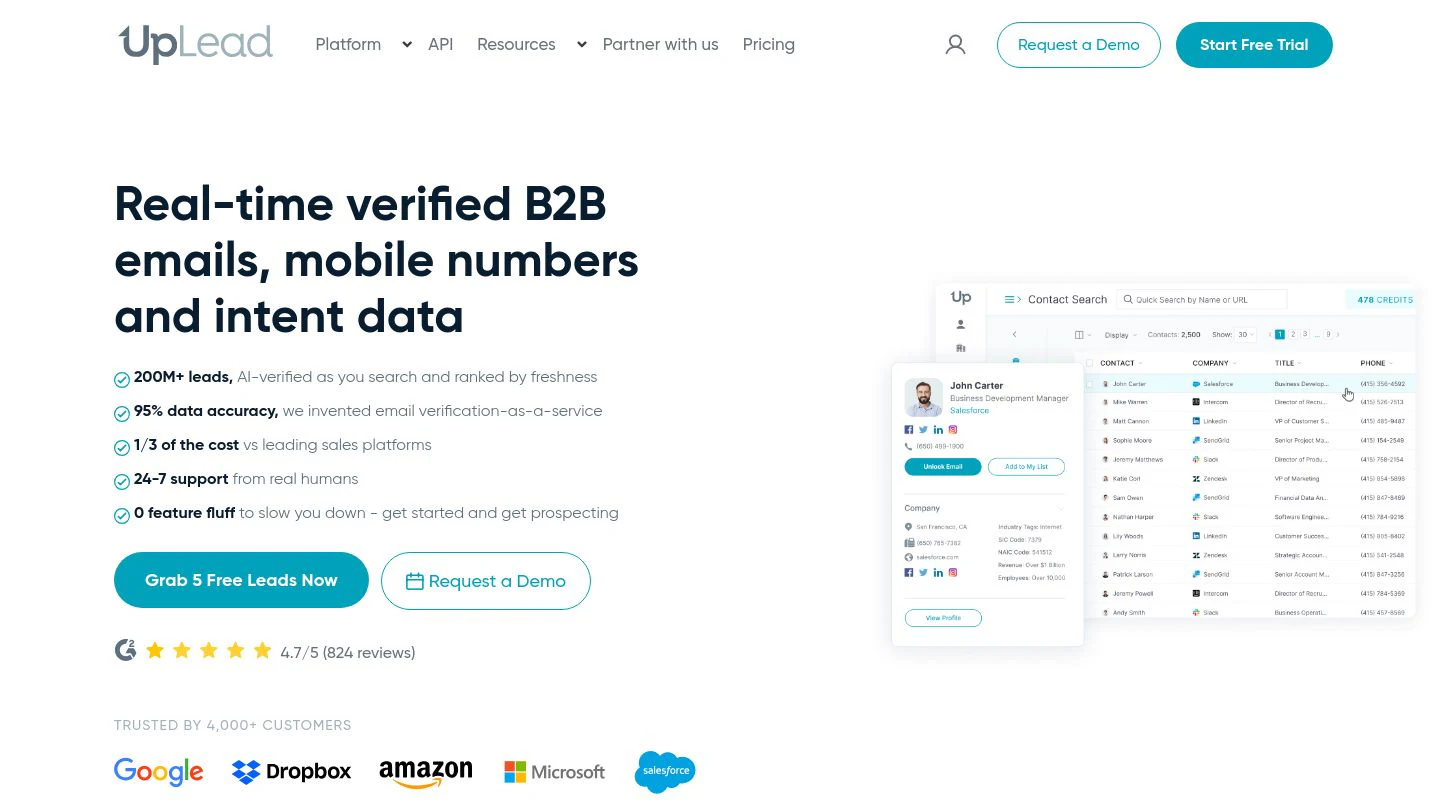
UpLead answers the accuracy complaint head-on. It verifies emails in real time at the moment you export and backs a 95% accuracy guarantee, crediting you back for any invalid record. It carries firmographic and technographic filters, an intent-data add-on, and clean CRM sync, which makes it a tidy step up for teams that found Apollo's data hit-or-miss.
The database is smaller than Apollo's or ZoomInfo's, so raw volume is not its edge. It also lacks native sequencing, so you pair it with a sender. What you trade in breadth you gain in trust that a delivered record is real.
What we like about UpLead
- Real-time email verification at the point of export
- A 95% data-accuracy guarantee with credit-backs on bad records
- Firmographic and technographic filters plus an intent add-on
- Transparent, published pricing with a free trial
Where UpLead could be better
- Smaller database than Apollo and the enterprise incumbents
- No native sequencing or dialer
- Credits can run out quickly on lower tiers for high-volume teams
Why choose UpLead? The pick when data accuracy is why you left Apollo and you want a guarantee behind it.
UpLead pricing
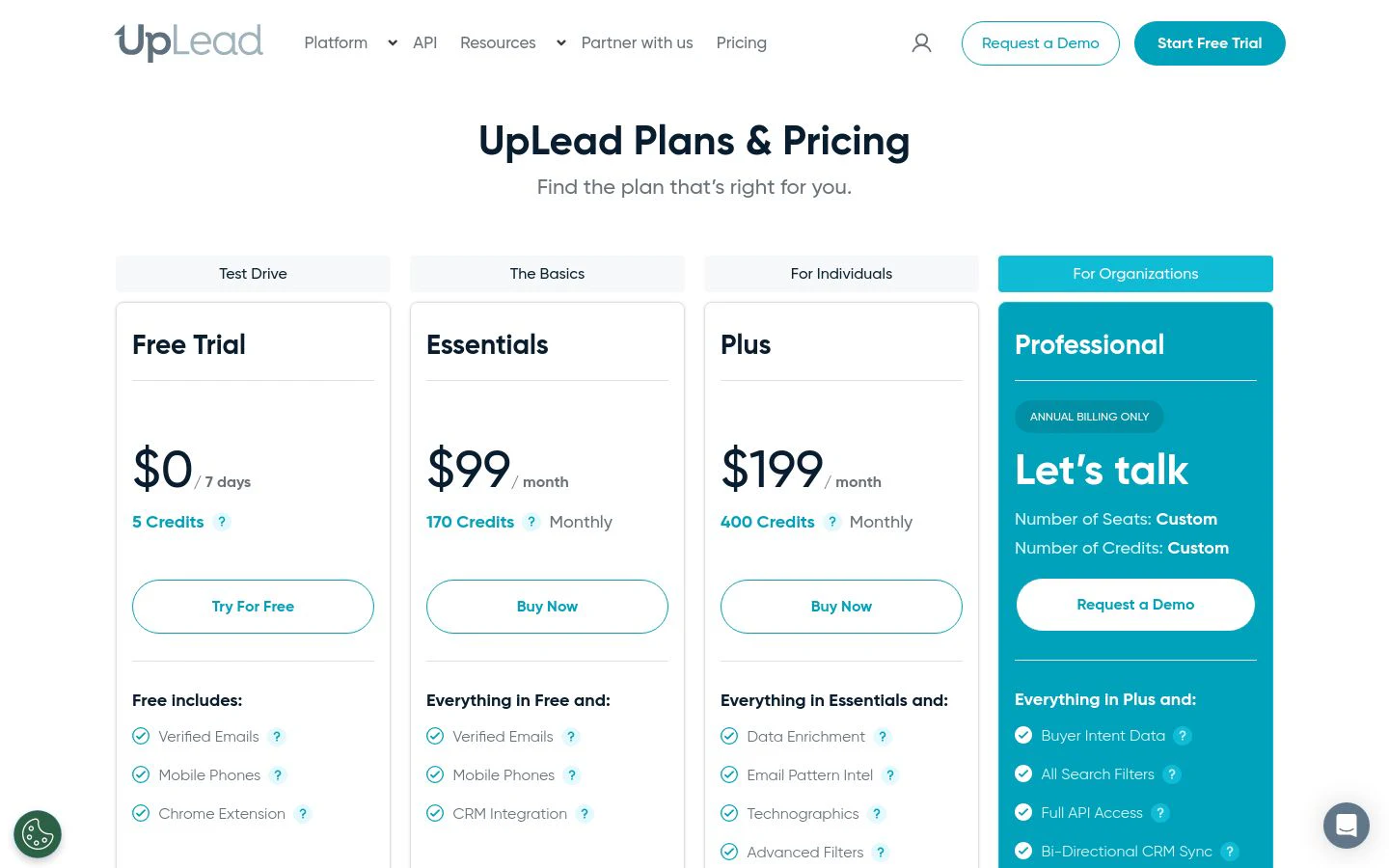
- Free trial: 7 days with 5 credits
- Essentials: $74/mo billed annually ($99 monthly) with 170 credits a month
- Plus: $149/mo billed annually ($199 monthly) with 400 credits a month
- Professional: custom annual pricing with higher credits, intent data, and API access
One credit reveals one contact. See UpLead's pricing page for current credit allowances.
UpLead reviews
- G2: 4.7/5 from 800+ reviews (G2)
9. LeadIQ
- Best forreps who prospect on LinkedIn and want one-click capture with job-change tracking
- Pricingfree plan, then paid from $36/user/mo (Essential, annual)
- What we likefast LinkedIn and Sales Navigator capture straight into your CRM and sequencer
LeadIQ is built for the LinkedIn workflow. Its Chrome extension captures contacts from LinkedIn and Sales Navigator in one click, enriches them, and pushes them straight to your CRM or sequencer, with job-change tracking (Champion tracking) that flags when a contact moves. For reps who live in Sales Nav and found Apollo's capture clunky, it removes a lot of copy-paste.
Its database is smaller than the big incumbents, and users note phone-number accuracy can be inconsistent. Pro pricing also scales with credit volume, so heavy users should size it before committing.
What we like about LeadIQ
- One-click capture from LinkedIn and Sales Navigator
- Job-change tracking flags when contacts move roles
- Clean push to Salesforce, HubSpot, and popular sequencers
- Scribe AI helps draft outreach copy in the flow
Where LeadIQ could be better
- Phone-number accuracy can be inconsistent
- Smaller database than the enterprise platforms
- Pro pricing scales with credit volume, so heavy usage adds up
Why choose LeadIQ? The smoothest LinkedIn-to-CRM capture when Sales Navigator is where your reps actually prospect.
LeadIQ pricing
- Free: $0 with 1 user and a small monthly credit allowance
- Essential: from $36/user/mo billed annually ($45 monthly)
- Pro: from around $200/mo, scaling with credit volume
- Enterprise: custom, quote-based
Costs scale mainly with credit volume and Scribe AI usage. See LeadIQ's pricing page for current tiers.
LeadIQ reviews
- G2: 4.2/5 from 1,100+ reviews (G2)
10. Kaspr

- Best forEU-focused reps pulling LinkedIn contact data with unlimited B2B emails
- Pricingfree plan, then paid from $49/mo (Starter, annual)
- What we likea LinkedIn Chrome extension with unlimited B2B email credits on paid plans
Kaspr, part of the Cognism group, is a fast LinkedIn data tool aimed at European teams. Its Chrome extension reveals phone numbers and emails straight from LinkedIn profiles, groups, and events, and paid plans include unlimited B2B email credits, which keeps costs predictable for high-volume prospecting. It's GDPR- and CCPA-aligned, a real plus over Apollo for EU-first teams.
It's a lookup and enrichment tool, not a full platform. Phone credits are capped and metered separately, and there's no native sequencing, so it works best paired with a CRM or outreach tool.
What we like about Kaspr
- Chrome extension pulls phone and email from LinkedIn in a click
- Unlimited B2B email credits on paid plans
- GDPR- and CCPA-aligned, strong for EU data
- Clean integrations with HubSpot, Salesforce, Pipedrive, and lemlist
Where Kaspr could be better
- Phone credits are capped and metered separately from emails
- No native sequencing or outreach engine
- Coverage is strongest in Europe and lighter elsewhere
Why choose Kaspr? A budget-friendly, GDPR-aligned LinkedIn data tool for EU reps who want unlimited emails.
Kaspr pricing
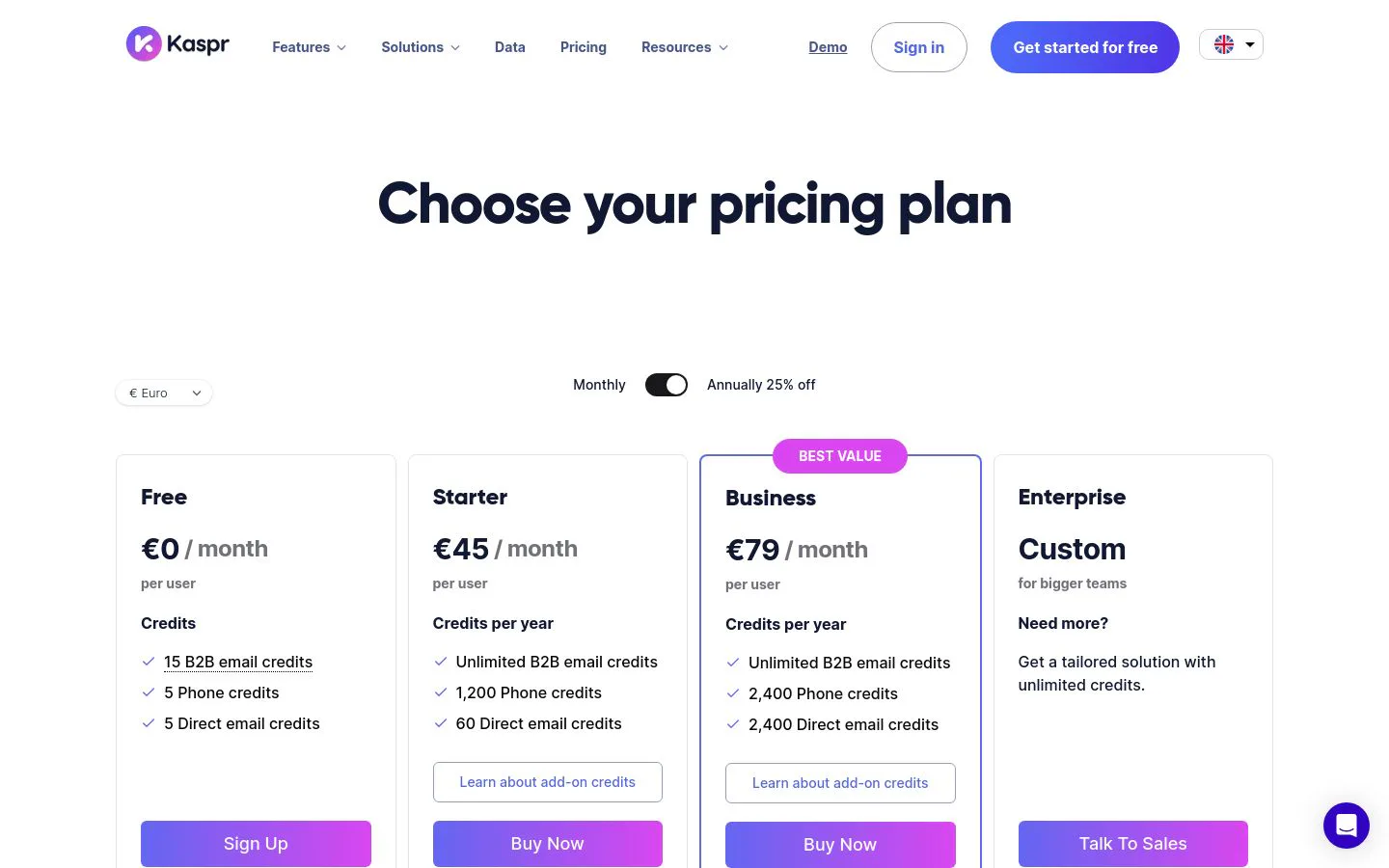
- Free: $0/mo with 15 B2B email, 5 phone, and 5 direct email credits
- Starter: $49/mo billed annually ($65 monthly) with unlimited B2B emails and 100 phone credits a month
- Business: $79/mo billed annually ($99 monthly) with more phone and direct email credits
- Organization: custom, annual only, 5-user minimum
Add-on credit packs are available on paid plans. See Kaspr's pricing page for current allowances.
Kaspr reviews
- G2: 4.4/5 from 800+ reviews (G2)
Which Apollo alternative should you choose?
Match the tool to the part of Apollo you've outgrown.
- Coverage capped by one database: Clay. It runs 200+ providers in a waterfall and adds AI research, so you're not limited to a single vendor's records.
- Enterprise depth and intent: ZoomInfo, if the budget and North American focus fit.
- Deliverability, not data: Instantly, when inbox placement is the reason sends underperform.
- EU and UK phone-verified, compliant data: Cognism, or Kaspr for a lighter, cheaper LinkedIn-first option.
- Real-time discovery: Seamless.AI.
- Fast SMB self-serve lookups: Lusha or RocketReach.
- Guaranteed data accuracy: UpLead.
- LinkedIn and Sales Navigator prospecting: LeadIQ.
If Apollo mostly works and you only need cleaner data on a few accounts, a lightweight lookup tool is the quickest fix. If your problem is that no single database covers your accounts, fix the data layer first, because a better sequencer can't send to contacts you don't have.
What is the best free Apollo alternative?
If you want to test an alternative without paying, a few free tiers stand out. Lusha's free plan (40 credits a month) is the simplest way to grab a few contacts. Kaspr's free plan adds LinkedIn lookups with a small phone and email allowance, and LeadIQ's free tier lets one rep try its capture workflow. RocketReach and UpLead both offer trials to test data quality before you buy.
For custom, AI-driven enrichment, Clay's free plan is the one that lets you build a real workflow: run a multi-provider waterfall and Claygent research against your own list before you spend a credit. It's the best way to see coverage on your actual accounts, not a vendor's demo list, before committing.
The catch with every free tier is credits. They're built for testing, not production, so treat them as a way to check accuracy on your own data before you choose.
Where sales intelligence is heading
For a decade, prospecting meant renting one big database and hoping your accounts were inside it. That model is fading. The teams pulling ahead in 2026 aren't the ones with a single all-in-one tool, they're the ones treating data as something to assemble from many sources, verify at the point of use, and enrich with AI research that no static field could hold. Sending is separating from sourcing, too, as deliverability becomes its own discipline.
Practically, that means starting from your bottleneck instead of the biggest brand. If Apollo mostly works and only your data is thin, a targeted enrichment or verification tool is the fastest win. If the problem is that no one database covers your market, or that sends land in spam, fix that specific layer first.
Whatever you shortlist, test it on your own list before committing a budget. The demo data always looks perfect. Yours is the only list that tells the truth.
Build the record first, then reach out
Start free, run a real waterfall against your own Apollo list, and see the coverage before you spend a credit.
FAQ
Why do teams look for an Apollo.io alternative?
Usually for one of three reasons: data accuracy that varies by region and thins outside North America, deliverability that suffers because Apollo also handles sending, or data depth that trails the enterprise incumbents on big accounts. Apollo remains a fair all-in-one, so the move is about fit, not a flaw. The best alternative is the one that fixes your specific gap.
What is the best Apollo alternative for data accuracy?
For guaranteed accuracy, UpLead verifies emails in real time and backs a 95% guarantee. For the widest coverage, Clay runs 200+ providers in a waterfall so a miss with one source becomes a hit with the next. ZoomInfo goes deepest on North American enterprise data. Always test on your own list first.
Is there a free Apollo alternative?
Yes. Lusha, Kaspr, and LeadIQ all have free plans for light contact lookups, and RocketReach and UpLead offer trials. Clay's free plan is the most complete for building a real enrichment workflow, letting you run a multi-provider waterfall and AI research against your own list before spending a credit.
What is the best Apollo alternative for cold email deliverability?
Instantly is the specialist here. It offers unlimited sending accounts, automated warmup, inbox rotation, and bounce detection, all built to keep messages out of spam. If your Apollo sends underperform on inbox placement rather than data, a dedicated sending platform like Instantly is the fix.
Which Apollo alternative is best for EU and UK data and GDPR?
Cognism is built around compliant EU and UK data with human-verified Diamond Data phone numbers and a strong GDPR posture. Kaspr is a lighter, cheaper LinkedIn-first option that is also GDPR- and CCPA-aligned. Both cover Europe better than Apollo does.
Do Apollo alternatives integrate with Salesforce and HubSpot?
Most do. Clay, ZoomInfo, Cognism, LeadIQ, UpLead, Lusha, and Kaspr all sync to Salesforce and HubSpot. Clay also writes enriched records back and re-runs them as data changes. Check that the specific fields and sync direction you need are supported on your plan.
How much do Apollo alternatives cost?
It varies widely. Self-serve tools like RocketReach, Lusha, Kaspr, and LeadIQ start around $33 to $49 a month. UpLead and Instantly publish mid-range tiers. Clay is free to start, then from $185 a month on usage-based credits. ZoomInfo, Cognism, and Seamless.AI are quote-based on annual contracts.
Is Clay a good Apollo alternative?
Clay fits teams whose main issue is coverage capped by one database. Instead of reselling a single source, it runs a waterfall across 200+ providers, adds AI research with Claygent, and orchestrates the data into your CRM. It's more of a builder's tool than Apollo's turnkey suite, so it rewards teams that want to design their own workflow.