
Lusha earned its spot as the fast, self-serve way to grab a work email or phone number. Its Chrome extension pulls a contact straight off a profile in a click. That speed is a genuine strength for SMB reps.
But teams outgrow it. Credit caps arrive quickly on the lower tiers. The dataset is lighter than the enterprise platforms. It fits one-off lookups better than enriching a whole TAM.
So how do you pick a replacement when a dozen tools all promise fresher, deeper contact data?
We compared 10 of the most-used Lusha alternatives on coverage, accuracy, pricing, and real G2 ratings. We judged each on what it returns, not what it claims. One truth held across all of them: no single database covers everyone, so the strongest teams run several sources in a waterfall and pay only for the match.
Here's the shortlist, then a closer look at each one.
What is a Lusha alternative?
A Lusha alternative is any tool that finds and enriches B2B contact data, work emails, direct dials, titles, and company details, so you can reach the right people. Lusha reads one database; the stronger options read many. The concept that separates good from mediocre is waterfall enrichment: running several providers in sequence so a miss with one source becomes a hit with the next. That's the gap between a list that's half empty and one you can actually work.
The 10 best Lusha alternatives for 2026
| # | Tool | Best for | Pricing from | G2 rating |
|---|---|---|---|---|
| 1 | Clay | AI plus waterfall enrichment | Free, paid from $185/mo | 4.6/5 |
| 2 | Apollo.io | All-in-one prospecting on a budget | Free, paid from $49/user/mo | 4.7/5 |
| 3 | ZoomInfo | Enterprise B2B intelligence | Quote-based | 4.5/5 |
| 4 | Seamless.AI | Real-time contact discovery | Free, then quote-based | 4.4/5 |
| 5 | Cognism | Phone-verified EU/UK data | Quote-based | 4.5/5 |
| 6 | RocketReach | Broad email and social lookups | Free, paid from $39/mo | 4.4/5 |
| 7 | UpLead | Verified data with an accuracy guarantee | Free trial, paid from $74/mo | 4.7/5 |
| 8 | LeadIQ | One-click capture into your CRM | Free, paid from $45/user/mo | 4.2/5 |
| 9 | Kaspr | LinkedIn contact lookups | Free, paid from $49/mo | 4.4/5 |
| 10 | Hunter | Email finding and verification | Free, paid from $34/mo | 4.4/5 |
1. Clay
- Best forRevOps and GTM teams wanting AI plus waterfall enrichment from many sources at once
- PricingFree plan, then Launch ($185/mo), Growth ($495/mo), and custom Enterprise
- What we likewaterfall enrichment across 200+ data providers plus AI research agents
Full disclosure: Clay is our product, and we put it first. Building and enriching a contact list from many sources is one of the most common things teams do on Clay. Here's what it does well and where it doesn't fit.
Where Lusha reads one database, Clay runs a waterfall across 200+ data providers in sequence and stops at the first hit. A miss with one source becomes a hit with the next, so you get the best coverage available and pay once per record, with no credit cap on how deep the search goes. On top of that it layers Signals (job changes, funding, hiring, web intent) and Claygent, an AI research agent that answers questions no fixed data field can, like whether an account mentions SOC 2 on its careers page. The finished record syncs back to Salesforce or HubSpot and re-runs as the data changes.
Enrich your own list, not a demo
Run 200+ providers against a real list and see the coverage before you spend a credit.
What we like about Clay
- Waterfall enrichment across 200+ providers, so a single-source miss becomes a hit with the next
- No credit cap on coverage depth, unlike a single-database tool that stops when its record is thin
- Claygent runs AI research that no fixed contact field can answer
- Signals surface job changes, funding, hiring, and web intent to prioritize accounts
- Writes enriched records back to Salesforce and HubSpot and re-runs as data changes
Where Clay could be better
- You build the enrichment yourself; there's no single "reveal this contact" button like Lusha's extension
- Getting provider order and fallbacks right takes some setup before coverage peaks
- Data Credits are usage-based, so a large one-off list needs a quick spend check
Why choose Clay? Every other tool reveals contacts from one database. Clay builds the record from 200+ sources first, then enriches and acts on it.
Proof. OpenAI hit 2x data enrichment coverage on Clay after consolidating its point vendors into one waterfall.
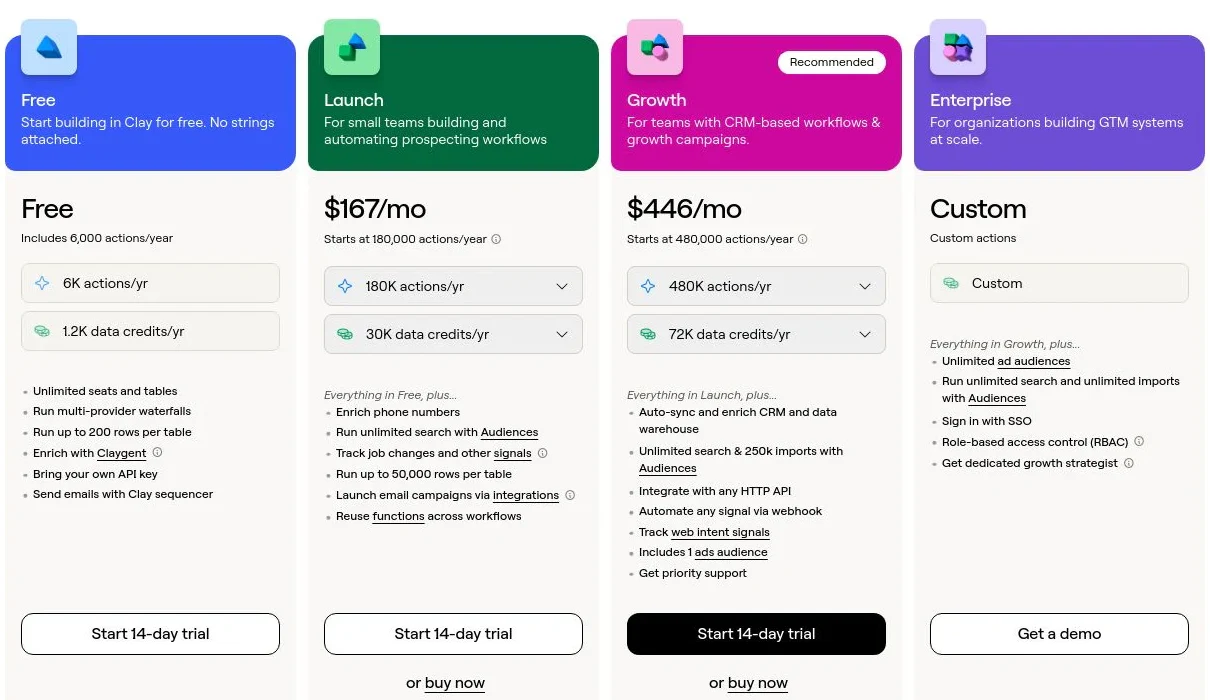
Clay pricing
- Free: $0/mo with 100 Data Credits, 500 Actions, unlimited seats and tables, multi-provider waterfalls, and Claygent
- Launch: starting at $185/mo with 2,500 Data Credits, 15,000 Actions, phone enrichment, and signal tracking
- Growth: starting at $495/mo with 6,000 Data Credits, 40,000 Actions, CRM auto-sync, and ads-audience pushes
- Enterprise: custom pricing with an annual commitment, 100,000+ Data Credits, unlimited Audiences, API access, SSO, and RBAC
Data Credits pay for the data itself and roll over; Actions pay for the platform work and reset monthly. Bring your own API keys and you skip Data Credits entirely. See Clay's pricing page for the full breakdown.
Clay reviews
- G2: 4.6/5 from 200+ reviews (G2)
2. Apollo.io

- Best forSMB and mid-market teams wanting a database, enrichment, and outreach in one tool
- Pricingfree plan, then paid tiers from $49/user/mo (annual)
- What we likean all-in-one platform at an accessible entry price
Apollo is the natural step up when Lusha's single-purpose lookups aren't enough. It pairs a large B2B contact database with enrichment and sequences, so you can build a list, fill in the data, and run outreach without stitching tools together. The generous free tier makes it a common first stop for founders and small teams doing outbound on a budget.
The all-in-one model is also the catch. Data accuracy varies by region and thins outside North America, and because Apollo also sends, deliverability comes down to your own list hygiene and sending discipline.
What we like about Apollo.io
- A large database, enrichment, and outreach sequences in one place
- A genuinely usable free tier to start
- Accessible per-seat pricing for small teams
- Solid CRM and email integrations out of the box
Where Apollo.io could be better
- Data accuracy varies by region, thinner outside North America
- Deliverability depends on your own list hygiene since Apollo also sends
- Depth of firmographic and intent data trails the enterprise incumbents
Why choose Apollo.io? Best price-to-value all-in-one, a database plus enrichment plus outreach without buying three tools.
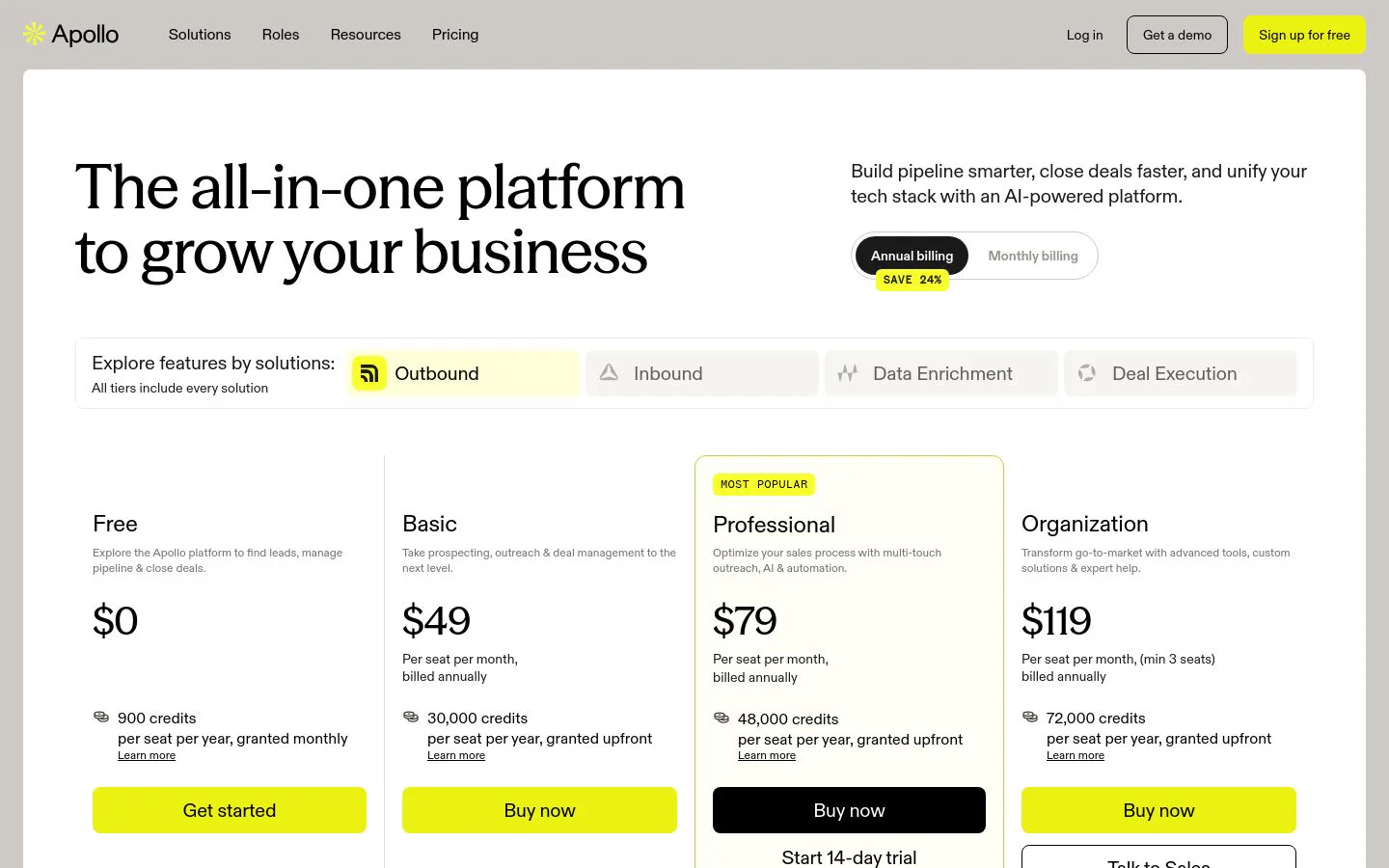
Apollo.io pricing
- Free: $0 with limited credits and core prospecting
- Basic: $49/user/mo (annual) with more credits and sequences
- Professional: $79/user/mo (annual) with advanced features and higher limits
- Organization: $119/user/mo (annual, 3-seat minimum) with the full feature set
Monthly billing runs higher than the annual rates shown. See Apollo's pricing page for current limits.
Apollo.io reviews
- G2: 4.7/5 from 9,000+ reviews (G2)
3. ZoomInfo
- Best forenterprise sales and marketing teams needing deep, broad B2B intelligence
- Pricingquote-based, annual contracts
- What we likea large verified database plus intent and org-chart data
ZoomInfo is the depth upgrade for teams that hit the ceiling of Lusha's dataset. Its database spans roughly 14 million companies and hundreds of millions of business professionals, layered with intent data, org charts, and website-visitor identification. For an enterprise team that needs broad coverage and buying intent in one place, it's the incumbent for a reason.
The cost shows up in more than the invoice. Pricing is premium and quote-based, contracts are annual, and coverage and price both vary by region, which international teams often find hard to justify.
What we like about ZoomInfo
- One of the largest verified B2B databases available
- Intent data and org charts built into the same platform
- Website-visitor identification reveals which companies visit your site
- Deep integrations across major CRMs and sales tools
Where ZoomInfo could be better
- Premium, quote-based pricing on annual contracts
- Accuracy is strong in North America and thins out in parts of EMEA
- Overkill and overpriced for an individual rep or a small team
Why choose ZoomInfo? Uniquely good at enterprise-scale coverage and intent, the depth others are measured against.
ZoomInfo pricing
ZoomInfo doesn't publish prices. Plans (commonly Professional, Advanced, and Elite) are quote-based and sold on annual contracts, priced by seats and credits. Third-party pricing analyses put entry-level contracts around $15,000 per year, rising with credits and add-ons. Get a quote on ZoomInfo's pricing page for your exact configuration.
ZoomInfo reviews
- G2: 4.5/5 from 8,000+ reviews (G2)
4. Seamless.AI
- Best forteams wanting real-time, search-engine-style contact discovery
- Pricingfree tier, then quote-based
- What we likea real-time engine that builds contact lists on demand
Seamless.AI works like a search engine for contacts, building lists in real time rather than querying a static database. Like Lusha it runs as a Chrome extension, but the engine finds emails and phone numbers on demand and offers buyer-intent add-ons, which suits high-volume prospecting teams that need fresh contacts fast.
Real-time discovery is a strength and a risk. Accuracy varies from record to record, so verify what it returns before you send, and the credit-and-upsell model means costs can climb as usage grows.
What we like about Seamless.AI
- Real-time engine builds lists on demand instead of querying a static database
- Finds emails and phone numbers with a Chrome extension
- Buyer-intent and other data add-ons available
- Free tier lets you try it before committing
Where Seamless.AI could be better
- Accuracy varies from record to record, so verify before sending
- The credit and upsell model can make costs climb
- Pricing is quote-based with no clear public tiers
Why choose Seamless.AI? Builds fresh contact lists in real time instead of querying a static database.
Seamless.AI pricing
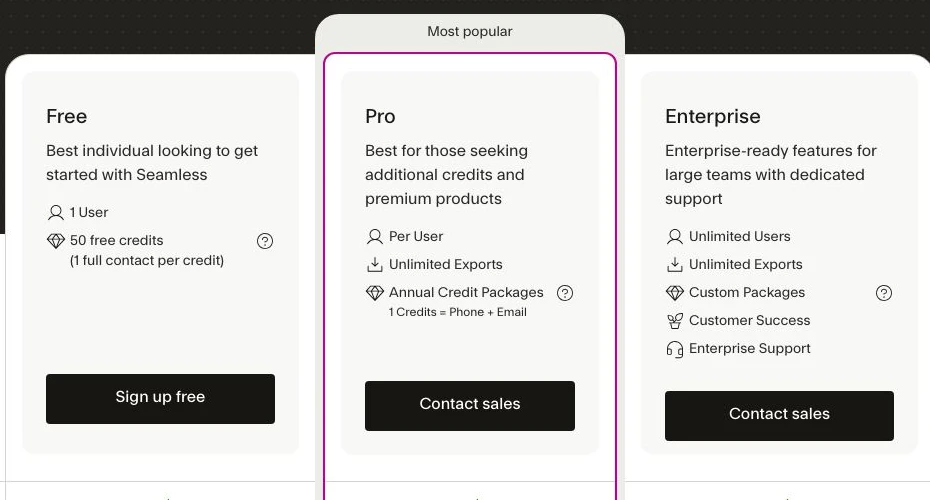
Seamless.AI is largely quote-based. There's a free tier with a limited number of lifetime credits, and Pro and Enterprise plans are custom-quoted annual contracts, often with a seat minimum. Contact Seamless.AI for a quote on its pricing page.
Seamless.AI reviews
- G2: 4.4/5 from 5,000+ reviews (G2)
5. Cognism
- Best forteams selling into the EU and UK that need phone-verified, compliant data
- Pricingquote-based
- What we likeDiamond Data phone verification and a strong GDPR posture
Cognism is the direct answer for European teams frustrated by thin coverage or compliance gaps elsewhere. Its Diamond Data phone numbers are human-verified, its EU and UK coverage is deep, and its GDPR posture is a genuine differentiator for compliance-sensitive teams. Records enrich into Salesforce automatically, and intent data helps prioritize the accounts worth a call.
Compared with US-first tools it's a premium, quote-based product, and its strength is regional. Coverage is strongest in the UK, EMEA, and DACH, and thinner than ZoomInfo in the US.
What we like about Cognism
- Diamond Data phone numbers are human-verified for accuracy
- Deep, compliant EU and UK coverage with a strong GDPR posture
- Automatic Salesforce enrichment and intent data
- Unrestricted-view access on many plans, so seats aren't nickel-and-dimed
Where Cognism could be better
- Premium, quote-based pricing with no public tiers
- US coverage is thinner than the North American incumbents
- Credit and seat structure needs a sales conversation to size
Why choose Cognism? Wins on phone-verified, compliant EU and UK data where other tools thin out.
Cognism pricing
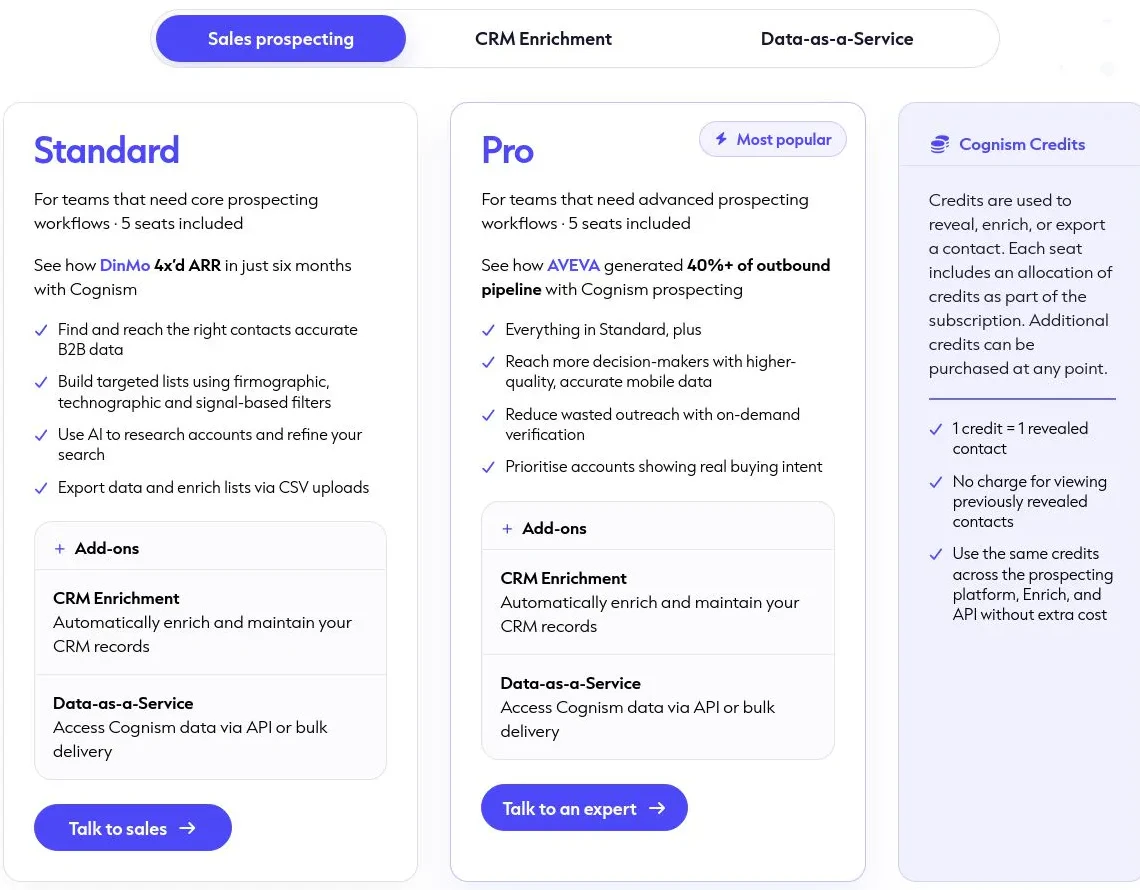
Cognism is quote-based. The pricing page lists Sales Prospecting packages (Standard and Pro) plus CRM Enrichment and Data-as-a-Service add-ons, all priced through sales. The model is credit-based, where one credit reveals one contact. Talk to Cognism for a quote sized to your region and seats. Start on Cognism's pricing page.
Cognism reviews
- G2: 4.5/5 from 1,300+ reviews (G2)
6. RocketReach
- Best forindividuals and teams needing broad reach across emails and social profiles
- Pricingfree plan, then paid tiers from about $39/mo (annual)
- What we likea huge contact database and simple per-user access
RocketReach is a broad, individual-friendly lookup tool in the same spirit as Lusha, but with a much larger reach. It searches across a database of hundreds of millions of professionals and returns emails, phone numbers, and links to social profiles. A Chrome extension and bulk lookups make it easy for a single rep or recruiter to find contacts without a platform commitment.
Breadth comes with the usual trade-offs. Email coverage is stronger than phone, accuracy varies by record, and the tiers gate mobile numbers behind higher plans, so verify before you dial.
What we like about RocketReach
- Very large database spanning emails, phones, and social profiles
- Chrome extension plus bulk lookups for fast prospecting
- Simple per-user plans that suit individuals
- API and CRM integrations for pushing contacts downstream
Where RocketReach could be better
- Email coverage is stronger than phone; mobile numbers sit on higher tiers
- Accuracy varies by record, so verify before dialing
- Lighter on intent and firmographic depth than the enterprise platforms
Why choose RocketReach? Broad reach across emails and social profiles at a per-user price an individual can justify.
RocketReach pricing
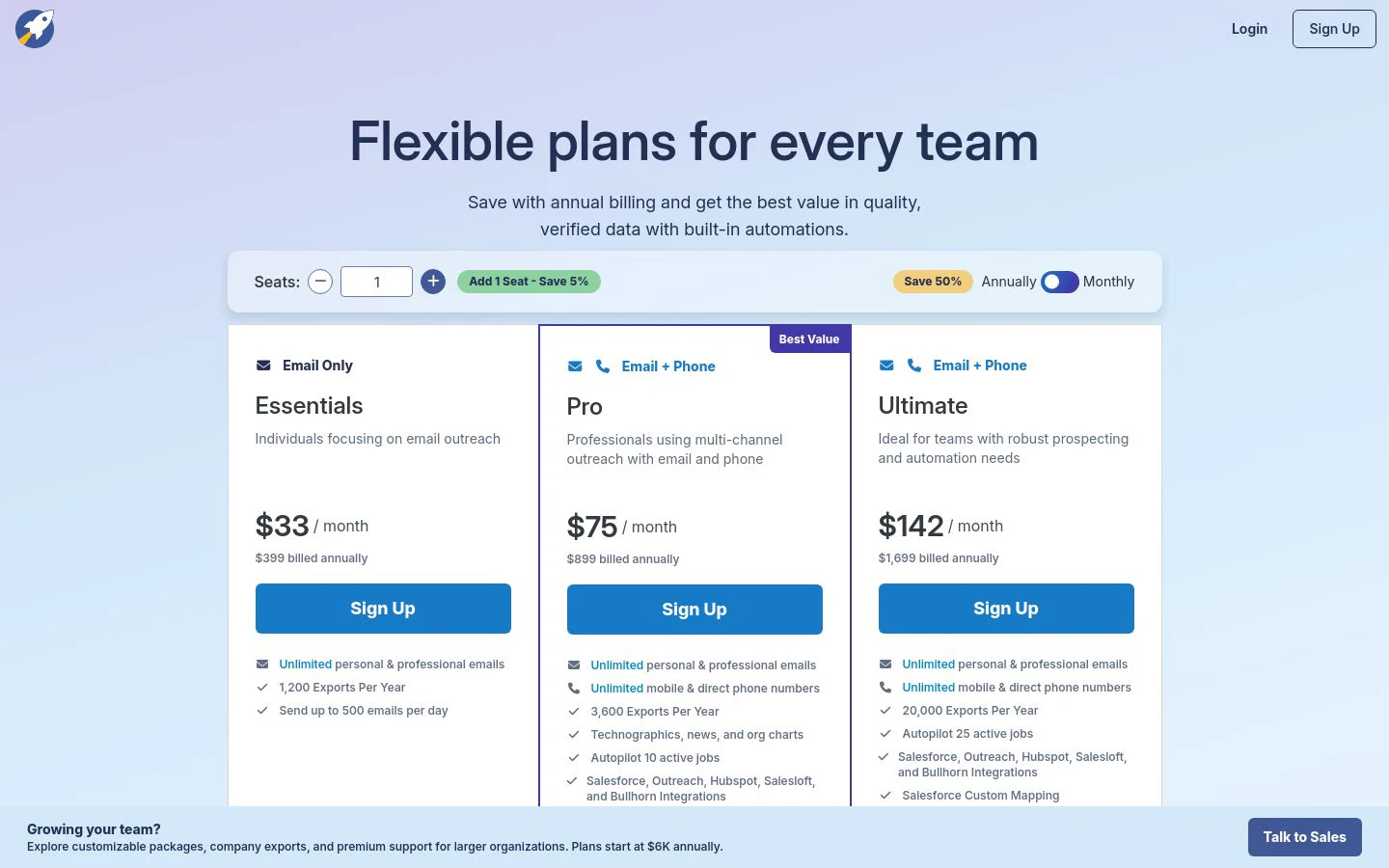
RocketReach has a free plan with a handful of monthly lookups, then individual tiers billed annually: Essentials (email only), Pro (adds mobile and direct dials), and Ultimate (higher volume), plus per-seat Team plans. Annual Essentials lands around $39/mo, and monthly billing costs more. A slider adjusts your lookup volume. See RocketReach's pricing page for current rates.
RocketReach reviews
- G2: 4.4/5 from 1,300+ reviews (G2)
7. UpLead
- Best forteams that want verified data with a real accuracy guarantee
- Pricingfree trial, then paid tiers from $74/mo (annual)
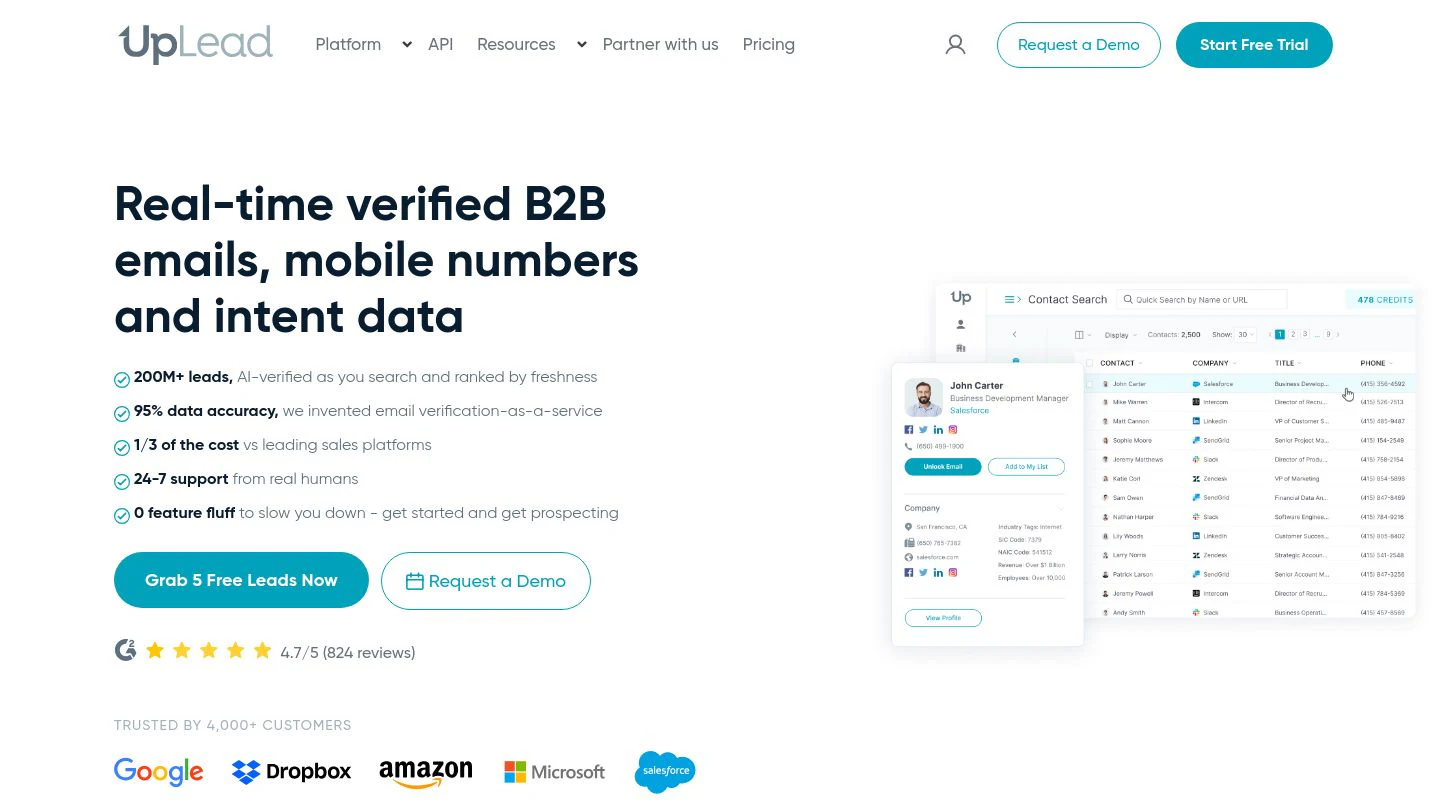
- What we likereal-time email verification with a 95% accuracy guarantee
UpLead answers the accuracy complaint that pushes many teams off Lusha. It verifies emails in real time at the moment you export, and it backs a 95% accuracy guarantee by refunding the credit for any address that bounces. You get contact and company data, technographics, and intent, with clean, transparent per-credit pricing that's easy to reason about.
The database is smaller than the enterprise incumbents, so coverage on long-tail or non-US accounts can trail ZoomInfo or Cognism. It's a quality-first tool, not the biggest-net option.
What we like about UpLead
- Real-time email verification with a 95% accuracy guarantee and credit refunds
- Clean per-credit pricing that's easy to predict
- Technographic and intent data alongside contacts
- Straightforward CRM integrations and bulk enrichment
Where UpLead could be better
- Smaller database than the enterprise platforms, thinner on long-tail accounts
- Credit model means heavy prospecting adds up
- Fewer outreach features; it's a data tool, not a sending platform
Why choose UpLead? The pick when verified accuracy matters more than raw database size, backed by a real guarantee.
UpLead pricing
- Free trial: a short trial with a handful of credits to test the data
- Essentials: $74/mo billed annually ($99 monthly) with 170 credits/mo
- Plus: $149/mo billed annually ($199 monthly) with 400 credits/mo
- Professional: custom annual pricing with higher volume and full features
One credit reveals a contact with a verified email and mobile. See UpLead's pricing page for current credits and rates.

UpLead reviews
- G2: 4.7/5 from 800+ reviews (G2)
8. LeadIQ

- Best forSDR teams that want one-click contact capture into their CRM and sequencer
- Pricingfree plan, then paid tiers from about $45/user/mo (annual)
- What we likefast capture from LinkedIn straight into your workflow
LeadIQ is built around the prospecting motion rather than a raw database. Its Chrome extension captures a contact from LinkedIn and pushes a verified email and phone straight into Salesforce or your sequencer in one click, so reps stop copy-pasting. It adds job-change tracking and AI-assisted message drafting to keep the workflow moving.
The database is not the largest, and heavy users report that credits and add-ons like AI drafting can push the real cost above the headline price. It shines as a rep workflow layer more than a bulk data source.
What we like about LeadIQ
- One-click capture from LinkedIn into Salesforce and sequencers
- Job-change tracking to catch warm moves
- AI-assisted message drafting inside the workflow
- Genuinely useful free tier to test the extension
Where LeadIQ could be better
- Database is smaller than the enterprise platforms
- Credits and add-ons can push the real cost above the headline price
- Best as a rep workflow layer, not a bulk enrichment source
Why choose LeadIQ? Fastest path from a LinkedIn profile to a captured, sequenced contact for SDR teams.
LeadIQ pricing
- Free: $0 with 1 user and a small monthly credit allowance to test the extension
- Essential: from about $45/user/mo (annual) for individual reps
- Pro: custom pricing that scales by credit volume via a slider
- Enterprise: custom, quote-based for larger orgs
Universal Credits are spent across search, enrichment, and CRM sync, and consumed only when you reveal data. See LeadIQ's pricing page for current rates.
LeadIQ reviews
- G2: 4.2/5 from 1,100+ reviews (G2)
9. Kaspr

- Best forreps who prospect on LinkedIn and want quick, GDPR-aware European contacts
- Pricingfree plan, then paid tiers from $49/mo (annual)
- What we likea LinkedIn extension with strong European coverage
Kaspr is the closest like-for-like swap for a Lusha user, especially in Europe. Its Chrome extension reveals phone numbers and emails directly from LinkedIn profiles, lists, and Sales Navigator searches, and it's backed by the same company as Cognism, which shows in its European data and GDPR posture. For a rep who lives in LinkedIn, it's live in minutes.
The scope is deliberately narrow. Coverage and accuracy are strongest in Europe and thinner elsewhere, and like Lusha, credit limits on lower tiers can bite once you prospect at volume.
What we like about Kaspr
- LinkedIn extension reveals emails and phones from profiles and lists
- Strong European coverage with a GDPR-aware posture
- Simple enough that a rep needs no training
- Free plan and low entry price to start
Where Kaspr could be better
- Coverage is strongest in Europe and thinner outside it
- Credit limits on lower tiers bite once you prospect at volume
- LinkedIn-centric, so it's not a full database or platform
Why choose Kaspr? The quickest LinkedIn-native lookup for reps who need GDPR-aware European contacts fast.
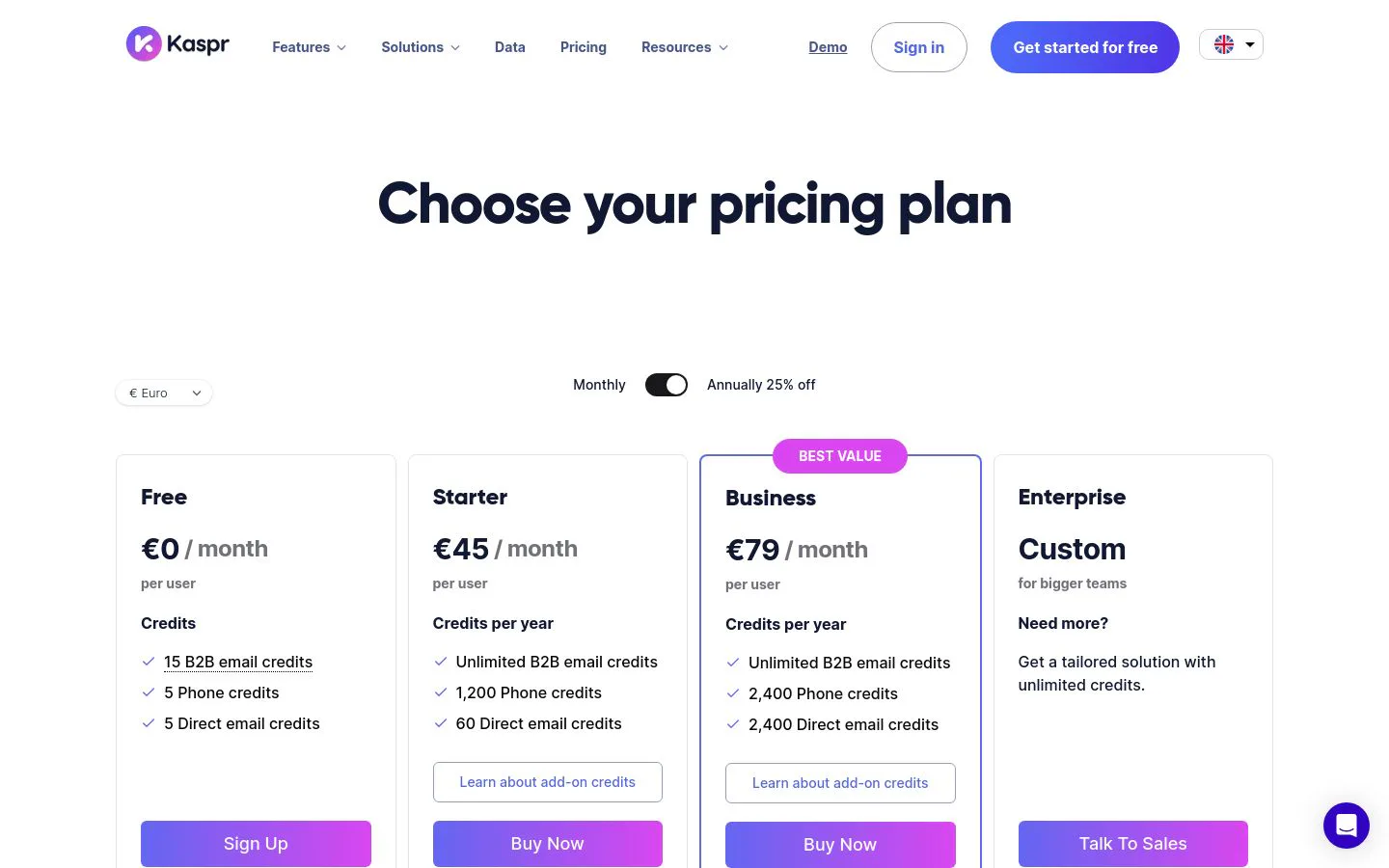
Kaspr pricing
- Free: $0 with a small monthly allowance of phone, email, and export credits
- Starter: from $49/mo billed annually ($65 monthly) for an individual rep
- Business: from $79/mo billed annually ($99 monthly), adding API access and higher limits
- Organization: custom pricing with team management and negotiated credits
Annual billing saves against the monthly rates. See Kaspr's pricing page for current credits and tiers.
Kaspr reviews
- G2: 4.4/5 from 800+ reviews (G2)
10. Hunter
- Best forteams needing affordable email finding and verification
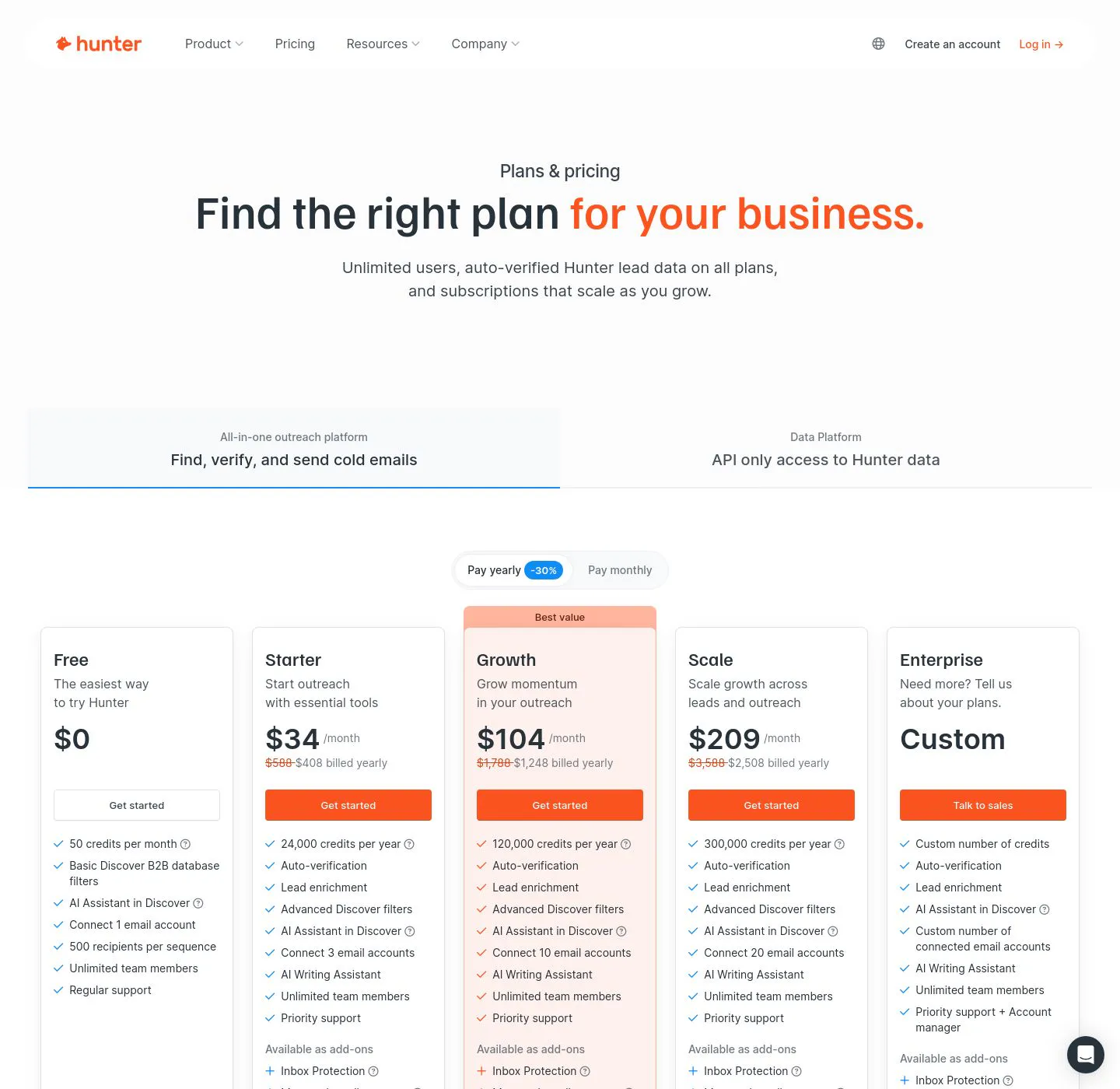
- Pricingfree plan, then paid tiers from $34/mo (annual)
- What we likesimple, reliable email discovery and verification
Hunter does one job well: email. It finds address patterns by domain, verifies lists before you send, and offers domain search, bulk tasks, and an API, all at a low price. If your issue with Lusha is cost and you only need clean, deliverable emails rather than phone numbers, Hunter is a focused, honest pick.
The focus is also the ceiling. Hunter is email-centric, so it won't fill direct-dial phone numbers or the rich firmographic and technographic fields a full platform provides.
What we like about Hunter
- Reliable email finding by domain and pattern
- Built-in verification to cut bounces before you send
- Unlimited users on every plan
- Low entry price and a genuinely useful free tier
Where Hunter could be better
- Email-centric, so no direct-dial phone numbers
- Limited firmographic and technographic data
- Not a full prospecting platform on its own
Why choose Hunter? The best pure-play email finder and verifier when deliverability is the priority.
Hunter pricing
- Free: $0/mo with 50 credits
- Starter: $34/mo annual ($49 monthly) with 2,000 credits
- Growth: $104/mo annual ($149 monthly) with 10,000 credits
- Scale: $209/mo annual ($299 monthly) with 25,000 credits
- Enterprise: custom
Every plan includes unlimited users. See Hunter's pricing page for current credits.
Hunter reviews
- G2: 4.4/5 from 600+ reviews (G2)
Which Lusha alternative should you choose?
Match the tool to your situation, not the other way around.
- AI plus waterfall across many providers: Clay. It's the only option here that builds the data your workflow acts on, instead of reselling one database.
- All-in-one prospecting on a budget: Apollo.io, when you want a database and outreach in one tool.
- Enterprise depth and intent: ZoomInfo, if the budget and North American focus fit.
- Phone-verified, EU/UK compliant: Cognism, or Kaspr for a lighter LinkedIn-native version.
- Verified accuracy with a guarantee: UpLead.
- Broad email and social reach for individuals: RocketReach.
- One-click capture into a CRM: LeadIQ.
- Email finding and verification only: Hunter.
If your data is already complete and clean, a simple lookup tool is the fastest fix. If your ideal record depends on data you don't have yet, no single-database tool can save you until you build the data layer first.
What is the best free Lusha alternative?
If you want to replace Lusha without paying, a few free tiers stand out. Hunter's free plan (50 credits a month) is the simplest way to find and verify emails. Apollo's free tier is the most generous all-in-one, giving you a database, enrichment, and a few sequences to try outbound end to end. Kaspr's free plan mirrors Lusha's own extension flow for a handful of monthly reveals.
For custom, AI-driven enrichment, Clay's free plan is the one that lets you build a real workflow, run a multi-provider waterfall, and use Claygent against your own list before you spend a credit. It's the best way to see coverage on your actual accounts, not a vendor's demo list, before committing.
The catch with every free tier is credits. They're built for testing, not production, so treat them as a way to check accuracy on your own data before you choose.
Where contact data tools are heading
For years, contact data meant renting one database and hoping your accounts happened to sit inside it. Tools like Lusha made that fast and self-serve, which was the right call for a rep grabbing a single number. But the teams pulling ahead in 2026 aren't the ones with the single biggest database. They're the ones assembling data from many sources on demand, verifying it at the moment of use, and extending it with AI research no static field could hold.
Practically, start from your bottleneck, not the brand name. If a rep just needs one clean email before a call, almost any tool here beats none, and a simple lookup is the quickest win. If the real problem is thin, stale, or capped coverage on the accounts that matter, fix the data layer first, because no extension can reveal a contact no single provider has.
Whatever you shortlist, test it on your own accounts before committing a budget. The demo list always looks perfect. Yours is the only one that tells the truth.
Stop hitting credit caps on contact data
Start free, run a real waterfall against your own list, and see the coverage before you spend a credit.
FAQ
Why do teams look for a Lusha alternative?
Lusha is fast and self-serve, but its dataset is lighter than the enterprise platforms and credit caps arrive quickly on lower tiers. Teams outgrow it when they need deeper coverage, non-US data, phone accuracy, or enrichment across a whole list rather than one-off lookups. The right alternative depends on which of those limits you hit first.
What is the best free Lusha alternative?
Hunter's free plan is best for finding and verifying emails, and Apollo's free tier is the most generous all-in-one for testing outreach. Kaspr's free plan mirrors Lusha's extension flow for a few reveals a month. For custom, AI-driven enrichment, Clay's free plan lets you build and run a real waterfall against your own list before spending a credit.
Which Lusha alternative has the most accurate phone numbers?
For verified mobile numbers, Cognism's human-checked Diamond Data leads in the EU and UK, and ZoomInfo is strong in North America. Kaspr is solid for European mobiles from LinkedIn. Accuracy varies by region and decays over time, so test phone fill rates on your own list before committing.
Are Lusha alternatives GDPR compliant?
Many are, but the posture varies. Cognism and Kaspr are built around a strong GDPR stance and compliant EU/UK data, and most enterprise tools support CCPA opt-out and DNC handling. If you sell into Europe, prioritize a provider with clear regional compliance and documented consent.
What is waterfall enrichment and why does it matter?
Waterfall enrichment checks multiple data providers in sequence and stops at the first one that returns a verified result. Because no single provider covers everyone, running several in order raises your fill rate well above any one vendor, and you only pay for the hit. It's the main advantage a platform like Clay has over a single-database lookup tool.
Do these tools integrate with HubSpot and Salesforce?
Most do. Clay, Apollo, ZoomInfo, Cognism, UpLead, LeadIQ, and Kaspr all sync to both HubSpot and Salesforce in some form. Clay also writes enriched records back and re-runs them as data changes, so your CRM stays current instead of drifting stale.
How is pricing usually structured for contact data tools?
Most use credits, where one credit reveals a contact or enrichment, on tiered plans, sometimes with per-seat costs. Lower tiers cap credits quickly, which is a common reason teams switch. Enterprise databases like ZoomInfo and Cognism are quote-based on annual contracts, while usage-based platforms like Clay separate the data cost from the platform cost.
Which Lusha alternative is best for a small team on a budget?
For pure email work, Hunter is cheap and reliable. For an all-in-one on a budget, Apollo's free and low tiers are hard to beat. And if you want to grow into custom, AI-driven enrichment without paying up front, Clay's free plan lets you build and test a real workflow before spending a credit.