
Every outbound number your team hits traces back to the same starting point: where the data came from. A B2B data provider is the source behind your emails, direct dials, firmographics, and buying signals, and the provider you pick quietly sets the ceiling on how much of your market you can actually reach.
The catch is that no two providers cover the same accounts. One is deep in North American mid-market, another owns phone-verified EU numbers, a third is really a developer API. So how do you know which source is right for the accounts you sell into?
We compared 10 of the most credible B2B data providers on coverage, accuracy by region, compliance, and pricing, and judged each on what it returns rather than what it advertises. One pattern held across all of them: buy from a single vendor and you inherit exactly one company's blind spots. The teams pulling ahead treat providers as interchangeable sources and run several at once.
Here's the shortlist, then a closer look at each one.
What is a B2B data provider?
A B2B data provider is the source you buy business contact and company data from: work emails, direct-dial phones, titles, company size, tech stack, and intent signals. Some sell access to a large owned database, some resell and repackage other datasets, and some expose the raw data through an API. The thing that separates a good provider from a bad one is coverage on your specific accounts, because every database is strong in some regions and segments and thin in others.
The 10 best B2B data providers for 2026
| # | Tool | Best for | Pricing from | G2 rating |
|---|---|---|---|---|
| 1 | Clay | Running 200+ providers in one waterfall | Free, paid from $185/mo | 4.6/5 |
| 2 | Apollo.io | All-in-one database on a budget | Free, paid from $49/user/mo | 4.7/5 |
| 3 | ZoomInfo | Enterprise-grade B2B database | Quote-based | 4.5/5 |
| 4 | Seamless.AI | Real-time contact sourcing | Free, then quote-based | 4.4/5 |
| 5 | Cognism | Phone-verified EU and UK data | Quote-based | 4.5/5 |
| 6 | Lusha | Fast SMB self-serve data | Free, then paid tiers | 4.3/5 |
| 7 | LeadIQ | Prospecting data into your CRM | Free, then paid tiers | 4.2/5 |
| 8 | Clearbit (Breeze Intelligence) | HubSpot-native company data | Credit packs from $45/mo | 4.4/5 |
| 9 | D&B Hoovers | Firmographic data of record | Quote-based | 4.1/5 |
| 10 | People Data Labs | Raw data API for builders | Free, paid from $98/mo | 4.6/5 |
1. Clay
- Best forteams that want to buy from many data providers at once instead of betting on a single vendor
- PricingFree plan, then Launch ($185/mo), Growth ($495/mo), and custom Enterprise
- What we likewaterfall enrichment runs 200+ data providers in sequence and charges only for the match
Full disclosure: Clay is our product, so we put it first. Running multiple data providers in one place is the most common thing teams build on Clay. Here's what it does well and where it doesn't fit.
Clay is not a data provider in the usual sense. It's the layer that sits on top of the providers, so instead of choosing between ZoomInfo, Cognism, or a developer API and living with that source's blind spots, you run 200+ of them in a single waterfall. Clay checks each provider in the order you set, stops at the first verified hit, and only charges for the record that comes back. On top of the raw data it adds Signals (job changes, funding, hiring, web intent) and Claygent, an AI research agent that answers questions no provider sells as a field, like whether an account runs a specific tool or mentions SOC 2 in a job post. The finished record syncs to Salesforce or HubSpot and re-runs as the underlying sources change.
Run every provider on your own list
Point 200+ data providers at a real list and see which source wins each record, free.
What we like about Clay
- Runs 200+ data providers in a waterfall, so no single vendor's coverage gap becomes yours
- Pays only for the first verified match, so you're not buying the same record from three sources
- Claygent researches facts no data provider sells as a field
- Signals surface job changes, funding, hiring, and web intent to time outreach
- Writes records back to Salesforce and HubSpot and re-runs as the providers refresh
Where Clay could be better
- You assemble and order the provider stack yourself; there's no single default source to switch on
- Tuning which providers to run first, and in what order, takes some setup before coverage is dialed in
- Data Credits are usage-based, so large one-off pulls across many providers need a spend check
Why choose Clay? Every other name here sells you one database; Clay lets you run 200+ of them in one waterfall and pay only for the match.
Proof. Anthropic hit 3x data enrichment coverage on Clay after consolidating several point vendors into one waterfall.
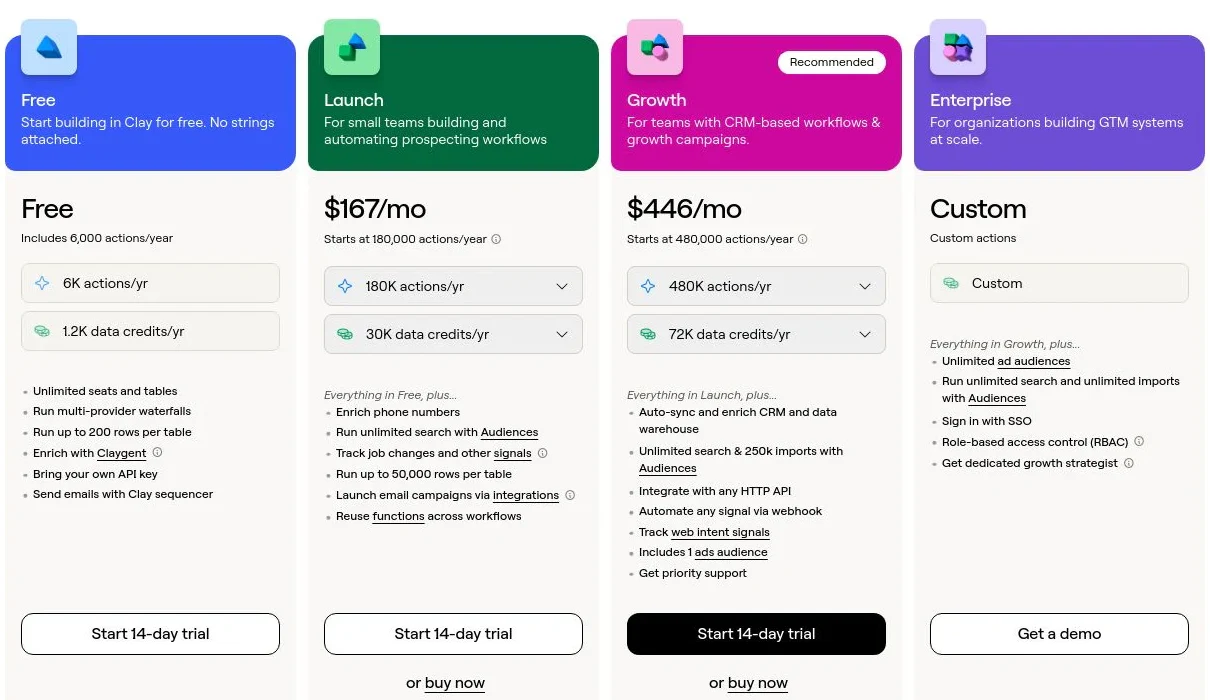
Clay pricing
- Free: $0/mo with 100 Data Credits, 500 Actions, unlimited seats and tables, multi-provider waterfalls, and Claygent
- Launch: starting at $185/mo with 2,500 Data Credits, 15,000 Actions, phone enrichment, and signal tracking
- Growth: starting at $495/mo with 6,000 Data Credits, 40,000 Actions, CRM auto-sync, and ads-audience pushes
- Enterprise: custom pricing with an annual commitment, 100,000+ Data Credits, unlimited Audiences, API access, SSO, and RBAC
Data Credits pay for the data itself and roll over; Actions pay for the platform work and reset monthly. Bring your own provider API keys and you skip Data Credits on those sources entirely. See Clay's pricing page for the full breakdown.
Clay reviews
- G2: 4.6/5 from 200+ reviews (G2)
2. Apollo.io
- Best forSMB and mid-market teams that want a large database and outreach in one affordable place
- Pricingfree plan, then paid tiers from $49/user/mo (annual)
- What we likea sizable contact database at an entry price most teams can start on
Apollo owns a large B2B contact database, over 200 million contacts by its own count, and bolts prospecting and sending on top. As a data provider it's the accessible default: the free tier lets a founder or small team pull contacts and start outbound without a procurement cycle, which is why so many companies meet their first data source here.
The trade-off is depth and consistency. Apollo's data leans heavily toward North America and gets thinner internationally, and because it's a self-serve database rather than a heavily human-verified one, accuracy varies record to record. Treat it as a broad, cheap source you verify, not the last word on a hard-to-find contact.
What we like about Apollo.io
- A large owned contact database you can query and export self-serve
- A genuinely usable free tier to start sourcing
- Accessible per-seat pricing for small teams
- Prospecting, enrichment, and sequences share one contact record
Where Apollo.io could be better
- Coverage is strongest in North America and thins out internationally
- Self-serve data means accuracy varies, so verify before high-stakes sends
- Depth on hard-to-find contacts trails the enterprise data houses
Why choose Apollo.io? The best price-to-coverage database for SMB teams that want a broad source without an enterprise contract.
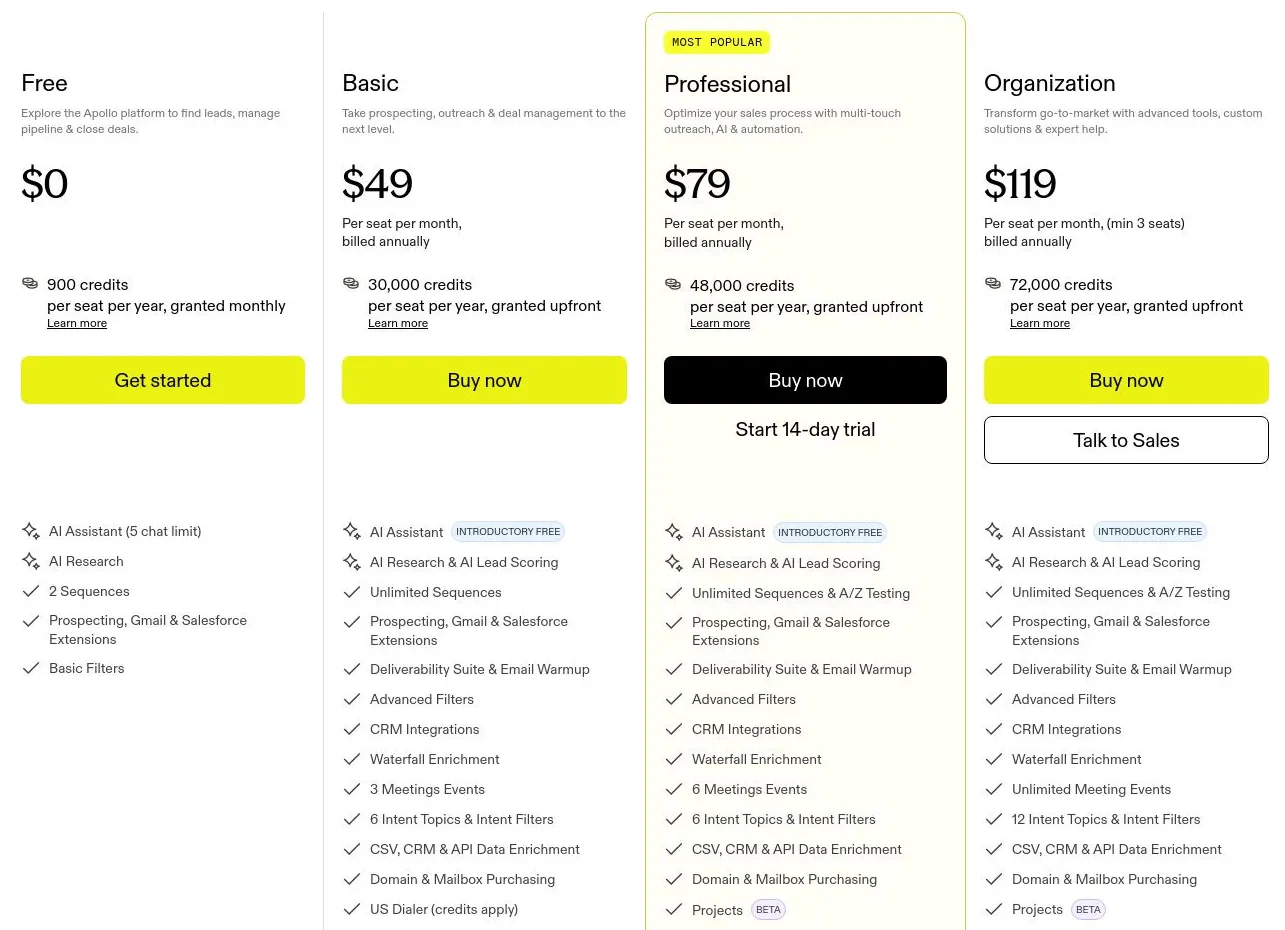
Apollo.io pricing
- Free: $0 with limited credits and core prospecting
- Basic: $49/user/mo (annual) with more credits and sequences
- Professional: $79/user/mo (annual) with advanced features and higher limits
- Organization: $119/user/mo (annual, 3-seat minimum) with the full feature set
Monthly billing runs higher than the annual rates shown. See Apollo's pricing page for current limits.
Apollo.io reviews
- G2: 4.7/5 from 9,000+ reviews (G2)
3. ZoomInfo
- Best forenterprise teams that need the deepest, broadest US B2B database on the market
- Pricingquote-based, annual contracts
- What we likean enormous verified database with intent and org-chart data attached
ZoomInfo is the source most other providers are measured against. Its database spans roughly 14 million companies and 235 million business professionals, layered with intent data, org charts, and WebSights website-visitor identification. For an enterprise team selling into North America, it's the closest thing to a data provider of record: if a contact exists in the US market, ZoomInfo probably has it.
That authority comes at enterprise cost and with regional limits. Pricing is quote-based on annual contracts, the entry point is steep, and coverage that's excellent in the US thins noticeably across parts of EMEA and APAC. It's a deep source to anchor on, but a heavy commitment to make it your only one.
What we like about ZoomInfo
- One of the largest verified B2B databases available anywhere
- Intent data and org charts sit alongside the contact record
- WebSights reveals which companies visit your site
- Deep integrations across major CRMs and sales tools
Where ZoomInfo could be better
- Premium, quote-based pricing on annual contracts with a high entry point
- Coverage is strong in North America and thins in parts of EMEA and APAC
- Overkill as a sole source for a small or international team
Why choose ZoomInfo? The deepest US B2B database on the list, the source others benchmark their coverage against.
ZoomInfo pricing
ZoomInfo doesn't publish prices. Plans (commonly Professional, Advanced, and Elite) are quote-based and sold on annual contracts, priced by seats and credits. Third-party pricing analyses put entry-level contracts around $15,000 per year, rising with credits and add-ons. Get a quote on ZoomInfo's pricing page for your exact configuration.
ZoomInfo reviews
- G2: 4.5/5 from 8,000+ reviews (G2)
4. Seamless.AI
- Best forhigh-volume teams that want contacts sourced fresh on demand rather than pulled from a static file
- Pricingfree tier, then quote-based
- What we likea real-time engine that assembles contact data at the moment you search
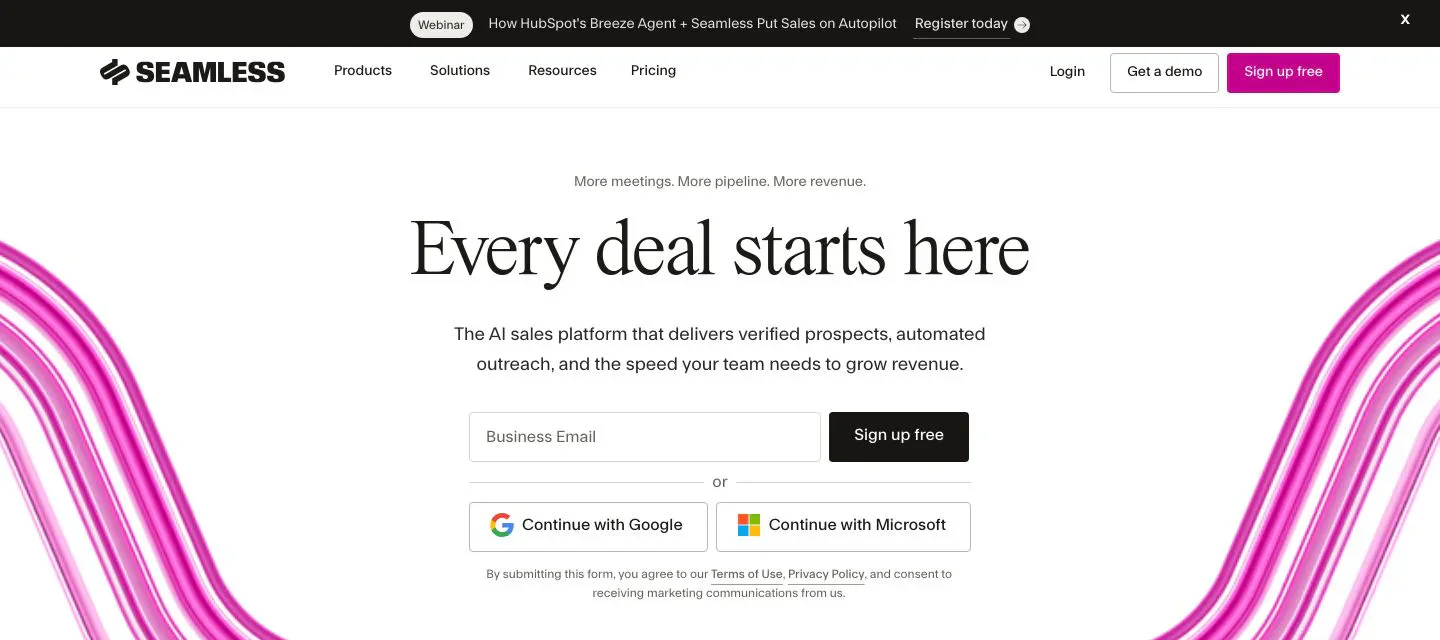
Seamless.AI is a different kind of source: instead of serving records from a fixed database, it works like a search engine that compiles contact data in real time when you look someone up. It finds emails and phone numbers, runs as a Chrome extension, and offers buyer-intent add-ons, which suits high-volume prospecting teams that would rather generate a fresh contact than trust a stored one.
Real-time sourcing is both the appeal and the risk. Because the data is assembled on the fly, accuracy swings from record to record, and the credit-and-upsell model means costs can climb as you scale. It's a strong source to run alongside a verified database, not on its own.
What we like about Seamless.AI
- Compiles contact data in real time instead of serving a static file
- Finds emails and phone numbers with a Chrome extension
- Buyer-intent and other data add-ons available
- Free tier lets you sample the source before committing
Where Seamless.AI could be better
- Real-time sourcing means accuracy varies, so verify before sending
- The credit and upsell model can make costs climb at volume
- Pricing is quote-based with no clear public tiers
Why choose Seamless.AI? Generates fresh contact data on demand, useful as a real-time source that catches what a static database missed.
Seamless.AI pricing
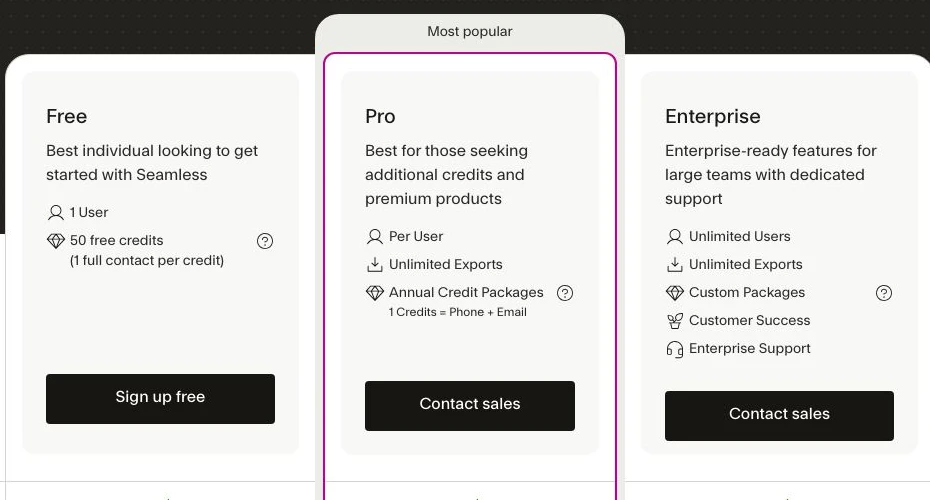
Seamless.AI is largely quote-based. There's a free tier with a limited number of lifetime credits, and Pro and Enterprise plans are custom-quoted annual contracts, often with a seat minimum. Contact Seamless.AI for a quote on its pricing page.
Seamless.AI reviews
- G2: 4.4/5 from 5,000+ reviews (G2)
5. Cognism
- Best forteams selling into the EU and UK that need phone-verified, compliant data at the source
- Pricingquote-based
- What we likehuman-verified Diamond Data phone numbers and a genuine GDPR posture
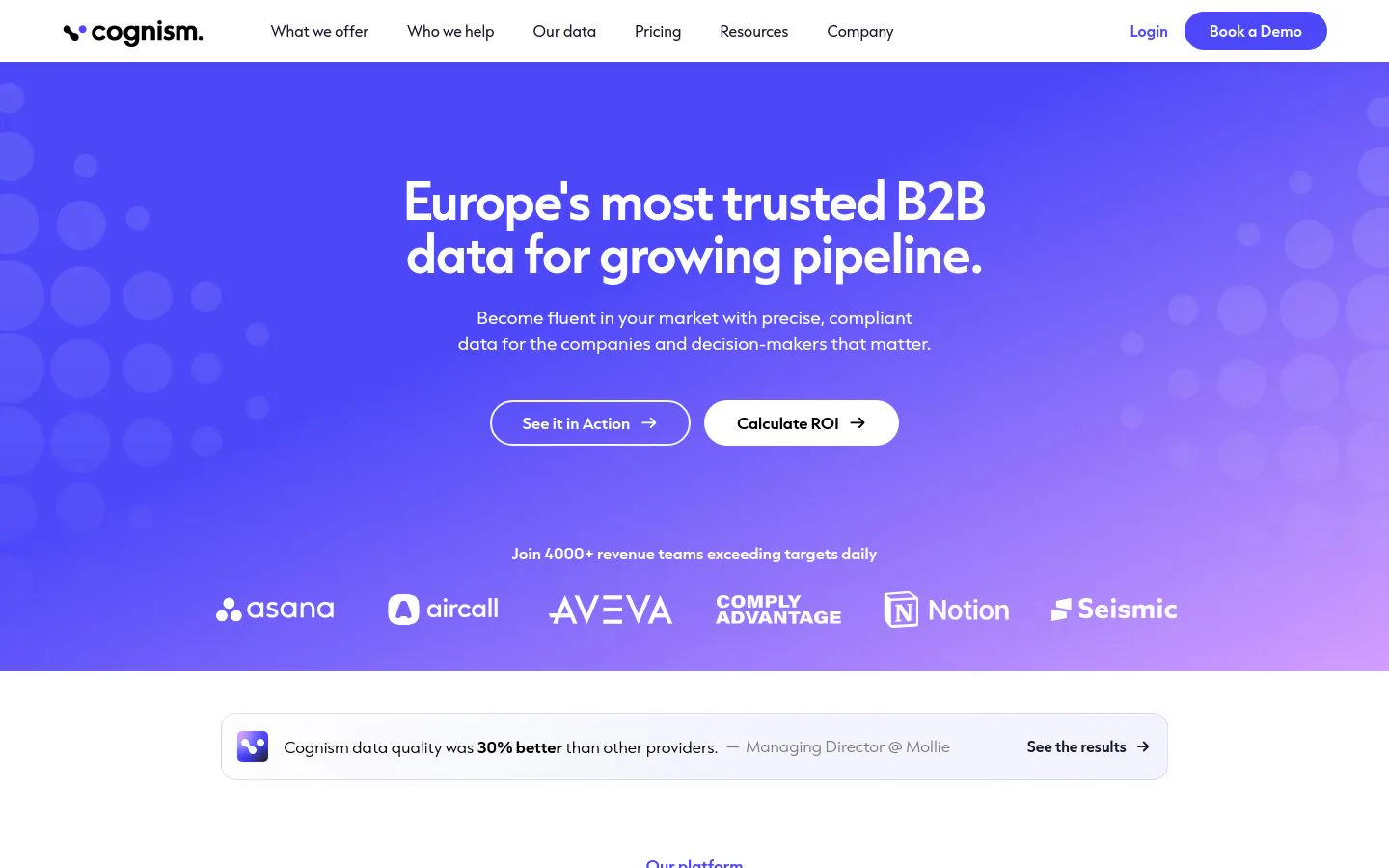
Cognism is the provider to reach for when Europe is your market. Its Diamond Data phone numbers are human-verified, its UK, EMEA, and DACH coverage is deep, and its GDPR-first sourcing is a real differentiator for teams that can't take chances on how data was collected. As a source it does what US-first databases can't: put a compliant, connectable European number in front of a rep.
Where the US incumbents thin out abroad, Cognism thins out at home. Coverage is strongest in Europe and lighter than ZoomInfo across North America, and it's a premium, quote-based product with no public tiers. It's the European anchor in a provider mix, not a global one-stop source.
What we like about Cognism
- Diamond Data phone numbers are checked by a human before they ship
- The deepest UK, EMEA, and DACH coverage of any source here
- GDPR-first sourcing that stands up to compliance review
- Unrestricted-view access on many plans, so reps aren't rationed by seat
Where Cognism could be better
- Premium and quote-based, with no self-serve tiers to try first
- North American coverage lags the US-first providers
- Sizing the right credit and seat mix needs a sales conversation
Why choose Cognism? The strongest source for phone-verified, GDPR-compliant EU and UK data, exactly where US-first providers run dry.
Cognism pricing
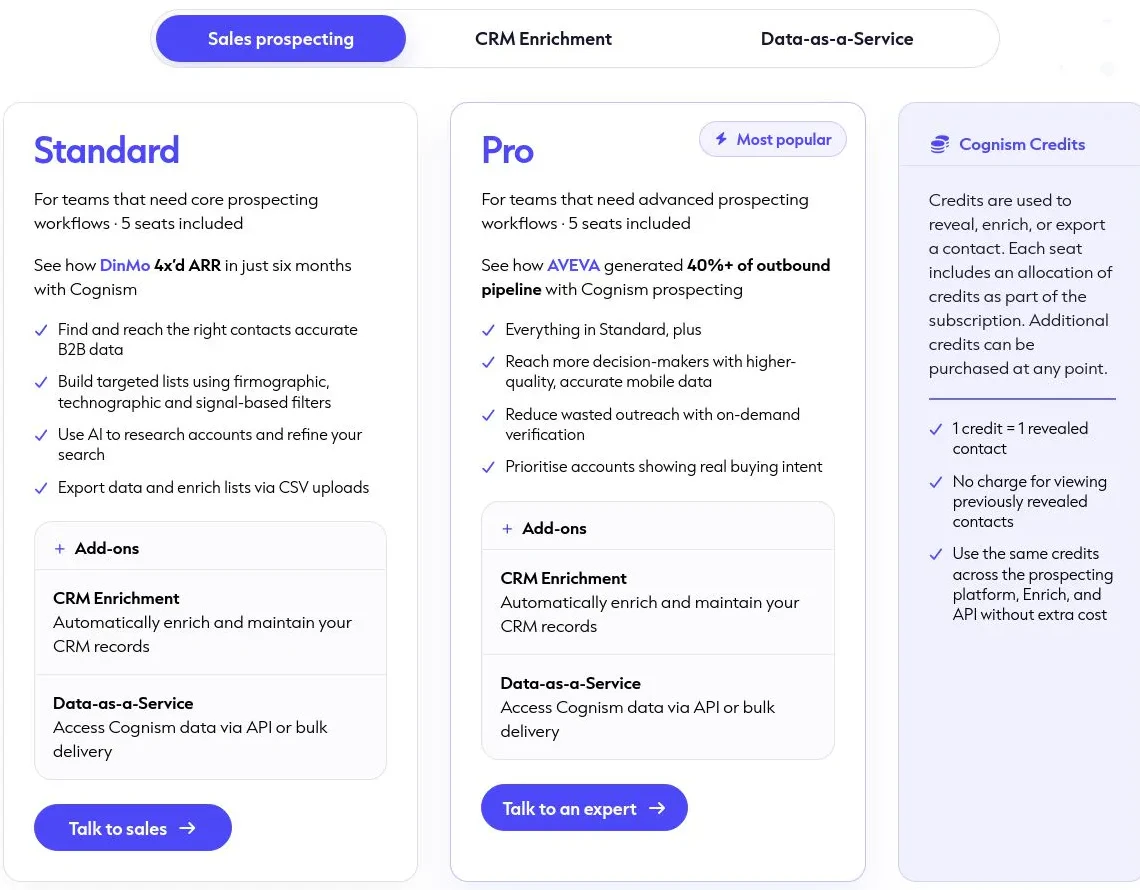
Cognism is quote-based. The pricing page lists Sales Prospecting packages (Standard and Pro) plus CRM Enrichment and Data-as-a-Service add-ons, all priced through sales. The model is credit-based, where one credit reveals one contact. Talk to Cognism for a quote sized to your region and seats. Start on Cognism's pricing page.
Cognism reviews
- G2: 4.5/5 from 1,300+ reviews (G2)
6. Lusha
- Best forSMB reps who want to pull contact data from a profile without a procurement process
- Pricingfree plan (40 credits/mo), then paid tiers
- What we likea self-serve source that lives in a Chrome extension
Lusha is the most approachable provider on the list. Its Chrome extension pulls a work email and phone number straight off a professional profile, it handles bulk enrichment, and it syncs to your CRM. For an individual rep or a small team, it's a source you can start using in minutes, no contract, no onboarding.
That accessibility caps its depth. The underlying dataset is lighter than the enterprise houses, credit limits arrive quickly on lower tiers, and coverage is best on straightforward contacts. It's a great convenience source for one-off lookups, less so for sourcing an entire market.
What we like about Lusha
- Grabs a work email and phone from a profile in one click
- Live in minutes on a free plan, no contract required
- Bulk enrichment and CRM sync once you upgrade
- So simple a new rep needs no onboarding
Where Lusha could be better
- Lower tiers run out of credits fast
- A lighter dataset than the enterprise data houses
- Suited to spot lookups more than sourcing a full market
Why choose Lusha? The fastest self-serve source for SMB reps who need a contact now, not after a sales call.
Lusha pricing
Lusha offers a free plan with 40 credits per month, then paid Pro, Premium, and Scale tiers that add credits, bulk enrichment, and team features. The model is credit-based (revealing an email costs one credit, a phone number more). Check Lusha's pricing page for current per-tier rates.
Lusha reviews
- G2: 4.3/5 from 1,500+ reviews (G2)
7. LeadIQ
- Best forSDR teams that want contact data captured straight into their CRM and sequencer
- Pricingfree plan, then paid tiers
- What we likeone-click capture from LinkedIn into Salesforce or Outreach, with tracked contacts
LeadIQ is a data source built around the prospecting workflow. Its strength isn't a headline database size, it's how cleanly it moves a contact from a LinkedIn profile into your CRM and sequencer, deduped and formatted, with job-change tracking so a saved contact tells you when it's time to reach out again. For SDR teams that live in the outbound tooling, it removes the copy-paste tax between finding a contact and working it.
The data itself is solid rather than exceptional. Reviewers flag occasional wrong emails and inconsistent quality on harder contacts, and phone coverage lags the phone-first providers. It's a workflow-friendly source best paired with a deeper database for the contacts it can't complete.
What we like about LeadIQ
- One-click capture from LinkedIn into Salesforce, HubSpot, and Outreach
- Contact tracking flags job changes so you re-engage at the right time
- Cleans and dedupes records before they hit your CRM
- Reasonable entry pricing for SDR teams
Where LeadIQ could be better
- Data quality is inconsistent on harder-to-find contacts
- Phone coverage trails the phone-verified providers
- Best as a capture layer, not a standalone database
Why choose LeadIQ? The smoothest source-to-CRM workflow for SDR teams that prospect out of LinkedIn all day.
LeadIQ pricing
LeadIQ publishes a Free plan, a paid Pro tier, and a custom Enterprise tier. Pro is credit-based and billed annually, sized by seats and the volume of contacts you capture, and Enterprise is quote-based for larger teams that need more data, users, and controls. Because the public rate depends on seats and credit volume, check LeadIQ's pricing page for current rates.
LeadIQ reviews
- G2: 4.2/5 from 1,100+ reviews (G2)
8. Clearbit (HubSpot Breeze Intelligence)
- Best forHubSpot teams that want a data source living natively on the CRM record
- Pricingcredit packs within HubSpot, from $45/mo for 100 credits
- What we likefirmographic and technographic data delivered right where HubSpot users work
Clearbit, now HubSpot Breeze Intelligence, is a data source that lives inside HubSpot. It fills firmographic and technographic fields on the record, shortens forms by enriching a visitor from just an email, and de-anonymizes website traffic to reveal in-market companies. If your stack lives in HubSpot, this is the source that requires no integration, the data simply lands on the record.
The value is bound to that ecosystem. It's most useful inside HubSpot, runs on credit packs on top of a paid subscription, and the standalone Clearbit API that developers once built on has been retired. Some users also report accuracy slipping on older records. As a source it's convenient for HubSpot shops and limited for everyone else.
What we like about Clearbit
- Data lands directly on the HubSpot record with zero integration work
- Progressive forms fill themselves from a single email address
- De-anonymizes site traffic to surface in-market companies
- Keeps firmographic and technographic fields current on their own
Where Clearbit could be better
- The value effectively requires you to run HubSpot already
- Credit packs stack on top of a paid HubSpot subscription
- The old standalone Clearbit API and free tools are gone
- A share of users report older records drifting out of date
Why choose Clearbit? The default data source if you run HubSpot, delivered on the record you already work.
Clearbit (HubSpot Breeze Intelligence) pricing
Breeze Intelligence is sold as credit packs on top of a paid HubSpot plan. Credits start around $45/mo (annual) for 100 credits and scale up in packs of 1,000 and 10,000. Your true cost depends on your HubSpot tier plus the credit volume you need. See HubSpot's Breeze Intelligence page for current credit-pack pricing. There's no standalone Clearbit plan anymore.
Clearbit (HubSpot Breeze Intelligence) reviews
- G2: 4.4/5 from 600+ reviews (G2)
9. D&B Hoovers
- Best forenterprise and finance-adjacent teams that need authoritative company and firmographic data
- Pricingquote-based, annual contracts
- What we likedeep corporate family trees and firmographics from a data house built on company records
D&B Hoovers draws on Dun & Bradstreet's decades-old commercial database and the DUNS numbering system, which makes it the firmographic source of record for a lot of enterprises. Its strength is company data: corporate family trees, financials, industry codes, and firmographics that hold up in procurement, credit, and account-planning use cases where provenance matters more than volume.
For sales prospecting specifically, it's a heavier fit. Contact-level data draws more complaints than the company data does, the interface feels dated, and contracts are quote-based with built-in annual increases and add-on fees that reviewers find hard to predict. It's a firmographic authority to pair with a contact-first provider, not a modern prospecting engine.
What we like about D&B Hoovers
- Authoritative company data anchored to DUNS numbers and corporate family trees
- Deep firmographics and financials suited to account planning and credit use cases
- Long-established data house with broad global company coverage
- Integrates with major CRMs and marketing platforms
Where D&B Hoovers could be better
- Contact-level accuracy draws more criticism than the company data
- The interface feels dated compared with newer providers
- Quote-based contracts with annual increases and add-on fees that are hard to predict
Why choose D&B Hoovers? The firmographic source of record when authoritative company data matters more than contact volume.
D&B Hoovers pricing
D&B Hoovers is quote-based and sold on annual contracts, priced by seats and dual company/contact credits. Third-party pricing analyses put entry-level plans in the hundreds of dollars per month and enterprise editions around $25,000 per year, with API access and add-ons billed separately. Contract terms commonly include a default annual rate increase, so negotiate the renewal, not just the first year. Contact Dun & Bradstreet through the D&B Hoovers product page for a quote.
D&B Hoovers reviews
- G2: 4.1/5 from 780+ reviews (G2)
10. People Data Labs
- Best forengineering and data teams that want raw person and company data through an API
- Pricingfree plan, then paid from $98/mo
- What we likea clean, well-documented API and dataset built for developers to build on
People Data Labs is a provider aimed at builders rather than reps. It sells raw access to a large person and company dataset through an API and flat data files, so a data or engineering team can enrich records, power a product feature, or feed a model without a sales-facing UI in the way. Reviewers consistently praise the data quality, the documentation, and the flexible Elasticsearch-style querying.
That developer focus is also the limit. There's no app, CRM sync, or workflow layer, so a non-technical GTM team has nothing to click. Its G2 footprint is small next to the sales-tool incumbents, and getting value out of it assumes someone can write against the API. It's an excellent source component, not an off-the-shelf prospecting tool.
What we like about People Data Labs
- Large person and company dataset delivered through a clean API
- Well-documented, with flexible Elasticsearch-style querying
- Flat-file delivery for teams that want to load the data themselves
- Strong data quality per reviewer feedback
Where People Data Labs could be better
- Developer-only: no app, CRM sync, or workflow layer for GTM teams
- Getting value requires engineering time to build against the API
- Small G2 review footprint compared with the sales-tool incumbents
Why choose People Data Labs? The best raw-data source for technical teams that want to build enrichment into their own product or pipeline.
People Data Labs pricing
- Free: $0/mo with 100 person or company lookups per month
- Pro: from $98/mo with around 350 enrichment credits, roughly $0.28 per record
- Enterprise: custom contracts for high-volume API and flat-file delivery
Per-credit rates drop with annual commitments and higher volume. See People Data Labs' pricing page for current tiers.
People Data Labs reviews
- G2: 4.6/5 from 15+ reviews (G2)
Which B2B data provider should you choose?
Match the source to who you sell to, not to the biggest brand.
- Many providers in one waterfall: Clay. It's the only option here that runs 200+ sources together, so no single vendor's blind spot becomes yours.
- Deep US enterprise coverage: ZoomInfo, if the budget and North American focus fit.
- A broad database on a budget: Apollo.io, when you want wide coverage and outreach without an enterprise contract.
- Phone-verified EU and UK data: Cognism.
- HubSpot-native data: Clearbit (Breeze Intelligence).
- Fast SMB self-serve lookups: Lusha or Seamless.AI.
- Source-to-CRM prospecting for SDRs: LeadIQ.
- Authoritative company firmographics: D&B Hoovers.
- Raw data through an API: People Data Labs.
If you sell into one clear region and segment, a single strong provider can carry you. If your market spans regions or the accounts that matter keep coming back empty, no one vendor will cover them, and running several sources together is the only way to close the gap.
What is the best free B2B data provider?
If you want to sample sources without paying, a few stand out. Apollo's free tier is the most generous single database, giving you contacts and a taste of outreach to test coverage on your accounts. People Data Labs' free plan (100 lookups a month) is the best way for a developer to try raw data through the API. Lusha's free plan (40 credits a month) is the quickest self-serve lookup, and Seamless.AI's free tier lets you sample its real-time engine.
For combining sources rather than testing one, Clay's free plan is the one that lets you point a real waterfall at your own list, run multiple providers, and see which source wins each record before you spend a credit. It's the only free option here that shows you coverage across providers instead of inside one.
The catch with every free tier is credits. They're built for testing, not production, so use them to check accuracy on your own accounts before you sign anything.
Where B2B data providers are heading
For a decade, buying B2B data meant picking one vendor and hoping your market lived inside its database. That model is fading. The providers themselves are converging on similar public sources, so the durable edge in 2026 isn't owning the single biggest database, it's assembling coverage from many sources on demand, verifying at the moment of use, and layering AI research on top of the fields a provider can sell.
Practically, start from where your data actually breaks, not from the vendor with the loudest pitch. If you sell into one region and your fill rate is fine, a single strong provider is the simplest answer. If the accounts that matter keep coming back blank, the fix is not a bigger single contract, it's routing across several providers so one covers what another misses.
Whatever you shortlist, run it against your own accounts before you commit a budget. Every provider's sample list looks complete. Only yours tells you where its coverage actually stops.
Stop betting your pipeline on one vendor
Start free, run a waterfall across 200+ providers, and pay only for the records that come back.
FAQ
What is a B2B data provider?
A B2B data provider is a company you buy business contact and company data from: work emails, direct-dial phones, titles, firmographics, tech stack, and intent signals. Some sell access to a large owned database, some resell and repackage other datasets, and some expose the raw data through an API for developers to build on.
What's the difference between a data provider and a data enrichment tool?
A data provider is the source the data comes from. A data enrichment tool takes a record you already have and fills in missing fields, often by querying one or more providers. The line blurs because many providers offer enrichment and many enrichment tools resell provider data, but the useful distinction is source versus the workflow that acts on it. A platform like Clay runs many providers in a waterfall, so it's the enrichment layer that sits on top of the sources.
How many B2B data providers should you use?
More than one, if your market is at all broad. Every provider is strong in some regions and segments and thin in others, so a single source caps your coverage at that vendor's blind spots. Running several in a waterfall, checking them in order and stopping at the first verified hit, raises fill rates well above any one provider while you pay only for the match.
Which B2B data providers have the best EU and GDPR-compliant data?
Cognism is built around GDPR-compliant sourcing and phone-verified EU and UK data, which makes it the common pick for European teams. Most enterprise providers support CCPA opt-out and DNC handling, but if you sell into Europe, prioritize a source with clear consent provenance and strong regional coverage rather than a US-first database.
How is B2B data provider pricing usually structured?
Most providers charge credits, one credit per revealed contact or company, on tiered or quote-based plans, sometimes with per-seat costs on top. Enterprise data houses like ZoomInfo and D&B Hoovers are quote-based on annual contracts with high entry points. Usage-based platforms like Clay separate the data cost from the platform cost, and developer sources like People Data Labs price per API record.
Do B2B data providers integrate with Salesforce and HubSpot?
Most do. Clearbit (Breeze Intelligence) is native to HubSpot; ZoomInfo, Apollo, Cognism, Lusha, and LeadIQ sync to both HubSpot and Salesforce. Clay writes enriched records back to both and re-runs them as the underlying providers refresh, so the data stays current instead of decaying in your CRM.
Which B2B data provider has the largest database?
ZoomInfo and Apollo both claim very large contact databases (ZoomInfo around 235 million professionals, Apollo over 200 million contacts), and D&B Hoovers is the deepest on company firmographics. But the largest single database still misses accounts it never collected, which is why total size matters less than coverage on your specific market, and why running several providers together beats betting on the biggest one.
Which is the best free B2B data provider?
For a broad database, Apollo's free tier is the most generous. For raw API data, People Data Labs' free plan is the best developer starting point. And if you want to compare sources rather than test just one, Clay's free plan lets you run a real waterfall across multiple providers on your own list and see which source wins each record before you spend a credit.