
Your CRM is only as useful as the records inside it. Sales reps route, forecast, and reach out based on whatever Salesforce or HubSpot tells them. But CRM data decays fast: people change jobs, companies move, titles shift. A record that was accurate at import quietly rots into a dead end.
Plenty of tools promise to keep those records complete and current. So how do you tell which one actually holds up on your CRM?
We compared 10 CRM enrichment tools on how well they sync, enrich on-record, dedupe, and keep data fresh. We judged them on what they maintain over time, not what they fill in once. One pattern held throughout: enrichment that runs once at import is a one-time clean, not a fresh CRM.
Here's the shortlist, then a closer look at each tool.
What is a CRM enrichment tool?
A CRM enrichment tool connects to Salesforce or HubSpot and keeps the records inside complete and current. It fills missing fields on a contact or account (email, direct dial, title, headcount, industry, tech stack), removes duplicates, and standardizes formatting. The best ones do this automatically: they enrich on a trigger, a new record, a form fill, or a scheduled refresh, and re-run as data ages. What separates a good tool from a bad one is not the first fill but how reliably it keeps records fresh after the first sync.
The 10 best CRM enrichment tools for 2026
| # | Tool | Best for | Pricing from | G2 rating |
|---|---|---|---|---|
| 1 | Clay | CRM enrichment and auto-sync from 200+ sources | Free, paid from $185/mo | 4.6/5 |
| 2 | Apollo.io | All-in-one CRM enrichment on a budget | Free, from $49/user/mo | 4.7/5 |
| 3 | ZoomInfo | Enterprise CRM data plus intent | Quote-based | 4.5/5 |
| 4 | Cognism | Phone-verified EU/UK CRM enrichment | Quote-based | 4.5/5 |
| 5 | Lusha | Fast SMB CRM enrichment and refresh | Free, then paid tiers | 4.3/5 |
| 6 | LeadIQ | Contact capture plus CRM data hygiene | Free, from $200/mo | 4.2/5 |
| 7 | Clearbit (Breeze Intelligence) | HubSpot-native on-record enrichment | Credit packs from $45/mo | 4.4/5 |
| 8 | Openprise | RevOps CRM data orchestration and dedupe | Quote-based | 4.9/5 |
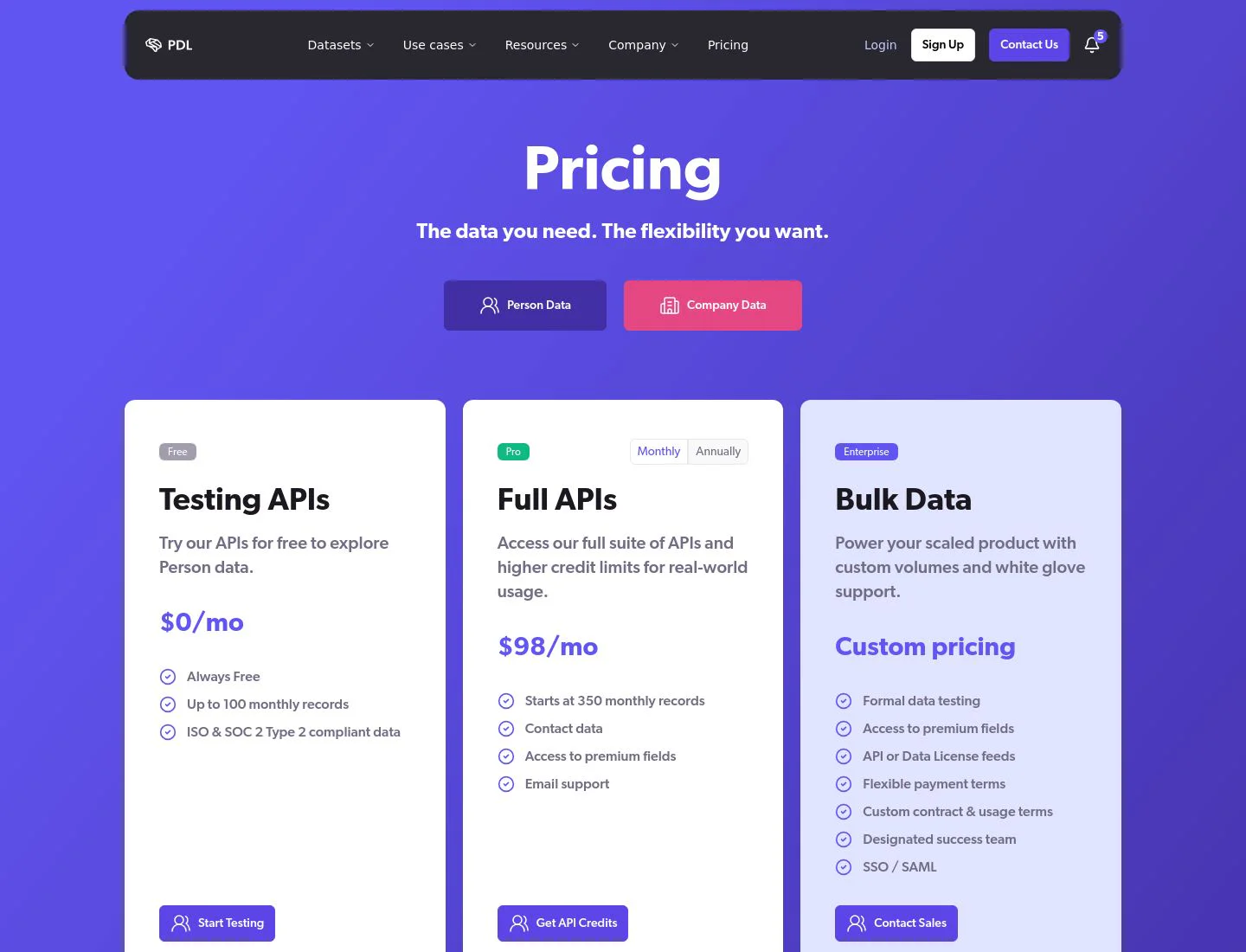
| 9 | People Data Labs | Programmatic CRM enrichment via API | Free, from $98/mo | 4.6/5 |
| 10 | Datagma | Real-time contact enrichment API | From $39/mo | 4.7/5 |
1. Clay
- Best forRevOps and GTM teams that want CRM enrichment and auto-sync keeping Salesforce and HubSpot fresh across 200+ sources
- PricingFree plan, then Launch ($185/mo), Growth ($495/mo), and custom Enterprise
- What we likeCRM enrichment with auto-sync that keeps records fresh across 200+ data sources, not a one-time fill
Full disclosure: Clay is our product, and we put it first. Keeping a CRM enriched and current is one of the most common things teams build on Clay. Here's what it does well and where it doesn't fit.
Clay treats your CRM as something to keep alive, not fill once. It enriches records directly in Salesforce and HubSpot and re-runs as data changes, so a job-switcher gets caught instead of going stale. Under each field, a waterfall runs 200+ data providers in sequence and stops at the first verified hit, so coverage beats any single connector. Signals watch for job changes, funding, and hiring, and trigger a re-enrichment when a record moves. Claygent, an AI research agent, fills fields a fixed data vendor never could, like whether an account runs the category you sell into. Matching on record ID means updates land on the right row instead of spawning duplicates.
Enrich your CRM against 200+ sources
Run a waterfall on your own Salesforce or HubSpot records and see the fill rate, free.
What we like about Clay
- Enriches records inside Salesforce and HubSpot and re-runs as data changes, so the CRM stays fresh on its own
- Waterfall across 200+ providers, so you pay once per record for the best available field
- Signals trigger a re-enrichment when a contact changes jobs or an account raises funding
- Claygent researches context no fixed CRM field can hold
- Matching on record ID writes updates to the right row instead of creating duplicates
Where Clay could be better
- You build the enrichment table and sync mapping yourself; there's no one-toggle native "enrich my CRM" switch
- Getting provider order, field mapping, and refresh cadence dialed in takes some setup before the CRM runs clean
- Data Credits are usage-based, so a full-base refresh across a large org needs a spend check first
Why choose Clay? Native tools enrich a record once from a single source. Clay rebuilds it from 200+ sources and re-runs as the record ages.
Proof. Sana lifted CRM accuracy 60% across 150,000 accounts on Clay.
Clay pricing
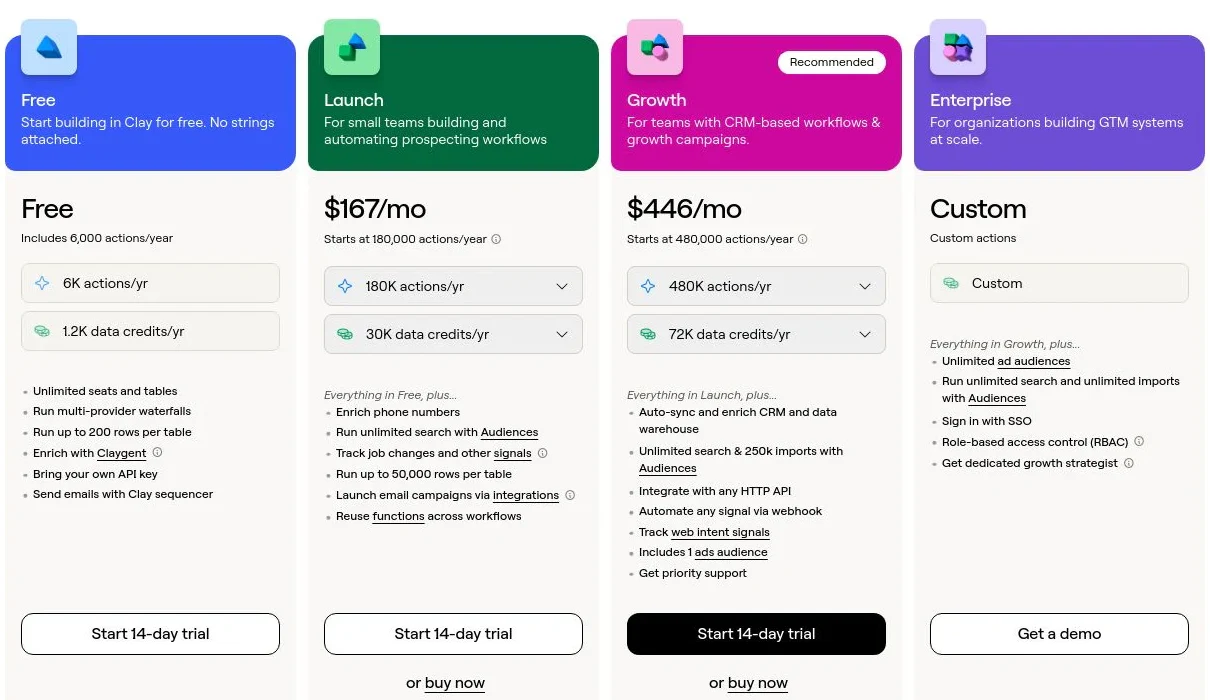
- Free: $0/mo with 100 Data Credits, 500 Actions, unlimited seats and tables, multi-provider waterfalls, and Claygent
- Launch: from $185/mo with 2,500 Data Credits, 15,000 Actions, phone enrichment, and signal tracking
- Growth: from $495/mo with 6,000 Data Credits, 40,000 Actions, and CRM auto-sync
- Enterprise: custom pricing on an annual commitment with 100,000+ Data Credits, unlimited Audiences, API access, SSO, and RBAC
Data Credits pay for the data itself and roll over; Actions pay for the platform work and reset monthly. Bring your own API keys and you skip Data Credits entirely. See Clay's pricing page for the full breakdown.
Clay reviews
- G2: 4.6/5 from 200+ reviews (G2)
2. Apollo.io
- Best forSMB and mid-market teams that want CRM enrichment and outreach in one affordable tool
- Pricingfree plan, then paid tiers from $49/user/mo (annual)
- What we likescheduled CRM enrichment and de-duplication at an accessible price
Apollo pairs a large contact database with CRM enrichment, so the same tool that finds a record can also keep it current. Its enrichment jobs update contact and account fields on a schedule, flag duplicates, and sync both ways with Salesforce and HubSpot. For a small team that wants data hygiene without a separate RevOps platform, the free tier makes it the default first stop.
The all-in-one model carries the usual trade. Record freshness varies by region, deeper CRM automation sits on higher tiers, and coverage is noticeably stronger in North America than elsewhere.
What we like about Apollo.io
- Scheduled enrichment keeps CRM contact and account fields current
- Two-way Salesforce and HubSpot sync with de-duplication
- A genuinely usable free tier to test the data first
- Database, enrichment, and outreach in one product
Where Apollo.io could be better
- Record freshness varies, so a big refresh still needs a verification pass
- Coverage thins outside North America
- The deeper CRM automation lives on higher tiers
Why choose Apollo.io? The best price-to-value option when you want CRM enrichment and outreach without buying two platforms.
Apollo.io pricing
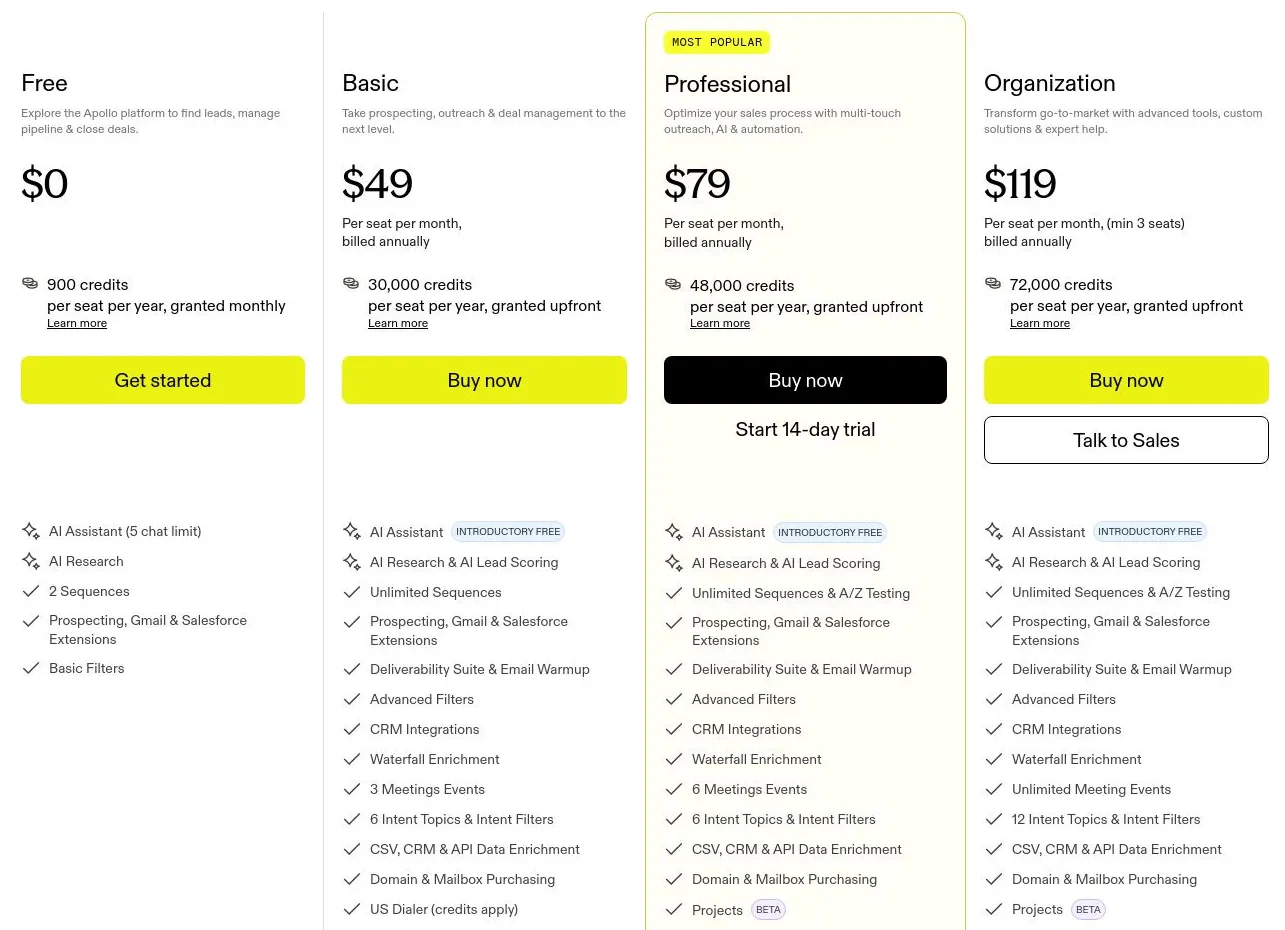
- Free: $0 with limited credits and core enrichment
- Basic: $49/user/mo (annual) with more credits and CRM sync
- Professional: $79/user/mo (annual) with advanced enrichment and higher limits
- Organization: $119/user/mo (annual, 3-seat minimum) with the full feature set
Monthly billing runs higher than the annual rates shown. See Apollo's pricing page for current limits.
Apollo.io reviews
- G2: 4.7/5 from 9,000+ reviews (G2)
3. ZoomInfo
- Best forenterprise teams that need deep CRM data enrichment plus intent and org charts
- Pricingquote-based, annual contracts
- What we likeenterprise-grade enrichment and de-duplication built on one of the largest B2B datasets
ZoomInfo is the depth benchmark for CRM data. Its operations tooling enriches Salesforce and HubSpot records against a store of roughly 14 million companies and 235 million professionals, then layers intent, org charts, and de-duplication on top. For an enterprise RevOps team standing up automated enrichment and routing across a large org, it's the incumbent for a reason.
The cost shows up beyond the invoice. Pricing is premium and quote-based on annual contracts, coverage is uneven by region, and the enrichment and operations modules often price separately from the core seats.
What we like about ZoomInfo
- Enriches CRM records against one of the largest verified B2B datasets
- De-duplication, normalization, and intent in the same platform
- Org charts and WebSights visitor data enrich account records
- Deep, native integrations with major CRMs
Where ZoomInfo could be better
- Premium, quote-based pricing on annual contracts
- Accuracy is strongest in North America and thins in parts of EMEA
- Enrichment and operations modules can price on top of core seats
Why choose ZoomInfo? Uniquely good at enterprise-scale CRM enrichment and intent in a single platform.
ZoomInfo pricing
ZoomInfo doesn't publish prices. Plans (commonly Professional, Advanced, and Elite) are quote-based and sold on annual contracts, priced by seats, credits, and the operations modules you add. Third-party pricing analyses put entry-level contracts around $15,000 per year, rising with credits and enrichment add-ons. Get a quote on ZoomInfo's pricing page for your exact configuration.
ZoomInfo reviews
- G2: 4.5/5 from 8,000+ reviews (G2)
4. Cognism
- Best forteams selling into the EU and UK that need phone-verified, compliant CRM enrichment
- Pricingquote-based
- What we likeDiamond Data phone verification and automatic Salesforce enrichment
Cognism is the CRM enrichment choice when your accounts sit in Europe. Its enrichment refreshes Salesforce records automatically, its Diamond Data phone numbers are human-verified rather than modeled, and its GDPR posture is a real differentiator for compliance-sensitive teams. For an EU or UK revenue team, it keeps the fields reps dial and email accurate where US-first tools thin out.
The trade-offs are regional and commercial. It's a premium, quote-based product, and coverage is strongest in the UK, EMEA, and DACH while thinner than the US incumbents stateside.
What we like about Cognism
- Automatic Salesforce enrichment that keeps records current
- Diamond Data phone numbers are human-verified for accuracy
- Deep, compliant EU and UK coverage with a strong GDPR posture
- Intent data to prioritize which enriched accounts to act on
Where Cognism could be better
- Premium, quote-based pricing with no public tiers
- US coverage is thinner than the North American incumbents
- Credit and seat structure needs a sales conversation to size
Why choose Cognism? Wins on phone-verified, compliant EU and UK CRM data where other tools thin out.
Cognism pricing
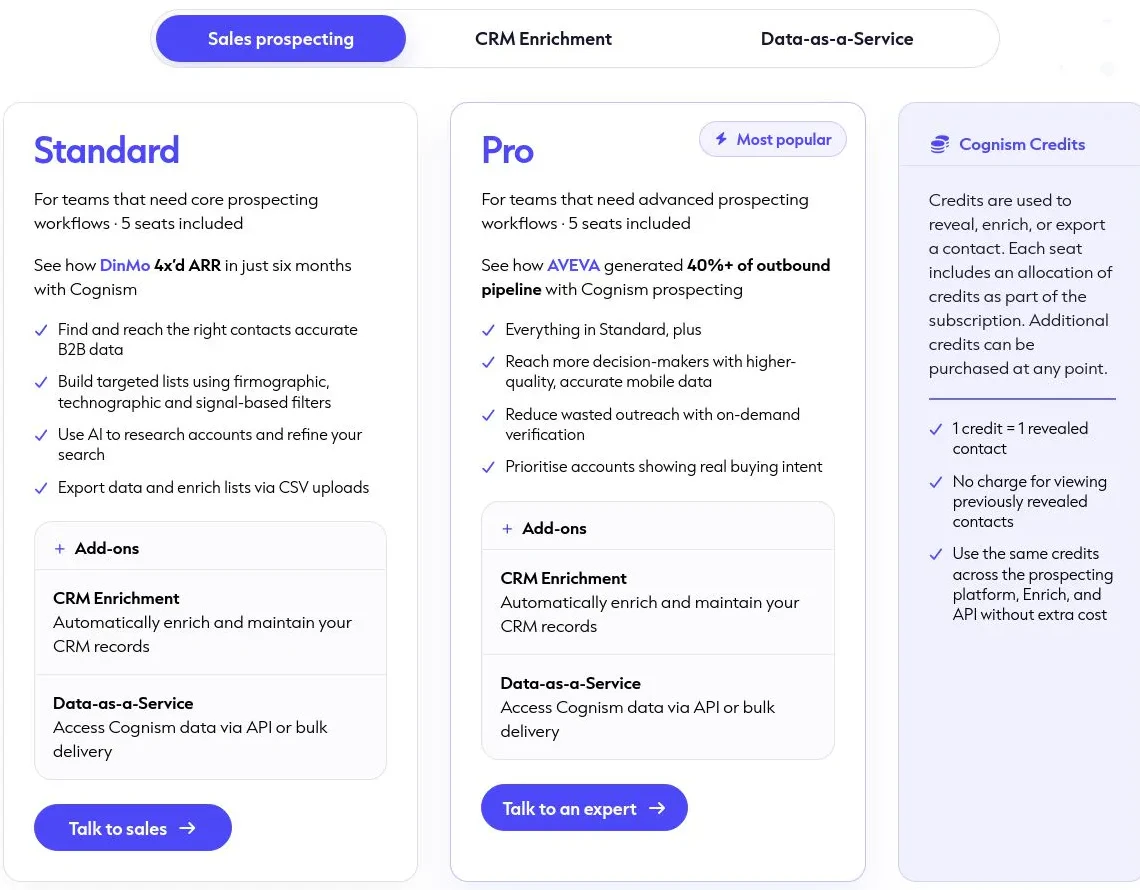
Cognism is quote-based. The pricing page lists Sales Prospecting packages (Standard and Pro) plus a dedicated CRM Enrichment add-on and Data-as-a-Service feeds, all priced through sales. The model is credit-based, where one credit reveals one contact. Talk to Cognism for a quote sized to your region and seats. Start on Cognism's pricing page.
Cognism reviews
- G2: 4.5/5 from 1,300+ reviews (G2)
5. Lusha
- Best forSMB teams that want fast, self-serve CRM enrichment and refresh
- Pricingfree plan (40 credits/mo), then paid tiers
- What we likebulk enrichment and CRM sync with almost no setup
Lusha is the lightest way to keep a CRM current. Its bulk enrichment fills email, phone, and firmographic fields on existing records, and paid tiers add automatic refresh and two-way CRM sync. A rep can enrich a HubSpot list in minutes without waiting on RevOps. For SMB teams that value speed over depth, it's live the same day.
That simplicity sets the ceiling. Credit caps arrive quickly on lower tiers, and the underlying dataset is lighter than the enterprise platforms, so it suits keeping an active book current more than refreshing a whole org.
What we like about Lusha
- Bulk enrichment fills missing fields on existing CRM records
- Automatic refresh and two-way CRM sync on paid tiers
- Chrome extension for one-off record lookups
- Simple enough that a rep needs no training
Where Lusha could be better
- Credit caps arrive quickly on lower tiers
- The dataset is lighter than the enterprise platforms
- Better for an active book than refreshing a whole org
Why choose Lusha? The fastest self-serve way for an SMB team to keep its CRM records current.
Lusha pricing
Lusha offers a free plan with 40 credits per month, then paid Pro, Premium, and Scale tiers that add credits, bulk enrichment, automatic refresh, and CRM sync. The model is credit-based (revealing an email costs one credit, a phone number more). Check Lusha's pricing page for current per-tier rates.
Lusha reviews
- G2: 4.3/5 from 1,600+ reviews (G2)
6. LeadIQ
- Best forrep teams that want to capture contacts into the CRM and keep them clean
- Pricingfree plan, then paid tiers from $200/mo
- What we likeone-click capture into the CRM plus job-change tracking that flags stale records
LeadIQ sits between prospecting and CRM hygiene. Reps capture verified contacts straight into Salesforce or HubSpot from LinkedIn, and LeadIQ enriches the record as it lands, so there's no manual copy-paste. Its job-change tracking watches saved contacts and flags when someone moves, which turns a decaying record into an alert instead of a silent bounce. For rep-led teams, it keeps the pipeline data usable without a separate ops project.
The focus is capture and hygiene, not a full data platform. Credits generally don't roll over, the entry paid tier now starts at $200 a month, and data depth trails the enterprise incumbents.
What we like about LeadIQ
- One-click capture and enrichment straight into Salesforce and HubSpot
- Job-change tracking flags stale contacts before they bounce
- Clean writeback that avoids messy duplicate rows
- Fits the way reps already work in LinkedIn
Where LeadIQ could be better
- Credits generally don't roll over month to month
- The entry paid tier jumps to $200/mo
- Data depth trails the enterprise platforms
Why choose LeadIQ? The pick when reps drive CRM data and you want capture plus job-change hygiene in their workflow.
LeadIQ pricing
- Free: $0/mo with 1 user and 50 credits to test the extension
- Pro: from $200/mo for 200 credits, scaling up a slider to 6,750 credits across up to 5 users
- Enterprise: custom, quote-based pricing
LeadIQ moved to a universal-credit model where credits power emails, phone finds, enrichment, and job tracking; annual billing saves roughly 25%. Credits generally do not roll over. See LeadIQ's pricing page for current rates.
LeadIQ reviews
- G2: 4.2/5 from 1,150+ reviews (G2)
7. Clearbit (HubSpot Breeze Intelligence)
- Best forHubSpot users who want enrichment to happen on the record automatically
- Pricingcredit packs within HubSpot, from $45/mo for 100 credits
- What we likenative HubSpot enrichment on create and form fill, with no integration work
Clearbit, now HubSpot Breeze Intelligence, enriches records in real time right where HubSpot users already work. It fills firmographic and technographic fields when a record is created, shortens forms by enriching a visitor from just an email, and keeps company data fresh automatically. If your stack lives in HubSpot, enrichment happens on the record with no connector to build.
The value is tightly bound to that ecosystem. It's most worthwhile inside HubSpot, runs on credit packs on top of your subscription, and some users report accuracy slipping over time on older records.
What we like about Clearbit
- Native to HubSpot, so enrichment fires on the record automatically
- Real-time enrichment on record creation and form submit
- Firmographic and technographic fields kept fresh without setup
- Website-visitor reveal to spot in-market companies
Where Clearbit could be better
- Most of the value requires living in HubSpot
- Credit-pack pricing on top of a paid HubSpot subscription
- The standalone Clearbit API and free tools were discontinued
- Some users report accuracy slipping on older records
Why choose Clearbit? The default if you live in HubSpot and want enrichment to happen on the record with zero integration.
Clearbit (HubSpot Breeze Intelligence) pricing
Breeze Intelligence is sold as credit packs on top of a paid HubSpot plan. Credits start around $45/mo (annual) for 100 credits and scale up in packs of 1,000 and 10,000. Your true cost depends on your HubSpot tier plus the credit volume you need. See HubSpot's Breeze Intelligence page for current credit-pack pricing. There's no standalone Clearbit plan anymore.
Clearbit (HubSpot Breeze Intelligence) reviews
- G2: 4.4/5 from 600+ reviews (G2)
8. Openprise

- Best forRevOps teams that want CRM data orchestration, dedupe, and enrichment in one no-code platform
- Pricingquote-based
- What we likeit handles the whole data-quality workflow, not just the enrichment step
Openprise is a RevOps data platform built around CRM hygiene. Instead of enriching one field, it orchestrates the whole workflow: dedupe, normalize, match leads to accounts, enrich from your chosen providers, then route the clean record. It's no-code, so an ops team designs rules rather than writing scripts, and it sits across your CRM and marketing automation as the layer that keeps both consistent. For a team where dedupe and routing matter as much as filling a field, it does the unglamorous work well.
It's a platform for RevOps, not individual reps. Pricing is quote-based and enterprise-leaning, and standing up the rules takes real implementation effort before the automation pays off.
What we like about Openprise
- Dedupe, normalize, enrich, match, and route in one no-code platform
- Sits across CRM and marketing automation to keep both consistent
- Bring-your-own-provider enrichment rather than a single locked source
- Consistently top-rated for customer satisfaction and data quality
Where Openprise could be better
- Quote-based, enterprise-leaning pricing with no public tiers
- Built for RevOps teams, not individual reps
- Rules and implementation take setup before the automation pays off
Why choose Openprise? The orchestration layer for CRM data quality when dedupe and routing matter as much as enrichment.
Openprise pricing
Openprise is quote-based. Pricing is sold through sales and scales with the data volume, connected systems, and number of orchestration processes you run, so there are no public self-serve tiers. Contact Openprise for a quote sized to your CRM and stack on its website.
Openprise reviews
- G2: 4.9/5 from 64 reviews (G2)
9. People Data Labs
- Best forteams with engineering that want to build CRM enrichment into their own systems
- Pricingfree plan, then Pro from $98/mo, Enterprise custom
- What we likea large licensed dataset and a clean API to power a custom enrichment pipeline
People Data Labs is the raw material behind a lot of enrichment tools. It licenses a large dataset of person and company records and exposes it through a person, company, and IP enrichment API. Teams with engineering resource use it to build enrichment directly into their own pipelines, feeding a CRM through code rather than a packaged connector. When you want to own the enrichment logic and enrich at scale programmatically, it's a strong foundation.
It's a data API, not a plug-and-play CRM app. There's no native Salesforce or HubSpot enrichment out of the box, so you build the sync, and contact data is gated on lower plans.
What we like about People Data Labs
- Large licensed person and company dataset
- Clean person, company, and IP enrichment APIs
- Bulk enrichment for high-volume, programmatic runs
- You own the enrichment logic and where it writes
Where People Data Labs could be better
- It's an API and dataset, not a native CRM app, so you build the sync
- No out-of-the-box Salesforce or HubSpot connector
- Contact data and premium fields are limited on the free plan
Why choose People Data Labs? The pick when you have engineering and want to build a custom CRM enrichment pipeline on a licensed dataset.
People Data Labs pricing
- Free: $0/mo with up to 100 person and company lookups, minus contact data and premium fields
- Pro: from $98/mo for 350 person enrichment credits and 1,000 company lookups
- Enterprise: custom, with bulk data licensing and volume rates (commonly starting around $2,500/mo)
Most enrichment APIs consume one credit per successful request, and annual billing lowers the per-credit rate. See People Data Labs' pricing page for current plans.
People Data Labs reviews
- G2: 4.6/5 from 16 reviews (G2)
10. Datagma
- Best forteams that want affordable, real-time contact enrichment to feed a CRM workflow
- Pricingfrom $39/mo for 1,000 credits
- What we likestrong mobile-phone enrichment at a low, transparent price
Datagma is a real-time enrichment API with a Chrome extension on top. It enriches a name and company into a verified mobile number and firmographic fields on the fly, and reviewers single out its mobile-phone accuracy as the standout. You plug it into a CRM workflow through the API or a tool like Clay, and its transparent credit pricing makes costs easy to predict. For a small team whose gap is reachable phone data, it's a cheap, focused fix.
It's a young, focused product rather than a full platform. Email accuracy is weaker than its phone data, the database is smaller than the incumbents, and the G2 track record is still thin.
What we like about Datagma
- Strong, real-time mobile-phone enrichment
- Transparent, low credit pricing that's easy to predict
- Chrome extension plus an API for CRM workflows
- Easy, low-commitment starting point
Where Datagma could be better
- Email accuracy is weaker than its phone data
- Smaller database than the enterprise platforms
- Thin G2 track record, so lean on a trial over the score
Why choose Datagma? Affordable, real-time mobile-phone enrichment to plug into a CRM workflow.
Datagma pricing
- Discover: $39/mo for 1,000 credits
- Growth: $99/mo for 5,000 credits
- Business: $249/mo for 20,000 credits
- Enterprise: custom pricing
One credit covers one email and its enrichment; a mobile phone number costs more credits. See Datagma's pricing page for current tiers.
Datagma reviews
- G2: 4.7/5 from 5 reviews (G2)
Which CRM enrichment tool should you choose?
Match the tool to your situation, not the other way around.
- Auto-sync that keeps records fresh from many sources: Clay. It's the only option here that rebuilds each record from 200+ sources and re-runs as it ages.
- All-in-one on a budget: Apollo.io, when you want enrichment and outreach in one tool.
- Enterprise depth and intent: ZoomInfo, if the budget and North American focus fit.
- HubSpot-native, zero setup: Clearbit (Breeze Intelligence).
- Phone-verified, EU/UK compliant: Cognism.
- Rep-led capture and job-change hygiene: LeadIQ.
- Fast SMB refresh: Lusha.
- RevOps dedupe, routing, and orchestration: Openprise.
- A custom pipeline you build yourself: People Data Labs, or Datagma for affordable real-time phone data.
If your CRM is already clean and you just want on-record enrichment inside HubSpot, a native option is the quickest win. If records keep going stale faster than any single connector can catch, stop enriching once and set up a workflow that re-runs.
What is the best free CRM enrichment tool?
If you want to test CRM enrichment without paying, a few tools stand out. Apollo's free tier is the most generous all-in-one, with enrichment, CRM sync, and a starter credit balance. Lusha's free plan (40 credits a month) is the simplest way to refresh a short list of records. People Data Labs offers a free API tier for a developer to prototype an enrichment pipeline.
For custom enrichment that keeps your CRM fresh, Clay's free plan is the one that lets you build a real workflow, run a multi-provider waterfall, and sync against your own Salesforce or HubSpot records before you spend a credit. It shows the fill rate on your actual accounts, not a vendor's demo list.
The catch with every free tier is credits. They're built for testing, not production, so treat them as a way to check accuracy and freshness on your own data before you commit.
Where CRM enrichment is heading
For most of the last decade, CRM enrichment meant running a big cleanup once a quarter and watching the data rot in between. That model is quietly ending. The teams pulling ahead in 2026 don't think of enrichment as a project with a start and end; they treat the CRM as a live system that re-verifies itself as people change jobs and companies move.
Practically, start from where the data actually hurts. If new records land half-empty, on-record enrichment inside your CRM is the fastest fix. If duplicates and routing are the mess, an orchestration layer earns its keep. And if records go stale faster than any one connector can catch, the answer is a workflow that re-runs against many sources, not a bigger single database.
Whatever you shortlist, run it against your own CRM before committing a budget. A vendor's sample always enriches cleanly. Your Salesforce org is the only test that tells you the truth.
Keep your CRM fresh, don't just clean it once
Enrich your own Salesforce or HubSpot records against 200+ sources and watch them stay current, free.
FAQ
What is CRM enrichment and how does it work?
CRM enrichment connects a tool to Salesforce or HubSpot and keeps the records inside complete and current. It fills missing fields, removes duplicates, and standardizes data by matching each record against one or more data sources. The best tools enrich on a trigger, a new record, a form fill, or a scheduled refresh, and re-run as data ages, so the CRM stays fresh instead of decaying between cleanups.
How is CRM enrichment different from a contact database or a data enrichment tool?
A contact database is where you find net-new records to add. A data enrichment tool fills missing fields on a list. CRM enrichment focuses on the records already in your CRM: it keeps them synced, deduped, and fresh over time inside Salesforce or HubSpot, not in a spreadsheet you export once.
How do these tools keep CRM records fresh over time?
The strong ones re-enrich on a schedule or a trigger rather than once at import. Some, like Clay and LeadIQ, watch for job changes and re-run the record when someone moves. Others refresh company and firmographic fields automatically. Without that re-run, any enrichment is a one-time clean that decays as people change jobs.
Which CRM enrichment tools work with Salesforce and HubSpot?
Most on this list do. Clay, Apollo, ZoomInfo, Cognism, Lusha, and LeadIQ sync with both Salesforce and HubSpot; Clearbit (Breeze Intelligence) is native to HubSpot; Openprise orchestrates across both plus marketing automation. Clay also writes enriched records back and re-runs them as data changes. People Data Labs and Datagma are APIs, so you build the sync yourself.
How do these tools handle duplicates in the CRM?
Better tools match on a record ID or key fields so updates land on the existing row instead of creating a new one. Dedupe quality varies: Openprise treats it as a core workflow, ZoomInfo and Apollo include it in their operations tooling, and Clay's record-ID matching writes updates to the right row. Always test dedupe on a sample before a full run.
How is CRM enrichment pricing structured?
Most tools use credits (one credit per enriched or revealed contact) on tiered plans, sometimes with per-seat costs. Enterprise platforms like ZoomInfo, Cognism, and Openprise are quote-based on annual contracts. Usage-based platforms like Clay separate the data cost from the platform cost, and APIs like People Data Labs charge per successful request.
What's the best free CRM enrichment tool?
Apollo's free tier is the most generous all-in-one, with enrichment and CRM sync. Lusha's free plan is the simplest way to refresh a short list. To build custom enrichment that keeps your CRM fresh, Clay's free plan lets you run a multi-provider waterfall and sync against your own Salesforce or HubSpot records before spending a credit.