
Go-to-market teams now win on data, timing, and follow-through. The best ones catch a buying signal, enrich the account, and act on it before a competitor even notices. Most teams still run that motion across five disconnected tools and a lot of copy-paste.
So how do you pick a platform that actually unifies data, signals, and action instead of adding one more silo?
We compared 10 AI go-to-market platforms on how well they bring data, signals, and execution into one place. We ranked them on real G2 adoption, not marketing claims. One pattern held across all of them: a platform is only as smart as the data and signals feeding it.
Here's the shortlist, then a closer look at each one.
What is an AI GTM platform?
An AI go-to-market platform unifies the data, signals, and actions behind a revenue motion in one workspace. Instead of a static CRM or a single database, it pulls firmographics and intent from many sources, scores and routes accounts, and triggers the next play. The best ones do more than surface insight. They orchestrate the whole loop, from finding an account to acting on it, so AI runs the busywork and reps spend their time selling.
The 10 best AI GTM platforms for 2026
| # | Tool | Best for | Pricing from | G2 rating |
|---|---|---|---|---|
| 1 | Clay | Unifying data, signals, and actions | Free, paid from $185/mo | 4.6/5 |
| 2 | Salesforce | AI agents on the CRM of record | From $25/user/mo | 4.4/5 |
| 3 | Apollo.io | All-in-one on a budget | Free, paid from $49/user/mo | 4.7/5 |
| 4 | Clari | Forecasting and pipeline visibility | Quote-based | 4.6/5 |
| 5 | Demandbase | Account-based GTM with intent and ads | Quote-based | 4.4/5 |
| 6 | 6sense | Predicting who is in-market | Free, then quote-based | 4.4/5 |
| 7 | Warmly | Acting on website visitors in real time | Free, paid from ~$900/mo | 4.6/5 |
| 8 | Common Room | Product and community signals | From $2,100/mo | 4.5/5 |
| 9 | Default | Inbound capture and routing | From $750/mo plus per user | 4.6/5 |
| 10 | HubSpot Breeze | AI inside HubSpot | Bundled in HubSpot, plus add-ons | 4.3/5 |
1. Clay

- Best forRevOps and GTM teams that want to unify data, signals, and actions in one orchestration layer
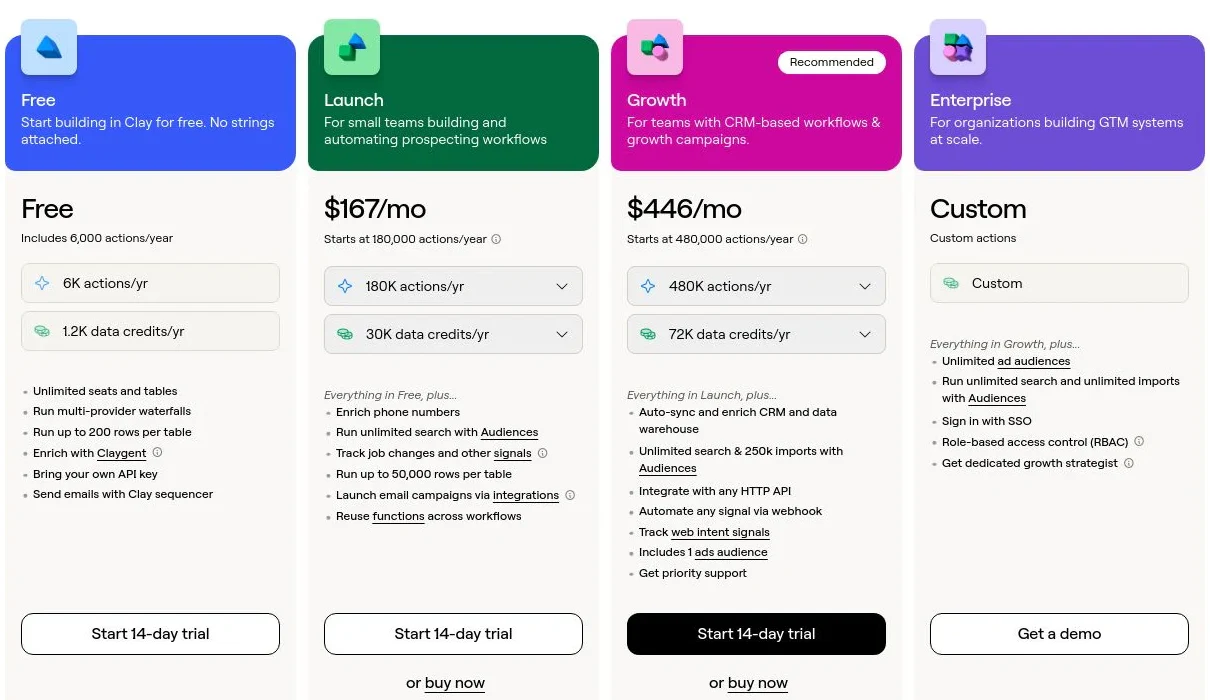
- PricingFree plan, then Launch ($185/mo), Growth ($495/mo), and custom Enterprise
- What we likeGTM orchestration that runs waterfall data, Signals, Claygent, and actions in one workspace
Full disclosure: Clay is our product, and we put it first. It holds a 4.6/5 G2 rating, and running a full GTM motion in one place is what teams build on Clay most. Here's what it does well and where it doesn't fit.
Clay works as the GTM orchestration layer that sits between your data and your actions. It builds the record first, running a waterfall across 200+ data providers, then layers Signals like job changes, funding, and hiring on top. Claygent, an AI research agent, answers questions no fixed field holds, such as whether an account ships a mobile app or names SOC 2 on its careers page. Then Clay acts: it scores accounts, routes them, drafts copy, and syncs the finished record back to Salesforce or HubSpot, re-running as things change.
Run your whole GTM motion in one place
Enrich, score, and act on your own account list in Clay, free.
What we like about Clay
- Waterfall across 200+ providers builds the record before you act on it
- Signals catch job changes, funding, hiring, and web intent as they happen
- Claygent runs AI research that no fixed data field can return
- Scores, routes, sequences, and syncs back to Salesforce and HubSpot from one table
- Audiences runs the same orchestration across millions of records, not just inbound
Where Clay could be better
- You assemble the orchestration yourself; there's no one-click "run my GTM motion" preset
- The building blocks reward a learning curve before the motion runs on its own
- Data Credits are usage-based, so large signal-and-enrichment runs need a spend check
Why choose Clay? Every other platform acts on the data you hand it. Clay builds and orchestrates that data first, then runs the play.
Proof. OpenAI hit 2x data enrichment coverage on Clay, taking match rates from around 40% into the high 80s after moving its GTM data work into one workspace.
Clay pricing
- Free: $0/mo with 100 Data Credits, 500 Actions, unlimited seats and tables, multi-provider waterfalls, and Claygent
- Launch: starting at $185/mo with 2,500 Data Credits, 15,000 Actions, phone enrichment, and signal tracking
- Growth: starting at $495/mo with 6,000 Data Credits, 40,000 Actions, CRM auto-sync, and ads-audience pushes
- Enterprise: custom pricing with an annual commitment, 100,000+ Data Credits, unlimited Audiences, API access, SSO, and RBAC
Data Credits pay for the data itself and roll over; Actions pay for the platform work and reset monthly. Bring your own API keys and you skip Data Credits entirely. See Clay's pricing page for the full breakdown.
Clay reviews
- G2: 4.6/5 from 200+ reviews (G2)
2. Salesforce

- Best forenterprises that want AI agents and unified data built on top of the CRM system of record
- Pricingfrom $25/user/mo, up to $550/user/mo for the Agentforce sales edition
- What we likeAgentforce AI agents and Data Cloud layered onto the most widely used CRM
Salesforce turned its CRM into an AI go-to-market platform with Agentforce and Data Cloud. Agentforce runs autonomous agents that research accounts, draft outreach, and update records. Data Cloud unifies customer data so those agents act on one profile instead of scattered fields. For teams already standardized on Salesforce, the AI layer arrives where the pipeline already lives.
The cost and complexity are the trade-off. The AI editions carry premium per-seat pricing, and Agentforce consumption adds up on top. Getting real value takes admin work and clean data first.
What we like about Salesforce
- Agentforce agents research, draft, and update records inside the CRM
- Data Cloud unifies customer data into one profile for AI to act on
- The system of record most GTM tools already integrate with
- Deep ecosystem of apps, automation, and reporting
Where Salesforce could be better
- Premium per-seat pricing, and the AI editions climb fast
- Agentforce runs on consumption credits that need monitoring
- Real value depends on clean data and admin setup up front
Why choose Salesforce? The default when your GTM motion has to run on the CRM system of record the whole company already uses.
Salesforce pricing
- Starter Suite: $25/user/mo
- Pro Suite: $100/user/mo
- Enterprise: $175/user/mo
- Unlimited: $350/user/mo
- Agentforce 1 Sales: $550/user/mo with the full AI suite
Agentforce add-ons start around $125/user/mo on Enterprise and Unlimited, with consumption-based Flex Credits on top. All paid tiers are billed annually. See Salesforce's pricing page for current editions.

Salesforce reviews
- G2: 4.4/5 from 25,000+ reviews (G2)
3. Apollo.io

- Best forSMB and mid-market teams that want data, signals, and outreach in one affordable platform
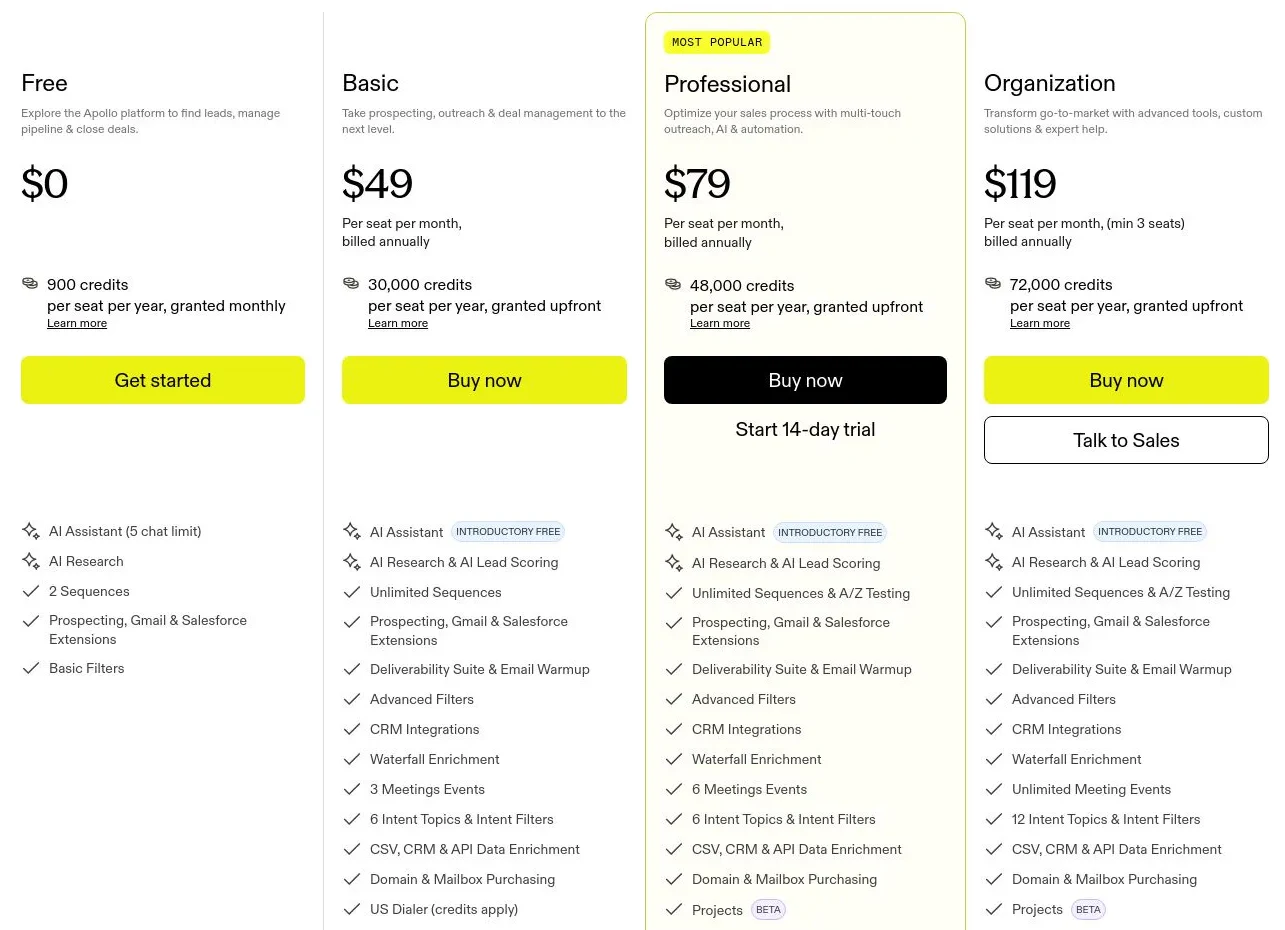
- Pricingfree plan, then paid tiers from $49/user/mo (annual)
- What we likea database, enrichment, signals, and sequencing in one accessible platform
Apollo is building toward an AI-native GTM operating system on top of its large B2B database. It pairs contact and company data with buying signals, AI-assisted sequencing, and account scoring, so a small team can find, prioritize, and reach accounts without stitching tools together. Its March 2026 acquisition of Pocus added signal-based prioritization to that stack.
The breadth is the catch. Data accuracy varies by region, and the newer AI and signal features are still maturing next to specialist platforms. Because Apollo also sends, deliverability rests on your own list hygiene.
What we like about Apollo.io
- Database, enrichment, signals, and sequencing in one platform
- A genuinely usable free tier to start
- Accessible per-seat pricing for smaller teams
- Signal-based prioritization added through the Pocus acquisition
Where Apollo.io could be better
- Data accuracy varies by region, thinner outside North America
- Newer AI and orchestration features still trail the specialists
- Deliverability depends on your own sending discipline since Apollo also sends
Why choose Apollo.io? Best value all-in-one, data plus signals plus outreach without buying three platforms.
Apollo.io pricing
- Free: $0 with limited credits and core prospecting
- Basic: $49/user/mo (annual) with more credits and sequences
- Professional: $79/user/mo (annual) with advanced features and higher limits
- Organization: $119/user/mo (annual, 3-seat minimum) with the full feature set
Monthly billing runs higher than the annual rates shown. See Apollo's pricing page for current limits.
Apollo.io reviews
- G2: 4.7/5 from 9,000+ reviews (G2)
4. Clari
- Best forrevenue teams that want AI forecasting and pipeline visibility across the funnel
- Pricingquote-based, per user on annual contracts
- What we likeAI revenue intelligence that reads pipeline health and predicts the number
Clari approaches GTM from the revenue side. Its platform captures activity across your CRM, email, and calls, then uses AI to forecast the quarter, flag deals going dark, and show where pipeline is leaking. Copilot adds conversation intelligence from recorded calls. For a RevOps or sales leader who lives in the forecast, Clari turns scattered signals into one view of the number.
It is built for forecasting and execution, not net-new sourcing. Pricing is quote-only with platform minimums, and the value shows up once enough of your motion runs through it.
What we like about Clari
- AI forecasting that reads pipeline health across the funnel
- Deal and activity capture without heavy manual logging
- Copilot conversation intelligence from calls
- Strong fit for RevOps and revenue leaders
Where Clari could be better
- Built for forecasting and execution, not net-new prospecting or sourcing
- Quote-only pricing with platform minimums and setup fees
- Value depends on adoption across the whole revenue team
Why choose Clari? The pick when the bottleneck is forecast accuracy and pipeline visibility, not finding new accounts.
Clari pricing
Clari is quote-based with no public self-serve tier. Third-party analyses put the Core platform around $100 to $120 per user per month billed annually, with Copilot and other modules priced separately and setup fees common on larger rollouts. Contact Clari for a quote sized to your team. See Clari's pricing page for current details.
Clari reviews
- G2: 4.6/5 from 5,500+ reviews (G2)
5. Demandbase

- Best forB2B teams running account-based GTM with intent data and advertising
- Pricingquote-based, annual contracts
- What we likean ABM platform that unites account intelligence, intent, and advertising
Demandbase One is an account-based GTM platform. It combines first- and third-party intent, account intelligence, and B2B advertising so marketing and sales work the same target accounts. AI scores accounts by their stage in the buying journey, and the ad platform reaches them across channels. For enterprise ABM, it keeps data, intent, and activation in one place.
It is an enterprise commitment. Pricing is quote-based on annual contracts, onboarding is involved, and value-for-money is where users push back hardest.
What we like about Demandbase
- Unites account intelligence, intent, and B2B advertising
- AI account scoring by buying-journey stage
- One platform for marketing and sales to share target accounts
- Strong fit for structured enterprise ABM
Where Demandbase could be better
- Quote-based pricing on annual contracts, with onboarding cost
- Value-for-money is the most common user complaint
- Overkill for small teams or simple motions
Why choose Demandbase? Wins when account-based marketing, intent, and advertising need to run from one enterprise platform.
Demandbase pricing
Demandbase is quote-based with no free plan or self-serve trial. Third-party pricing analyses put the base platform around $45,000 to $65,000 per year for mid-market teams, rising with modules, advertising, and seats. Contact Demandbase for a quote sized to your program. See Demandbase's pricing page for details.
Demandbase reviews
- G2: 4.4/5 from 1,900+ reviews (G2)
6. 6sense
- Best forteams that want AI to predict which accounts are in-market and when
- Pricingfree plan, then quote-based
- What we likepredictive intent that surfaces accounts before they raise a hand
6sense is built around predictive intent. Its AI reads anonymous buying signals across the web and predicts which accounts are researching, and roughly where they sit in the journey. Sales Copilot then recommends who to contact and what to say. For teams that want to reach buyers before a form fill, 6sense turns dark-funnel signals into a prioritized list.
The strength is prediction, not execution across the whole motion. Real pricing is quote-only and lands in the enterprise range, and the free tier holds intent behind a paywall.
What we like about 6sense
- Predictive AI flags in-market accounts from anonymous signals
- Intent, firmographic, and technographic data in one platform
- Sales Copilot recommends next actions
- Free plan to try company and people search
Where 6sense could be better
- Full intent and prediction sit behind quote-based enterprise pricing
- Best at prediction; execution still leans on your other tools
- Onboarding and data setup take time
Why choose 6sense? The pick when knowing which accounts are in-market, and when, is the edge you're buying.
6sense pricing
6sense offers a free plan with 50 data credits a month and company and people search, but it excludes intent and predictive scoring. Paid plans moved to a single license model that is quote-only. Third-party data from Vendr puts the median buyer around $55,000 a year, scaling past $100,000 for enterprise packages. Contact 6sense for a quote. See 6sense's pricing page for current plans.
6sense reviews
- G2: 4.4/5 from 1,000+ reviews (G2)
7. Warmly

- Best forSMB and mid-market teams that want to act on website visitors in real time
- Pricingfree plan, then paid from about $900/mo (annual)
- What we likereal-time visitor de-anonymization wired straight to action
Warmly is a signals-first GTM platform for smaller teams. It de-anonymizes website visitors, layers intent from Bombora and others, and fires the hot ones into Slack, sequences, or live chat while they are still browsing. AI orchestration decides which visitors are worth a nudge. For a lean team, it turns anonymous traffic into timed outreach without a heavy ABM build.
Its edge is website and intent signals, so coverage depends on traffic and the data behind it. Paid plans jump quickly, and it is not a full database for net-new sourcing.
What we like about Warmly
- Real-time website de-anonymization at the company and contact level
- Intent signals wired to Slack, sequences, and live chat
- AI orchestration prioritizes which visitors to act on
- Fast to set up for a lean team
Where Warmly could be better
- Value scales with your website traffic and intent coverage
- Paid tiers climb quickly beyond the entry plan
- Not a full database for net-new sourcing on its own
Why choose Warmly? Best when your warmest signal is website traffic and you want to act on it the moment it happens.
Warmly pricing
- Free: $0/mo with up to 500 visitors revealed per month and limited intent signals
- Data: from about $900/mo (annual) with more reveals and automation
- Business: from $1,500+/mo (annual) with fuller orchestration
Paid plans are annual, so the minimum commitment runs into five figures a year. See Warmly's pricing page for current tiers.

Warmly reviews
- G2: 4.6/5 from 200+ reviews (G2)
8. Common Room

- Best forteams unifying product, community, and buying signals into one person and account view
- Pricingfrom $2,100/mo (annual), quote-based above
- What we likea signal graph that pulls person-level intent from many sources
Common Room started in community and grew into a signals platform. It stitches product usage, social, community, and web activity into one person and account view, then uses AI (RoomieAI) to identify who is showing intent and route them to the right rep. For product-led and community-led teams, it connects signals that usually live in separate tools.
It is signal aggregation and routing, not a contact database or a sender. Pricing starts high with no free tier now, and it pays off most when you already have rich first-party signals.
What we like about Common Room
- Unifies product, community, social, and web signals per person
- RoomieAI surfaces and summarizes buying intent
- Automatic routing of hot signals to the right rep
- Strong fit for product-led and community-led motions
Where Common Room could be better
- Signal aggregation and routing, not a database or sender
- No free tier now, and entry pricing is high
- Value depends on having rich first-party signals to start
Why choose Common Room? The pick when your best signals are product and community activity that no database captures.
Common Room pricing
Common Room dropped its free and lower tiers in 2026. The Essential plan starts at $2,100/mo billed annually (about $25,200 a year) with 5 seats and set enrichment volumes; Advanced and Enterprise are quote-based. See Common Room's pricing page for current plans.

Common Room reviews
- G2: 4.5/5 from 100+ reviews (G2)
9. Default
- Best forinbound-heavy teams automating lead capture, enrichment, and routing
- Pricingfrom $750/mo plus per user, custom above
- What we likea workflow engine that captures, enriches, and routes inbound in one flow
Default is a GTM workflow engine focused on the inbound motion. It captures form and website leads, enriches them, qualifies with AI, and routes them to the right rep or sequence, with scheduling built in. For teams whose bottleneck is speed-to-lead, it connects capture, enrichment, and routing that usually span several tools.
It is younger than the incumbents, and some users report the AI and routing features still maturing. It shines on inbound orchestration more than net-new sourcing or forecasting.
What we like about Default
- Captures, enriches, qualifies, and routes inbound in one workflow
- Built-in scheduling to cut speed-to-lead
- Connects to Salesforce, HubSpot, and outreach tools
- Visual workflow builder that is quick to adjust
Where Default could be better
- Younger platform; some AI and routing features are still maturing
- Best for inbound orchestration, less so for outbound sourcing
- Per-user cost on top of the platform fee adds up
Why choose Default? Best when speed-to-lead on inbound is the bottleneck and you want capture, enrichment, and routing in one flow.
Default pricing
- Startup: $750/mo plus $45/user/mo (annual) with 1 workflow and 10,000 enrichment credits per year
- Growth: custom plus $45/user/mo with 10 workflows and 20,000 credits per year
- Enterprise: custom with unlimited workflows and credits
A Web Intent add-on runs about $400/mo for 10,000 credits. See Default's pricing page for current tiers.
Default reviews
- G2: 4.6/5 from 60+ reviews (G2)
10. HubSpot Breeze

- Best forHubSpot-anchored teams that want AI built into the CRM they already use
- Pricingbundled into HubSpot Hubs, plus credit-based and outcome-based add-ons
- What we likean AI layer native to HubSpot, so it acts where your data already lives
Breeze is HubSpot's AI layer across marketing, sales, and service. Breeze Copilot answers questions and drafts inside the CRM, Breeze Agents run tasks like prospecting and support, and Breeze Intelligence enriches records and adds buyer intent. For teams already living in HubSpot, the AI arrives on the record with no integration work. As a dedicated product it is new, so its standalone review history is still thin.
The value is tied to HubSpot; standalone, it trails focused enrichment and ABM platforms. Credit and outcome-based pricing can be hard to predict, and some agent outputs still need a human check.
What we like about HubSpot Breeze
- AI native to HubSpot, acting on records already in the CRM
- Copilot, Agents, and Intelligence cover drafting, tasks, and enrichment
- No integration work for HubSpot-anchored teams
- Outcome-based agent pricing means you pay on results
Where HubSpot Breeze could be better
- Most of the value requires living in HubSpot
- Standalone capability trails focused enrichment and ABM tools
- Credit and outcome pricing can be hard to forecast
Why choose HubSpot Breeze? The default if your GTM stack already runs on HubSpot and you want AI on the record.
HubSpot Breeze pricing
Breeze Copilot is bundled into HubSpot Hub subscriptions at no extra list price, so your cost tracks the Hubs and tiers you buy. Breeze Intelligence sells as credits (around $10 per 1,000), and Breeze Agents moved to outcome-based pricing in 2026, for example $0.50 per resolved conversation and $1.00 per qualified lead. See HubSpot's pricing page for current Hub and Breeze rates.

HubSpot Breeze reviews
- G2: 4.3/5 from 3 reviews (G2)
Which AI GTM platform should you choose?
Match the platform to your motion, not the other way around.
- Unify data, signals, and actions in one orchestration layer: Clay. The only one here that builds and orchestrates the data before it acts.
- Run AI agents on the CRM system of record: Salesforce, if you are already standardized on it.
- All-in-one on a budget: Apollo.io, for data, signals, and outreach in one place.
- Forecasting and pipeline visibility: Clari.
- Account-based marketing with intent and ads: Demandbase.
- Predict who is in-market: 6sense.
- Act on website visitors in real time: Warmly.
- Product- and community-led signals: Common Room.
- Inbound capture and routing: Default.
- AI inside HubSpot: HubSpot Breeze.
If your data and signals are already unified and clean, a native AI layer is the fastest win. If your real problem is scattered data and signals no single tool captures, build the orchestration layer first, because no agent can act on a motion you haven't connected.
What is the best free AI GTM platform?
A few platforms let you start without paying. Apollo's free tier is the most generous all-in-one, with a database, enrichment, and a few sequences to try a motion end to end. 6sense offers a free plan for company and people search, though it holds intent behind paid tiers. Warmly's free plan reveals up to 500 website visitors a month.
For orchestration, Clay's free plan is the one that lets you build a real GTM motion, run a waterfall, add Signals, and use Claygent against your own accounts before you spend a credit. It's the best way to see the motion run on your actual pipeline, not a vendor's demo.
Every free tier is built for testing, not production, so use them to check fit on your own data before you choose.
Where AI GTM platforms are heading
The GTM stack is collapsing. For years teams bought a database, an intent tool, a routing tool, and a sequencer, then paid people to move data between them. AI is folding those layers into one motion, where an agent enriches an account, reads the signal, and acts without a human relay. The platforms pulling ahead in 2026 are the ones that orchestrate the whole loop, not the ones with the biggest single database.
Practically, start from your bottleneck rather than the brand. If reps can't see which accounts to work, a native AI layer on your CRM is the quick win. If the real gap is data and signals scattered across tools that never talk, build the orchestration layer first, because no agent can run a motion you haven't connected.
Whatever you shortlist, run it against your own accounts before you commit a budget. A demo always looks orchestrated. Your pipeline is the only test that tells the truth.
Orchestrate your GTM motion in one place
Start free, connect data, signals, and actions on your own accounts, and watch the motion run before you pay.
FAQ
What is an AI GTM platform?
An AI go-to-market platform unifies the data, signals, and actions behind a revenue motion in one place. It pulls firmographic and intent data from many sources, uses AI to score and research accounts, and then acts by routing, sequencing, or syncing to your CRM. The goal is to run the whole loop, from finding an account to acting on it, instead of moving data between separate tools.
How is an AI GTM platform different from a CRM?
A CRM is the system of record where deals and contacts live. An AI GTM platform sits around or on top of it, bringing in outside data and signals, deciding what to do next, and taking action. Some platforms, like Salesforce with Agentforce or HubSpot with Breeze, add that AI layer to the CRM directly. Others, like Clay, orchestrate across whatever CRM you already run.
What should an AI GTM platform actually automate?
The busywork between a signal and an action: enriching an account, scoring it, researching context, drafting outreach, and routing it to the right rep or sequence. The best platforms automate the full handoff so a buying signal becomes a next step without a person copying data between tabs. Reps keep the judgment and the conversations.
Do these platforms replace my sales team or my CRM?
No. They remove manual data work and speed up the motion, but reps still own the relationships and the close. Most work alongside your CRM rather than replacing it; Clay, Apollo, 6sense, and Demandbase all sync to Salesforce and HubSpot. Think of the platform as the layer that feeds and orchestrates the CRM, not a substitute for it.
How is pricing usually structured?
It varies widely. All-in-one tools like Apollo use per-seat tiers with credits. Enterprise platforms like Clari, 6sense, and Demandbase are quote-based on annual contracts. Orchestration platforms like Clay separate the data cost from the platform cost so you pay for usage. HubSpot Breeze bundles some AI into Hub subscriptions and sells agents and enrichment as add-ons.
Do AI GTM platforms integrate with Salesforce and HubSpot?
Most do. Salesforce and HubSpot are AI GTM platforms in their own right through Agentforce and Breeze. Clay, Apollo, 6sense, Demandbase, Warmly, Common Room, and Default all connect to one or both, and Clay also writes enriched records back and re-runs them as data changes. Check that the platform syncs the fields and signals your motion depends on.
Which AI GTM platform is best for a small team on a budget?
For an all-in-one, Apollo's free and low tiers are hard to beat for data, signals, and outreach in one place. Warmly is a good pick if website visitors are your warmest signal. And if you want to grow into full orchestration without paying up front, Clay's free plan lets you build and test a real GTM motion on your own accounts before spending a credit.