





































.avif)








Put an expert agent on every account.
Account Agents reason over your GTM data layer, decide the next best action, and remember what they learned — so every play starts from the full account context.
How Account Agents work
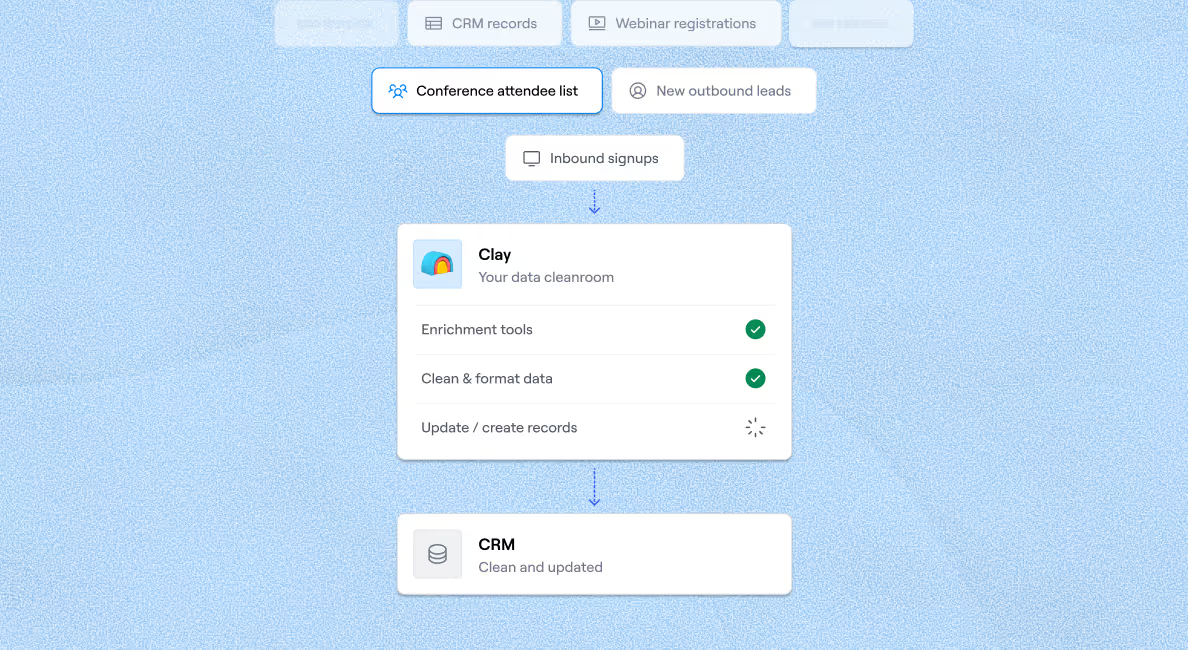
Account Agents run in a loop — every conclusion is written back to the account, so the next run starts where the last one left off.
A dedicated expert on every account
Synthesize new account information from your CRM, warehouse, Gong calls, and other signals in Audiences. Build on what the agent concluded last time, so intelligence compounds over time.
Close the gap between insight and action
Trigger a play the moment a signal fires, a lead lands, or a deal stage changes. The agent decides the next best action, whether it’s branching, enriching, or sending a Slack message — choosing only from the actions you allow.
Visibility into agent reasoning
Inspect your agent’s reasoning as it crawls over data sources and decides the best action to take. Track spend and errors per agent and per segment across your whole book.
FAQs about agents in Clay
How are Account Agents different from general-purpose Claygents?
When you build a Claygent, you choose the type that fits the job. This includes:
- General purpose Claygents that run in Tables and Workflows
- Account Agents that run in Audiences and Workflows across every account in a segment
Account Agents run over Audiences in Clay and have the added benefit of:
- Unlocking high-volume plays: No cell size or row limits in Audiences. Context, scheduling, and enrichment come pre-configured, so you can run plays like outbound expansion or closed-lost analysis without rebuilding a pipeline for every new question.
- Improving with every run: Claygents in tables start fresh every run. Account Agents’ context lives in Audiences, so intelligence builds account by account instead of resetting each pull.
What are the main use cases for Account Agents?
Because they run over Audiences, Account Agents are built for plays that need full account context at scale. GTM plays we see people use Account Agents for include:
- Expansion plays that surface high-usage customers ready for an upsell, so reps work the accounts most likely to grow
- Inbound and signal routing so every form fill, funding event, or usage spike is worked with the account's full history behind it
- Closed-lost revival that re-engages lost accounts on a synthesized record of why they were lost, months after the fact
- Scoring and account health built on full account state — deal history, product usage, support relationships, prior agent conclusions — not just the few firmographic fields that are cheap to encode
How do I know which Claygent to use?
Here’s some quick rules of thumb of when to use a general-purpose Claygent vs. an Account Agent:
How much do Account Agents in Clay cost?
Account Agents (in beta) are available for Enterprise, Growth, and Launch plans only. Customers are charged on the actual complexity and token usage of their requests. There are two components to the pricing:
- Data credits: Variable pricing
- Action: 1 action per record processed by the agent
Exports to the CRM or data warehouse have no additional charge.