





















.avif)













.avif)










"I don't know if we would have been able to grow so quickly without Clay. It’s the core of our GTM stack. It's amazing, and we're only just beginning." Stuart Lundberg, Head of Operations
Pump helps companies reduce cloud infrastructure costs, using group buying and AI to optimize cloud costs. Used by over 2,000 customers, Pump delivers automatic savings on AWS, Google Cloud, and Azure spend without requiring engineering work or commitment changes.
Cloud Cost Optimization
San Francisco, CA
When Stuart Lundberg joined Pump as Head of Operations two years ago, leadership set the aggressive growth mandate to scale from 50 customers to thousands, build a quota-carrying sales organization from scratch, and shift from an inbound-only to outbound-first GTM motion.
It quickly became clear to Stuart that sending sales reps into a very broad TAM without systematic targeting wasn't going to get them to their growth goal.
Early sales hires indicated that new reps spent up to 12 weeks independently figuring out how to prioritize and outreach their accounts. Multiply that across rapid headcount growth and Pump would be scaling inefficiency alongside revenue.
Beyond the targeting problem, Pump's early outbound attempts weren't converting. Generic cold emails fell flat because they failed the technical credibility test with their technical buyers.
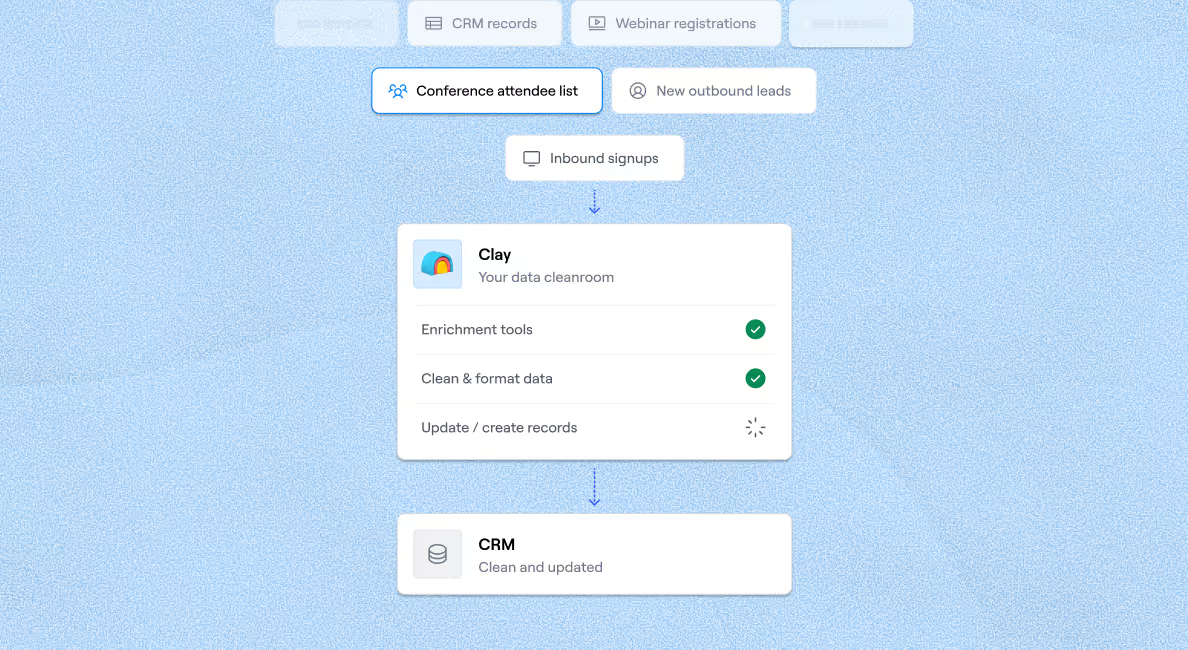
Pump needed infrastructure that could identify technical details about their accounts at scale, enable rapid personalization, and give new reps clear targeting from day one. They started with Clay for basic enrichment, but quickly realized it could power their entire GTM engine.
Automated ICP research enables new sales reps to ramp in less than 2 weeks
When you hire quota-carrying sales reps into a massive TAM, their productivity clock starts immediately. But if they don't know who to target, they'll spend their first 90 days learning through expensive trial and error. For Pump, scaling from 0 to 30+ sales reps, this was mathematically unsustainable.
Pump used Clay to codify their ICP criteria and automatically identify companies who matched the tech stack profile, then enriching the account using the 150+ data sources available. New reps received pre-built territory lists showing exactly who to pursue, complete with stakeholder contacts and context. Instead of spending weeks figuring out who are Pump's customers, new reps were revenue-generating 6x faster than before Clay.
New reps went from 90 to just 14 days to reach full productivity using Clay-enriched target account lists. This allowed Pump to ramp the 30 sales reps needed to hit their quarter-over-quarter revenue targets.
And because reps no longer need to do their own research they now carry a higher quota, generating 25% more revenue per rep.
"We've completely eliminated the problem of reps wasting time on account research. With Clay, each rep gets an up-to-date list with their target accounts, key contacts, and account context."
Stuart Lundberg, Head of Operations
Now, sales leadership have perfect visibility into territory and account coverage. The GTM engineering team avoids constant ad-hoc list requests from reps building their own territories. And critically, this foundation set up their next evolution: moving to an outbound-first GTM motion.
Account enrichment gives outbound +30% conversion lift
With target lists defined, Stuart now focused his attention on improving meeting booking rates. He had the data to show that generic outbound wasn't delivering the rates their growth targets required. When you're selling cloud cost optimization, your prospect's cloud provider is the entire context for whether your message makes sense. A DevOps engineer using AWS thinks in EC2 instances and RDS databases. Send them an email mentioning Google Cloud Run and you've immediately signaled you don't understand their environment.
Pump used Clay to built dynamic messaging templates that referenced provider-specific services. AWS customers received outreach mentioning EC2, RDS, and S3. Google Cloud customers saw references to Cloud Run and GCP terminology.
The team then stacked additional context layers: hiring signals triggered timely outreach, location data routed prospects to regional reps, and AI-generated copy combined all these signals into natural-sounding messages.
Response rates increased 25% after implementing cloud provider personalization alone. Overall outbound lead to meeting conversion improved 20-30%. Signal-based campaigns achieved 5%+ reply rates versus sub-2% industry baselines.
"The technographic data was the mission-critical unlock to make outbound at scale even possible," Stuart said. "We cultivated very tailored copy based on cloud providers and when engineering and finance teams were growing, which led to a 25% better response rate. The biggest gains came from being able to rapidly test and iterate. Clay allowed us to quickly create really precise and large lists. We moved from generic outbound to highly relevant outreach, which directly translated into more qualified conversations and more closed-won deals."
Automated workflow recovers 26% of meeting no-shows
With personalized outbound converting at higher rates, Stuart was able to go down the sales funnel to improve meeting no-show follow up. One of their top AEs had developed a manual recovery process, taking lead context and company details into ChatGPT to craft personalized follow-up emails. It worked well, generating high reschedule rates, but it was time-consuming, fragmented, and only one person was doing it.
Stuart saw an opportunity to replicate what their best reps do manually and automate it for everyone.
The GTM team reverse-engineered the workflow and automated it in Clay. After a no-show occurs, Clay enriches the lead's company, pulls recent hiring activity and growth signals, then generates a personalized follow-up email explaining why now is the right time to reconsider Pump. BDRs simultaneously receive a prioritized call list with full context on each no-show, replacing generic "they didn't show up" notifications with enriched profiles explaining why each prospect matters.
With this automated workflow, they saw a no-show recovery rate of 23-26% with zero marginal time investment per lead. The process that one rep spent 20 minutes executing manually now happens automatically at scale.
"Clay has helped us scale the impact of RevOps alongside our revenue."
Stuart Lundberg, Head of Operations
This pattern of capturing what top performers do manually and systematizing it proved that tribal knowledge doesn't have to stay in one person’s head. Clay provided the infrastructure to codify best practices and distribute them across the team.
Building GTM infrastructure that scales at startup velocity
Before Clay, scaling Pump's sales team created an impossible trade-off. To support 30+ quota-carrying reps with personalized outbound at scale, the GTM team would need to hire a massive list-building and research operation, destroying unit economics before proving the model. The alternative was accepting generic outbound with its sub-2% conversion rates, which wouldn't support the aggressive growth mandate leadership had set.
Clay eliminated that trade-off. The GTM engineering team now operates with just three people supporting 30+ quota-carrying reps. A ratio only possible because Clay handles enrichment, personalization, and workflow automation.
This allowed Pump to scale from $1M to $25M in 18-months using Clay as their GTM foundation.
"I don't know if we would have been able to grow so quickly without Clay. It's the core of our GTM stack. It's amazing, and we're only just beginning."
Stuart Lundberg, Head of Operations
The efficiency gains spread across the organization. Leadership gained clear TAM visibility for fundraising and growth planning. Engineering reclaimed time previously spent on GTM tooling. Sales stopped debating ICP fit and started executing against centrally-defined criteria. What used to require cross-functional alignment and custom development now happens in days through Clay workflows.
"Clay has saved our sales team, our engineering team, and our leadership team an immense amount of time," Stuart explained. "As we scale, it's how we stay focused."












.svg)