



































.avif)










“When your product has thousands of use cases across many target industries, the GTM complexity is enormous. Clay gives our lean team the intelligence and orchestration to be precise in how we approach every account.” Tim Bourcier, RevOps, Marketing Lead
Merge is the leading provider of agentic tools and customer-facing integrations for the largest banks (U.S. Bank, Mastercard, JPMorgan Chase), AI companies (OpenAI, Perplexity, Dropbox), HR technology providers (BambooHR, Carta), and more.
AI Infrastructure
San Francisco, CA
Tailoring your positioning for one product takes enormous effort. But when your product includes thousands of integrations and an equal number of use cases, the GTM complexity becomes overwhelming.
Merge Unified sells eight categories of customer-facing integrations (with more categories being added constantly) into every B2B industry, from fintech to frontier AI . Prospects require different positioning for how Merge can work for them based on use cases relevant to their business needs. This complexity was further amplified with the launch of Merge Agent Handler, as any company can use it to connect their agents with enterprise-grade MCP servers.
"The depth and the breadth of our use cases are just so wide across industries," Tim Bourcier, RevOps, Marketing Lead, explains. "It's very hard to make sure that we are approaching each account in the right way."
Covering that surface area fell to a lean team of four people in RevOps and five in marketing, with Tim straddling both teams. His mandate was to support sales, marketing, and customer success simultaneously. He needed to equip reps with account intelligence, scale high-ROI marketing activities, and give CSMs the signals they needed for renewal and expansion conversations.
The data to do all of this existed across Salesforce, Gong, spreadsheets, and a handful of other tools. But it lived in silos. "We have very established systems, a lot of data points, a lot of knowledge," Tim says. "But how do we make this accessible to the people who are actually using it?"
Tim started building AI agents in Clay to close the gap between what the team knew and what they could act on, starting with the accounts that mattered most.
Map the enterprise TAM, automatically inform reps when and how to engage
Merge's first challenge was knowing which accounts to prioritize in the first place. Merge Unified is a horizontal product serving virtually every B2B SaaS company, so the universe of potential customers is enormous. Each account could need any combination of Merge's eight integration categories depending on their tech stack and roadmap.
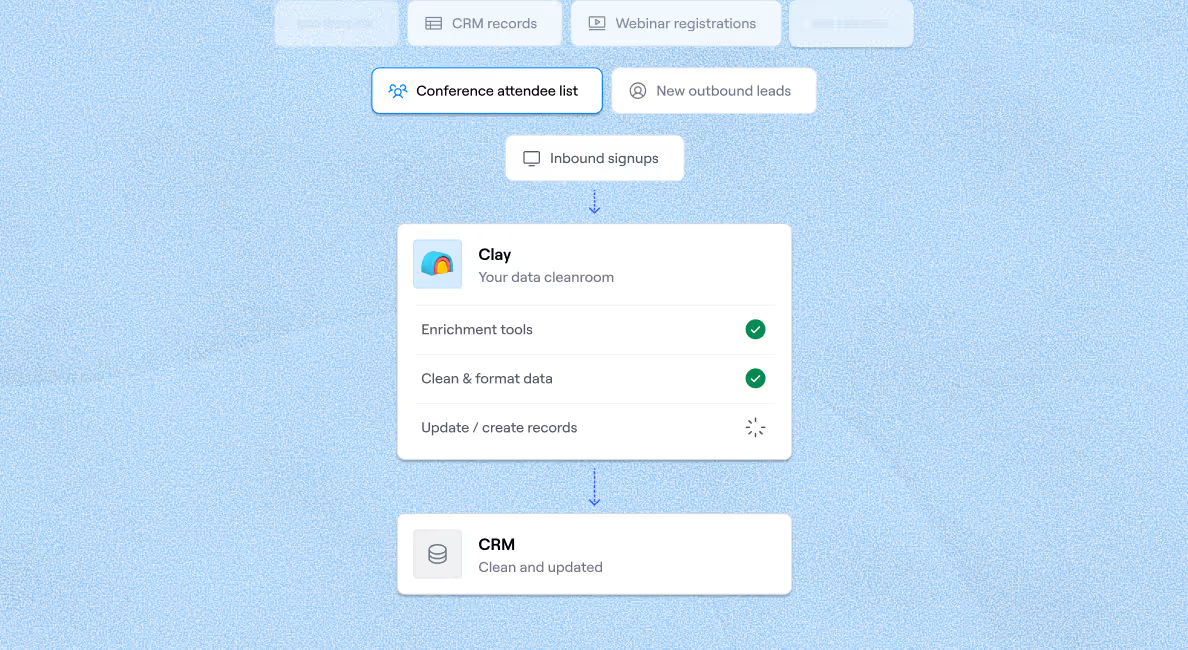
The team used Clay to enrich and categorize over 50,000 accounts in Salesforce, automatically tagging each with industry, sub-industry, and a suggested Merge use case tailored to that specific company. Instead of reps researching each account to figure out the right angle, the data was already there.
SDRs got 10+ hours back every week, and response rates climbed 20% because outreach was tailored from the first touch.
But a categorized TAM is a snapshot. Enterprise accounts at Merge's scale are living targets. When a company that needed CRM integrations last quarter launches a new product this quarter, it opens up an entirely different use case Merge can offer. Reps couldn't afford to pitch last month's positioning to this month's reality.
Tim built a separate Clay agent that follows over 1,500 enterprise accounts on a weekly cadence, scanning for new product launches, feature releases, partnerships, and organizational changes. Data not found in traditional enrichment datasets.
When the agent detects a relevant update, it surfaces an alert to the account owner with the context and a drafted email ready to send, recommending the relevant product-line and use case.
"We use Clay to follow all of our key accounts, looking for any relevant updates, new products, new features, new announcements, and feed this directly to the go-to-market team with suggested wording for them to outreach"
Tim Bourcier, RevOps, Marketing Lead
The enrichment layer tells reps what to say. The signal layer tells them when to say it. Together, Merge has seen a 15% increase in enterprise meetings booked driven by outreach that's consistently tailored to what each account actually needs right now.
With enterprise prospecting running on current intelligence, Tim turned the same approach inward by applying Clay's AI agents to the customers Merge already had.
Turn 1st & 3rd-party data into customer intelligence, driving 10% retention and expansion lift
Merge's customer success team carries renewal and upsell quotas. Knowing which customers are ready to expand (and which are at risk) requires synthesizing signals that no single tool can surface alone.
Tim connected Clay to Gong and Salesforce, then built agents that analyze call transcripts from QBRs alongside product usage data. The agents assess tone, extract product requests and frustrations, track adoption metrics by API category, and flag patterns that indicate churn risk or expansion readiness.
"We analyze feedback that was given during QBRs," Tim says. "From there we can identify potential churn risks or potential adoption and upsell for certain customers."
The agent also looks at trends by segment and by product, giving the team a portfolio-level view of the health of their customers and where to focus.
CSMs now walk into renewal and expansion conversations already knowing the customer's trajectory. They know whether adoption meets Merge's internal benchmarks, which new integration categories the customer has been asking about, and whether recent calls carried a frustrated or enthusiastic tone. The same intelligence feeds Merge's product team, giving them structured customer feedback that previously lived only in call recordings no one had time to review. This automated analysis now saves the CS team 5 hours per week per rep that was previously spent manually reviewing transcripts and piecing together account health from scattered data points.
“Not only is the team better prepared for our QBRs but we’re also more proactive,” Tim shares. “Alerts get triggered based on the agent’s sentiment, we build stronger partnerships and can automatically create tickets and product requests to improve the customer experience.”
“Our enterprise retention and expansion rates have seen a significant 10% increase since implementing this Clay workflow.”
Sales and CS were now equipped with automated intelligence. The last piece was giving marketing the same infrastructure to scale their biggest investment: events.
Scale high-ROI marketing activities and improve cost-to-pipeline ratio 2.5x
Merge invests heavily in events, accounting for 20-25% of pipeline generated each quarter. But the team has only one person dedicated to events full-time, which means every activation needs to prove strong ROI. Merge can't afford to sponsor the wrong events, miss leads on the ground, or lose attribution after the fact.
The team built three connected workflows in Clay that cover the full event lifecycle.
Pre-Event: The first is an agent that sources and scores upcoming events against Merge's criteria: location, speaker quality, topic relevance, and audience fit. It scrapes event platforms, evaluates each opportunity, and recommends which ones deserve Merge's sponsorship budget. "The agent has the knowledge of what kind of events Merge likes to partner on or host," Tim explains. "It surfaces them to the team with justification and estimated impact so we can strategize which we want to invest in."
The result is a more selective events calendar. Merge now sponsors fewer but better events, allocating resources strategically and improving their event ROI.
Event Prep: The third workflow briefs Merge employees before VIP dinners and high-touch activations, pulling attendee roles, their company's products, existing integrations, and which Merge solutions are most relevant. Reps show up knowing exactly what to talk about.
During Event: The second workflow captures leads that would otherwise disappear. At in-person events, Merge employees who meet prospects outside the booth (no badge scan, no demo request) simply drop the person's name and company into a Slack channel. Clay picks up the message, enriches the contact, checks whether they exist in Salesforce, creates a record if they don't, scores them against Merge's ICP, and adds them to the appropriate campaign for follow-up. What used to be a hallway conversation with no follow-up now enters the system within minutes.
"We'd miss at least 50% of the deals sourced from events if it weren't for Clay."
Together, these workflows give a one-person events team the intelligence and attribution infrastructure that larger teams build with dedicated headcount. Merge's cost-to-pipeline ratio for in-person events started around 2x and is tracking toward 5x. A direct result of being more selective about which events to sponsor and actioning every lead that comes out of them.
A small team building GTM systems that compound
Eight months ago, Tim would have described Clay as a smart spreadsheet. He doesn't anymore.
"I have data in Salesforce, transcripts in Gong, leads coming through Slack. With Clay I can connect all of it, add a layer of AI, and build a system driving real impact for the team in 10 minutes," he says. "That used to take days, if not more."
What Merge built is a system where each layer feeds the next. Enterprise account intelligence sharpens outbound, which generates pipeline. Customer health signals surface expansion opportunities, which drive net revenue retention. Event attribution justifies marketing spend, which funds the next round of activations.
"We have to be very lean and make sure that everything we work on is scalable," Tim says. "Clay makes us a lot smarter and a lot faster. Across the board, we just work better."
Every workflow compounds because they all write back to the same data infrastructure.
This leverage allows a lean RevOps team to influence revenue across sales, CS, and marketing simultaneously, with data systems that get smarter with every cycle.












.svg)