




























.avif)









"Clay is our GTM signals orchestration engine. It's the infrastructure that lets a small team like depthfirst go-to-market like a much bigger one." – Mark Hardy, Head of Revenue Operations
depthfirst is an AI-native application security company that helps security teams autonomously detect, triage, and remediate critical code vulnerabilities to secure software at machine speed.
Cybersecurity
San Francisco, CA
When Mark Hardy joined depthfirst as Head of Revenue Operations, the company had strong product-market fit, early enterprise traction, and a growing roster of customers in financial services, software, and manufacturing. What they didn't have was the GTM infrastructure to match the pace of product development.
During his interviews, leadership asked what tools he'd need to build depthfirst’s GTM tech stack from scratch. "The primary tool I wanted was Clay," Mark explained. "With Clay, I built our initial ICP and the rest of our tech stack followed. CRM, call intelligence, and an outreach sequencer are important, but if we couldn’t identify who our top buyer personas were first and what messaging would resonate with them, then none of those other tools would have an impact." Clay was the data foundation and orchestration layer that everything else would be built on to enable depthfirst to go from signal to pipeline to revenue in short order.
Selling application security into enterprise accounts comes with a specific set of constraints. CISOs and security leaders are cautious buyers. Their email filters screen outreach. Links get inspected. Cold email in isolation barely registers. Mark needed a system where outbound, signals, and marketing activation all reinforced each other. Not three separate channels, but one coordinated motion.
Cleaning the data layer before building on top of it
Mark starts with a principle he comes back to often: garbage in, garbage out. Before layering on signals, scoring, or campaign activation, the underlying account and contact data needed to be accurate, current, and complete.
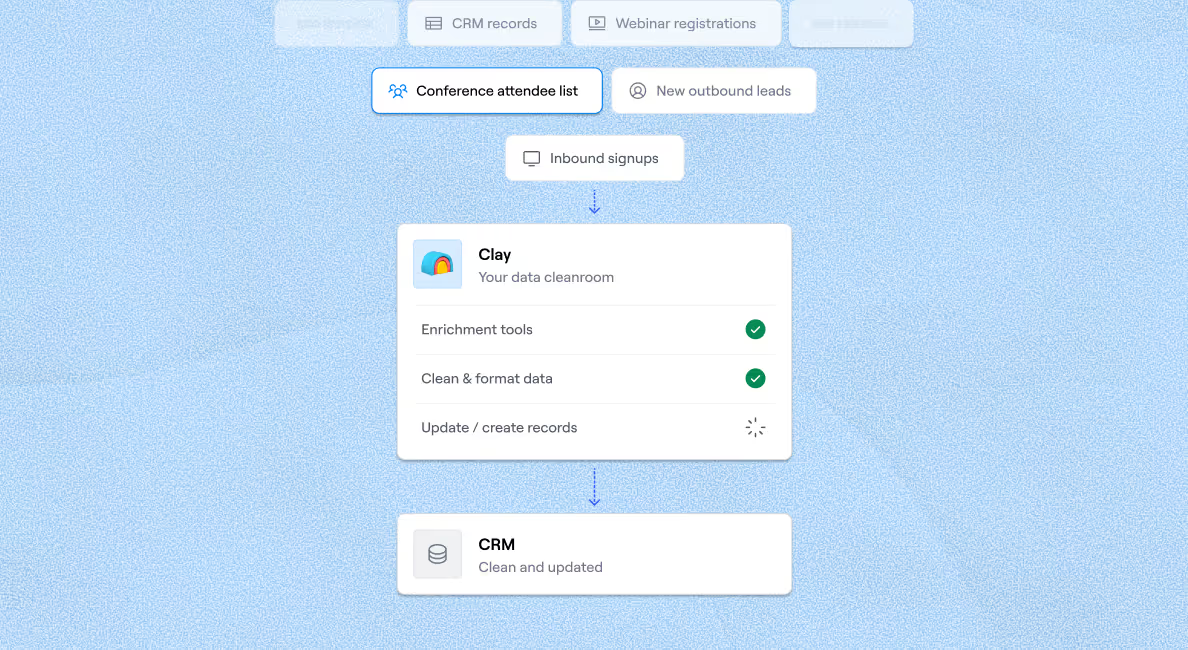
He built two primary Clay tables. One for account ingestion and signals enrichment, another for contacts. Both run waterfall enrichment across Clay's data providers and write the results back into Salesforce automatically. Schema audits closed the remaining gaps, catching fields where enriched data lived in Clay but hadn't been mapped into Salesforce properly. Fill rates on key firmographic and technographic fields climbed from 50% to over 95%.
Clay Audiences makes sure that data stays clean and gives the team a real-time, continuously synced view of the CRM to then layer on additional signals and segment dynamically. "None of our go-to-market tactics work if that foundational data layer is not clean," Mark said.
With the data foundation in place, Mark turned to the next question: which accounts should they prioritize, and what should they say?
Using signals to score accounts and shape messaging
depthfirst sells into a market where the buying signal isn't generic intent. It's specific technology choices that indicate both vulnerability and readiness to evaluate. It’s understanding how AI-native and tech-forward a company is versus the legacy competitors. depthfirst’s solutions address pain points in both, but the messaging is unique and requires understanding what pain points need to be solved for which buyer personas. Mark built a signal system in Clay that scores accounts and contacts across multiple dimensions, giving reps context that shapes not just who they target but how they message each buyer persona.
The first layer is technographic. Clay identifies which accounts run legacy rules-based application security tools that struggle to keep up with AI-generated code. Mark rolls this into a "legacy score" on the account record. Separately, he tracks accounts using AI-native AppSec competitors, because the sell is fundamentally different. "We're developing messaging for companies who are actively engaged with AI-native competitors versus ones who are true rip-and-replace of legacy technology," Mark explained.
The second layer looks at AI coding tool adoption as a proxy for both engineering maturity and risk. Companies generating code with AI assistants are tech-forward, but they're also creating more vulnerabilities than their security teams can keep up with. That gap is where depthfirst's product fits.
The third monitors 10-K filings and security news for breach disclosures. This one requires finesse. Instead of referencing breaches directly, the team develops messaging around how depthfirst's solution handles the specific types of exploits disclosed. Tactful, informed, and relevant without being opportunistic.
These signals compound. An account running legacy AppSec tools, adopting AI coding assistants, and disclosing security concerns in their 10-K gives the rep a clear angle before they ever pick up the phone to call an AppSec leader. Just as importantly, the system lets Mark test messaging against specific segments and see what resonates fast. For a company still building its sales motion, that rapid feedback loop is how they narrow down ICP and sharpen positioning in real time rather than guessing for months. With accounts scored and messaging mapped to personas, the next step was getting that targeting into the market through every channel simultaneously.
Coordinating outbound and ads into a single always-on system
Mark is a believer in outbound, but also knows that outbound in isolation doesn't work, especially in cybersecurity. "You've got to engage with the account in different ways," he said. The play Mark wanted to build was outbound sequences running in parallel with paid LinkedIn ads targeting the same contacts with matching messaging.
Before Clay Audiences, this meant managing 30-plus Salesforce reports, exporting CSVs, and manually uploading audiences to LinkedIn Campaign Manager. It was manual, slow, and couldn't keep pace with how quickly depthfirst was refining its ICP.
Now Mark segments contacts dynamically within Clay Audiences. He creates highly specific audiences, like CISOs at financial services companies with over a billion in revenue, or AppSec leaders at commercial-stage manufacturing firms. Those segments feed into persona-specific outbound sequences and simultaneously push as LinkedIn ad audiences through Clay Ads. The ad copy matches the outbound CTAs. A prospect receiving a cold email is also seeing depthfirst content in their LinkedIn feed. The audiences update dynamically as accounts move through different stages of the sales cycle and into the customer renewal journey.
Every Clay-built audience achieves a 90%+ match rate, compared to 65% manually. This coordinated signals-led outbound + paid ads cross-engagement approach has led to a 2x lift in outbound-sourced pipeline. "Clay Audiences turned 30 Salesforce reports into always-on targeting that syncs across outbound and ads automatically," Mark said “which enables us to focus on how we are engaging with prospects and not the infrastructure to get us there. Without Clay, none of this would be possible at the scale we want to operate at.”
Enabling Google Ads with dynamic Audiences
Before Clay Audiences, depthfirst couldn’t effectively run Google ads. Google customer match depends on a high-quality seed list the platform can resolve. Federico Mobilia, Marketing Lead at depthfirst, had the customers in Salesforce, but the emails he uploaded to Google intended to train the algorithm didn’t match a large enough audience, leaving the channel with nothing to optimize against.
That customer seed list now lives as a Clay Audience that syncs to Google through Clay Ads. The sync sends up to three hashed email identifiers per record for a higher match rate, and the audience stays connected to Salesforce, so it reflects the customer base as it changes.
Google ads now average 80% match rate; as a result, cost per lead has dropped 40%, and Federico can now effectively run Google Ads: "For Google, I couldn't do it at all before. Clay Ads enables me to actually upload customer lists," he says.
Using rep activity to decide where ad spend goes
Federico strategically avoids top-of-funnel spend on large static audiences. "It's one thing to just spend on TOFU and warm up a huge audience in the hope that maybe we get some inbound leads," Federico says. "That's very expensive, and I just don't see immediate benefits." That broad audience has no connection to which contacts reps were actually working that month.
Instead, he built a field in Salesforce that flags any contact with sales activity in the last 30 days, updated daily. That field drives a Clay Audience of roughly 4,000 to 5,000 contacts, refreshing every two days and pushing automatically into a LinkedIn TOFU campaign. "Before using Audiences, I wouldn’t have been able to do this, because this is really a dynamic audience that needs to be updated every day. It wouldn't be worth it to spend my time doing this manually," says Federico.
He used Clay to automatically apply exclusion audiences, keeping existing customers and hundreds of accounts with open opportunities out of wasted ad spend. Because every contact in that audience is an active sales lead, Federico trusts spending up to five times more per impression than against a broad audience.
Clay’s dynamic Audience also gives reps direct control over which of their prospects keep seeing depthfirst. A contact with no recent activity drops out of the ads audience. Sending a new blog post or product release resets that contact's 30-day clock so reps keep engaging the contacts they want covered. "It helps drive rep behavior, which is not always easy," says Federico. “Clay Ads aligns marketing and sales to work more closely, do plays together, and drive sales behavior."
In some cases, accounts reps are outbounding to have started coming inbound. depthfirst recently had what Federico believes was its biggest week ever for meetings booked, though partner-sourced meetings contributed too, alongside the boost from ads.
A small team running a big GTM motion
What Mark and Federico built at depthfirst is a system where each layer feeds the next. Clean CRM data feeds signal scoring. Signal scoring shapes messaging. Messaging runs through coordinated outbound and ads that reinforce each other. New signals are captured from call intelligence data that are then fed back into Clay’s signals infrastructure layer as the connective tissue of their GTM engine.
Mark describes Clay as a "centralized signals repository" where 150+ data providers, enrichment sources, and web scraping agents all converge without needing to manage individual integrations. The CRM stores the data. Emails, calls, and Slack messages collect new first-party signals. Clay orchestrates it. A lean RevOps and marketing team operates with the precision and coverage that would typically require a much larger headcount because the system does the work that used to require intensive manual research, list management, and cross-platform coordination.
The results show up across the entire funnel. CRM data fill rates on key firmographic and technographic fields jumped from 50% to over 95%. LinkedIn ad audience match rates hit 90%+, up from 65% with manual uploads. Signals-led, outbound-sourced pipeline has doubled. On Google, cost per lead dropped an estimated 40% once customer lists began matching.
And because signals, messaging, and targeting all run through one system, the sales, marketing, and account management teams can test, learn, and refine faster than competitors with much larger go-to-market organizations. "Clay was the first tool I asked for when I walked in the door," Mark said. "It's the infrastructure that lets a small team go-to-market like a much bigger one."











.svg)