




















.avif)












.avif)










"Every lead is pre-qualified, scored on unique signals, and routed automatically through Clay. We're now generating pipeline from segments we weren't even touching before." – Raman Khanna, Growth
ElevenLabs is an AI research and product company transforming how we interact with technology.
AI Voice Technology
London, UK
ElevenLabs builds enterprise AI agents for voice and chat, creative tools for content teams, and audio AI models for developers. Today it serves millions of users and thousands of the largest global businesses.
For Raman Khanna on the Growth team, and Alinga Jiang on the Revenue Strategy and Operations team, the question was never whether they had enough leads. It was whether they had the infrastructure to identify which ones to prioritize and act on before the moment passed.
ElevenLabs had signals coming in from inbound form fills, product usage data, and website visits from named accounts, but no connective layer that could enrich, score, and route across all of them. The CRM data that every downstream system depended on needed continuous enrichment to stay reliable at ElevenLabs' scale. "We weren't able to pull in the high-signal enrichment fields to feed into the overall score," Raman recalls. With inbound volume growing across every channel, the team wanted a way to act on the best leads the moment they came in, not hours later.
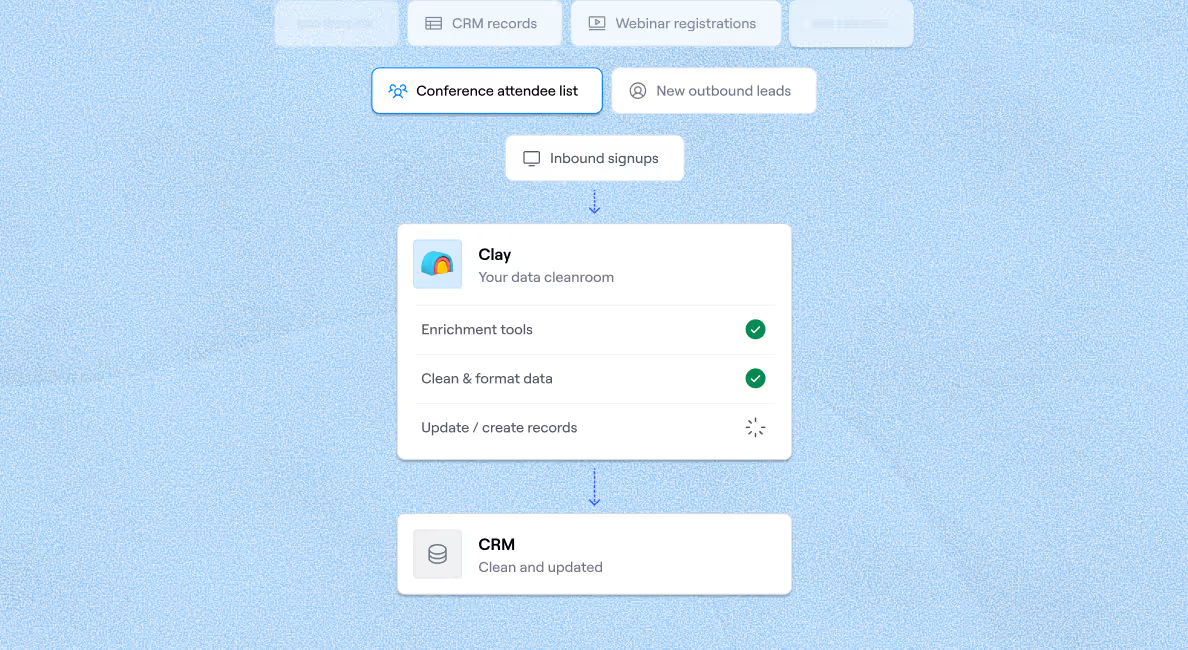
They brought in Clay to build the GTM intelligence layer that would sit above their CRM, enriching data continuously, processing signals from every source, qualifying leads automatically, and orchestrating GTM plays for reps and automated systems. What started as a data foundation project became the orchestration architecture for their entire go-to-market.
Building the data foundation that powers every play
Before ElevenLabs could score a lead or route an account, the data underneath had to be right. Alinga's RevOps team owns the enrichment infrastructure that every other motion depends on: firmographic data like industry and employee size, which reps they're assigned to, and how they score against ElevenLabs' ICP.
When ElevenLabs refreshed their sales strategy and ICP definitions at the start of the year, Alinga's team reclassified the entire existing account base and active pipeline at scale. They used Clay to re-segment thousands of accounts into the right buckets without manual rework. "We were able to use Clay to do the full changeover and reclassify our existing accounts in a very scalable way," Alinga says.
The enrichment extends to the contact level, too. Department, seniority, and mobile phone numbers flow through Clay's waterfall enrichment across multiple providers, with the team controlling which sources to prioritize and in what order. That data writes back to Salesforce, giving reps and automated systems reliable records to work from.
The data foundation also shapes what becomes buildable on top of it. The ICP classification logic Alinga's team maintains in Clay is the same logic Raman's scoring models draw on for demand gen leads. Every use case that follows works because the data stays current.
Qualifying and scoring every lead
ElevenLabs runs many marketing and demand generation programs across a number of channels. So when a lead comes through, they want to make sure it’s routed to the right journey.
Inbound
Every inbound lead goes through Clay before it ever reaches a rep. To manage that huge volume, Alinga’s RevOps team built the qualification system for organic inbound. A two-agent system evaluates each lead. The first agent researches the prospect's website to determine whether it's a legitimate company. The second reads through the use case details, usage estimates, and timelines the prospect submitted, pairing that with the website findings to assess intent and quality. Together, they produce a pre-qualification recommendation for the SDR: continue working the lead, disqualify it, or route it to support.
Demand Gen
Raman built the equivalent for demand gen channels like LinkedIn campaigns, paid ads, gated content downloads, and webinars. The scoring model draws on firmographic signals like job title, company size, revenue, and ICP fit.
But the signals that show the strongest fit are the ones Clay agents surface by researching each company directly. Is the company actively hiring for engineering talent? Does it have a voice AI product already in-market? "Those are really high-intent signals," Raman explains. Standard firmographics plus unstructured research give them a scoring model that keeps pace with how fast the market moves.
Leads that cross the threshold get passed to SDRs, with a QA layer running in the background. Before this system existed, that filtering happened manually. "SDRs were spending cycles opening records, assessing fit, even booking calls, only to realize the lead wasn't a good fit," Alinga says. At ElevenLabs’ scale, that wasted rep productivity added up quickly.
Switching from static scoring to Clay's multi-signal model delivered +50% incremental sales-qualified leads overall. On demand gen specifically, Clay-based scoring drove a 4x increase in SQLs.
Speed-to-lead
With lead quality under control, the next question was speed. Alinga's view is direct: "The highest conversion happens when someone submits a form and hears back almost immediately. Wait even a couple of hours and the urgency is gone." Before Clay, response time depended on rep behavior. The fastest moved quickly. Others took hours. Leads outside business hours waited until the next morning.
To close that gap, ElevenLabs built a direct-to-sequence workflow they are piloting in Clay. When an inbound qualified lead is confirmed, Clay pushes it into their sales automation tool automatically. No rep action required. Response time from form submission to first touch is now under five minutes.
Turning product signals into a new pipeline source
High-usage accounts were already being flagged as product-qualified leads (PQLs) and routed to sales. But Raman and Alinga spotted an untapped segment: employees at large enterprise logos were signing up for ElevenLabs on self-serve plans. They knew the product, had a use case in mind, and were actively exploring. But no one was reaching out to them because they weren’t hitting the required high usage markers. Enterprise opportunities were getting lost among millions of self-serve users.
They built a workflow in Clay that enriches high-intent signups with firmographic data, scores them on ICP fit, and routes the strongest matches directly to SDRs as outbound leads.
"This was a completely new motion for us," Raman says. "We weren't doing anything there before." In its first quarter, workspace MQLs already contributed roughly 4% of all outbound SQLs. For a motion that requires no additional spend or demand gen effort, and surfaces enterprise opportunities from users who are already in the product, the early signal is strong.
Surfacing enterprise intent and coordinating strategic action
ElevenLabs' AEs each carry a book of named strategic accounts. Those accounts were already visiting the website, reading the enterprise landing page, reviewing legal documentation, and studying case studies. What was missing was any way to surface those visits in real time.
To solve this, Raman built a website de-anonymization workflow in Clay. When a named account visits a high-intent page and spends enough time to indicate genuine research, the assigned AE receives a Slack message with a link to the Salesforce record and a summary of their research activity. A timestamp field in Salesforce updates at the same time, so AEs can sort their entire book by recency and prioritize accordingly.
The workflow covers every account in an AE's book, including previously closed-lost opportunities. When an account that went cold starts reading the enterprise documentation, the assigned AE finds out immediately. "It's a strong signal to reach out and try to win back an account," Raman says. When AEs receive these alerts, they forward them to their SDR partners, turning a single signal into a coordinated play for multithreaded outreach.
The infrastructure that makes every play possible
ElevenLabs was already running a sophisticated go-to-market. But Clay gave them a new layer of intelligence and infrastructure to orchestrate plays from. Raman now runs scoring infrastructure for every lead type independently, while Alinga's team maintains the data foundation that every downstream motion draws on.
"Being able to pass the best-fit leads to our sales team without setting up a bunch of data pipelines for every change has been a big unlock." – Raman Khanna, Growth
That independence is what made the velocity possible. Three GTM motions that didn't previously connect now run on the same orchestration layer and write back to the same source of truth. Each one compounds the others because they all draw from the same enriched, continuously updated foundation: better-qualified leads reach SDRs faster, product signals surface enterprise buyers who would have gone uncontacted, and AE alerts turn website visits into coordinated outreach.
For Alinga, the most meaningful shift is in what the team now considers buildable. "There's a much bigger universe of possibilities out there that we can do using Clay," she says. The signals existed. Now they have the infrastructure to act on them.












.svg)