

































.avif)










A lot of successful selling is just timing. Even with promising signals, like a fresh RevOps hire or a recently announced funding round, you’re still guessing at when the right moment arises. But inbound removes a lot of that guesswork: someone who fills out a demo form or requests a pricing one-pager has told you the moment is now.
Unfortunately, “now” is fleeting. A person who gets a reply four hours after submitting a form is probably still comparing options. But after two or three days, they’ve already sat through a competitor’s demo or started a trial somewhere else.
Speed-to-lead is a metric that go-to-market teams should care about. And yet, companies may not be measuring it, and fewer know how their response time compares with similar companies. So Alex Lindahl, Clay’s Creator-in-Residence, tested it directly, with a team of agents built in Clay that submitted 6,346 demo and contact forms and waited to see who replied.
Check out our full speed-to-lead findings; it’s the first in a series of reports on GTM Engineering Benchmarks. Each one will measure a single metric across thousands of companies, so you can compare how you stack up (and get advice on improvements).
What 6,346 form fills got back
Ahead of getting into exactly how the process ran (and some of the limitations inherent in our methodology), let’s get into the results. In short, based on the numbers, speed to lead isn’t a priority at most companies, or at least isn’t being managed as one. Replies, when they came, tended to arrive the next day, and many companies didn’t reply at all.
Of the 6,346 forms submitted:
- Two-thirds of companies never replied. Only 2,013 forms (32%) got an email response.
- 96% of companies never picked up the phone to call. The 100 that did were about 5% of those that replied, even though many forms required a phone number. The calls that did come arrived, on average, 34.5 hours after the form was submitted.
- About 7% of people got a reply from a salesperson. Of the 2,013 replies, 64% were automated and 732 (36%) came from a person. Of those human replies, 445 were from a salesperson actually trying to start a sales conversation, which works out to 7% of all forms.
- Average speed to lead was 15 to 24 hours depending on the cut, or 26 to 40 hours for human replies only. 5% of replies arrived within five minutes.
- Automated replies were almost never personalized, and human replies usually were. 75.8% of human replies were fully personalized, compared with four of the 1,281 automated ones.
- Bigger companies were faster on average and had automated more of their first replies.
How agents ran the study from a single Clay table
No humans at Clay were involved in manually filling out forms. Doing 6,346 by hand would have taken a small team weeks, so Alex built the backbone for this process inside a single Clay table instead. Here are the steps:
- Our process started with gathering more than 10,000 target domains from Clay’s account lists. For each one, Claygent (Clay’s research agent) found the URL of the contact or demo form.
- A separate browser agent then submitted the form with one consistent identity, and the system waited, sending no follow-up.
- When an email or a call arrived, the timestamp was posted back into the same table, and Claygent compared it to the submission time.
- It also judged whether the sender was human or automated and just how personalized the reply was.
The 6,346 forms came from 100 countries and spanned industries like software and IT, professional services, manufacturing, and retail.
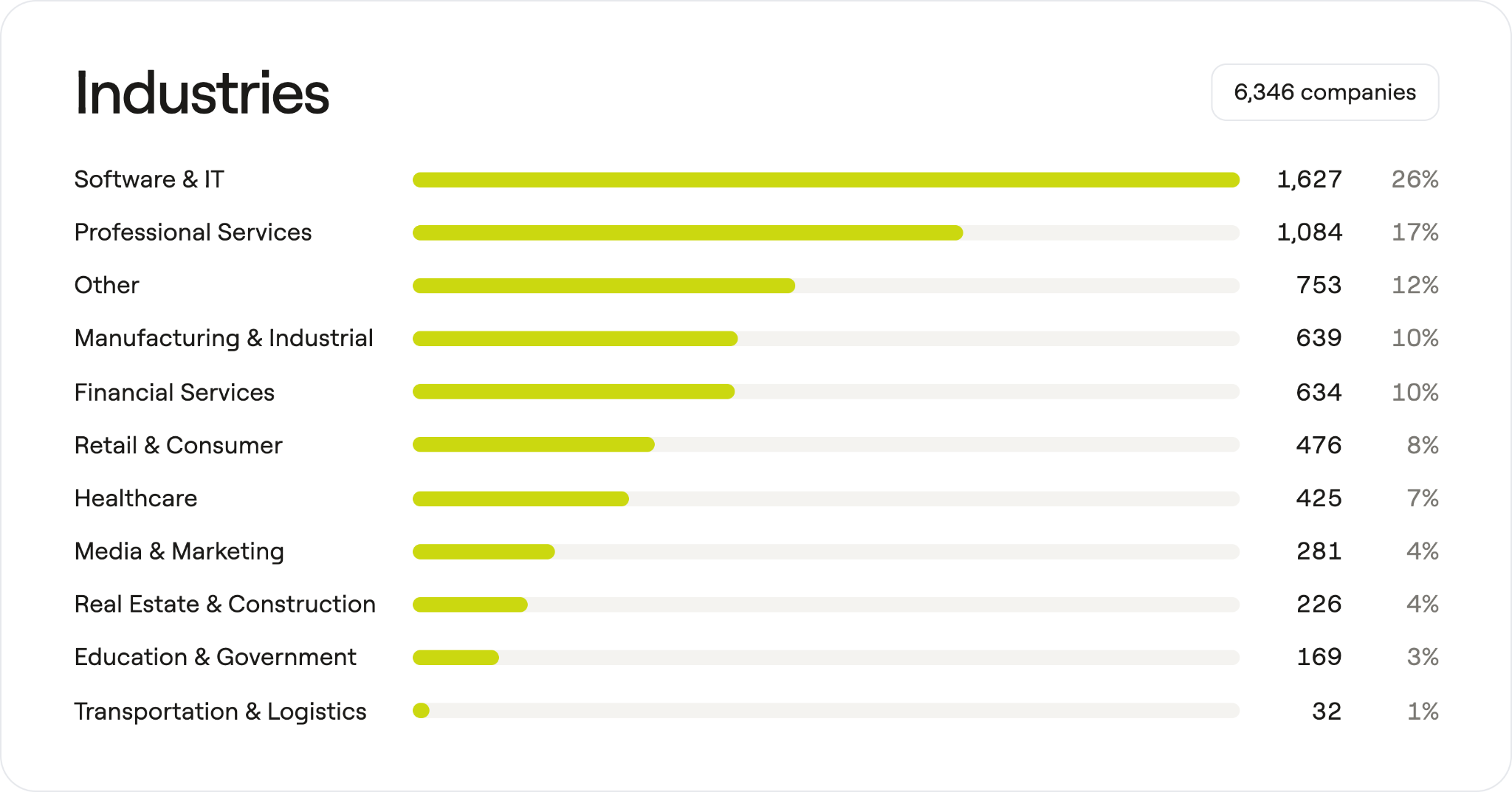
Check out the full breakdown for more details on company size, geographic regions, and the split between privately held and public companies.
The three startups that gave the agents an inbox and a phone number
A real individual requesting a demo needs to read and fill in a web page, plus supply contact details where the company can reach them. Naturally, an agent needs those same things. For this experiment, we partnered with three great startups to supply those primitives:
- Subconscious built the browser agent that opened each form and filled it in.
- AgentMail provided a working email inbox, so replies could be received and auto-timestamped.
- Saperly provided a working phone number for the agents, so calls could be captured and timestamped the same way.
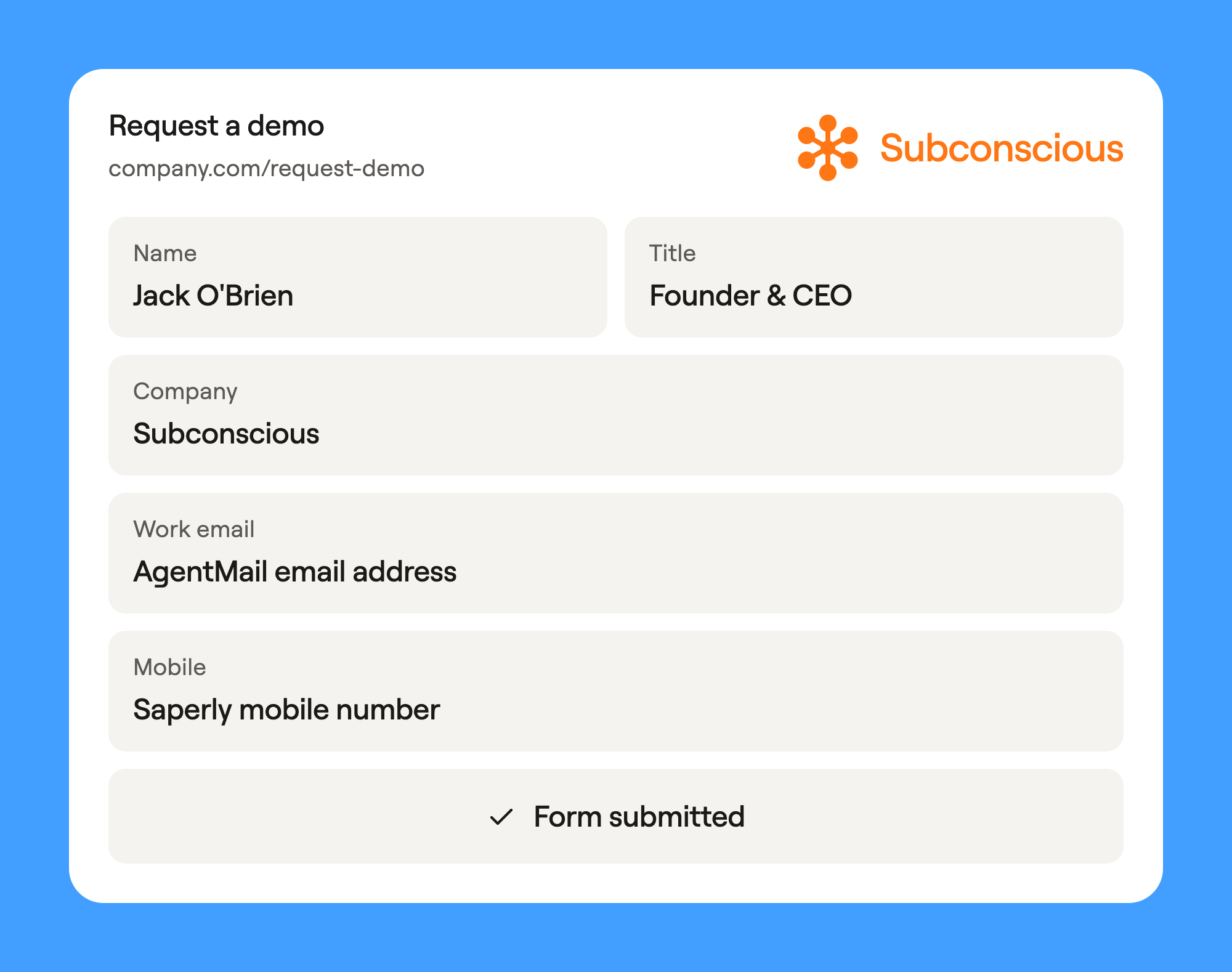
The identity on every form was Jack O’Brien, founder and CEO of Subconscious, with an AgentMail address and a Saperly number. Interestingly, more than 50 companies ignored that number and called him on his real one, and 20 or so called his teammates. Those teams had enriched the lead before dialing.
Three reasons the numbers might be off
Two-thirds of companies never replied, and only about 7% of forms got a reply from a salesperson. These results are more dramatic than even we’d expect, so they deserve some additional scrutiny. It’s entirely possible that those numbers also come with some margin for error, for these reasons:
- A non-reply doesn’t mean a lack of diligence or care. Every form carried the same made-up buyer, the founder of an AI startup. Some of the 68% may have looked at that profile and decided, correctly, that he wasn’t a fit, or suspected a bot. Our data can’t separate those cases from plain non-responses.
- Spam filters may have blocked some submissions. AgentMail addresses may have been caught by spam or bot filters at some companies, which would understate the real response rate.
- The human-versus-automated split was judged by AI. A well-written automated email can be mistaken for a person’s, and vice versa.
The fixes most companies haven’t made
Even if the numbers are off by a margin, most inbound still appear to go unanswered or get a slow reply. Plus, if there’s a lead you’ve decided not to pursue, silence is a poor response. Here’s how to improve on inbound:
- Reply to everyone. Coverage is a bigger problem than speed, and an automated acknowledgment on every submission is enough to start.
- Give disqualified leads a next step. If a form rules someone out, say so and point them to something useful: a group demo, a recorded demo, a self-serve trial, the pricing page, an integration guide. Something! A redirect is better than no reply, and that person may be the right buyer as they scale (or at their next company).
- Get a human reply to your best-fit leads quickly. Run lead research automatically before it reaches the rep, so the rep can reply with context right away instead of looking up the company first. Almost no company in the data managed to be both fast and personal.
- Call your strongest-fit accounts the same day. With 96% of companies never calling, a phone call is something very few competitors do.
Compare your own company’s speed-to-lead
Our full report has breakdowns by company size and industry, and the Clay table used to run this experiment, in case you want to run your own. The page also has a lookup: enter your company email, and it shows how your response time compares with companies of your size and industry. Alternatively, fill out your own company’s form from a personal address to understand what happens.
Of the companies that replied at all, almost every one did one of two things: sent a template within seconds, or sent a personal reply a day later. Hardly any managed to be both quick and personal. You can do it if you research and route the lead before a rep ever opens it, so the first human reply goes out quickly with context. The companies that get there will be the ones that can get in front of leads first and win them over as customers.












.png)








.avif)

















.avif)















.avif)