

Our founders coined the job title “Go-to-Market Engineer” (GTME) for an internal role in 2023. Yash Tekriwal, one of Clay’s early employees, was the first person to ever hold the designation. With a flood of inbound demand to address and no sales team to support him, he began automating his job, starting with a form that qualified prospects and replied within minutes if they were a fit. The title spread across the company as we hired more people who could build in this same way. Then it spread to our customers, and then to our competitors. According to data from Pave, the share of companies with a GTME on payroll went from under 0.1% in January 2023 to 1.3% in January 2026.
Fast forward to October 2026, and go-to-market engineering work looks markedly different from what it did in 2023. Developments at the frontier of artificial intelligence show no signs of stalling, altering the way we collectively work. That includes GTMEs. For one, GTMEs are using coding agents like Claude Code and Grok Bot, embracing agent-first workflows and bypassing platform interfaces in favor of APIs and MCPs. And increasingly, teams have moved beyond discrete AI experimentation and “vibecoding” individual GTM plays and toward building more reliable and scalable frameworks. For example, at Clay we’re building more durable and interconnected systems that can handle greater complexity and volume, with built-in self-learning loops that bring us closer to the age of agentic GTM.
Despite being nascent, the role of the GTME will continue to evolve. How we recruit and hire GTMEs is evolving in lockstep. In July 2025, we published a guide to hiring a GTM engineer. Its core recommendations, like waiting to hire until you have repeatable processes to systematize and valuing curiosity over expertise in any one tool like Clay, are deeply relevant. They remain ingrained within our present process. But we also want to bring our latest thinking to the table on how we’re addressing the challenge that comes with recruiting for a new profession that continues to shapeshift.
I lead our Revenue Platform org at Clay, where our internal GTMEs sit. We’ve pulled together what we’ve learned building this team and helping other companies recruit for their own GTMEs. That includes input from Erica Ford and Alexa McCue, our GTM Talent Recruiters at the forefront of defining (and redefining) our hiring. We share everything from the skills to screen for and the ideal interview questions to take-home assignments and compensation benchmarks.
What exactly is a go-to-market engineer?
GTM engineering takes the discrete components of a company’s GTM motion and builds them into a single, integrated system. As for the people orchestrating this motion, here’s the definition we’ve settled on internally:
GTM engineers increase revenue efficiency by combining creative GTM thinking with the ability to build at scale. They identify new ways to reach, convert, and grow customers, then turn those ideas into durable systems that can run across the organization as it scales. In the agentic GTM era, that system includes a reasoning layer: agents completing judgment-based tasks that previously required a living-and-breathing person.
Osman Sheikhnureldin, our Head of GTM Engineering, has a complementary description of what he and his team do: “One, [we] identify things that are stopping us from growing as fast as we can. Two, [we ask] how we solve that, not with more headcount, but with more automation and better data.”
The role is often mentioned in the same breath as RevOps.
RevOps and GTM engineering are coming closer together, and we intend to merge them further at Clay. Sydney Bedient, our CX GTME, is a good example. She functions as RevOps plus GTME, building next-best-action agents for our Growth Strategy team while also handling core RevOps work like territory planning and post-sale account assignment.
This doesn’t mean the traditional RevOps skillset is disappearing. As we’ve built more complex workflows and GTM rules of engagement, we’re seeing more complexity, more need for analytical skills to serve it, and more space for human judgment.
Internal GTMEs at Clay
Internal GTMEs at Clay sit in the GTM Operations department in the broader Revenue Platform org, reflecting our view that the RevOps and GTME skill set are continuing to overlap.
Their mandate is to act as a force multiplier; each day, they strategize and execute on ways to give GTM teams the ability to scale their work and ideas with tooling, automation, and data.
They make Clay’s revenue motion more efficient like so:
- They own all the systems our GTM team runs on. Of course, that includes Clay. But it also extends to tooling like Salesforce, Gong, and the internal tools our reps work within. Beyond the software itself, they oversee the GTM plumbing: the tracking that attributes pipeline to specific plays and certain reps, the pipes that pull in the right buying signals, and the exact logic that routes leads to the right person.
- They’re measured on revenue outcomes instead of tickets answered. Last quarter (Q3 2026), our team was measured on metrics related to business objectives: pipeline created, stage-one-to-stage-two conversion, and quota capacity per seller. Down the line, we expect GTMEs to carry their own goals, maybe even quotas, tied directly to the functions they support.
- They prioritize scalable platform investments rather than one-off requests. Work that doesn’t improve pipeline generation, pipeline efficiency, or customer expansion falls to the bottom of their priority list. Instead, internal GTMEs focus on building systems that create leverage across multiple GTM teams. Osman refers to this as solving “compound problems.”
When should you hire a go-to-market engineer?
There’s no defined timeline or exact funding stage that signals it’s time to hire your first GTME. Don’t think of “Series A” or any other arbitrary milestone as the trigger to start recruiting for the role. We’ve hired GTM engineers at every stage of Clay’s growth, and have supported other companies in doing the same—from seed to Series C and beyond.
Instead, ensure you have these two factors in place:
- Product-market fit
- A revenue motion that needs to be systemized
However, the financial stage of your company may shape the role and its responsibilities. An early-stage company needs someone who can iterate quickly on plays. A company with a repeatable motion necessitates someone who can build and maintain systems. Either way, be precise about the problem you need solved before you open the role and promote it on LinkedIn. The less clarity you have on the outcome your org needs, the harder it is to hire the right person to deliver that result.
Different internal GTME archetypes
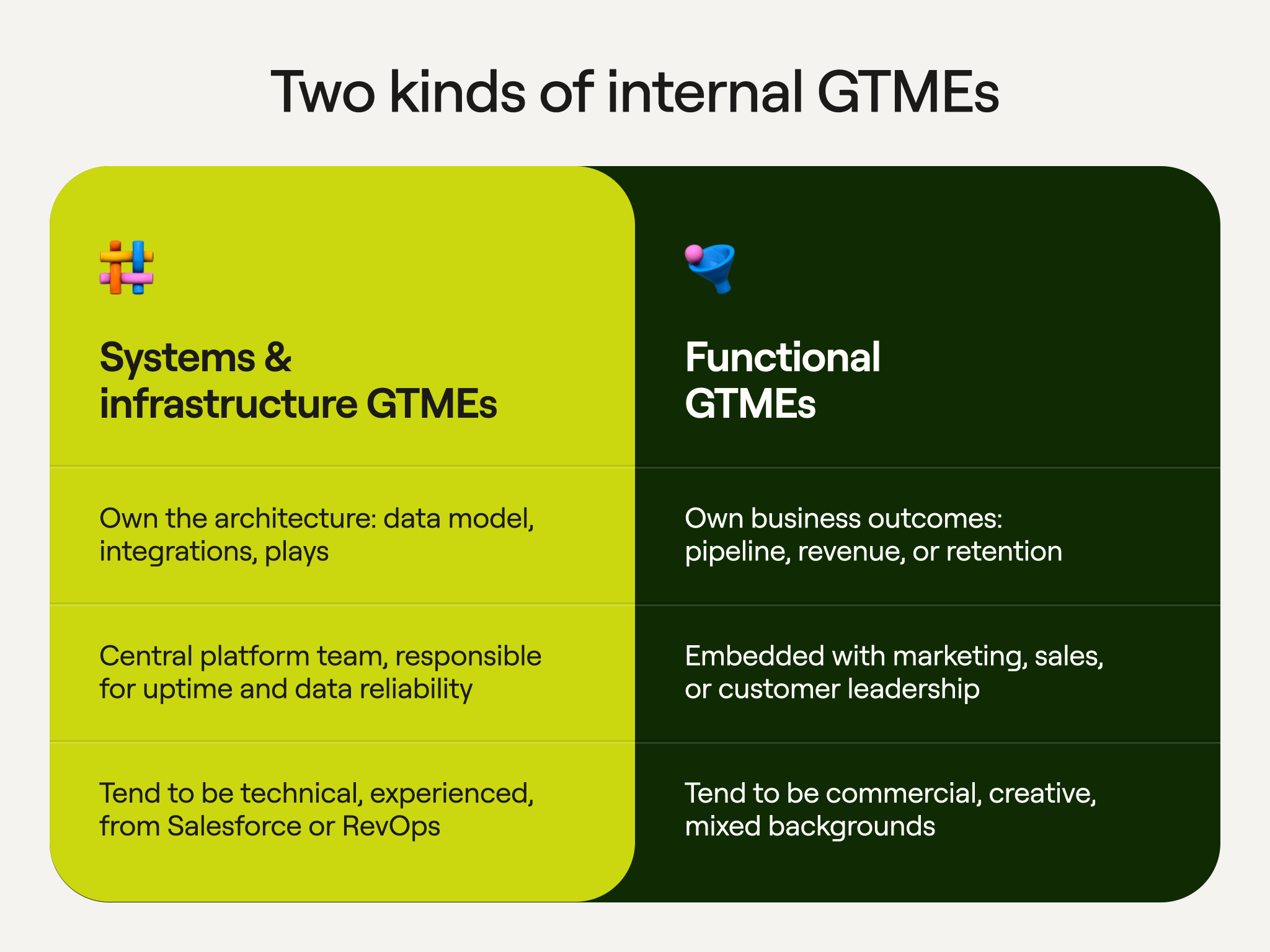
For our internal GTMEs, we’ve identified two archetypes and scope and interview differently for each: systems and infrastructure GTMEs and functional GTMEs.
Systems and Infrastructure GTMEs
Systems and Infrastructure GTMEs build and own cross-functional architecture: the data model, integration layer, and interactions between GTM plays in the larger system. They likely come from more traditional technical ops backgrounds and skew toward more technical competencies.
Evan frames the systems and infrastructure profile as the evolution of the Salesforce admin. Our revenue platform now spans Clay plus a dozen third-party tools, and someone has to be the platform owner for all of it.
- They’re responsible for uptime of the platform and reliability of the data and systems. Typically more experienced. Greig Fields, a GTM engineer at Clay who leads this work for us, is a career Salesforce admin with about ten years of building Apex flows, and integrations, which transferred directly to building Clay CLI flows.
- In an agentic system, these are also the people who make the non-deterministic layer observable and debuggable.
Functional GTMEs
Functional GTMEs are aligned to business outcomes, typically pipeline generation, closed-won revenue, or net revenue retention. At Clay, this now means hiring for domain spikes, like seller efficiency or CX. These GTMEs have a close working relationship with the functional owner of that outcome. For example, a functional GTME aligned to net revenue retention sits with the leader of the post-sales team, learns where growth strategists lose time or miss signals, and builds for them directly. That could be something like an agent that flags renewal risks and expansion opportunities before a customer call or a system that recommends the next product use case based on how similar accounts adopted Clay. They typically skew to more commercial and creative competencies.
- They’re embedded with marketing, sales, or customer leadership, building the flows closest to the reps and marketers who use them every day. That could be account agents that flag an upsell or message generation tables.
- People who do well here have been successful in multiple types of roles and are very curious. This could be a writing major who went into RevOps, or a math major who went into selling.
How should you hire GTMEs for the agentic GTM era?
We’re constantly evaluating how the role of GTMEs will evolve as AI becomes even more embedded into how teams go-to-market. We suggest that other organizations do the same.
What does it mean to hire someone who’s a strong collaborator, when collaboration comes to mean working well with the people sitting next to them, but also playing nice with their agent “colleagues” in the cloud? What’s the best way to assign and assess a take-home assignment when candidates can hand the prompt to Claude Code and have a working workflow in minutes?
These are the considerations we’ve been grappling with that inform our present hiring process.
Placement within an org
Where a GTME reports matters less than whether their work is scalable and makes an impact. However, you should still be intentional about org structure. In speaking to dozens of companies, we’ve observed two common placements for GTMEs: in RevOps or GTM Operations or inside Growth Marketing.
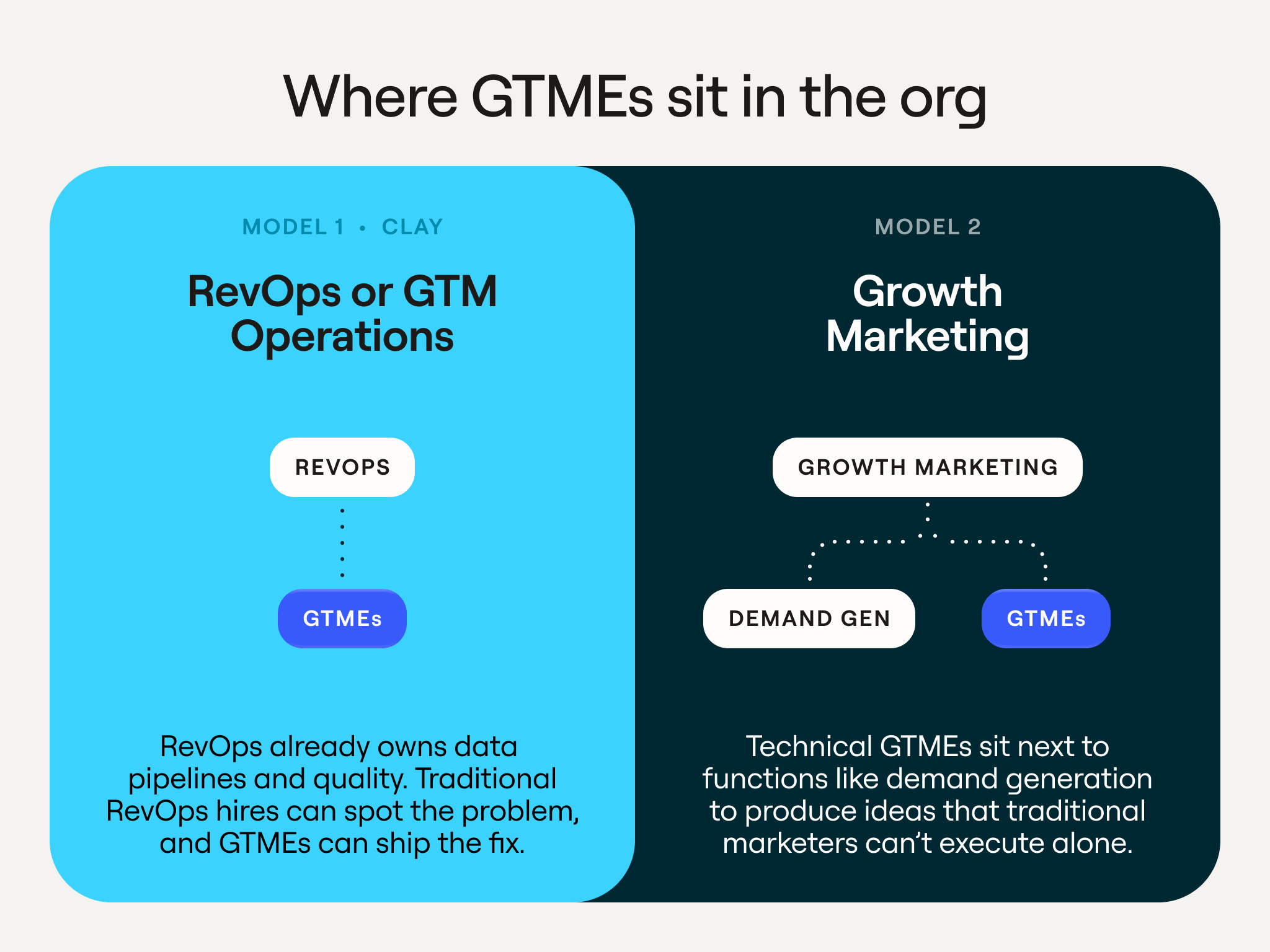
- RevOps or GTM Operations. This is a common pattern for mid-to-large companies. In this scenario, RevOps already owns data pipelines and quality; traditional RevOps hires can spot the problem, and GTMEs can ship the fix.
- Growth Marketing. Putting technical GTMEs next to functions like demand generation produces ideas that traditional marketers might need engineering capacity to execute. That includes programmatic landing pages for ABM campaigns or automating most of an SDR’s workflow so reps book many more meetings than they otherwise would.
Clay follows the first model. Internal GTMEs sit in the Revenue Platform organization alongside revenue enablement, solutions, and GTM strategy and ops. Functional GTMEs are further embedded with their business partner but roll up through the central team, while systems and infrastructure GTMEs own the platform everyone builds on.
Traits and skills to assess for
Many of the traits we hire for today will carry into the agentic era mostly intact. That includes recruiting people who have a bias to build, are creative problem solvers, and effective collaborators.
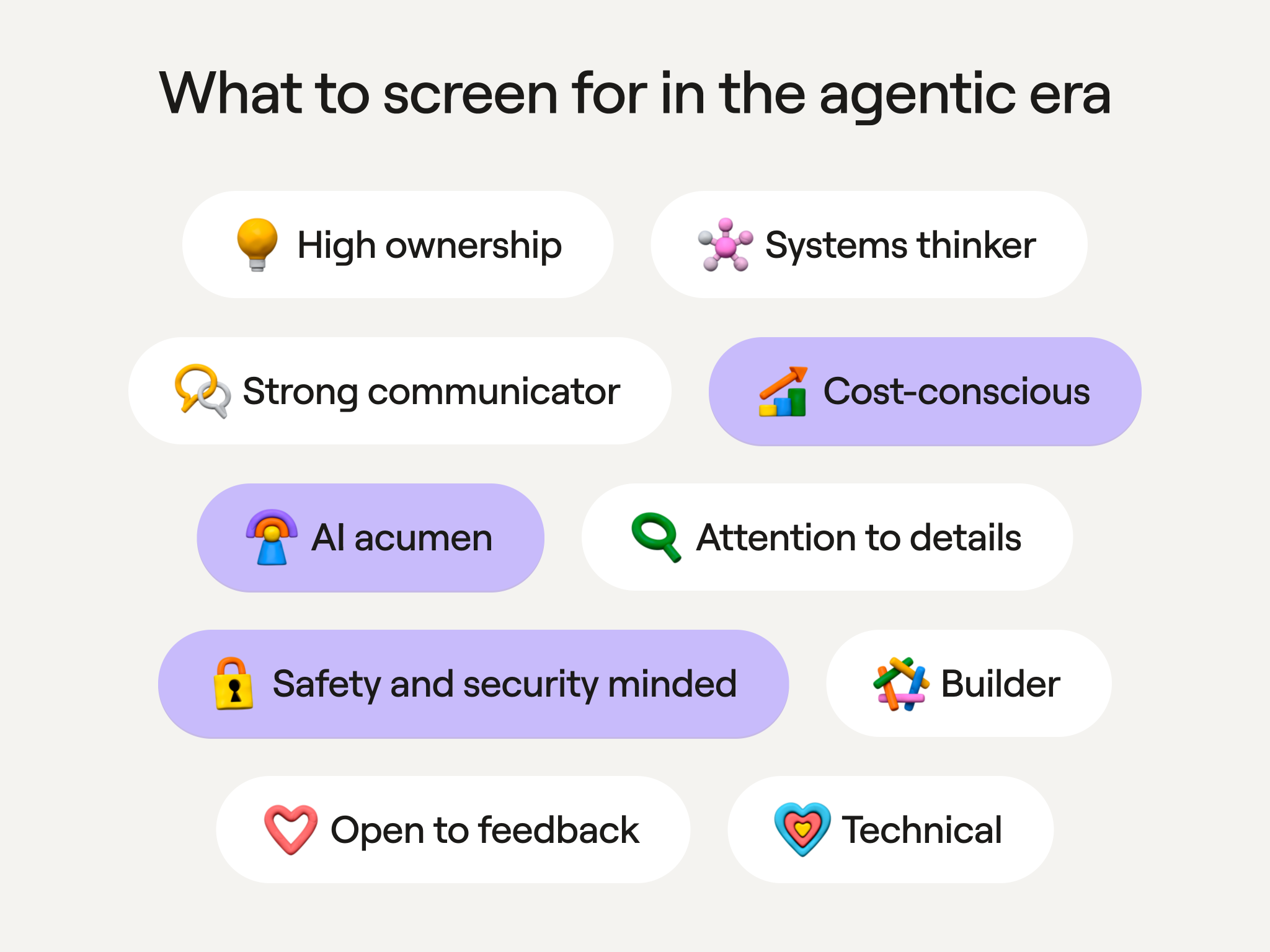
These are key skills that Erica looks for when she’s recruiting for GTMEs:
- Strong communicator. GMTE is a deeply cross-functional role, so we look for individuals with both strong verbal and written communication skills. Across early email communication, interviews with the team, plus the assignment and presentation, we’re assessing how clearly someone can explain their experience and ideas.
- Solves with building. We’re less interested in how candidates say they’ll solve a problem, versus how they show a solution. We want to know about the workflows they’ve built in previous roles and the outcomes. This is also something we assess for in take-home assignments.
- Technical. We look for working ability in at least one of Python, JavaScript, SQL, or TypeScript, plus experience connecting systems through APIs and webhooks. For systems and infrastructure GTMEs, we also screen for hands-on Salesforce development. We don’t require a CS degree or prior Clay experience.
- Systems thinker. While GTMEs often have a specific purview, we gravitate toward candidates who don’t just think about their piece of the puzzle. That means people who can understand an entire system and think logically about second- and third-order effects when one part of a sequence falters.
- Open to feedback. Our operating principles manual includes a page on sharing and giving feedback; we tell Claymates not to be afraid to “step on toes.” Everyone we bring on needs to be equally versed in providing feedback and receiving it, especially when it’s critical.
- Attention to detail. We look for people who care about the minutiae. They can explain precisely why they made a particular choice while implementing a project versus telling us a decision was arbitrary.
- Structured thinking. Our systems at Clay are large and complex. Successfully working within them, troubleshooting problems, and building on the existing foundation means making sense of disparate parts.
- Vertical and lateral thinking. These two modes of thought go hand-in-hand for GTMEs. We’re seeking candidates who can sequentially solve problems, but can also take a non-linear approach to unearth solutions to nebulous issues.
- High ownership. Although GTMEs collaborate heavily, we search for candidates who can balance teamwork with a high level of self-direction. Throughout the process, we dig into anecdotes and data points that reveal someone has owned projects end-to-end.
We’re also considering screening for additional skills that apply even more directly to running and managing fleets of agents. With an always-on, non-deterministic layer in everything you do, the structured data underneath becomes more important, and testing and observing what the agents do becomes a growing share of the work. These are the proficiencies that we think will prove useful:
- Safety- and security-minded. GTMEs will increasingly be responsible for setting stricter guardrails, defining the ways agents can (and can’t) act when revenue-seeking. That will mean screening for people who have some perspective on alignment and what it means for agents to approach growth ethically.
- Financials and cost-consciousness. The coming era means agents working overtime, equating to more inference and token usage. Finance teams will continue to be at the helm of monitoring AI budgets, but GTMEs will be tasked with creating systems that optimize costs rather than reaching for the most expensive frontier model for every action.
- AI acumen. GTMEs will need to keep pace with the market and carve out dedicated time to experiment with new models rather than defaulting to existing systems. That could mean assessing the performance of a recently-released open-source model for a GTM play or finding a use case for a decision-focused AI model like Jev.
Professional background
The GTME profession is new, so there’s simply not that many people with extensive GTM engineering experience. The pools of candidates we look through often have strong hacking and vibe-coding skills, but few within that set have built robust systems or managed stakeholders through periods of change. Our response has been to index less on whether someone has used Clay or held a specific role, and more on whether they have years of experience doing something comparable.
The shorthand we’ve landed on is “RevOps + data + building.”
For functional GTMEs, we look for more than three but fewer than ten years of total work experience and a background that pairs at least two of the following: a commercial role, revenue or marketing or sales operations, solutions engineering, software engineering, product management, and data science or GTM analytics.
- The ideal profiles pair two of these areas, like solutions engineering plus RevOps or product management plus RevOps. The rarest candidates stack three or more.
- Former founders do well at Clay, since they combine marketing, sales, systems, and technical skills. A strategy and ops consulting background translates well, too.
The common thread across our team is that everyone loves GTM processes and wants to spend most of their time, around 70%, building.
- Sydney Bedient came from CX with prior experience building CRM applications and found clever ways to automate her workflows when her team downsized at a previous company. Now she builds for our CX team at Clay.
For systems and infrastructure GTMEs, we look for around ten years working on core revenue systems, ideally with both Clay and Salesforce expertise. Titles vary wildly here, from “Technical RevOps” to “Business Applications.” Similarly, we source by profile rather than title, using Clay tables to find people who’ve handled enterprise B2B SaaS data.
GTME interview phases
Our hiring process for GTMEs includes around five interviews and a take-home assignment. In combination, these distinct phases evaluate a candidate’s background, their hands-on building skills, their ability to communicate, and their overall alignment with our values and how we work at Clay. We aim to go from first call to decision in two weeks or less. Similarly, we suggest finding a balance between a process that’s comprehensive without taking up an inordinate amount of time.
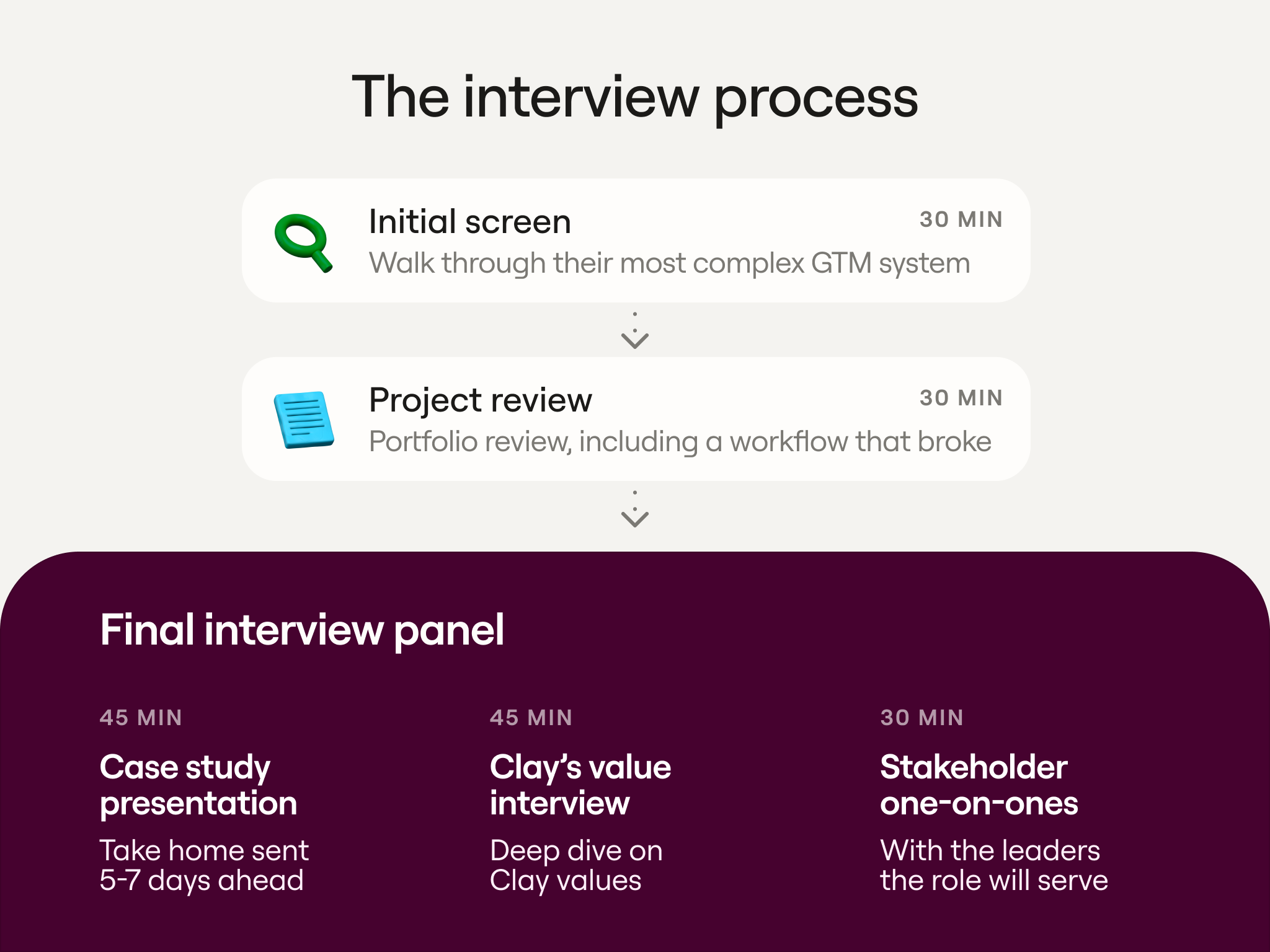
Initial screen (30 minutes)
This is the first call with the recruiter, like Erica, or the hiring manager, like Osman. This is the phase where we ask a candidate to discuss the most complex GTM system they’ve ever built and the specific problem it solved. A strong answer ideally covers the initial problem, the trade-offs they weighed before building, and the impact, including who uses it and at what scale. We listen for details like the multiple systems they linked together or the data sources they incorporated.
Project review (45 minutes)
This is similar to a portfolio review, typically with the hiring manager. The candidate shows actual projects they’ve built. Candidates are pressed on how they’ve handled it when a project or workflow broke and how they resolved the incident.
Final interview panel
- A 45-minute case study presentation. The prompt is sent in advance with five to seven days to work on it, and it’s tailored to the domain the role supports. Beyond a clear and concise presentation, the ones that go best are when the candidate shares their screen to show off the workflow and is visibly excited about what they built.
- A 45-minute deep dive, which is Clay’s values interview. This covers why the candidate took the roles they did and how they approach decisions. It also assesses their drive and motivation.
- 30-minute one-on-ones with the stakeholders the role will serve, such as the head of sales or head of marketing.
Interview questions to ask
Having a standardized list of questions helps assess key areas, while making it simpler to compare answers across candidates. However, your questions should also flow from a person’s experience and be more tailored to individual GTME roles—for instance, we’d ask slightly different questions when hiring a GTME Engineer for Systems and Infrastructure that will spend more time on Salesforce and reliability versus a GTM Engineer for Marketing that might spend more time on funnel mechanics.
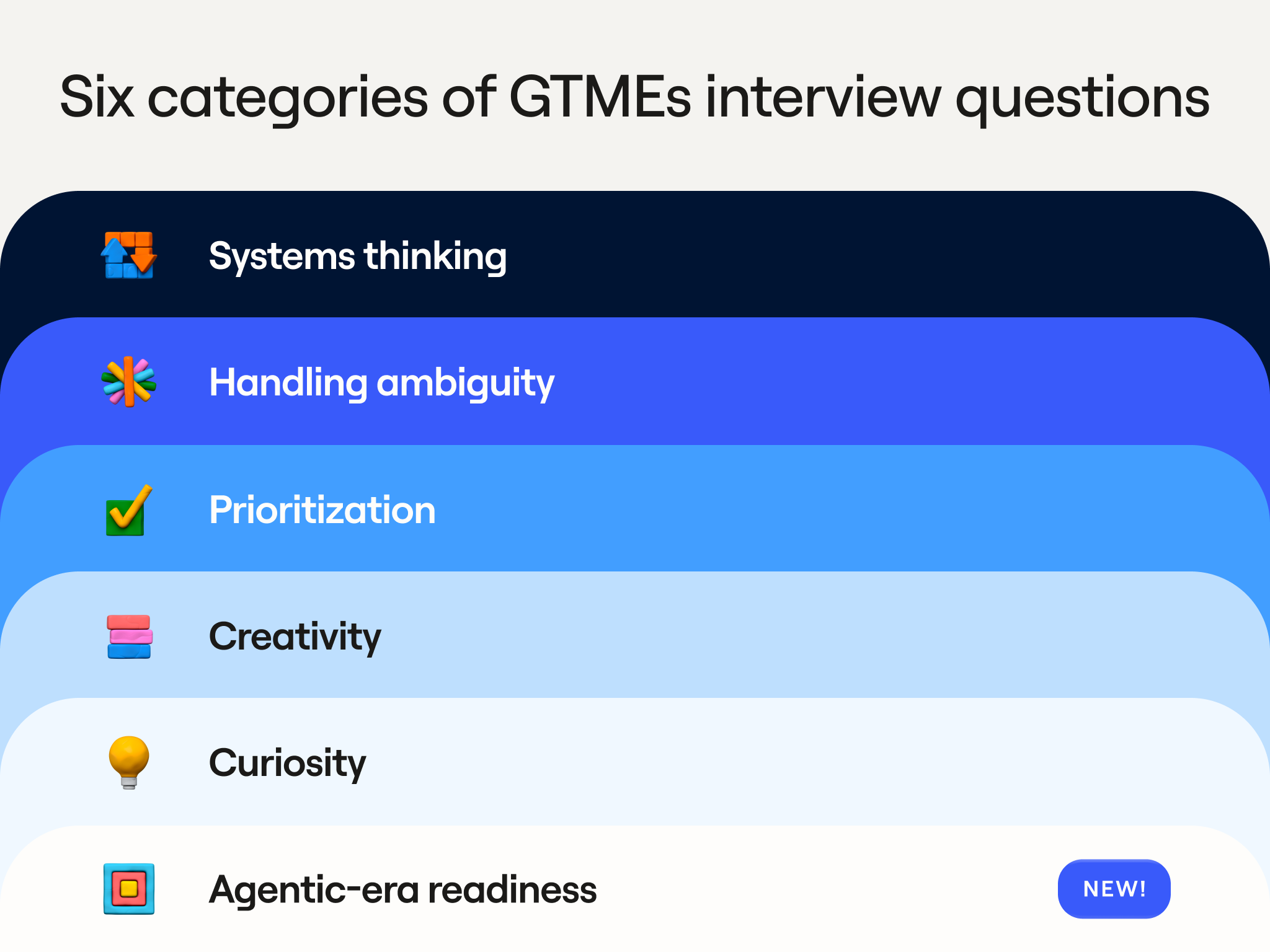
Treat this list as a starting point, rather than a boilerplate for each candidate. Some of these questions come from our original guide, but we’ve added additional ones that reflect our present process and how the role is evolving.
Systems thinking
- Can you walk me through a GTM workflow that you’ve set up before?
- If there was a drop in email response rates last month, how would you work to get the response rate back to where it was?
- Tell me about a time when you’ve helped automate a handoff between teams, e.g., growth team to SDR team.
- Walk me through a lead routing process that you’ve built before. How did you account for edge cases?
- If we have an account’s information in Snowflake, Salesforce, and Clay, which one is the source of truth, and how do you ensure the other systems stay in line with the source of truth?
Handling ambiguity
- How would you work on cleaning up our account records across different systems?
- Our sales leader is complaining that their reps are wasting time dialing and emailing bad accounts. What would you do to help them?
- Have you ever inherited a workflow that wasn’t well documented? How did you approach this?
- It’s been a year since we set our definition for a sales-qualified lead. How would you determine if our definition still makes sense?
- Tell me about a time when you didn’t have adequate data to answer a question a leader had at your company. What did you do?
Prioritization
- When have you had to ship something quickly and iterate on it later?
- You’re supporting a lot of different teams, including sales, customer success, and marketing. How would you make sure you’re helping not only the team that’s the loudest?
- Tell me about a time when you had to push back on a project you perceived as low impact. How did you communicate to the person asking you that the project wasn’t worthwhile?
- How would you measure if a workflow that you set up is working? Is this something you’d do temporarily after setting up the workflow, or is it something that would be ongoing?
- If a tool our sales reps use internally was down and we also had a malfunctioning workflow that is used to bill customers, which would you work on first and why?
Creativity
- What’s the most creative GTM automation you’ve ever seen or built?
- What’s a buying signal that you think a lot of companies aren’t looking at?
- If we wanted to double our pipeline over the next 6 months but not double our headcount, how would you help us get there?
- If you wanted to make sure our sales reps had everything they needed to win an account that’s up for renewal in a year, what’s the number one piece of context you’d want them to have, and how would you put it in front of them?
- Can you share a workflow that you originally set up for yourself that turned out to be valuable to others?
Curiosity
- What’s something technical you’ve taught yourself recently?
- Is there a tool you were really excited to try, but ended up dropping after trialing it for a while?
- Who do you follow to help you level up as a GTM engineer? What’s something specific you learned from them in the past year?
- If you’re not already really good with Clay, you’ll need to be good with it. How would you work to become proficient in the tool?
Agentic era readiness
- How do you determine when to use AI in one of your builds vs. using something that’s more deterministic (i.e., a formula)?
- Tell me about a workflow you’ve built that was mostly automated, but involved humans in the loop. How did you determine what the agent should do vs. what a person should do?
- How do you decide which model to use and route to when you’re building workflows? In what situations do you use a more expensive frontier model vs. a more budget-friendly one?
- If you had an agent that was writing to Salesforce, what guardrails would you put in place for it?
- If you had an agent that was writing outbound copy for you, how would you monitor it?
Take-home projects to assign
If you want to find a GTM builder, incorporate a build into your interview process. Our take-home assignments typically give candidates a prompt and some Clay data to work with. As output, we expect to see a functioning workflow, as well as a thoughtful presentation that walks through their building process, the assumptions they made, and any challenges or wins throughout the process.
The best ones are when the candidate shares their screen and is visibly excited about the build. Tailor the prompt to your business and the kinds of challenges a GTME might actually encounter on the job.
Here are some ideas for assignments:
- Inbound routing rebuild. This take-home asks candidates to fix a broken lead handoff. To get them started, share a month of inbound leads, and for each lead include the form the person filled out, what enrichment came back, which sales rep was assigned, and how long that rep took to follow up. As part of the assessment, this data should have some visible issues, like leads that sat untouched for days or went to the wrong rep. Then ask the candidate to explain why the leads were mishandled, build the routing and speed-to-lead logic that should replace the current setup, and to describe how they would prove the new version performs better.
- Renewal signals for sales reps. In this scenario, provide a book of customers whose contracts renew in the next three months. Share each customer’s product usage, support tickets, and summaries of recent calls. The instruction here is to build a workflow that scores every account for churn risk and expansion potential, and then to decide what a rep should see before the renewal call. Assess them on the sophistication of the build and how they balanced leaving information out to save reps time while providing them with enough context to win the deal.
- Agent audit. Share a case where an agent has spent several weeks enriching new accounts, scoring them, and drafting first-touch emails without oversight. Hand the candidate the workflow along with everything the agent produced in that time. Ask them to find the rows where the agent got the answer wrong and explain why. Then have them decide which steps should stay with the agent, which should become deterministic, and which need a human review before anything goes out. Ask for a plan to monitor the agent going forward.
When it comes to the presentation, we grade on system-level clarity: Can they explain how the flows work, defend each choice, and show they started from a complete analysis of the initial problem?
We suggest having your own rubric that decides ahead of time what “bad,” “okay,” “good,” and “exceptional” look like, not just for take-homes, but for the entire process.
Pay to provide
Pave reports that GTM engineers earn 24.7% more than traditional revenue operations professionals, but 6.4% less than software engineers.
One analysis of roughly 1,000 GTM engineering postings put the average salary at $127,500 and about four years of experience. Median listed salaries clustered around $125,000 to $150,000, but top-tier offers at companies like OpenAI reached $250,000 and above.
Here’s our approach to date:
- Start with RevOps data, adjusted for the person’s spike (marketing ops, CX ops, and so on).
- Add a premium when the candidate is more technical. RevOps itself is likely undervalued in compensation because RevOps teams are getting leaner and more senior.
- Account for the person’s previous role. For someone with an engineering background, look at where your engineering team sits.
- Use externally posted ranges as other companies hire for the role, and compensation benchmarks as they catch up.
For reference, here are three open roles we had available in November 2026. All three also provided equity, so they don’t reflect total compensation:
- GTM Engineer, Marketing: $150,000 to $220,000. Six to 10 years in marketing ops, RevOps, GTM engineering, or a similar applied technical role, with at least three of those in marketing or demand gen ops.
- GTM Engineer, Systems and Infrastructure: $140,000 to $200,000. Six to 10 years in technical RevOps, GTM engineering, SRE, or a similar field, with at least three in RevOps or sales ops, plus deep hands-on Salesforce experience.
- GTM Engineer Manager, Seller Efficiency: $240,000 to $265,000. 8 or more years building revenue systems and at least three years managing technical teams, while staying hands-on in code.
Our RevOps baseline served us early on, but now it undersells what the more technical GTMEs do. The candidates we want are increasingly comparing our offers to engineering offers. As a result, we’re moving our benchmarks closer to software engineering for the roles that call for it.
The role of the GTME will continue to evolve
If you plan to find your company’s unique GTM alpha, a GTME hiring rubric created a year ago may not be adequate to assess candidates today. People in the profession are using AI to push the boundaries of what’s possible. We’re avoiding inertia in our hiring process and continuously evolving it to scour the world for the best GTM talent.
We also want to play a part in developing talent: we recently announced a $1 million community scholarship to cover GTM engineering programs, with priority for career changers, early-career candidates, and people currently underrepresented in go-to-market. We’re excited to see how the role continues to develop, on our own team and at other companies.