


























.png)










Your sales team just closed a deal with a company that's been sitting in your CRM for eight months. The problem: the record still shows the old CEO, a generic info@ email, and an employee count from 2022. Nobody reached out because nobody knew the account had raised a Series B, hired a new VP of Sales, and started evaluating solutions in your category.
This is the CRM enrichment problem in its purest form. It's not about having data. It's about having data that's accurate enough to act on, fresh enough to reflect reality, and complete enough that your reps don't waste cycles on dead ends. The real decision tension isn't "should I enrich my CRM?" It's whether you need a point solution that fills in emails and phone numbers, or a system that continuously updates records, layers in signals, and automates what happens next.
The tools in this comparison range from browser extensions that cost $37 per seat to enterprise platforms that start at $50,000 per year. Some excel at verified direct dials in EMEA. Others are built for engineering teams who want raw API access. A few try to do everything: data, engagement, and orchestration in one platform. The right choice depends on your team size, your CRM, your target market, and whether you need enrichment as a feature or enrichment as infrastructure.
We evaluated these nine tools based on G2 ratings and review volume, pricing transparency, data coverage, CRM integration depth, and how well each fits specific GTM use cases. The goal is to help you skip the vendor demos that waste your time and focus on the two or three options that actually match how your team operates.
TL;DR
- Clay is the best choice for teams who need to aggregate data from multiple providers and automate enrichment workflows, not just fill in fields.
- ZoomInfo and Apollo.io have the largest review bases on G2, but ZoomInfo requires enterprise budgets while Apollo offers a free tier.
- Cognism wins for EMEA direct dials; Clearbit is now HubSpot-only; Lusha is the simplest option for individual reps.
- If you're building custom data products or need API-first access, People Data Labs is the developer-focused choice.
9 best CRM data enrichment tools at a glance
Clay: GTM infrastructure for teams who need more than a data vendor
Clay is not a data enrichment tool. It's the infrastructure GTM engineers use to build enrichment workflows that compound over time. The distinction matters because most tools in this category give you access to one database. Clay gives you access to 150+ data providers through a single interface, then lets you waterfall across them automatically when the first one misses.
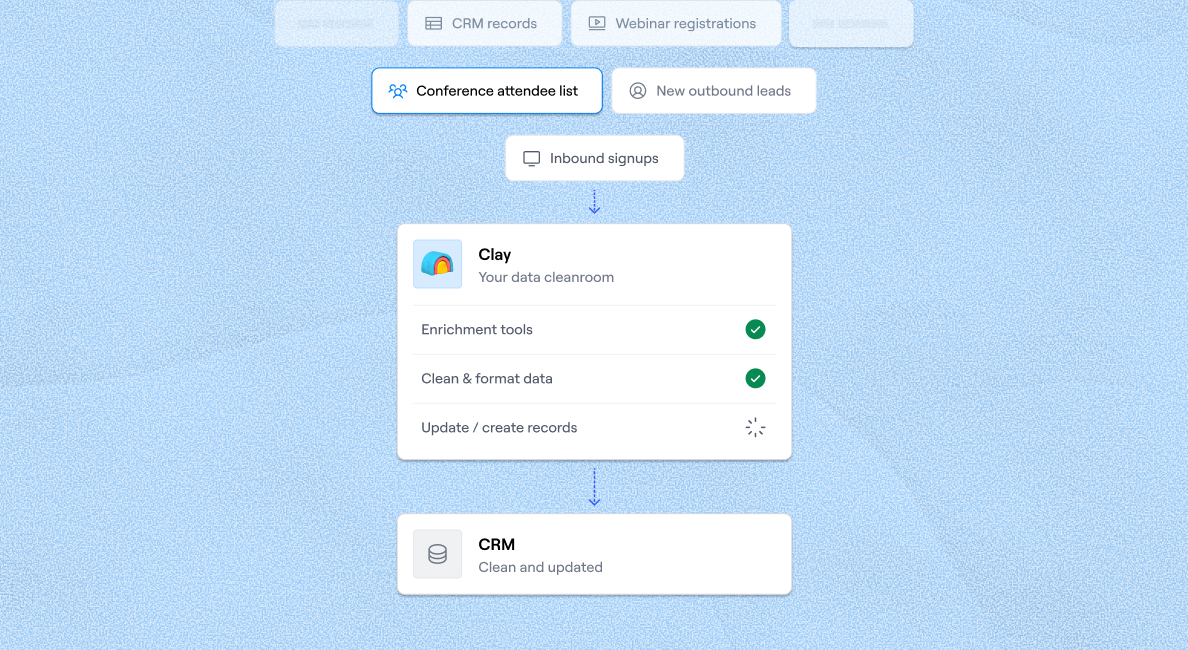
The platform combines four primitives: Data (the 150+ provider marketplace plus AI web research), Agents (Claygent for automated research at scale), Orchestration (workflows that coordinate enrichment, scoring, and routing), and Execution (write to CRM, trigger sequences, launch ads). For CRM enrichment specifically, this means you can pull a list of stale accounts from Salesforce, enrich them across multiple providers until you hit your coverage threshold, use AI to research each company's recent news, then push the updated records back to your CRM with new fields populated.
The waterfall enrichment model
Waterfall enrichment is Clay's core differentiator for CRM data quality. Instead of relying on a single provider's database, you define a sequence: try Provider A first, if no match then try Provider B, then Provider C. Clay runs this automatically for every record. The result is coverage rates that typically exceed what any single vendor can deliver.
This matters because no single data provider has complete coverage. ZoomInfo might have the direct dial for a VP of Sales at a Fortune 500, but miss the mobile number for a startup founder. Apollo might have the startup founder but lack the enterprise contact. Clay lets you stack providers without managing multiple contracts or building custom integrations.
Claygent and AI-powered research
Claygent is Clay's AI research agent. Point it at a company website, a LinkedIn profile, or any public URL, and it extracts structured data based on your prompt. For CRM enrichment, this means you can fill fields that don't exist in traditional databases: "What does this company's pricing page say about their target customer?" or "Has this person posted about evaluating new tools in the last 90 days?"
The native sequencer and workflow automation layer means enrichment doesn't stop at data. Once a record is enriched, Clay can automatically route it to the right rep, trigger a personalized email sequence, or update a lead score in your CRM. This is what makes Clay infrastructure rather than a point solution.
Pricing and the credit system
Clay uses a credit-based model split into two meters: Actions (workflow operations) and Data Credits (purchases from third-party providers in the marketplace). The free tier includes 100 data credits per month and 500 actions. Paid plans start at $185 per month for Launch (2,500+ data credits, 15,000 actions) and $495 per month for Growth (6,000+ data credits, 40,000 actions). Enterprise pricing is custom.
The credit system takes time to understand. Each fully enriched record typically costs 6-20 data credits depending on which providers you use and how many fields you're filling. The tradeoff is flexibility: you only pay for successful matches, and you can bring your own API keys to reduce costs for providers you already have contracts with.
What G2 reviewers say
Clay holds a 4.7 out of 5 rating across 213 reviews on G2. Reviewers consistently highlight the automation capabilities and time savings for lead research. The integrations library gets praise for connecting enrichment to outreach without manual exports. The main criticisms center on the learning curve and the credit system's complexity. Teams that invest in understanding the platform report significant ROI; teams looking for plug-and-play simplicity sometimes struggle in the first few weeks.
Best for: GTM teams and sales professionals at small to mid-market businesses running high-volume outbound campaigns who need to automate lead research and data enrichment workflows.
How Clay works differently
Most CRM enrichment tools are databases with an API. You query them, they return what they have, and you're stuck with their coverage gaps. Clay inverts this model. Instead of being a data provider, Clay is a data aggregator and orchestration layer. You define what data you need, Clay figures out where to get it, and the platform handles the logic of trying multiple sources until it finds a match.
The 150+ provider marketplace includes major vendors like Clearbit, ZoomInfo, and Apollo alongside specialized sources for technographics, intent signals, and contact verification. You can also use Claygent to research information that doesn't exist in any database: scraping pricing pages, reading LinkedIn posts, or extracting data from SEC filings.
This is what GTM engineering looks like in practice. Instead of buying a tool that does one thing, you build a system that compounds. Your enrichment workflow improves as you add new data sources, refine your waterfall logic, and automate more of the downstream actions.
HEX — CUSTOMER STORY
Hex, a collaborative data platform, struggled with incomplete CRM data that left their sales team working from outdated records. Their previous enrichment vendor couldn't fill critical gaps in contact information and company details.
After switching to Clay's waterfall enrichment, Hex achieved a +50% win-rate improvement and filled 88% of data gaps that their previous vendor missed. They also consolidated three separate GTM data vendors into one platform.
"We consolidated three vendors into Clay and started enriching data points that didn't exist in any traditional database. Our reps went from starting every conversation cold to knowing exactly who to call and what to say."
— Bryanna Clancy, Marketing Strategy and GTM Engineering Leader, Hex. Read their story →
SANA — CUSTOMER STORY
Sana, a learning platform for enterprises, needed to maintain accurate CRM data across 150,000 accounts spanning multiple countries. Manual enrichment couldn't keep pace with their growth, and single-vendor solutions left too many records incomplete.
Using Clay's multi-provider waterfall and automated refresh workflows, Sana achieved a 60% lift in CRM accuracy across their entire account base, enriched 30,000 accounts with custom signals, and expanded their addressable market by 20% through better data coverage.
"Reps used to spend hours validating account information because they couldn't trust the data. With Clay, reps are much more confident in our CRM data and most accounts in their books of business are now worth reaching out to. That changes everything about how you scale a GTM team."
— Fredrika Hillström, GTM Operations, Sana. Read their story →
Apollo.io: The all-in-one platform for budget-conscious teams
Apollo.io combines a 230 million contact database with built-in email sequencing, a dialer, and conversation intelligence. For teams that want CRM enrichment bundled with outreach tools, it's one of the most cost-effective options on the market.
What the database actually includes
The contact database covers verified emails and phone numbers with buyer intent scoring layered on top. Apollo's strength is breadth: 230 million contacts means you'll find matches for most B2B companies in North America and Western Europe. The platform also includes company data, technographics, and job change alerts.
The multichannel sequencing lets you build outreach workflows that combine email, phone, and LinkedIn touches. This is useful for teams that want enrichment and engagement in one tool, though the sequencing features are less customizable than dedicated sales engagement platforms.
Pricing that makes sense for SMBs
Apollo offers a free plan with 50 credits per month. Paid plans start at $49 per user per month for Basic, $79 for Professional, and $119 for Organization, all billed annually. This per-seat model is straightforward compared to credit-based systems, though costs scale linearly as you add reps.
The tradeoff is that Apollo's data comes from Apollo. You're not waterfalling across multiple providers, so coverage gaps in their database become your coverage gaps. For teams with straightforward enrichment needs and limited budgets, this is often acceptable. For teams that need maximum coverage or specialized data, it's a limitation.
Apollo.io holds a 4.7 out of 5 rating across 9,624 reviews on G2, making it the most-reviewed tool in this comparison. Users praise the ease of use and the filtering capabilities for building targeted lists. The main complaints involve data accuracy issues and limited customization in the email sequencing features.
Best for: Small business and mid-market sales teams looking for an all-in-one prospecting and engagement platform with strong filtering capabilities.
ZoomInfo: The enterprise standard with enterprise pricing
ZoomInfo is the largest B2B contact database on the market, with buyer intent signals, AI-powered sales agents, and deep CRM integrations. It's the default choice for enterprise sales teams with the budget to match.
The data foundation
ZoomInfo's database includes contact information, company firmographics, technographics, and real-time buyer intent signals. The ZoomInfo Copilot AI agent can prioritize accounts, suggest next actions, and automate research tasks. For CRM enrichment, the platform offers native integrations with Salesforce, HubSpot, and Microsoft Dynamics that keep records updated automatically.
The intent data is particularly valuable for account-based motions. ZoomInfo tracks buying signals across the web and surfaces accounts that are actively researching solutions in your category. This turns CRM enrichment from a data hygiene exercise into a prioritization engine.
What you'll actually pay
ZoomInfo doesn't publish pricing, but third-party data suggests the Professional plan starts around $14,995 per year for 3 seats with 5,000 credits. Advanced and Elite plans range from $25,000 to $45,000+ annually. Annual contracts are required, and there's no free tier.
This pricing makes ZoomInfo a non-starter for small teams. For enterprise organizations that need comprehensive data, intent signals, and integrated engagement tools, the cost is often justified by the breadth of the platform.
ZoomInfo holds a 4.5 out of 5 rating across 9,085 reviews on G2. Reviewers highlight the accurate direct dial information and the intuitive interface. The most common criticism is that contact data can be outdated, requiring verification through LinkedIn or other sources before outreach.
Best for: Enterprise and mid-market sales teams needing comprehensive B2B contact data, intent signals, and company intelligence for prospecting and outreach.
Lusha: Simple contact data for individual reps
Lusha is a browser extension that reveals contact information while you're browsing LinkedIn. It's the simplest tool in this comparison, designed for individual reps who need quick access to emails and phone numbers without complex workflows.
How the extension works
Install the Chrome extension, navigate to a LinkedIn profile, and Lusha displays verified emails and direct dial phone numbers in a sidebar. The web app and API extend this functionality for teams that need bulk enrichment or CRM integration. Lusha also offers buying signals and job change tracking, though these features are less developed than dedicated intent platforms.
The credit-based pricing is straightforward: you get a certain number of reveals per month based on your plan. This works well for reps who prospect opportunistically rather than running systematic enrichment workflows.
Pricing for small teams
Lusha offers a free plan with 70 credits per month. Paid plans start at $37.45 per user per month for Starter and $52.45 for Pro, billed annually. Scale plans have custom pricing. This makes Lusha one of the most affordable options for individual reps or small teams.
The limitation is that Lusha is a point solution. It reveals contacts one at a time (or in small batches), and the data comes from a single source. Teams that need systematic CRM enrichment or multi-provider coverage will outgrow Lusha quickly.
Lusha holds a 4.3 out of 5 rating across 1,645 reviews on G2. Users appreciate the ease of access and the reliability of contact data for LinkedIn prospecting. Common complaints include occasional inaccuracies and data that can be slow to update after job changes.
Best for: Individual sales reps and small to mid-market teams needing quick contact data access via browser extension for LinkedIn prospecting.
6sense: Predictive intent for enterprise ABM
6sense is an account-based marketing platform that uses AI to identify which accounts are in-market for your solution. CRM enrichment is one component of a broader system designed to prioritize accounts, personalize outreach, and measure pipeline impact.
The Signalverse engine
6sense's differentiator is the Signalverse, which captures over one trillion intent signals daily from across the web. The platform uses predictive AI to identify which accounts are actively researching solutions in your category and what buying stage they're in. This transforms CRM enrichment from filling in fields to prioritizing which accounts deserve attention.
The Sales Copilot provides AI-recommended actions for each account, and the platform integrates with major CRMs and marketing automation tools. For enterprise teams running sophisticated ABM programs, 6sense provides the intelligence layer that makes account prioritization data-driven rather than intuition-based.
Enterprise pricing and complexity
6sense offers a free plan with 50 data credits per month, but the full platform requires custom pricing that typically ranges from $50,000 to $200,000+ per year. Annual contracts are required. This positions 6sense as an enterprise tool for teams with mature data operations and significant budgets.
The learning curve is steep. Reviewers on G2 consistently mention the time required for setup and training. Teams that invest in proper implementation report strong results; teams that expect plug-and-play simplicity are often disappointed.
6sense holds a 4.3 out of 5 rating across 1,423 reviews on G2. Users praise the intent data quality and the visibility into account buying stages. The main criticisms involve the complex initial configuration and the time required to interpret the data effectively.
Best for: Enterprise B2B marketing and sales teams with data maturity running account-based programs who need predictive intent data and AI-driven account prioritization.
Cognism: Verified direct dials for EMEA markets
Cognism specializes in phone-verified mobile numbers and GDPR-compliant data, with particular strength in European markets. For teams selling into EMEA, it's often the best source for direct dials that actually connect.
Diamond Data verification
Cognism's Diamond Data program manually verifies mobile numbers through human researchers. This verification process produces higher connect rates than database-only approaches, which matters for teams where phone outreach is a primary channel. The platform also includes Bombora intent data integration and technographics.
The compliance focus is genuine. Cognism screens contacts against Do-Not-Call lists across 13 countries and maintains GDPR and CCPA compliance certifications. For teams selling into regulated industries or privacy-conscious markets, this reduces legal risk.
What EMEA coverage costs
Cognism doesn't publish pricing, but estimates suggest the Grow plan starts around $15,000 per year plus $1,500 per seat, with Elevate plans starting at $25,000 per year plus $2,500 per seat. Annual contracts are required, and there's no free tier.
This pricing reflects the cost of human verification. Teams that prioritize phone outreach and sell into European markets often find the premium worthwhile. Teams focused on email-first outreach or North American markets may find better value elsewhere.
Cognism holds a 4.5 out of 5 rating across 1,322 reviews on G2. Reviewers highlight the accuracy of phone numbers and the ease of building targeted lists. Some users report gaps in Continental Europe coverage and occasional inaccuracies in company details.
Best for: Mid-market and enterprise sales teams selling into EMEA markets who need verified direct dials and GDPR-compliant B2B data.
Clearbit: HubSpot-native enrichment
Clearbit is now part of HubSpot as Breeze Intelligence. For teams already using HubSpot as their CRM, it provides real-time enrichment, lead scoring, and website visitor identification without leaving the platform.
The HubSpot integration
Clearbit enriches records with 100+ B2B attributes from 250+ sources directly within HubSpot. The Reveal feature identifies anonymous website visitors via IP intelligence, turning traffic into actionable leads. Dynamic form shortening reduces friction by pre-filling fields based on known data.
The native integration means enrichment happens automatically as records enter your CRM. There's no export/import workflow, no separate login, and no data sync to manage. For HubSpot-centric teams, this simplicity is the primary value proposition.
Pricing tied to HubSpot
Clearbit as Breeze Intelligence starts at $45 per month (billed annually) for 100 credits and requires an existing HubSpot subscription. There's no standalone option, and the previous free tier has been sunset. This makes Clearbit inaccessible to teams using Salesforce, Pipedrive, or other CRMs.
The credit-based model means costs scale with usage. Teams doing high-volume enrichment may find the per-credit cost adds up quickly compared to unlimited-seat models.
Clearbit holds a 4.4 out of 5 rating across 632 reviews on G2. Users praise the easy interface and accurate company data. The main complaints involve pricing (especially for smaller teams) and occasional inaccuracies in job titles and company information.
Best for: Sales and marketing teams at small to mid-market companies needing lead enrichment, company insights, and website visitor tracking, especially HubSpot users.
FullContact: Identity resolution for MarTech platforms
FullContact is a privacy-safe identity resolution platform that links customer identifiers to a persistent PersonID. It's designed for MarTech and AdTech platforms that need to recognize people across channels, not for sales teams doing outbound prospecting.
The identity graph approach
FullContact's identity graph includes over 1 billion person profiles and 22 million company profiles. The platform links emails, phone numbers, social handles, and device IDs to a single persistent identifier. This enables cross-channel recognition without relying on third-party cookies.
For CRM enrichment, FullContact provides 900+ attributes per person, including demographic, psychographic, and behavioral data. The cookie-free website visitor identification is particularly relevant as privacy regulations tighten.
Enterprise-focused pricing
FullContact doesn't publish pricing, but third-party data suggests contracts range from $6,000 to $83,000 per year with an average around $30,000. There's no free tier, and the platform is clearly positioned for enterprise use cases.
The match rate is a consideration. G2 reviewers report rates around 50%, which can make the effective cost per enriched record higher than expected. Teams should test match rates against their specific data before committing.
FullContact holds a 4.3 out of 5 rating across 100 reviews on G2. Users highlight the identity resolution capabilities and compliance certifications (SOC 2 Type 2, GDPR, CCPA). The main criticisms involve match rates and a complicated pricing model with low rate limits for batch processing.
Best for: MarTech and AdTech platforms needing privacy-safe identity resolution and cross-channel customer recognition at enterprise scale.
People Data Labs: API-first data for developers
People Data Labs is a developer-focused data provider offering person and company data via clean, well-documented APIs. It's built for engineering teams creating data products, not for sales reps doing manual prospecting.
The API-first model
PDL provides access to over 1.5 billion person profiles through enrichment, search, and identity resolution APIs. The Elasticsearch-powered search lets you query the database with complex filters. The Person Identify API resolves partial identifiers to complete profiles.
The documentation is genuinely good. Engineering teams can integrate PDL into custom workflows, data pipelines, or product features without extensive support. The pay-per-successful-match pricing means you only pay when PDL returns data, reducing waste compared to seat-based models.
Usage-based pricing
PDL offers a free tier with 100 lookups per month. The Pro plan starts at $98 per month for 350 credits. Person enrichment costs $0.28 per successful match. Enterprise pricing is available for high-volume usage.
The tradeoff is that costs can scale quickly at high volume. G2 reviewers note that credits drain fast for teams doing bulk enrichment. The monthly data refresh cycle can also leave records weeks old, which matters for time-sensitive outreach.
People Data Labs holds a 4.3 out of 5 rating across 17 reviews on G2. Users praise the developer-grade API and the data quality philosophy. The small review count reflects PDL's niche positioning: it's excellent for engineering teams but not designed for typical sales use cases.
Best for: Engineering teams building data products, identity resolution pipelines, or recruiting platforms that need API-first data access with flexible integration.
How Clay, Apollo, ZoomInfo, Cognism, Lusha, and 6sense compare
If your CRM data decays faster than your team can update it, Clay's waterfall enrichment finds what single-vendor tools miss and keeps records fresh automatically.
The 14-day free trial includes 1,000 data credits, enough to enrich a real segment of your CRM and see how multi-provider coverage compares to your current stack.
Enrich your CRM with Clay →Frequently asked questions
Is Clay worth it for a 3-person sales team?
Yes, if your team runs systematic outbound and needs better coverage than a single data provider offers. The free tier lets you test waterfall enrichment before committing. If you're doing opportunistic prospecting with low volume, Lusha or Apollo's free tier might be simpler starting points.
What's the difference between Clay and ZoomInfo?
ZoomInfo is a data provider with a large proprietary database. Clay is infrastructure that aggregates 150+ data providers, including ZoomInfo if you bring your own API key. Clay gives you multi-provider coverage and workflow automation; ZoomInfo gives you one comprehensive database with integrated engagement tools.
Which tool has the best EMEA coverage?
Cognism specializes in European markets with phone-verified direct dials and GDPR compliance. Clay can also achieve strong EMEA coverage by waterfalling across multiple providers that specialize in different regions. ZoomInfo and Apollo have decent Western Europe coverage but are weaker in Eastern Europe and smaller markets.
Do I need a separate data provider if I use Clay?
No. Clay's marketplace includes 150+ data providers that you access through the platform. You can also bring your own API keys for providers you already have contracts with, which reduces your data credit spend. Clay handles the orchestration; you don't need to manage separate vendor relationships.
What's the cheapest option for basic CRM enrichment?
Lusha's free tier (70 credits per month) or Apollo's free tier (50 credits per month) are the lowest-cost starting points. Clay's free tier offers 100 data credits with multi-provider access. For paid plans, Lusha at $37.45 per user per month is the most affordable per-seat option for simple contact enrichment.
Your sales team just closed a deal with a company that's been sitting in your CRM for eight months. The problem: the record still shows the old CEO, a generic info@ email, and an employee count from 2022. Nobody reached out because nobody knew the account had raised a Series B, hired a new VP of Sales, and started evaluating solutions in your category.
This is the CRM enrichment problem in its purest form. It's not about having data. It's about having data that's accurate enough to act on, fresh enough to reflect reality, and complete enough that your reps don't waste cycles on dead ends. The real decision tension isn't "should I enrich my CRM?" It's whether you need a point solution that fills in emails and phone numbers, or a system that continuously updates records, layers in signals, and automates what happens next.
The tools in this comparison range from browser extensions that cost $37 per seat to enterprise platforms that start at $50,000 per year. Some excel at verified direct dials in EMEA. Others are built for engineering teams who want raw API access. A few try to do everything: data, engagement, and orchestration in one platform. The right choice depends on your team size, your CRM, your target market, and whether you need enrichment as a feature or enrichment as infrastructure.
We evaluated these nine tools based on G2 ratings and review volume, pricing transparency, data coverage, CRM integration depth, and how well each fits specific GTM use cases. The goal is to help you skip the vendor demos that waste your time and focus on the two or three options that actually match how your team operates.
TL;DR
- Clay is the best choice for teams who need to aggregate data from multiple providers and automate enrichment workflows, not just fill in fields.
- ZoomInfo and Apollo.io have the largest review bases on G2, but ZoomInfo requires enterprise budgets while Apollo offers a free tier.
- Cognism wins for EMEA direct dials; Clearbit is now HubSpot-only; Lusha is the simplest option for individual reps.
- If you're building custom data products or need API-first access, People Data Labs is the developer-focused choice.
9 best CRM data enrichment tools at a glance
Clay: GTM infrastructure for teams who need more than a data vendor
Clay is not a data enrichment tool. It's the infrastructure GTM engineers use to build enrichment workflows that compound over time. The distinction matters because most tools in this category give you access to one database. Clay gives you access to 150+ data providers through a single interface, then lets you waterfall across them automatically when the first one misses.
The platform combines four primitives: Data (the 150+ provider marketplace plus AI web research), Agents (Claygent for automated research at scale), Orchestration (workflows that coordinate enrichment, scoring, and routing), and Execution (write to CRM, trigger sequences, launch ads). For CRM enrichment specifically, this means you can pull a list of stale accounts from Salesforce, enrich them across multiple providers until you hit your coverage threshold, use AI to research each company's recent news, then push the updated records back to your CRM with new fields populated.
The waterfall enrichment model
Waterfall enrichment is Clay's core differentiator for CRM data quality. Instead of relying on a single provider's database, you define a sequence: try Provider A first, if no match then try Provider B, then Provider C. Clay runs this automatically for every record. The result is coverage rates that typically exceed what any single vendor can deliver.
This matters because no single data provider has complete coverage. ZoomInfo might have the direct dial for a VP of Sales at a Fortune 500, but miss the mobile number for a startup founder. Apollo might have the startup founder but lack the enterprise contact. Clay lets you stack providers without managing multiple contracts or building custom integrations.
Claygent and AI-powered research
Claygent is Clay's AI research agent. Point it at a company website, a LinkedIn profile, or any public URL, and it extracts structured data based on your prompt. For CRM enrichment, this means you can fill fields that don't exist in traditional databases: "What does this company's pricing page say about their target customer?" or "Has this person posted about evaluating new tools in the last 90 days?"
The native sequencer and workflow automation layer means enrichment doesn't stop at data. Once a record is enriched, Clay can automatically route it to the right rep, trigger a personalized email sequence, or update a lead score in your CRM. This is what makes Clay infrastructure rather than a point solution.
Pricing and the credit system
Clay uses a credit-based model split into two meters: Actions (workflow operations) and Data Credits (purchases from third-party providers in the marketplace). The free tier includes 100 data credits per month and 500 actions. Paid plans start at $185 per month for Launch (2,500+ data credits, 15,000 actions) and $495 per month for Growth (6,000+ data credits, 40,000 actions). Enterprise pricing is custom.
The credit system takes time to understand. Each fully enriched record typically costs 6-20 data credits depending on which providers you use and how many fields you're filling. The tradeoff is flexibility: you only pay for successful matches, and you can bring your own API keys to reduce costs for providers you already have contracts with.
What G2 reviewers say
Clay holds a 4.7 out of 5 rating across 213 reviews on G2. Reviewers consistently highlight the automation capabilities and time savings for lead research. The integrations library gets praise for connecting enrichment to outreach without manual exports. The main criticisms center on the learning curve and the credit system's complexity. Teams that invest in understanding the platform report significant ROI; teams looking for plug-and-play simplicity sometimes struggle in the first few weeks.
Best for: GTM teams and sales professionals at small to mid-market businesses running high-volume outbound campaigns who need to automate lead research and data enrichment workflows.
How Clay works differently
Most CRM enrichment tools are databases with an API. You query them, they return what they have, and you're stuck with their coverage gaps. Clay inverts this model. Instead of being a data provider, Clay is a data aggregator and orchestration layer. You define what data you need, Clay figures out where to get it, and the platform handles the logic of trying multiple sources until it finds a match.
The 150+ provider marketplace includes major vendors like Clearbit, ZoomInfo, and Apollo alongside specialized sources for technographics, intent signals, and contact verification. You can also use Claygent to research information that doesn't exist in any database: scraping pricing pages, reading LinkedIn posts, or extracting data from SEC filings.
This is what GTM engineering looks like in practice. Instead of buying a tool that does one thing, you build a system that compounds. Your enrichment workflow improves as you add new data sources, refine your waterfall logic, and automate more of the downstream actions.
HEX — CUSTOMER STORY
Hex, a collaborative data platform, struggled with incomplete CRM data that left their sales team working from outdated records. Their previous enrichment vendor couldn't fill critical gaps in contact information and company details.
After switching to Clay's waterfall enrichment, Hex achieved a +50% win-rate improvement and filled 88% of data gaps that their previous vendor missed. They also consolidated three separate GTM data vendors into one platform.
"We consolidated three vendors into Clay and started enriching data points that didn't exist in any traditional database. Our reps went from starting every conversation cold to knowing exactly who to call and what to say."
— Bryanna Clancy, Marketing Strategy and GTM Engineering Leader, Hex. Read their story →
SANA — CUSTOMER STORY
Sana, a learning platform for enterprises, needed to maintain accurate CRM data across 150,000 accounts spanning multiple countries. Manual enrichment couldn't keep pace with their growth, and single-vendor solutions left too many records incomplete.
Using Clay's multi-provider waterfall and automated refresh workflows, Sana achieved a 60% lift in CRM accuracy across their entire account base, enriched 30,000 accounts with custom signals, and expanded their addressable market by 20% through better data coverage.
"Reps used to spend hours validating account information because they couldn't trust the data. With Clay, reps are much more confident in our CRM data and most accounts in their books of business are now worth reaching out to. That changes everything about how you scale a GTM team."
— Fredrika Hillström, GTM Operations, Sana. Read their story →
Apollo.io: The all-in-one platform for budget-conscious teams
Apollo.io combines a 230 million contact database with built-in email sequencing, a dialer, and conversation intelligence. For teams that want CRM enrichment bundled with outreach tools, it's one of the most cost-effective options on the market.
What the database actually includes
The contact database covers verified emails and phone numbers with buyer intent scoring layered on top. Apollo's strength is breadth: 230 million contacts means you'll find matches for most B2B companies in North America and Western Europe. The platform also includes company data, technographics, and job change alerts.
The multichannel sequencing lets you build outreach workflows that combine email, phone, and LinkedIn touches. This is useful for teams that want enrichment and engagement in one tool, though the sequencing features are less customizable than dedicated sales engagement platforms.
Pricing that makes sense for SMBs
Apollo offers a free plan with 50 credits per month. Paid plans start at $49 per user per month for Basic, $79 for Professional, and $119 for Organization, all billed annually. This per-seat model is straightforward compared to credit-based systems, though costs scale linearly as you add reps.
The tradeoff is that Apollo's data comes from Apollo. You're not waterfalling across multiple providers, so coverage gaps in their database become your coverage gaps. For teams with straightforward enrichment needs and limited budgets, this is often acceptable. For teams that need maximum coverage or specialized data, it's a limitation.
Apollo.io holds a 4.7 out of 5 rating across 9,624 reviews on G2, making it the most-reviewed tool in this comparison. Users praise the ease of use and the filtering capabilities for building targeted lists. The main complaints involve data accuracy issues and limited customization in the email sequencing features.
Best for: Small business and mid-market sales teams looking for an all-in-one prospecting and engagement platform with strong filtering capabilities.
ZoomInfo: The enterprise standard with enterprise pricing
ZoomInfo is the largest B2B contact database on the market, with buyer intent signals, AI-powered sales agents, and deep CRM integrations. It's the default choice for enterprise sales teams with the budget to match.
The data foundation
ZoomInfo's database includes contact information, company firmographics, technographics, and real-time buyer intent signals. The ZoomInfo Copilot AI agent can prioritize accounts, suggest next actions, and automate research tasks. For CRM enrichment, the platform offers native integrations with Salesforce, HubSpot, and Microsoft Dynamics that keep records updated automatically.
The intent data is particularly valuable for account-based motions. ZoomInfo tracks buying signals across the web and surfaces accounts that are actively researching solutions in your category. This turns CRM enrichment from a data hygiene exercise into a prioritization engine.
What you'll actually pay
ZoomInfo doesn't publish pricing, but third-party data suggests the Professional plan starts around $14,995 per year for 3 seats with 5,000 credits. Advanced and Elite plans range from $25,000 to $45,000+ annually. Annual contracts are required, and there's no free tier.
This pricing makes ZoomInfo a non-starter for small teams. For enterprise organizations that need comprehensive data, intent signals, and integrated engagement tools, the cost is often justified by the breadth of the platform.
ZoomInfo holds a 4.5 out of 5 rating across 9,085 reviews on G2. Reviewers highlight the accurate direct dial information and the intuitive interface. The most common criticism is that contact data can be outdated, requiring verification through LinkedIn or other sources before outreach.
Best for: Enterprise and mid-market sales teams needing comprehensive B2B contact data, intent signals, and company intelligence for prospecting and outreach.
Lusha: Simple contact data for individual reps
Lusha is a browser extension that reveals contact information while you're browsing LinkedIn. It's the simplest tool in this comparison, designed for individual reps who need quick access to emails and phone numbers without complex workflows.
How the extension works
Install the Chrome extension, navigate to a LinkedIn profile, and Lusha displays verified emails and direct dial phone numbers in a sidebar. The web app and API extend this functionality for teams that need bulk enrichment or CRM integration. Lusha also offers buying signals and job change tracking, though these features are less developed than dedicated intent platforms.
The credit-based pricing is straightforward: you get a certain number of reveals per month based on your plan. This works well for reps who prospect opportunistically rather than running systematic enrichment workflows.
Pricing for small teams
Lusha offers a free plan with 70 credits per month. Paid plans start at $37.45 per user per month for Starter and $52.45 for Pro, billed annually. Scale plans have custom pricing. This makes Lusha one of the most affordable options for individual reps or small teams.
The limitation is that Lusha is a point solution. It reveals contacts one at a time (or in small batches), and the data comes from a single source. Teams that need systematic CRM enrichment or multi-provider coverage will outgrow Lusha quickly.
Lusha holds a 4.3 out of 5 rating across 1,645 reviews on G2. Users appreciate the ease of access and the reliability of contact data for LinkedIn prospecting. Common complaints include occasional inaccuracies and data that can be slow to update after job changes.
Best for: Individual sales reps and small to mid-market teams needing quick contact data access via browser extension for LinkedIn prospecting.
6sense: Predictive intent for enterprise ABM
6sense is an account-based marketing platform that uses AI to identify which accounts are in-market for your solution. CRM enrichment is one component of a broader system designed to prioritize accounts, personalize outreach, and measure pipeline impact.
The Signalverse engine
6sense's differentiator is the Signalverse, which captures over one trillion intent signals daily from across the web. The platform uses predictive AI to identify which accounts are actively researching solutions in your category and what buying stage they're in. This transforms CRM enrichment from filling in fields to prioritizing which accounts deserve attention.
The Sales Copilot provides AI-recommended actions for each account, and the platform integrates with major CRMs and marketing automation tools. For enterprise teams running sophisticated ABM programs, 6sense provides the intelligence layer that makes account prioritization data-driven rather than intuition-based.
Enterprise pricing and complexity
6sense offers a free plan with 50 data credits per month, but the full platform requires custom pricing that typically ranges from $50,000 to $200,000+ per year. Annual contracts are required. This positions 6sense as an enterprise tool for teams with mature data operations and significant budgets.
The learning curve is steep. Reviewers on G2 consistently mention the time required for setup and training. Teams that invest in proper implementation report strong results; teams that expect plug-and-play simplicity are often disappointed.
6sense holds a 4.3 out of 5 rating across 1,423 reviews on G2. Users praise the intent data quality and the visibility into account buying stages. The main criticisms involve the complex initial configuration and the time required to interpret the data effectively.
Best for: Enterprise B2B marketing and sales teams with data maturity running account-based programs who need predictive intent data and AI-driven account prioritization.
Cognism: Verified direct dials for EMEA markets
Cognism specializes in phone-verified mobile numbers and GDPR-compliant data, with particular strength in European markets. For teams selling into EMEA, it's often the best source for direct dials that actually connect.
Diamond Data verification
Cognism's Diamond Data program manually verifies mobile numbers through human researchers. This verification process produces higher connect rates than database-only approaches, which matters for teams where phone outreach is a primary channel. The platform also includes Bombora intent data integration and technographics.
The compliance focus is genuine. Cognism screens contacts against Do-Not-Call lists across 13 countries and maintains GDPR and CCPA compliance certifications. For teams selling into regulated industries or privacy-conscious markets, this reduces legal risk.
What EMEA coverage costs
Cognism doesn't publish pricing, but estimates suggest the Grow plan starts around $15,000 per year plus $1,500 per seat, with Elevate plans starting at $25,000 per year plus $2,500 per seat. Annual contracts are required, and there's no free tier.
This pricing reflects the cost of human verification. Teams that prioritize phone outreach and sell into European markets often find the premium worthwhile. Teams focused on email-first outreach or North American markets may find better value elsewhere.
Cognism holds a 4.5 out of 5 rating across 1,322 reviews on G2. Reviewers highlight the accuracy of phone numbers and the ease of building targeted lists. Some users report gaps in Continental Europe coverage and occasional inaccuracies in company details.
Best for: Mid-market and enterprise sales teams selling into EMEA markets who need verified direct dials and GDPR-compliant B2B data.
Clearbit: HubSpot-native enrichment
Clearbit is now part of HubSpot as Breeze Intelligence. For teams already using HubSpot as their CRM, it provides real-time enrichment, lead scoring, and website visitor identification without leaving the platform.
The HubSpot integration
Clearbit enriches records with 100+ B2B attributes from 250+ sources directly within HubSpot. The Reveal feature identifies anonymous website visitors via IP intelligence, turning traffic into actionable leads. Dynamic form shortening reduces friction by pre-filling fields based on known data.
The native integration means enrichment happens automatically as records enter your CRM. There's no export/import workflow, no separate login, and no data sync to manage. For HubSpot-centric teams, this simplicity is the primary value proposition.
Pricing tied to HubSpot
Clearbit as Breeze Intelligence starts at $45 per month (billed annually) for 100 credits and requires an existing HubSpot subscription. There's no standalone option, and the previous free tier has been sunset. This makes Clearbit inaccessible to teams using Salesforce, Pipedrive, or other CRMs.
The credit-based model means costs scale with usage. Teams doing high-volume enrichment may find the per-credit cost adds up quickly compared to unlimited-seat models.
Clearbit holds a 4.4 out of 5 rating across 632 reviews on G2. Users praise the easy interface and accurate company data. The main complaints involve pricing (especially for smaller teams) and occasional inaccuracies in job titles and company information.
Best for: Sales and marketing teams at small to mid-market companies needing lead enrichment, company insights, and website visitor tracking, especially HubSpot users.
FullContact: Identity resolution for MarTech platforms
FullContact is a privacy-safe identity resolution platform that links customer identifiers to a persistent PersonID. It's designed for MarTech and AdTech platforms that need to recognize people across channels, not for sales teams doing outbound prospecting.
The identity graph approach
FullContact's identity graph includes over 1 billion person profiles and 22 million company profiles. The platform links emails, phone numbers, social handles, and device IDs to a single persistent identifier. This enables cross-channel recognition without relying on third-party cookies.
For CRM enrichment, FullContact provides 900+ attributes per person, including demographic, psychographic, and behavioral data. The cookie-free website visitor identification is particularly relevant as privacy regulations tighten.
Enterprise-focused pricing
FullContact doesn't publish pricing, but third-party data suggests contracts range from $6,000 to $83,000 per year with an average around $30,000. There's no free tier, and the platform is clearly positioned for enterprise use cases.
The match rate is a consideration. G2 reviewers report rates around 50%, which can make the effective cost per enriched record higher than expected. Teams should test match rates against their specific data before committing.
FullContact holds a 4.3 out of 5 rating across 100 reviews on G2. Users highlight the identity resolution capabilities and compliance certifications (SOC 2 Type 2, GDPR, CCPA). The main criticisms involve match rates and a complicated pricing model with low rate limits for batch processing.
Best for: MarTech and AdTech platforms needing privacy-safe identity resolution and cross-channel customer recognition at enterprise scale.
People Data Labs: API-first data for developers
People Data Labs is a developer-focused data provider offering person and company data via clean, well-documented APIs. It's built for engineering teams creating data products, not for sales reps doing manual prospecting.
The API-first model
PDL provides access to over 1.5 billion person profiles through enrichment, search, and identity resolution APIs. The Elasticsearch-powered search lets you query the database with complex filters. The Person Identify API resolves partial identifiers to complete profiles.
The documentation is genuinely good. Engineering teams can integrate PDL into custom workflows, data pipelines, or product features without extensive support. The pay-per-successful-match pricing means you only pay when PDL returns data, reducing waste compared to seat-based models.
Usage-based pricing
PDL offers a free tier with 100 lookups per month. The Pro plan starts at $98 per month for 350 credits. Person enrichment costs $0.28 per successful match. Enterprise pricing is available for high-volume usage.
The tradeoff is that costs can scale quickly at high volume. G2 reviewers note that credits drain fast for teams doing bulk enrichment. The monthly data refresh cycle can also leave records weeks old, which matters for time-sensitive outreach.
People Data Labs holds a 4.3 out of 5 rating across 17 reviews on G2. Users praise the developer-grade API and the data quality philosophy. The small review count reflects PDL's niche positioning: it's excellent for engineering teams but not designed for typical sales use cases.
Best for: Engineering teams building data products, identity resolution pipelines, or recruiting platforms that need API-first data access with flexible integration.
How Clay, Apollo, ZoomInfo, Cognism, Lusha, and 6sense compare
If your CRM data decays faster than your team can update it, Clay's waterfall enrichment finds what single-vendor tools miss and keeps records fresh automatically.
The 14-day free trial includes 1,000 data credits, enough to enrich a real segment of your CRM and see how multi-provider coverage compares to your current stack.
Enrich your CRM with Clay →Frequently asked questions
Is Clay worth it for a 3-person sales team?
Yes, if your team runs systematic outbound and needs better coverage than a single data provider offers. The free tier lets you test waterfall enrichment before committing. If you're doing opportunistic prospecting with low volume, Lusha or Apollo's free tier might be simpler starting points.
What's the difference between Clay and ZoomInfo?
ZoomInfo is a data provider with a large proprietary database. Clay is infrastructure that aggregates 150+ data providers, including ZoomInfo if you bring your own API key. Clay gives you multi-provider coverage and workflow automation; ZoomInfo gives you one comprehensive database with integrated engagement tools.
Which tool has the best EMEA coverage?
Cognism specializes in European markets with phone-verified direct dials and GDPR compliance. Clay can also achieve strong EMEA coverage by waterfalling across multiple providers that specialize in different regions. ZoomInfo and Apollo have decent Western Europe coverage but are weaker in Eastern Europe and smaller markets.
Do I need a separate data provider if I use Clay?
No. Clay's marketplace includes 150+ data providers that you access through the platform. You can also bring your own API keys for providers you already have contracts with, which reduces your data credit spend. Clay handles the orchestration; you don't need to manage separate vendor relationships.
What's the cheapest option for basic CRM enrichment?
Lusha's free tier (70 credits per month) or Apollo's free tier (50 credits per month) are the lowest-cost starting points. Clay's free tier offers 100 data credits with multi-provider access. For paid plans, Lusha at $37.45 per user per month is the most affordable per-seat option for simple contact enrichment.













.avif)













.avif)


















.webp)



.avif)