


































.avif)









LLMs have made software dramatically cheaper to build. The result is a market flooded with new products, all competing for the same finite customer attention. When everyone can ship quickly, winning becomes less about what you build and more about how precisely you understand the people you're selling to.
Speed without context produces noise. Without a unified view of who a prospect is, how they've engaged, and when to act, outreach lands generic and mistimed regardless of how fast it moves.
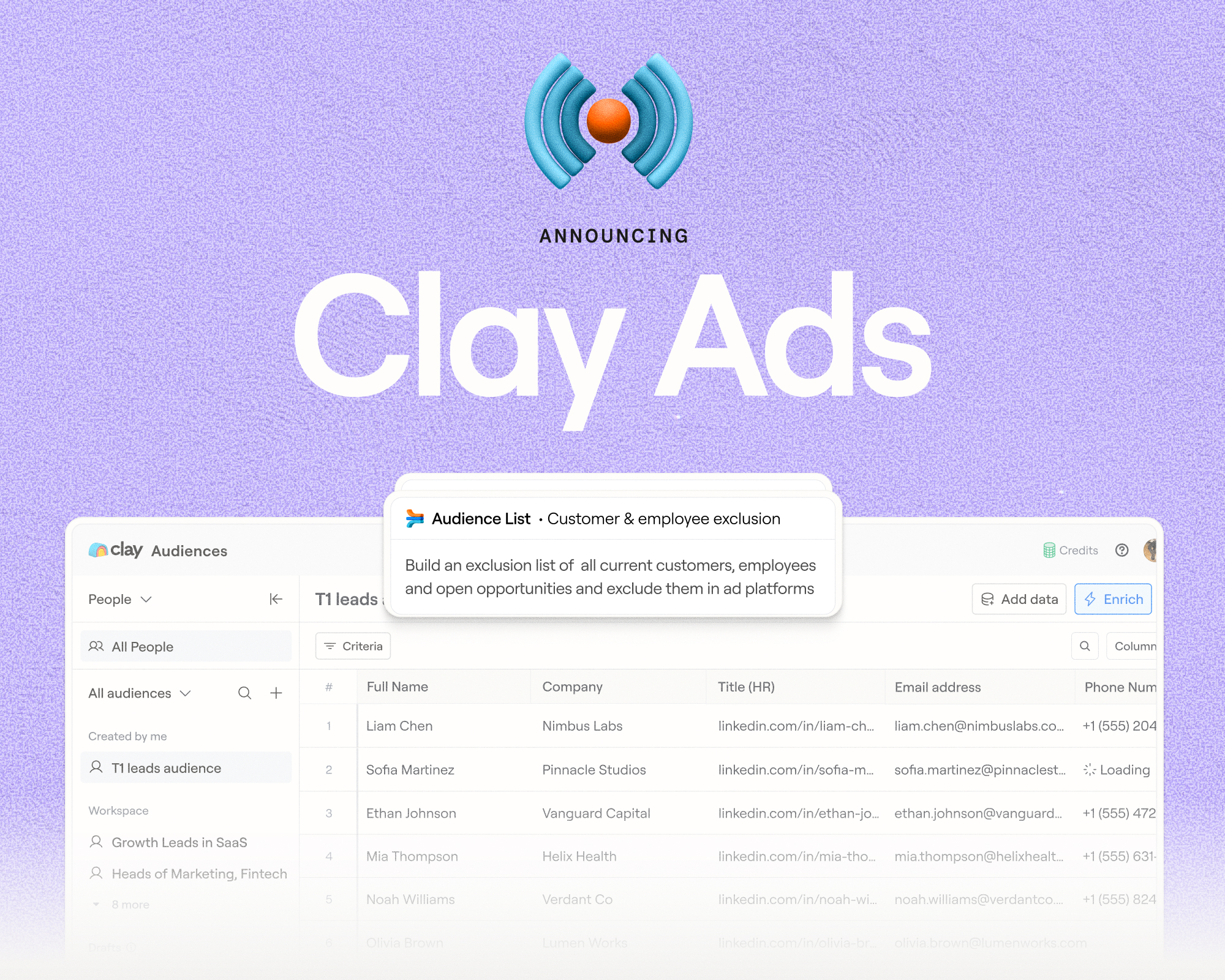
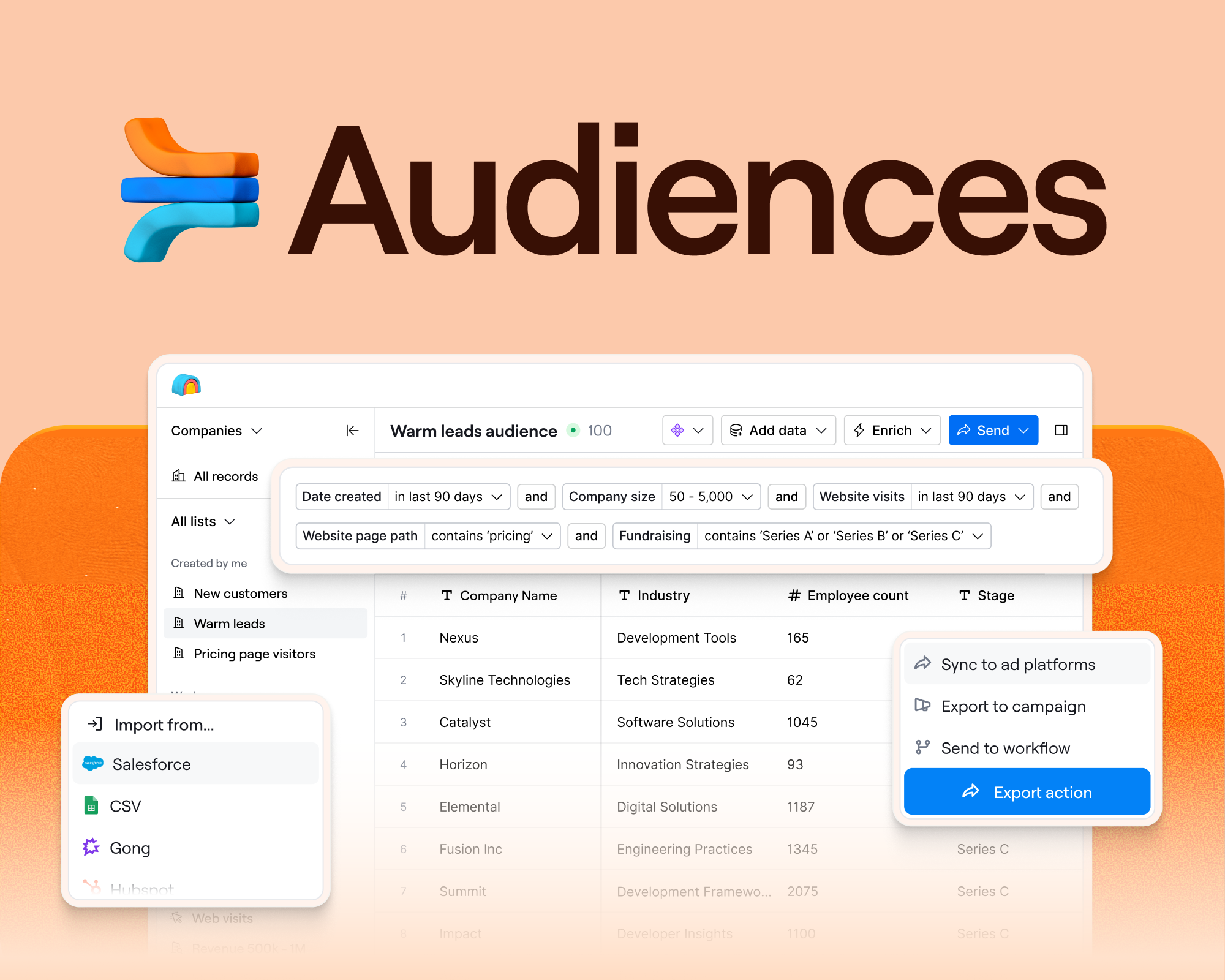
This is why we’re launching Audiences, now available in Enterprise beta. Audiences brings millions of first-party records from your CRM and data warehouse into Clay, layers in third-party enrichments and real-time intent signals, and enables agentic and human-led workflows to act on top of it. It gives you a complete picture of your customers, prospects, and addressable market in one place, so both reps and agents have the unified data layer they need to run plays that differentiate from competitors.
Incomplete context produces generic outreach
Consider the plays that matter most to your team right now: a hyper-growth customer showing early churn signals who needs proactive, personalized outreach before they start evaluating alternatives; an account actively comparing you to a competitor, where your champion needs to hear from you before the deal goes cold; a set of tier-1 upsell targets whose product usage and review activity just spiked.
None of these work effectively without deep, unified context about the account. That's true whether a rep is running them manually or an agent is running them at scale. Some of that context lives in third-party data — firmographics, funding signals, technographics, competitive intelligence. The signals that make these plays precise, though, live in your own systems: CRM records, product usage data, call transcripts, deal history. Without access to both, execution breaks down the same way regardless of who's doing it.
How Audiences works
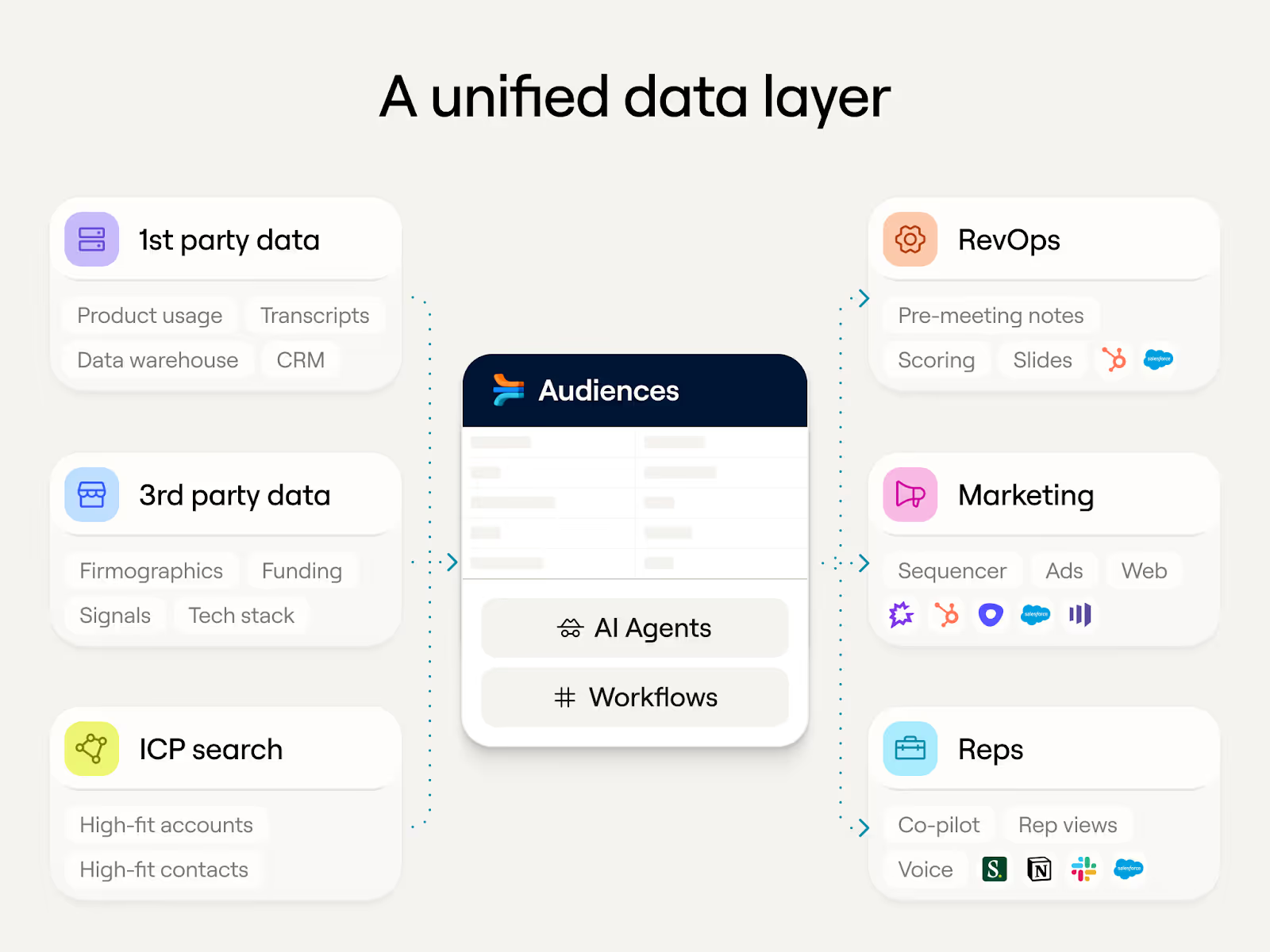
Audiences unifies your GTM data inside Clay across three layers of context:
- First, it lets you import millions of first-party records from your CRM or data warehouse into Clay. That includes product usage data, call transcripts, deal stages, and much more.
- Second, it layers in third-party enrichments and intent signals to this. This includes firmographics, tech stack data, hiring trends, funding events, web intent, and AI-driven research.
- Third, it can source your complete TAM, not just accounts already in your pipeline. Named accounts, untouched prospects, dormant deals, and net-new companies can all live inside the same dynamic segmentation system.
A team with all three layers can target mid-market SaaS companies already using their product on a self-serve plan, whose usage spiked last week, and whose champion just changed jobs. That precision lets companies find their GTM alpha, and run unique plays their competitors can’t.
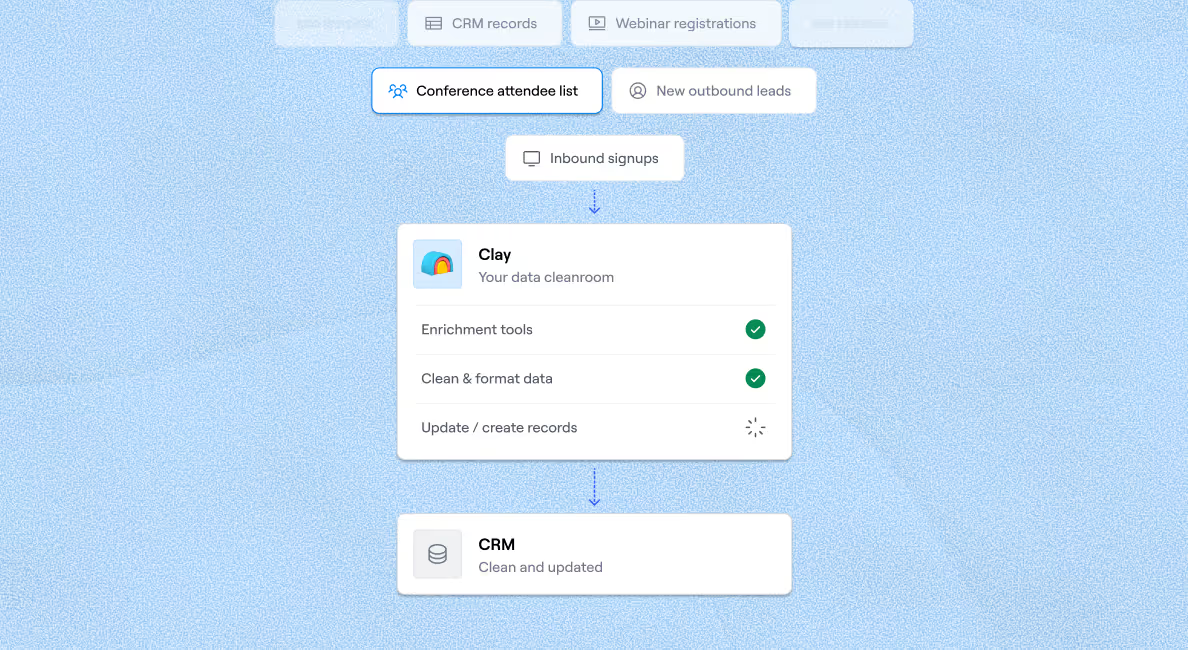
Audiences is built to unify all three layers, pulling first-party records from your CRM and data warehouse, enriching them with third-party signals, and keeping the whole picture current as your market changes.
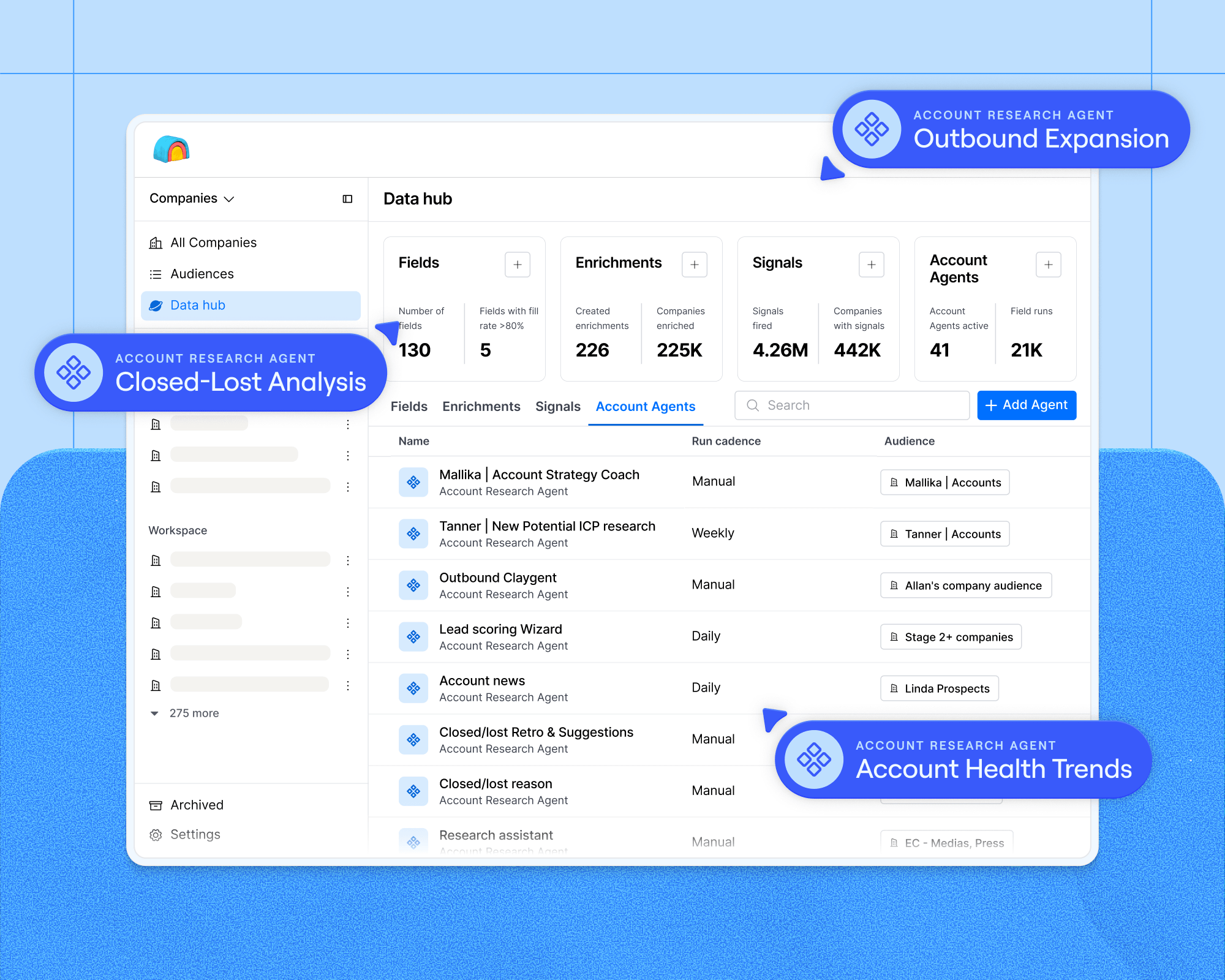
Once that data is unified in Clay, teams can run workflows directly on top of it. RevOps can build scoring and routing logic, marketing can activate segments for campaigns, and reps can get pre-call context and signal alerts without pulling a single report manually.
Use cases
Audiences enables TAM sourcing: finding accounts your competitors haven't
Figma's Salesforce database had grown through years of organic activity with no continuous enrichment process. Over 30% of contacts no longer worked at the companies they were listed under. Their marketing ops team used Audiences to import the entire CRM, enrich every record with firmographic data and identity resolution, and configure always-on enrichment that writes back to Salesforce automatically. The database stopped being a historical archive and started behaving like a living system the team could confidently build on top of.
Read the entire Figma case study here.
Lead scoring: activating first-party data across the funnel
Most GTM teams are sitting on product usage data, CRM records, and call transcripts they never systematically connect to their outreach. Audiences pulls all of it into Clay and makes that context available to every workflow running on top of it.
ElevenLabs had signals everywhere, from inbound form fills to product usage data to website visits from named accounts. But there was no connective layer that could enrich, score, and route across all of them. They built a multi-signal scoring model in Clay that now evaluates every inbound lead automatically before it reaches a rep, delivering 50% more incremental sales-qualified leads overall and a 4x increase in SQLs from demand gen campaigns specifically.
They're now piloting Audiences to take this further. The goal: aggregate every intent signal at the account level across each rep's full book, and turn it into a living, prioritized view of which accounts to work right now. That data pipes into Salesforce to power account-level intent scores and workflows, giving AEs and SDRs a single place to see where activity is spiking, why, and what to do next.
Signal-based plays: acting on signals before the window closes
Knowing an account is a good fit matters less than knowing when they're ready to buy. Funding events, product signals, and web intent indicate buying readiness, but only if you act on them before the moment passes.
Figma had roughly 150,000 Pro accounts in its PLG pipeline, but no signal infrastructure connecting them to the sales motion, the vast majority were invisible to reps even when showing signs of upgrade intent. Their team is using Audiences to pull Snowflake product signals into the same data layer as CRM history and third-party enrichment, then built segments combining product-qualified activity with funding signals and hiring patterns. When conditions are met, reps receive recommended plays and outreach personalization automatically. No manual list pulls. No stale exports.
AI outbound: the right message for the right person, automatically
Context determines who to reach and what to say. Audiences can reference complete context about a contact like its account value, touchpoint history, and prior outreach to generate the right message for that specific person. Sequences branch automatically based on what's there: a cold introduction for net-new contacts, re-engagement copy for anyone previously reached.
One customer was running this process manually, with reps importing weekly book top-ups into Salesloft every Monday morning. They're moving it into Clay so that personalized, segmented sequences fire automatically as new accounts enter their book at a scale of 10M+ records that a manual process couldn't support.
Why this matters more as AI becomes standard
When every company uses AI to build and sell, the teams with deeper context win. Generic AI outputs are easy to produce and easy to ignore. Outreach that reflects specific, accurate knowledge about a prospect's situation is harder to replicate and harder to dismiss.
Audiences is how we're making all of this information actionable. We’re unifying first-party data from your CRM and data warehouse with third-party enrichments and real-time signals across your entire TAM, all inside Clay. The result is a complete picture of your customers, prospects, and addressable market in one place, with agentic and human-led workflows running on top of it.
GTM advantages don't last forever. The teams building this context layer now will have the infrastructure to adapt quickly when the next shift comes.
Audiences is available in Enterprise beta. Enterprise customers will now be able to access Audiences directly in Clay, and we’re working on making this feature available across more plans. To learn more, book time with the Clay team here.






.png)



.avif)














.avif)













.avif)