Close
Thank you! Your submission has been received!
Oops! Something went wrong while submitting the form.
We couldn't find anything for that query...

How Clay turns closed lost deals into pipeline, product signals, and buyer intelligence

Author
Author
Clay Team
Date
Jun 3, 2026

GTM teams are sitting on a gold mine of opportunities that cost zero dollars to activate: your CRM and your call data. Peek inside and you’ll see the opportunities you lost, the calls your reps made, the champions who moved on, the deals that stalled because of a product gap that may no longer exist.

The problem is that most of this data is incomplete, stale, or buried and even when it's there, nobody's watching for the signals that tell you when to act.

Clay's growth team built a system to pull that intelligence systematically and route it to three audiences at once: sales teams get automated re-engagement plays with full deal context and timing signals, and product and product marketing teams receive aggregated insight that normally takes weeks of customer interviews to surface. Same data source. Three compounding outputs.

This post walks through how the system works, what it produces, and how it keeps running without anyone manually maintaining it.

Keep reading to see how:

  • A Clay table pulls closed lost opportunities from Snowflake, ingests Gong transcripts tied to each deal, and uses Claygent to extract true loss reasons, competitive intel, buying committee details, re-engagement likelihood and recommendation, and write a re-engagement email.
  • The same data feeds a Sculptor analysis that replaces weeks of customer interviews with automated pattern recognition - surfacing product gaps by revenue impact, competitive signals, as well as pricing, persona and positioning insights in a document you can bring directly to a roadmap planning session.
  • The workflow runs continuously - updating Salesforce fields like loss reason, product gaps, and positioning intel as new closed lost deals come in, and triggering re-engagement plays automatically when timing signals fire.

The problem: your CRM data is incomplete and your call transcripts are sitting unwatched

Ask any sales leader how accurate their closed lost data is and the answer is usually some version of "not very." Loss reason fields are filled in under pressure, usually with whatever category requires the least explanation. "Other", "price", and "no response" are doing a lot of heavy lifting in most instances.

The actual story of why you lost a deal lives somewhere else: in the Gong call where the champion mentioned a competitor by name, in the conversation where the buying timeline shifted, in the moment the economic buyer explained exactly what was missing. That context exists, just not in your CRM.

And even when the data is accurate at the time of close, it goes stale. A deal you lost to a competitor nine months ago looks different if that competitor just raised prices. A deal you lost because of a missing feature looks different if you shipped that feature last quarter and now you have a reason to go back.

The manual approach to this problem - running win/loss reviews, surveying lost customers, pulling call recordings one by one - is too slow and too dependent on someone remembering to do it.

Here are three plays you can run in Clay to make it all possible at scale.

Clay Play 1: Identifying which closed lost accounts to re-engage

The first workflow starts with a pull from Snowflake. Everything tied to an opportunity comes in: the account, the contacts, who was on the calls, the loss reason field (however unreliable), and the call transcripts linked to that deal through Gong.

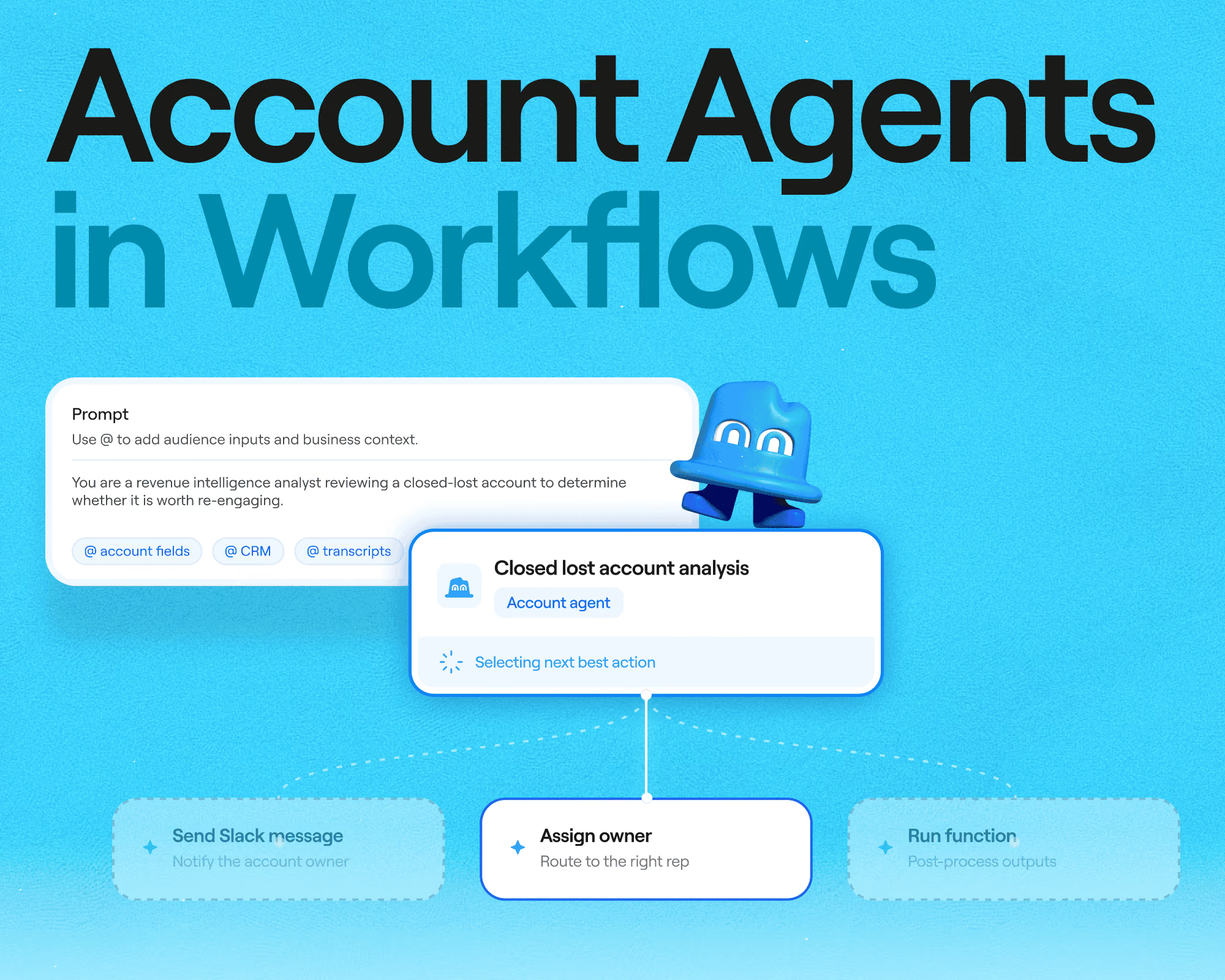
From there, a Claygent runs a custom prompt against the transcript data to extract:

  • The true loss reason, derived from what was actually said on calls rather than what was logged in Salesforce
  • Competitive intelligence: which products came up, how they were framed, and what specifically tipped the decision
  • The buying committee: champion, decision-maker, economic buyer, and which personas were most engaged
  • Pain points and product gaps mentioned explicitly, with the exact language the prospect used
  • Internal and external timing signals: new funding rounds, champion movement, competitor contract windows, negative competitor press, and Clay product releases that close a gap that previously blocked the deal
  • Re-engagement likelihood (high, medium, low) and recommended timing (act now or wait) based on internal deal context and external signals surfaced at run time

The output is a ready-to-use re-engagement play: a personalized email that references the original context, an account summary with full deal history, and re-engagement timing recommendation. The rep gets everything they need to reach back out intelligently, without having to track down the original account owner or read through call transcripts.

What makes this programmatic rather than a one-time audit: the table runs on a schedule you set, continuously re-evaluating every closed lost account against current signals. The right accounts surface at the right time - when a competitor contract window opens, when a product gap gets shipped, when a champion moves. You build the workflow once and it keeps finding opportunities without anyone managing it.

Clay Play 2: Turning call intelligence into product and competitive insight

The same data that runs the re-engagement workflow also feeds something less obvious: a structured input for product planning that replaces weeks of manual customer research.

[IMAGE] 

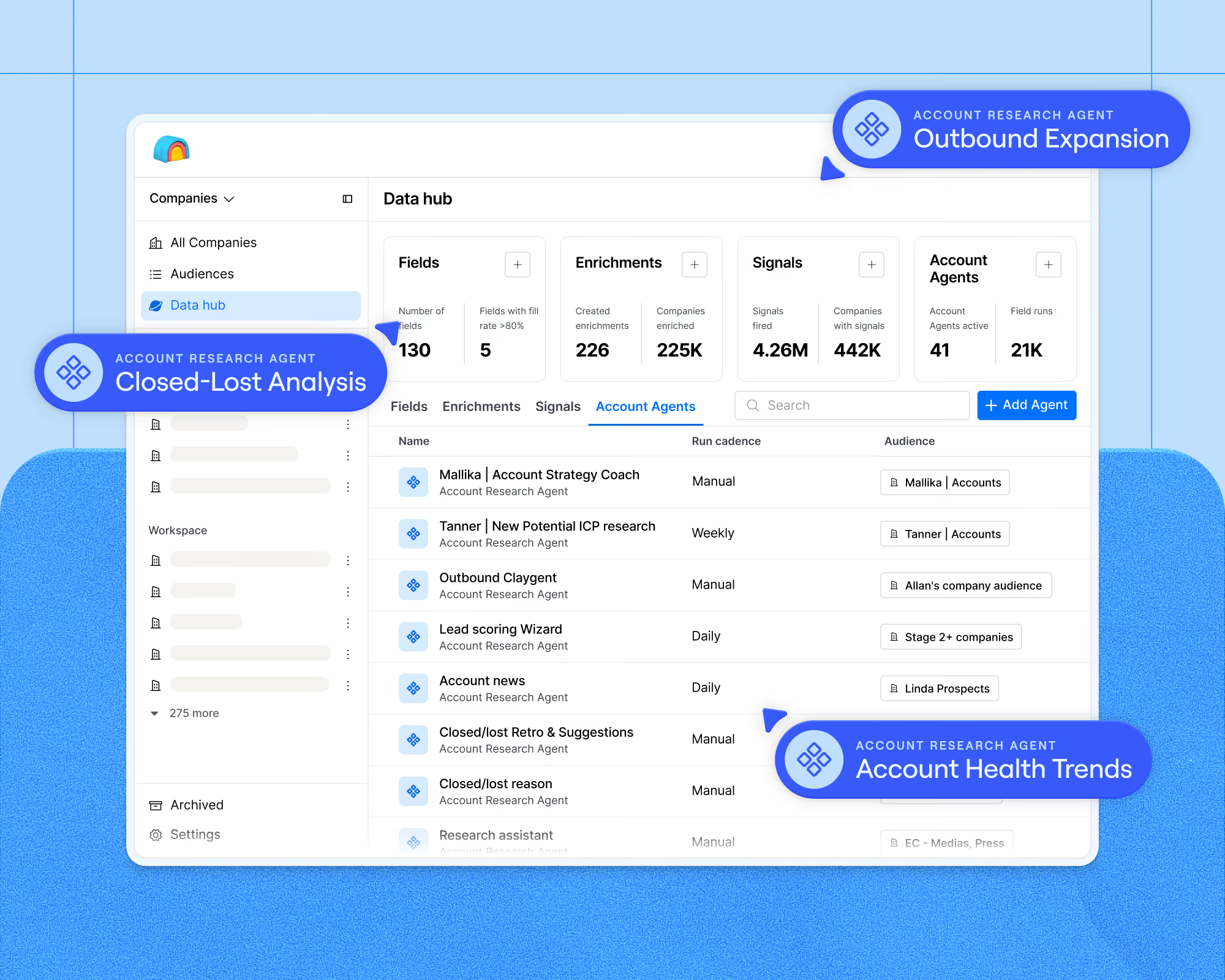
Once the Claygent has processed the transcripts, the extracted structured fields - loss reasons, pain points, product gaps, competitive mentions, and voice of customer feedback - live in a Clay table. Sculptor can then run an analysis across any time window and generate a document summarizing the patterns.

Ask it to look at the last two quarters of closed lost deals and it will tell you: which product gaps came up most frequently and what the combined deal value of those losses was, what competitors kept appearing in the same context, how different buyer personas described their needs, and what objections are clustering around specific use cases.

This is pattern recognition at scale. The same insight you'd get from fifty customer interviews surfaced automatically from conversations that already happened.

Critically, it also tells you which features to prioritize. Not based on the loudest customer voice or a product manager's intuition, but based on aggregated deal data. What gaps are costing you the most revenue, and what wins are most commonly associated with specific capabilities.

One example of this in practice: Signals, a feature Clay launched to help teams track job changes and other buying triggers, was showing up consistently in competitive loss analysis. Prospects would say they preferred Clay on the product but that a competitor offered signals, so they went elsewhere. When that pattern appeared repeatedly in the transcript data, it became hard to ignore. We shipped the features and the loss reason stopped appearing. And the close-lost accounts who mentioned signals were re-engaged with a timely and relevant talk-track for the rep. 

That feedback loop doesn't require a quarterly survey or a series of advisory calls. It requires a table that runs automatically and someone to read the document it produces.

Clay Play 3: Keeping Salesforce accurate without asking reps to do it

The same Claygent logic that extracts intelligence from closed lost deals gets written back to Salesforce automatically, so the CRM record is finally accurate.

[IMAGE] 

The problem it solves is familiar to anyone who's spent time in a CRM: Salesforce fields that reps are supposed to fill in manually such as champion name, tools in use, renewal date, and attribution source are either blank or wrong.

When a deal becomes lost, the workflow pulls the Gong calls, runs the Claygent, and writes the real loss reason, product gaps, competitive mentions, and buying committee back to Salesforce automatically so the CRM record reflects what actually happened in the deal.

Timing signals buried in transcripts like a competitor contract coming up for renewal, a budget freeze lifting after a fundraise, a product gap the prospect named explicitly get extracted and stored as structured fields. When those conditions change, the workflow acts. A competitor contract approaches expiration, a re-engagement play fires. A product gap gets shipped, accounts that cited it as a loss reason surface for outreach the same day.

The result is a CRM that reflects reality where sales reps get time back to focus on building relationships that close deals.

What this adds up to

Closed lost re-engagement, product roadmap prioritization, pricing and positioning intelligence, and CRM hygiene are four distinct problems. Call transcripts tied to opportunities address all of them.

What makes the approach durable is the two-angle structure. Product and product marketing teams get aggregated deal intelligence they can bring to roadmap planning: which features are driving wins, which gaps are costing deals, how the ICP actually talks about their problems. Sales teams get automated plays that trigger when conditions change with personalized outreach ready to go.

Neither team has to ask the other for what they need. The same workflow produces both outputs, continuously, from data you already have.

Want to see the full workflow? Watch the livestream where Clay's GTM team walks through the end-to-end build, from CRM connection to rep handoff.

Frequently asked questions

How does Clay extract accurate loss reasons if the CRM data is incomplete? The Claygent reads Gong call transcripts tied to each opportunity and derives the true loss reason from what was said on calls. This surfaces competitive intel, product gaps, and timeline objections that never make it into the CRM loss reason field.

How does the re-engagement scoring work? The Claygent assigns a high, medium, or low score based on current signals: whether the champion has changed roles, whether there are recent funding events, whether a competitor is approaching a renewal window. The score updates automatically when the table re-runs, so prioritization reflects current conditions rather than a static snapshot.

Can the workflow trigger outreach automatically when conditions change? Yes. When a competitor contract approaches renewal, when a feature ships that addresses a logged product gap, or when a champion moves to a new company, the workflow can surface the account and trigger a re-engagement play without anyone manually monitoring for those signals.

Does this replace the need for customer research? No. Transcript data structured in Clay gives product and PMM teams a continuous layer of market feedback that supplements customer interviews.

GTM teams are sitting on a gold mine of opportunities that cost zero dollars to activate: your CRM and your call data. Peek inside and you’ll see the opportunities you lost, the calls your reps made, the champions who moved on, the deals that stalled because of a product gap that may no longer exist.

The problem is that most of this data is incomplete, stale, or buried and even when it's there, nobody's watching for the signals that tell you when to act.

Clay's growth team built a system to pull that intelligence systematically and route it to three audiences at once: sales teams get automated re-engagement plays with full deal context and timing signals, and product and product marketing teams receive aggregated insight that normally takes weeks of customer interviews to surface. Same data source. Three compounding outputs.

This post walks through how the system works, what it produces, and how it keeps running without anyone manually maintaining it.

Keep reading to see how:

  • A Clay table pulls closed lost opportunities from Snowflake, ingests Gong transcripts tied to each deal, and uses Claygent to extract true loss reasons, competitive intel, buying committee details, re-engagement likelihood and recommendation, and write a re-engagement email.
  • The same data feeds a Sculptor analysis that replaces weeks of customer interviews with automated pattern recognition - surfacing product gaps by revenue impact, competitive signals, as well as pricing, persona and positioning insights in a document you can bring directly to a roadmap planning session.
  • The workflow runs continuously - updating Salesforce fields like loss reason, product gaps, and positioning intel as new closed lost deals come in, and triggering re-engagement plays automatically when timing signals fire.

The problem: your CRM data is incomplete and your call transcripts are sitting unwatched

Ask any sales leader how accurate their closed lost data is and the answer is usually some version of "not very." Loss reason fields are filled in under pressure, usually with whatever category requires the least explanation. "Other", "price", and "no response" are doing a lot of heavy lifting in most instances.

The actual story of why you lost a deal lives somewhere else: in the Gong call where the champion mentioned a competitor by name, in the conversation where the buying timeline shifted, in the moment the economic buyer explained exactly what was missing. That context exists, just not in your CRM.

And even when the data is accurate at the time of close, it goes stale. A deal you lost to a competitor nine months ago looks different if that competitor just raised prices. A deal you lost because of a missing feature looks different if you shipped that feature last quarter and now you have a reason to go back.

The manual approach to this problem - running win/loss reviews, surveying lost customers, pulling call recordings one by one - is too slow and too dependent on someone remembering to do it.

Here are three plays you can run in Clay to make it all possible at scale.

Clay Play 1: Identifying which closed lost accounts to re-engage

The first workflow starts with a pull from Snowflake. Everything tied to an opportunity comes in: the account, the contacts, who was on the calls, the loss reason field (however unreliable), and the call transcripts linked to that deal through Gong.

From there, a Claygent runs a custom prompt against the transcript data to extract:

  • The true loss reason, derived from what was actually said on calls rather than what was logged in Salesforce
  • Competitive intelligence: which products came up, how they were framed, and what specifically tipped the decision
  • The buying committee: champion, decision-maker, economic buyer, and which personas were most engaged
  • Pain points and product gaps mentioned explicitly, with the exact language the prospect used
  • Internal and external timing signals: new funding rounds, champion movement, competitor contract windows, negative competitor press, and Clay product releases that close a gap that previously blocked the deal
  • Re-engagement likelihood (high, medium, low) and recommended timing (act now or wait) based on internal deal context and external signals surfaced at run time
The output is a ready-to-use re-engagement play: a personalized email that references the original context, an account summary with full deal history, and re-engagement timing recommendation. The rep gets everything they need to reach back out intelligently, without having to track down the original account owner or read through call transcripts.

What makes this programmatic rather than a one-time audit: the table runs on a schedule you set, continuously re-evaluating every closed lost account against current signals. The right accounts surface at the right time - when a competitor contract window opens, when a product gap gets shipped, when a champion moves. You build the workflow once and it keeps finding opportunities without anyone managing it.

Clay Play 2: Turning call intelligence into product and competitive insight

The same data that runs the re-engagement workflow also feeds something less obvious: a structured input for product planning that replaces weeks of manual customer research.

[IMAGE] 

Once the Claygent has processed the transcripts, the extracted structured fields - loss reasons, pain points, product gaps, competitive mentions, and voice of customer feedback - live in a Clay table. Sculptor can then run an analysis across any time window and generate a document summarizing the patterns.

Ask it to look at the last two quarters of closed lost deals and it will tell you: which product gaps came up most frequently and what the combined deal value of those losses was, what competitors kept appearing in the same context, how different buyer personas described their needs, and what objections are clustering around specific use cases.

This is pattern recognition at scale. The same insight you'd get from fifty customer interviews surfaced automatically from conversations that already happened.

Critically, it also tells you which features to prioritize. Not based on the loudest customer voice or a product manager's intuition, but based on aggregated deal data. What gaps are costing you the most revenue, and what wins are most commonly associated with specific capabilities.

One example of this in practice: Signals, a feature Clay launched to help teams track job changes and other buying triggers, was showing up consistently in competitive loss analysis. Prospects would say they preferred Clay on the product but that a competitor offered signals, so they went elsewhere. When that pattern appeared repeatedly in the transcript data, it became hard to ignore. We shipped the features and the loss reason stopped appearing. And the close-lost accounts who mentioned signals were re-engaged with a timely and relevant talk-track for the rep. 

That feedback loop doesn't require a quarterly survey or a series of advisory calls. It requires a table that runs automatically and someone to read the document it produces.

Clay Play 3: Keeping Salesforce accurate without asking reps to do it

The same Claygent logic that extracts intelligence from closed lost deals gets written back to Salesforce automatically, so the CRM record is finally accurate.

[IMAGE] 

The problem it solves is familiar to anyone who's spent time in a CRM: Salesforce fields that reps are supposed to fill in manually such as champion name, tools in use, renewal date, and attribution source are either blank or wrong.

When a deal becomes lost, the workflow pulls the Gong calls, runs the Claygent, and writes the real loss reason, product gaps, competitive mentions, and buying committee back to Salesforce automatically so the CRM record reflects what actually happened in the deal.

Timing signals buried in transcripts like a competitor contract coming up for renewal, a budget freeze lifting after a fundraise, a product gap the prospect named explicitly get extracted and stored as structured fields. When those conditions change, the workflow acts. A competitor contract approaches expiration, a re-engagement play fires. A product gap gets shipped, accounts that cited it as a loss reason surface for outreach the same day.

The result is a CRM that reflects reality where sales reps get time back to focus on building relationships that close deals.

What this adds up to

Closed lost re-engagement, product roadmap prioritization, pricing and positioning intelligence, and CRM hygiene are four distinct problems. Call transcripts tied to opportunities address all of them.

What makes the approach durable is the two-angle structure. Product and product marketing teams get aggregated deal intelligence they can bring to roadmap planning: which features are driving wins, which gaps are costing deals, how the ICP actually talks about their problems. Sales teams get automated plays that trigger when conditions change with personalized outreach ready to go.

Neither team has to ask the other for what they need. The same workflow produces both outputs, continuously, from data you already have.

Want to see the full workflow? Watch the livestream where Clay's GTM team walks through the end-to-end build, from CRM connection to rep handoff.

Frequently asked questions

How does Clay extract accurate loss reasons if the CRM data is incomplete? The Claygent reads Gong call transcripts tied to each opportunity and derives the true loss reason from what was said on calls. This surfaces competitive intel, product gaps, and timeline objections that never make it into the CRM loss reason field.

How does the re-engagement scoring work? The Claygent assigns a high, medium, or low score based on current signals: whether the champion has changed roles, whether there are recent funding events, whether a competitor is approaching a renewal window. The score updates automatically when the table re-runs, so prioritization reflects current conditions rather than a static snapshot.

Can the workflow trigger outreach automatically when conditions change? Yes. When a competitor contract approaches renewal, when a feature ships that addresses a logged product gap, or when a champion moves to a new company, the workflow can surface the account and trigger a re-engagement play without anyone manually monitoring for those signals.

Does this replace the need for customer research? No. Transcript data structured in Clay gives product and PMM teams a continuous layer of market feedback that supplements customer interviews.

More Articles