
We’re making the most significant change to Clay’s pricing since we launched. We've spent the better part of the last year stress-testing this model — talking to customers, reviewing workflows, and working through the financial implications. This memo lays out what we're changing and why.
In 2022, Clay was one of the first GTM companies with a usage-based pricing model that revolved around credits, rather than seats. Pricing via credits gave our customers flexibility and has been a meaningful driver of our growth.
Our credit-based pricing gave customers access to 150+ data vendors without managing individual contracts or minimums, so customers paid only for what they used. As customers advanced through our self-serve plans, they paid less per credit. Enterprise customers, at the top end, paid a higher cost per credit in exchange for premium features and a more supported experience.
In short, our pricing worked. So why make a change?
Clay is a different product than it was in 2022, and our customers use Clay very differently too. We’ve moved from a simpler enrichment-oriented product to a true end-to-end GTM platform, but our pricing hasn't kept up with that change.
We have a thesis that there is a broader industry shift coming for most AI businesses. When AI introduced real marginal costs into SaaS for the first time in decades, most companies — including us — responded by reorienting pricing away from value metrics like seats towards costs instead, most often with credits or tokens.
But customers don't come to Clay to buy inputs. They come to run outbound, score leads, and automate their GTM. While the AI industry dreams about outcome-based pricing, we think there is a more likely intermediate step where companies re-learn that pricing is not just about covering high costs.
This isn’t a new frontier: almost every other hard-cost industry over centuries, from potato chips to automobiles, has dealt with high variable cost goods. In almost all of those cases, the differentiated players don’t price cost-plus, but based on the value customers get out of the product.
At Clay, we want to separate those two components and provide more clarity to our customers: the raw ingredient inputs we help customers find, and the way they use those inputs to create value and grow on Clay.
Specifically, our current pricing has three core problems:
1. We priced Clay like a data product. It’s evolved into an end-to-end GTM platform.
When we started, most customers came to Clay to enrich and export lists — companies, contacts, work emails. Simple data enrichment was where most people began, and the pricing reflected that starting point.
Today, data is still a powerful wedge — with 150+ data partners and AI-sourced enrichment, we consistently win data evaluations. But our most sophisticated customers have moved well beyond enrichment. They use Clay to run acquisition, retention, and expansion plays at scale, combining first-party data, third-party signals, and AI in a single workflow. Features like Audiences, Sculptor, and Sequencer accelerated that shift.
The value of Clay is not just the data we source, but the workflow, GTM executions, and capabilities we enable on top. Our pricing, however, never caught up: we still charge primarily per data point, even as more of the value we deliver comes from orchestration and automation.
Pricing primarily per data point made sense when data was the product. This creates a few challenges: customers don't want to pay a premium on data that's becoming commoditized, platform value is hard to capture through data markups, and there's no clear relationship between how much a customer gets out of Clay and what they pay today.
2. Data costs don't scale fairly across plans
Today, the spread in what customers pay per credit has become hard to justify. Our smallest self-serve customers pay close to 8 cents per credit, while others pay ~80% less — a nearly 5x spread. With a spread that large, you either end up overpricing small customers or losing money on large ones.
In 2022, we made the second mistake. When we created our pricing plans, we mispriced cost per credits in the Pro segment. Not only has this created challenging dynamics as our customer scaled with us, but it’s also meant that we’ve been operating at a loss in this segment for years.
3. Fixed AI pricing creates adverse selection
When we introduced fixed AI pricing, costs were more predictable and customers valued certainty. Reasoning models changed that. Some prompts take a few steps; others take dozens. The cost variance is significant.
Fixed pricing near the average means simple prompts are overcharged while complex prompts are unprofitable. This has led to adverse selection: customers with low-cost workloads use their own API keys and find Clay’s pricing to be poor value, while high-cost workloads concentrate within Clay's fixed-price model.
[REDACTED] Chart: AI cost ($) vs. Distribution of customer AI-runs (percentile), for reasoning and non-reasoning models
We are making four core changes to Clay’s pricing model
1. Price platform value and data separately
Clay exists to help teams grow; data is just an input. Currently, every credit you spend in Clay is tied to data — but a lot of what Clay does isn't about data. Running AI, calling external APIs, pushing account research to your reps before customer calls: that's orchestration work, and our pricing does not capture it.
To reflect this, we are separating out the cost of the underlying data you consume from the amount of work you accomplish. Every plan will come with both Data Credits and Actions.
Data Credits, as before, give customers access to data from Clay's marketplace of 150+ partners. But now, for the first time, Clay’s data won’t have a large platform markup. We’re reducing the cost of data in our marketplace by 50–90%, making prices comparable to what customers would pay externally. Buying data on Clay should feel flexible, convenient, and competitive.
Actions are a new measurement of the orchestration work that Clay performs: enrichments, AI tasks, HTTP API calls, and pushes to third-party platforms. Basic functionality like first-party imports, formulas, and transformations do not count. This aligns pricing with where platform value is actually created.
Every plan will default with 4-5 actions per data credit, which is based on the usage of Clay’s power users. We've intentionally set Action limits generously, and expect 90% of customers will never hit them on the entry-level Actions count for each plan tier. Customers can explore Clay without worrying about usage, and only need to expand their Actions capacity when their ambitions on Clay expand.
And as always, we want customers to bring as much of their own data into Clay as they’d like, in addition to using our ecosystem of partners. Our goal is simply to power their growth, no matter what their starting point is.
2. Streamline from four to three paid plans
Right now, the main difference between Clay plans is how many credits you get. That makes choosing the right plan harder than it should be
In our new pricing, plans have highly differentiated features and usage capacity. Choosing a plan should feel intuitive based on what features customers need, how much they’re doing in Clay, and what level of support they want. They’re designed around where customers are on their journeys.
Launch plans are great for individuals and very small teams just getting started with GTM orchestration.
Growth plans are extremely feature rich for scaling teams: they include CRM integrations to run plays seamlessly with your system of record; HTTP APIs for more customizability; and an introduction to our upcoming Ads capabilities with industry-leading match rates and best-in-class CPLs.
Enterprise plans offer Clay’s full feature capabilities, including data warehouse integrations, bulk enrichments that enable workloads well past 50,000 row limits on tables, more Ads audiences, and working alongside our Growth Strategists to help build workflows that are suited to your business’s needs. Our Enterprises succeed with Clay at a remarkable rate — we have yet to churn an Enterprise account, and they double their activity with Clay on average within the first 12 months — and we’re excited to see more customers experience that level of success in Clay.
We’re also making a conscious decision to move more value into the highest self-serve tier while lowering the access price meaningfully. Our new Growth plan starts at $495 per month, more than $300 cheaper than our legacy Pro plan ($800). While there’s revenue risk to doing so, there’s a clear bet here: we know there’s a lot of value in premium features like HTTP API and CRM integrations, which unlock better outcomes for our customers, so we’d rather expand access and bet on our customers succeeding and growing with us, rather than gatekeeping some of Clay’s best capabilities to a smaller audience.
Legacy plans:
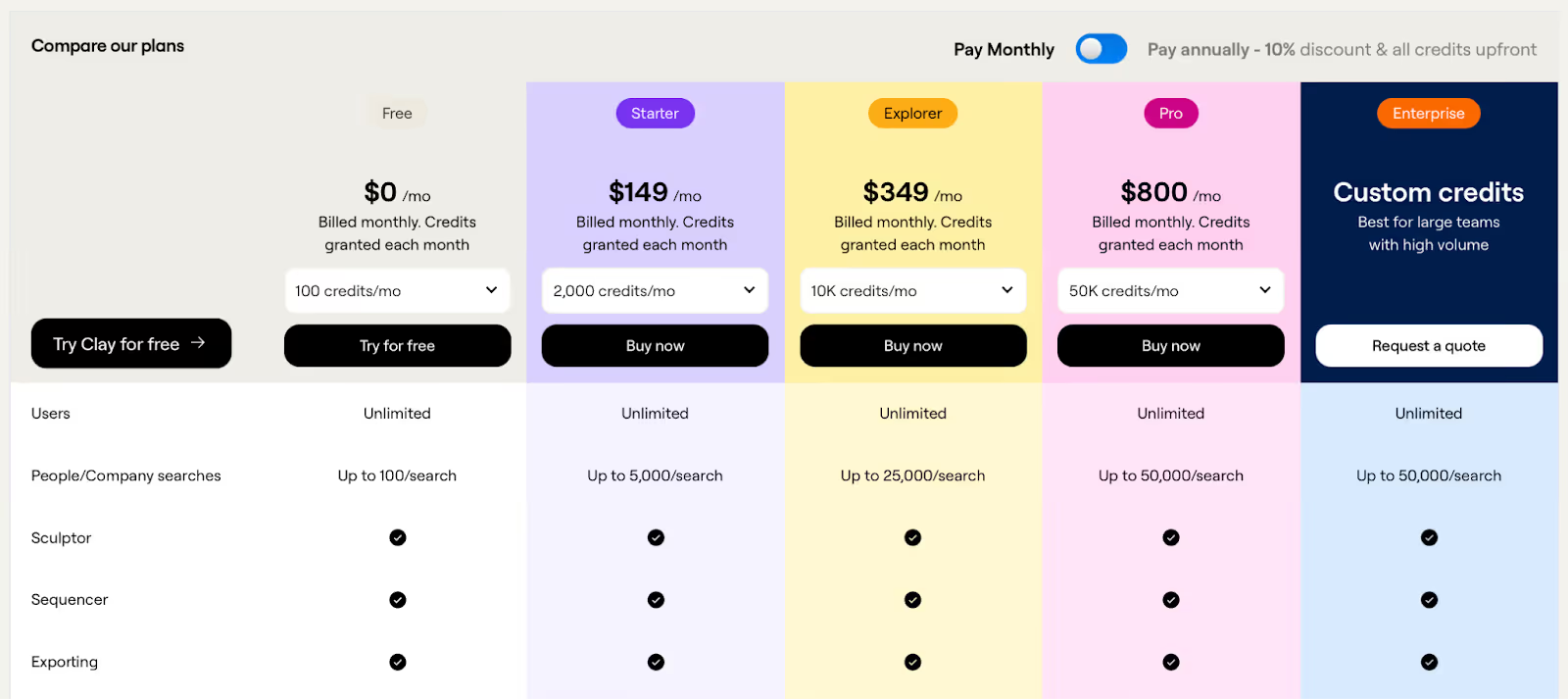
Modern plans:
3. Make data cheaper, especially at scale
Beyond offering price cuts on data, our new pricing model smooths out the cost curve. Data credits will never get more expensive as usage scales — from our smallest self-serve customers through our largest Enterprise accounts. The goal is for Clay to feel like the most competitive place to buy data at any point in our customers’ growth journey.
As Clay continues to scale and gets better rates from our data partners, we're committed to passing those savings on to customers. We believe making data more accessible with our scale will drive more usage and better outcomes for our customers. We’re excited to grow as our customers scale their volume of workflows and use cases, rather than by maximizing prices.
4. Shift AI pricing to reflect actual usage, and remove markup on reasoning models
Our customers value predictability, and they want pricing that feels fair. We're introducing a hybrid structure that gives them both.
For most models — simpler models and Clay's first-party Claygent models (Helium, Neon, and Argon) — we're keeping fixed credit pricing. Because the cost outcomes on these models are more bounded, Clay can absorb the outcome volatility for our customers and pass on predictability. Customers know exactly what they're spending before they hit “run.”
For more complex reasoning models, where token consumption can vary significantly, we're moving to variable pricing based on actual tokens consumed. Rather than setting an arbitrarily high fixed price to cover that volatility, customers pay for what they actually use — at exactly the cost they'd pay going direct, with 0% markup from Clay.
In both cases, paying for AI through Clay comes with the benefit of our negotiated rate limits with model providers: customers can run complex workflows at least 2x faster through Clay than they could with their own API keys.
The result is that customers have a real choice in how they pay for AI in Clay, with pricing that reflects what they're actually doing.
Existing customers have the option to stay on legacy plans
Most pricing changes come with a firm end date for old plans, and for good reason: maintaining legacy pricing plans can be expensive and logistically challenging across Engineering, Customer Success, Product, Support, and many other teams. Every pricing consultant we spoke with recommended against this.
But forcing our customers into a change this big didn’t feel right to us. We think the right thing to do is to offer our customers the optionality to choose what is best for them.
Existing customers can stay on their current plan — and if that ever changes, we'll communicate it transparently well in advance. Customers will have 30 days to decide which legacy plan they want to keep. After that window, legacy plans will be closed to new sign-ups and plan changes, though existing customers can stay on them. We'll reach out proactively to any customers who stand to save under the new pricing.
Enterprise customers transition to the new model at renewal or earlier if they’d like. For most, we’d expect this to be a net positive — driven primarily by lower data costs and a more scalable pricing structure.
Our near-term financial impact is negative — and that’s okay
This pricing change is intentionally revenue- and profit-negative in the near term. Here's what that looks like across segments.
Self-serve segment
Either customers will be able to save money by moving (and we'll let them know!), so they'll move; or new pricing may be more expensive, so they'll stay on their current plan. We estimate that [REDACTED]% of customers could save money by switching to a modern plan within Self-serve, amounting to $[REDACTED] impact.
[REDACTED] Table: Revenue % mix that can save by plan (Self-serve): Low, base, high estimate (Dec 2025)
Enterprise segment
With significant price reductions in Data Credits, more than [REDACTED]% of Enterprise customers are expected to save money under the new structure. If all Enterprise customers migrated today, they would collectively save [REDACTED] data credits, worth approximately $[REDACTED]. We'll reach out proactively to customers who stand to benefit.
[REDACTED] Table: Revenue % mix that can save (Enterprise plan): Low, base, high estimate (Dec 2025)
Reduction in data revenue
We are cutting the cost of data credits across our most used enrichments and highlighting some of the most significant changes below.
[REDACTED] Table: Top 20 Enrichments with credit reductions, ranked by % change
We estimate a [REDACTED]% decline in revenue from data credits, with a larger impact on gross profit.
The six main risks of this proposed change
We see six risks with this change. Here's how we're thinking about each.
1. New customers may convert at a lower rate. Based on simulated revenue data using existing usage patterns, roughly [REDACTED]% of new customers would face a higher starting price under the new model versus old. Some may convert at a lower rate or start at a lower plan tier. We’d expect that as customers adopt the product and see value, they'll expand to the right plan level over time — but this is a real near-term risk.
[REDACTED] Chart: Simulated self-serve MRR pricing impact, grouped by price increase / decrease bands
2. The model is more complex. Customers are sometimes anxious about tracking credit balances, and adding Actions to the mix doesn’t make that any simpler. We’re mitigating this risk by scoping our plans generously, so 90% of customers should never hit the Action limits scoped in their plans. Actions should feel like a background metric for most users
3. Customers might experiment less. This is the risk we take most seriously. We want people trying everything in Clay—adding new signals, testing workflows, etc. It’s fair to ask whether activity ceilings could discourage that.
Two things give us confidence. First, since enrichments are cheaper under the new model, most customers should actually be able to do more with the same spend. Second, if a customer is consistently hitting their ceiling, it likely means they're getting strong value from the product. We'll be watching this closely.
4. Direct API users may find Clay more expensive. Direct API usage would no longer be unbounded, which is a real shift for Agency partners who frequently use APIs. This is partly offset by native platform data getting meaningfully cheaper. Existing self-serve customers could stay on their current plans, which should ease the transition.
[REDACTED] Chart: % of Customers with Direct API usage by Plan (Dec 2025)
Beyond the near-term impact, we think this change is net positive for Agencies over time. Deeper enterprise adoption will create more opportunities for Agency partners — higher-value engagements and more clients running their own workspaces. As that happens, Agencies shift toward the strategic work they're best at.
5. Our community may push back. Our community is one of our biggest superpowers, and pricing changes are sensitive. While we have customer education to do, our flexible rollout with our existing customers should mitigate large backlash. No one is being forced onto a new plan, and existing users can stay on their current plan while they evaluate on their own terms.
We've already talked to key customers and partners across segments, and they’ve generally been receptive. They almost universally understand how this model better aligns with Clay's value.
6. The financial impact on Clay could be worse than modeled. We have a real risk of ongoing negative financial impact. If all customers downgraded to the closest modern plan, we could see revenue fall another REDACTED%. We're watching conversion, ARPA, and retention closely. We don't see this as a one-way door — we'll track the data and adjust as we learn.
[REDACTED] Chart: Estimated Combined Financial Impact (Dec 2025)
Four upside levers from pricing
We see four potential upside scenarios that could offset near-term losses.
1. Fewer direct API substitutions. Today, [REDACTED]% of enrichments in Clay run through unmonetized direct APIs. Under the new model, data purchased through Clay would be more competitively priced, which should incentivize more purchases through our marketplace.
2. More feature-driven upgrades. Historically, customers upgraded when they ran out of credits. Under this proposal, they should also upgrade when they need more features.
Among Starter and Explorer customers, [REDACTED]% use HTTP API — meaning [REDACTED]% will need a Growth plan for their feature needs alone.
If 25% of them upgrade to the lowest Growth tier, that translates to a [REDACTED]% ARR increase. This creates a healthier dynamic: customers upgrade to unlock more capability, not simply to overcome volume limits.
[REDACTED] Table: Estimated Impact of Feature-Led Upgrades by Legacy Plan
3. More self-serve to Enterprise upgrades. Clay has never churned an Enterprise customer: they succeed with us at a higher rate and grow at a higher rate. The new pricing would create a smoother pathway for our self-serve customers to experience our Enterprise offering. Assuming 10% of Pro customers expand to an Enterprise plan, we'd see [REDACTED]% incremental ARR, and also see higher success rates.
[REDACTED] Table: Estimated Impact of Self-Serve to Enterprise Upgrades - Low, Base, High
4. Better profit contribution from large self-serve customers. Previously, our Pro customers were a conundrum for Clay’s business. While they were scaled users, we were selling them credits at or below breakeven levels. Under the new model, large self-serve customers would be profitable. If Pro customers migrated to Growth plans over time, revenue would shift down by [REDACTED]%, but gross profit would increase by [REDACTED]%.
[REDACTED] Table: Gross Profit Impact of Pro Customers - Low, Base, High
Where we go from here
We don’t take pricing changes lightly, and we don’t plan to make them often (except to keep bringing down the cost of data over time!). They’re major transitions, both for customers who value predictability and for our team as we work to implement them.
We think this change is the right thing to do. It aligns our model with how customers actually use Clay, and positions Clay for sustainable, long-term growth by aligning our business model with how customers create value. The near-term financial impact is negative, but the alternative — a pricing model that increasingly misrepresents the value we deliver — is worse.
Executing this well would take focus across Growth Strategists, GTMEs, Support, and Marketing. The teams closest to customers will be critical in helping them understand the new model and navigate the transition. Done well, this strengthens our relationships with customers and sets Clay up for more durable, long-term growth: one where what's good for customers and what's good for Clay point in the same direction.
We’re making the most significant change to Clay’s pricing since we launched. We've spent the better part of the last year stress-testing this model — talking to customers, reviewing workflows, and working through the financial implications. This memo lays out what we're changing and why.
In 2022, Clay was one of the first GTM companies with a usage-based pricing model that revolved around credits, rather than seats. Pricing via credits gave our customers flexibility and has been a meaningful driver of our growth.
Our credit-based pricing gave customers access to 150+ data vendors without managing individual contracts or minimums, so customers paid only for what they used. As customers advanced through our self-serve plans, they paid less per credit. Enterprise customers, at the top end, paid a higher cost per credit in exchange for premium features and a more supported experience.
In short, our pricing worked. So why make a change?
Clay is a different product than it was in 2022, and our customers use Clay very differently too. We’ve moved from a simpler enrichment-oriented product to a true end-to-end GTM platform, but our pricing hasn't kept up with that change.
We have a thesis that there is a broader industry shift coming for most AI businesses. When AI introduced real marginal costs into SaaS for the first time in decades, most companies — including us — responded by reorienting pricing away from value metrics like seats towards costs instead, most often with credits or tokens.
But customers don't come to Clay to buy inputs. They come to run outbound, score leads, and automate their GTM. While the AI industry dreams about outcome-based pricing, we think there is a more likely intermediate step where companies re-learn that pricing is not just about covering high costs.
This isn’t a new frontier: almost every other hard-cost industry over centuries, from potato chips to automobiles, has dealt with high variable cost goods. In almost all of those cases, the differentiated players don’t price cost-plus, but based on the value customers get out of the product.
At Clay, we want to separate those two components and provide more clarity to our customers: the raw ingredient inputs we help customers find, and the way they use those inputs to create value and grow on Clay.
Specifically, our current pricing has three core problems:
1. We priced Clay like a data product. It’s evolved into an end-to-end GTM platform.
When we started, most customers came to Clay to enrich and export lists — companies, contacts, work emails. Simple data enrichment was where most people began, and the pricing reflected that starting point.
Today, data is still a powerful wedge — with 150+ data partners and AI-sourced enrichment, we consistently win data evaluations. But our most sophisticated customers have moved well beyond enrichment. They use Clay to run acquisition, retention, and expansion plays at scale, combining first-party data, third-party signals, and AI in a single workflow. Features like Audiences, Sculptor, and Sequencer accelerated that shift.
The value of Clay is not just the data we source, but the workflow, GTM executions, and capabilities we enable on top. Our pricing, however, never caught up: we still charge primarily per data point, even as more of the value we deliver comes from orchestration and automation.
Pricing primarily per data point made sense when data was the product. This creates a few challenges: customers don't want to pay a premium on data that's becoming commoditized, platform value is hard to capture through data markups, and there's no clear relationship between how much a customer gets out of Clay and what they pay today.
2. Data costs don't scale fairly across plans
Today, the spread in what customers pay per credit has become hard to justify. Our smallest self-serve customers pay close to 8 cents per credit, while others pay ~80% less — a nearly 5x spread. With a spread that large, you either end up overpricing small customers or losing money on large ones.
In 2022, we made the second mistake. When we created our pricing plans, we mispriced cost per credits in the Pro segment. Not only has this created challenging dynamics as our customer scaled with us, but it’s also meant that we’ve been operating at a loss in this segment for years.
3. Fixed AI pricing creates adverse selection
When we introduced fixed AI pricing, costs were more predictable and customers valued certainty. Reasoning models changed that. Some prompts take a few steps; others take dozens. The cost variance is significant.
Fixed pricing near the average means simple prompts are overcharged while complex prompts are unprofitable. This has led to adverse selection: customers with low-cost workloads use their own API keys and find Clay’s pricing to be poor value, while high-cost workloads concentrate within Clay's fixed-price model.
[REDACTED] Chart: AI cost ($) vs. Distribution of customer AI-runs (percentile), for reasoning and non-reasoning models
We are making four core changes to Clay’s pricing model
1. Price platform value and data separately
Clay exists to help teams grow; data is just an input. Currently, every credit you spend in Clay is tied to data — but a lot of what Clay does isn't about data. Running AI, calling external APIs, pushing account research to your reps before customer calls: that's orchestration work, and our pricing does not capture it.
To reflect this, we are separating out the cost of the underlying data you consume from the amount of work you accomplish. Every plan will come with both Data Credits and Actions.
Data Credits, as before, give customers access to data from Clay's marketplace of 150+ partners. But now, for the first time, Clay’s data won’t have a large platform markup. We’re reducing the cost of data in our marketplace by 50–90%, making prices comparable to what customers would pay externally. Buying data on Clay should feel flexible, convenient, and competitive.
Actions are a new measurement of the orchestration work that Clay performs: enrichments, AI tasks, HTTP API calls, and pushes to third-party platforms. Basic functionality like first-party imports, formulas, and transformations do not count. This aligns pricing with where platform value is actually created.
Every plan will default with 4-5 actions per data credit, which is based on the usage of Clay’s power users. We've intentionally set Action limits generously, and expect 90% of customers will never hit them on the entry-level Actions count for each plan tier. Customers can explore Clay without worrying about usage, and only need to expand their Actions capacity when their ambitions on Clay expand.
And as always, we want customers to bring as much of their own data into Clay as they’d like, in addition to using our ecosystem of partners. Our goal is simply to power their growth, no matter what their starting point is.
2. Streamline from four to three paid plans
Right now, the main difference between Clay plans is how many credits you get. That makes choosing the right plan harder than it should be
In our new pricing, plans have highly differentiated features and usage capacity. Choosing a plan should feel intuitive based on what features customers need, how much they’re doing in Clay, and what level of support they want. They’re designed around where customers are on their journeys.
Launch plans are great for individuals and very small teams just getting started with GTM orchestration.
Growth plans are extremely feature rich for scaling teams: they include CRM integrations to run plays seamlessly with your system of record; HTTP APIs for more customizability; and an introduction to our upcoming Ads capabilities with industry-leading match rates and best-in-class CPLs.
Enterprise plans offer Clay’s full feature capabilities, including data warehouse integrations, bulk enrichments that enable workloads well past 50,000 row limits on tables, more Ads audiences, and working alongside our Growth Strategists to help build workflows that are suited to your business’s needs. Our Enterprises succeed with Clay at a remarkable rate — we have yet to churn an Enterprise account, and they double their activity with Clay on average within the first 12 months — and we’re excited to see more customers experience that level of success in Clay.
We’re also making a conscious decision to move more value into the highest self-serve tier while lowering the access price meaningfully. Our new Growth plan starts at $495 per month, more than $300 cheaper than our legacy Pro plan ($800). While there’s revenue risk to doing so, there’s a clear bet here: we know there’s a lot of value in premium features like HTTP API and CRM integrations, which unlock better outcomes for our customers, so we’d rather expand access and bet on our customers succeeding and growing with us, rather than gatekeeping some of Clay’s best capabilities to a smaller audience.
Legacy plans:

Modern plans:
3. Make data cheaper, especially at scale
Beyond offering price cuts on data, our new pricing model smooths out the cost curve. Data credits will never get more expensive as usage scales — from our smallest self-serve customers through our largest Enterprise accounts. The goal is for Clay to feel like the most competitive place to buy data at any point in our customers’ growth journey.
As Clay continues to scale and gets better rates from our data partners, we're committed to passing those savings on to customers. We believe making data more accessible with our scale will drive more usage and better outcomes for our customers. We’re excited to grow as our customers scale their volume of workflows and use cases, rather than by maximizing prices.
4. Shift AI pricing to reflect actual usage, and remove markup on reasoning models
Our customers value predictability, and they want pricing that feels fair. We're introducing a hybrid structure that gives them both.
For most models — simpler models and Clay's first-party Claygent models (Helium, Neon, and Argon) — we're keeping fixed credit pricing. Because the cost outcomes on these models are more bounded, Clay can absorb the outcome volatility for our customers and pass on predictability. Customers know exactly what they're spending before they hit “run.”
For more complex reasoning models, where token consumption can vary significantly, we're moving to variable pricing based on actual tokens consumed. Rather than setting an arbitrarily high fixed price to cover that volatility, customers pay for what they actually use — at exactly the cost they'd pay going direct, with 0% markup from Clay.
In both cases, paying for AI through Clay comes with the benefit of our negotiated rate limits with model providers: customers can run complex workflows at least 2x faster through Clay than they could with their own API keys.
The result is that customers have a real choice in how they pay for AI in Clay, with pricing that reflects what they're actually doing.
Existing customers have the option to stay on legacy plans
Most pricing changes come with a firm end date for old plans, and for good reason: maintaining legacy pricing plans can be expensive and logistically challenging across Engineering, Customer Success, Product, Support, and many other teams. Every pricing consultant we spoke with recommended against this.
But forcing our customers into a change this big didn’t feel right to us. We think the right thing to do is to offer our customers the optionality to choose what is best for them.
Existing customers can stay on their current plan — and if that ever changes, we'll communicate it transparently well in advance. Customers will have 30 days to decide which legacy plan they want to keep. After that window, legacy plans will be closed to new sign-ups and plan changes, though existing customers can stay on them. We'll reach out proactively to any customers who stand to save under the new pricing.
Enterprise customers transition to the new model at renewal or earlier if they’d like. For most, we’d expect this to be a net positive — driven primarily by lower data costs and a more scalable pricing structure.
Our near-term financial impact is negative — and that’s okay
This pricing change is intentionally revenue- and profit-negative in the near term. Here's what that looks like across segments.
Self-serve segment
Either customers will be able to save money by moving (and we'll let them know!), so they'll move; or new pricing may be more expensive, so they'll stay on their current plan. We estimate that [REDACTED]% of customers could save money by switching to a modern plan within Self-serve, amounting to $[REDACTED] impact.
[REDACTED] Table: Revenue % mix that can save by plan (Self-serve): Low, base, high estimate (Dec 2025)
Enterprise segment
With significant price reductions in Data Credits, more than [REDACTED]% of Enterprise customers are expected to save money under the new structure. If all Enterprise customers migrated today, they would collectively save [REDACTED] data credits, worth approximately $[REDACTED]. We'll reach out proactively to customers who stand to benefit.
[REDACTED] Table: Revenue % mix that can save (Enterprise plan): Low, base, high estimate (Dec 2025)
Reduction in data revenue
We are cutting the cost of data credits across our most used enrichments and highlighting some of the most significant changes below.
[REDACTED] Table: Top 20 Enrichments with credit reductions, ranked by % change
We estimate a [REDACTED]% decline in revenue from data credits, with a larger impact on gross profit.
The six main risks of this proposed change
We see six risks with this change. Here's how we're thinking about each.
1. New customers may convert at a lower rate. Based on simulated revenue data using existing usage patterns, roughly [REDACTED]% of new customers would face a higher starting price under the new model versus old. Some may convert at a lower rate or start at a lower plan tier. We’d expect that as customers adopt the product and see value, they'll expand to the right plan level over time — but this is a real near-term risk.
[REDACTED] Chart: Simulated self-serve MRR pricing impact, grouped by price increase / decrease bands
2. The model is more complex. Customers are sometimes anxious about tracking credit balances, and adding Actions to the mix doesn’t make that any simpler. We’re mitigating this risk by scoping our plans generously, so 90% of customers should never hit the Action limits scoped in their plans. Actions should feel like a background metric for most users
3. Customers might experiment less. This is the risk we take most seriously. We want people trying everything in Clay—adding new signals, testing workflows, etc. It’s fair to ask whether activity ceilings could discourage that.
Two things give us confidence. First, since enrichments are cheaper under the new model, most customers should actually be able to do more with the same spend. Second, if a customer is consistently hitting their ceiling, it likely means they're getting strong value from the product. We'll be watching this closely.
4. Direct API users may find Clay more expensive. Direct API usage would no longer be unbounded, which is a real shift for Agency partners who frequently use APIs. This is partly offset by native platform data getting meaningfully cheaper. Existing self-serve customers could stay on their current plans, which should ease the transition.
[REDACTED] Chart: % of Customers with Direct API usage by Plan (Dec 2025)
Beyond the near-term impact, we think this change is net positive for Agencies over time. Deeper enterprise adoption will create more opportunities for Agency partners — higher-value engagements and more clients running their own workspaces. As that happens, Agencies shift toward the strategic work they're best at.
5. Our community may push back. Our community is one of our biggest superpowers, and pricing changes are sensitive. While we have customer education to do, our flexible rollout with our existing customers should mitigate large backlash. No one is being forced onto a new plan, and existing users can stay on their current plan while they evaluate on their own terms.
We've already talked to key customers and partners across segments, and they’ve generally been receptive. They almost universally understand how this model better aligns with Clay's value.
6. The financial impact on Clay could be worse than modeled. We have a real risk of ongoing negative financial impact. If all customers downgraded to the closest modern plan, we could see revenue fall another REDACTED%. We're watching conversion, ARPA, and retention closely. We don't see this as a one-way door — we'll track the data and adjust as we learn.
[REDACTED] Chart: Estimated Combined Financial Impact (Dec 2025)
Four upside levers from pricing
We see four potential upside scenarios that could offset near-term losses.
1. Fewer direct API substitutions. Today, [REDACTED]% of enrichments in Clay run through unmonetized direct APIs. Under the new model, data purchased through Clay would be more competitively priced, which should incentivize more purchases through our marketplace.
2. More feature-driven upgrades. Historically, customers upgraded when they ran out of credits. Under this proposal, they should also upgrade when they need more features.
Among Starter and Explorer customers, [REDACTED]% use HTTP API — meaning [REDACTED]% will need a Growth plan for their feature needs alone.
If 25% of them upgrade to the lowest Growth tier, that translates to a [REDACTED]% ARR increase. This creates a healthier dynamic: customers upgrade to unlock more capability, not simply to overcome volume limits.
[REDACTED] Table: Estimated Impact of Feature-Led Upgrades by Legacy Plan
3. More self-serve to Enterprise upgrades. Clay has never churned an Enterprise customer: they succeed with us at a higher rate and grow at a higher rate. The new pricing would create a smoother pathway for our self-serve customers to experience our Enterprise offering. Assuming 10% of Pro customers expand to an Enterprise plan, we'd see [REDACTED]% incremental ARR, and also see higher success rates.
[REDACTED] Table: Estimated Impact of Self-Serve to Enterprise Upgrades - Low, Base, High
4. Better profit contribution from large self-serve customers. Previously, our Pro customers were a conundrum for Clay’s business. While they were scaled users, we were selling them credits at or below breakeven levels. Under the new model, large self-serve customers would be profitable. If Pro customers migrated to Growth plans over time, revenue would shift down by [REDACTED]%, but gross profit would increase by [REDACTED]%.
[REDACTED] Table: Gross Profit Impact of Pro Customers - Low, Base, High
Where we go from here
We don’t take pricing changes lightly, and we don’t plan to make them often (except to keep bringing down the cost of data over time!). They’re major transitions, both for customers who value predictability and for our team as we work to implement them.
We think this change is the right thing to do. It aligns our model with how customers actually use Clay, and positions Clay for sustainable, long-term growth by aligning our business model with how customers create value. The near-term financial impact is negative, but the alternative — a pricing model that increasingly misrepresents the value we deliver — is worse.
Executing this well would take focus across Growth Strategists, GTMEs, Support, and Marketing. The teams closest to customers will be critical in helping them understand the new model and navigate the transition. Done well, this strengthens our relationships with customers and sets Clay up for more durable, long-term growth: one where what's good for customers and what's good for Clay point in the same direction.



.png)


.webp)


.avif)


.avif)


.avif)
.avif)