
How Clay runs ABM campaigns
Most companies treat their tier 1 accounts like any other outbound target. They load them into a sequence, fire off a templated email, and wonder why nothing converts. The accounts get burned while the sales team gets frustrated and marketing declares the campaign a success based on open rates.
We wanted to do the opposite.
This post walks through the ABM campaign our growth team ran against our top 300 enterprise accounts including what we built, how we built it, and what it actually took to get 1:1 personalization without months of manual work.
TL;DR
- Clay scores accounts across three dimensions (fit, engagement, and potential contract value) to build a focused target list, filtering hundreds of thousands of accounts down to 300.
- The campaign combined a personalized physical mailer, unique QR-linked landing pages populated with Clay enrichment data, and synchronized LinkedIn ads running before the package arrived.
- Delivery confirmation automatically triggered a four-step SDR follow-up sequence. Every research and logistics task was handled inside Clay so reps only had to have the conversation.
- Once built as a reusable playbook, running the campaign again takes about 20 minutes of Clay setup. The hard decisions are about targeting and messaging, not tooling.
The problem with how most ABM gets done
There's a real tension at the center of any account-based campaign. The accounts that matter most are the ones with the largest potential contract value and your team has been working on for months. That also means they're the ones you can least afford to waste a shot on.
Account executives know this tension well. Every generic outreach that hits a tier 1 account is a small deduction from a finite, exhaustible amount of trust. SDRs feel it differently: they're making cold calls into companies where they have no context, no warm-in, and roughly 10 seconds to not get hung up on. Marketing, meanwhile, is under pressure to show activity which often means sending campaigns that prioritize volume over quality.
The result is a familiar failure mode: high-value accounts receiving low-quality outreach, getting conditioned to ignore you, and becoming harder to reach over time.

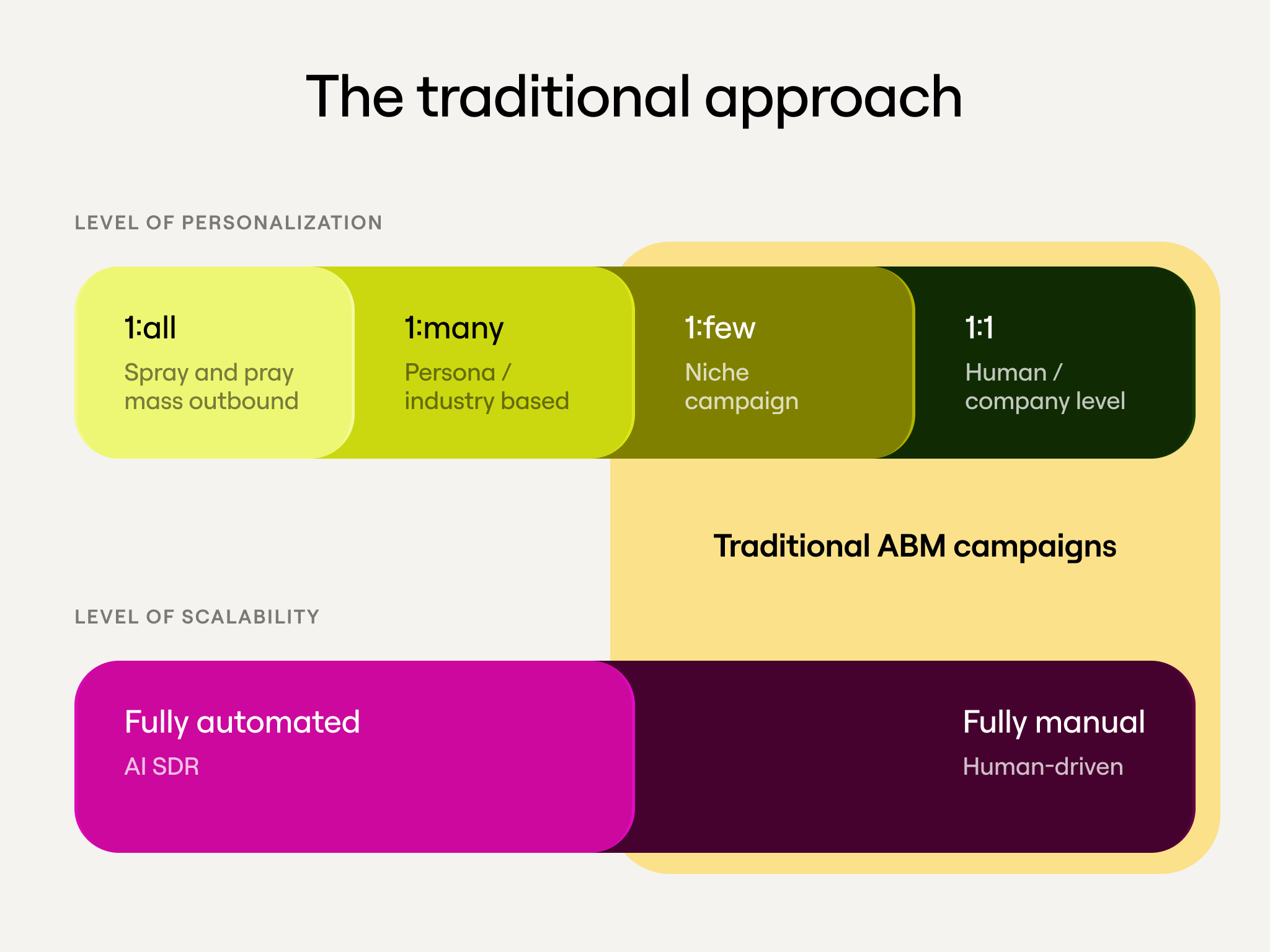
The conventional ABM answer to this is to go fully manual and dedicate a team member to researching and personalizing outreach for a handful of accounts at a time. That produces great output, but it doesn't scale. You end up with a choice between personalization and reach, and most teams quietly sacrifice one for the other.
Our goal was to break that tradeoff. We wanted 1:1 quality with hundreds of companies at scale. We also needed the whole thing built and running in two weeks.
How we scored and prioritized target accounts
The campaign started with account selection. It may sound obvious, but this is actually where most ABM efforts go wrong. Without a principled approach to prioritization, you either cast too wide and dilute the effort, or you rely on gut instinct and miss accounts that are actually in-market.
We score accounts across three dimensions:
- How well they fit our product (Account Fit Score)
- How actively they're engaging with us (Engagement Score)
- What they'd likely spend if they converted (Potential Contract Value)
Each score pulls from a combination of first- and third-party signals: company size, funding stage, hiring patterns, sales motion, website visits, event attendance, LinkedIn engagement, and product usage.
The engagement score is particularly important because it's dynamic. It updates on a 90-day rolling window, which means it reflects current behavior rather than a historical snapshot. An account that attended a Clay event last month and has three employees using the free tier looks very different from one that checked our website 18 months ago. The score captures that shift.
Plotting fit against engagement produces a prioritization matrix:
- Tier 1 is high fit and high engagement which is where you deploy your full sales force and coordinate every channel.
- Tier 2 accounts get marketing investment: thought leadership, events, content.
- Tier 3 gets de-prioritized. The point isn't to ignore lower-scored accounts but rather to stop asking your sales team to spend time where the odds are structurally bad.

Each score pulls from a combination of first- and third-party signals including company size, funding stage, hiring patterns, sales motion, website visits, event attendance, LinkedIn engagement, and product usage.
The engagement score is particularly important because it's dynamic. It updates on a 90-day rolling window, which means it reflects current behavior rather than a historical snapshot. An account that attended a Clay event last month and has three employees using the free tier looks very different from one that checked our website 18 months ago. The score captures that shift.
Plotting fit against engagement produces a prioritization matrix. But just to be totally clear: this is a snapshot, not a permanent ranking. For us, the tiered lists were our H1 focus list. The tiers set the agenda for the half, and then we re-evaluate.
The logic works in two directions. Sales, SDRs, and growth are working to unlock the Tier 1 accounts and, ideally, closing deals. Meanwhile, marketing is seeding the best-fit Tier 2 accounts: running thought leadership, events, and content designed to warm them up so they're no longer freezing cold when H2 starts. The goal is to promote the strongest Tier 2 accounts into Tier 1 the next time around.
This matters because the point of the whole system is a coordinated effort across the company. Sales, SDRs, growth, and marketing are all running in the same direction, against the same accounts, at the same time. That coordination is what maximizes the yield your sales org gets from its prospecting, which in turn makes higher quota attainment realistic and shortens deal cycles on accounts that have been properly warmed up.
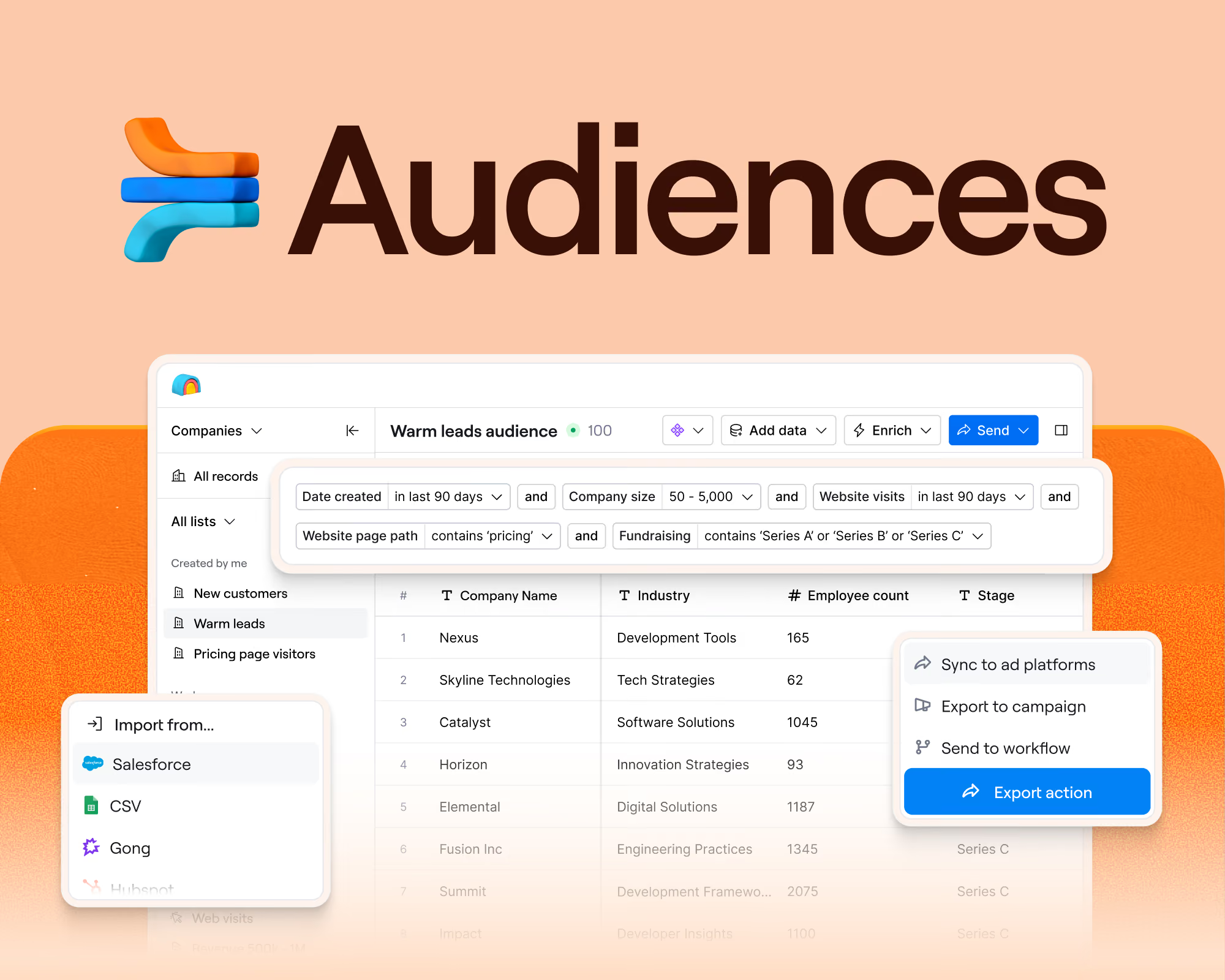
For this campaign, we filtered our CRM through Clay Audiences on three criteria: account fit rated "Good" or "Best," engagement score above "Passive" or "No Signal," and potential contract value over $50K. That brought us from hundreds of thousands of accounts down to 300. That's the list we worked from.

How we orchestrated the campaign across channels
We didn't want five tactics running in parallel with no relationship to one another. We wanted one campaign that happened to move across channels and every touchpoint reinforced the same message and the wider strategy.
The core of the campaign was a physical mailer: a custom air dry clay kit built in partnership with Claymoo (a small Canadian company). We wanted to send them to the most senior marketing leader at each of the 300 accounts and worked with &Open for our direct mailing. Each package included a personalized handwritten note and a unique QR code linking to a landing page built specifically for that recipient.
The QR codes were the core of the exercise. Because each code was tied to an individual, we could show different landing pages to different people when they scanned, including content pulled from the research we'd done on their company.
The landing pages were built in Webflow and populated with tokens from Clay enrichment to include the company's logo, their tech stack (Salesforce, HubSpot, etc.), their sales motion (self-serve, sales-led, or hybrid), and examples of Clay customers with similar profiles. The copy was human-written in modular sections; Clay selected which sections to show each visitor based on what we knew about them. AI handled token replacement and our team handled the actual arguments.
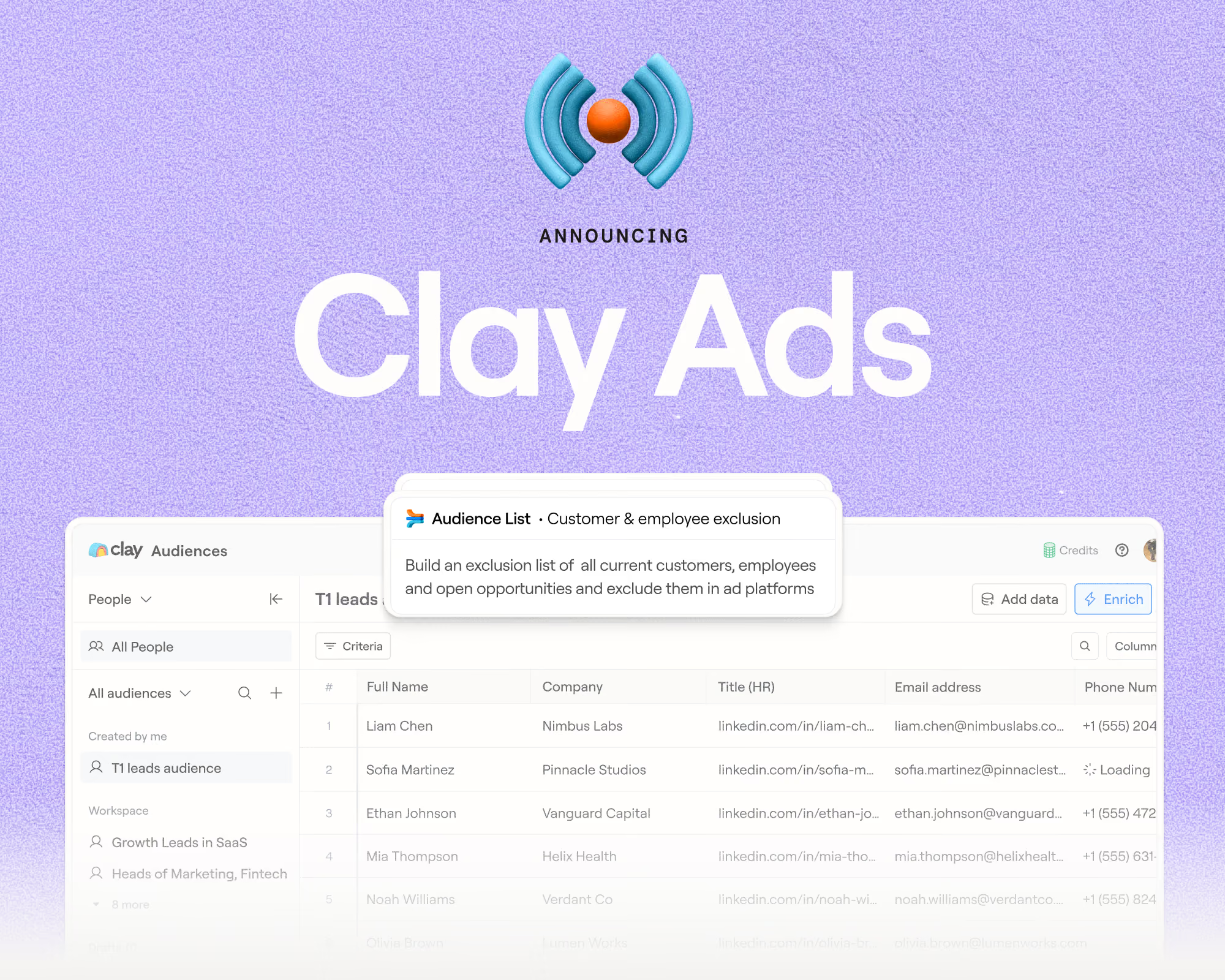
Alongside the mailer, we used Clay Ads to push the same list of 300 accounts into LinkedIn and ran ads across the full buying center including marketing, ops, finance, and sales. We wanted to go beyond the person receiving the package. Those ads ran during the two-to-three-week window between shipment and delivery, so by the time the package arrived on someone's desk, the company had already been seeing Clay in their feed.
When delivery confirmation came in, that triggered a four-step follow-up sequence. First, an email from our growth team copying the relevant SDR. This was a soft opener designed to catch easy replies. If there wasn't a response, the SDR got a call task with a detailed script: what was delivered, to which address, and what to say in the first 15 seconds. If the call didn't connect, the SDR manually added the prospect on LinkedIn and attempted to reach them there. And if that went nowhere, a final check-in email closed the loop.
The SDR's only job at each step was to have the conversation. Everything else was handled.
There's a version of outbound where marketing hands sales a list and calls it a day. We knew we needed to do more to be effective. The idea was to remove every possible obstacle between a rep and a booked meeting and then get out of the way.

What Clay made possible
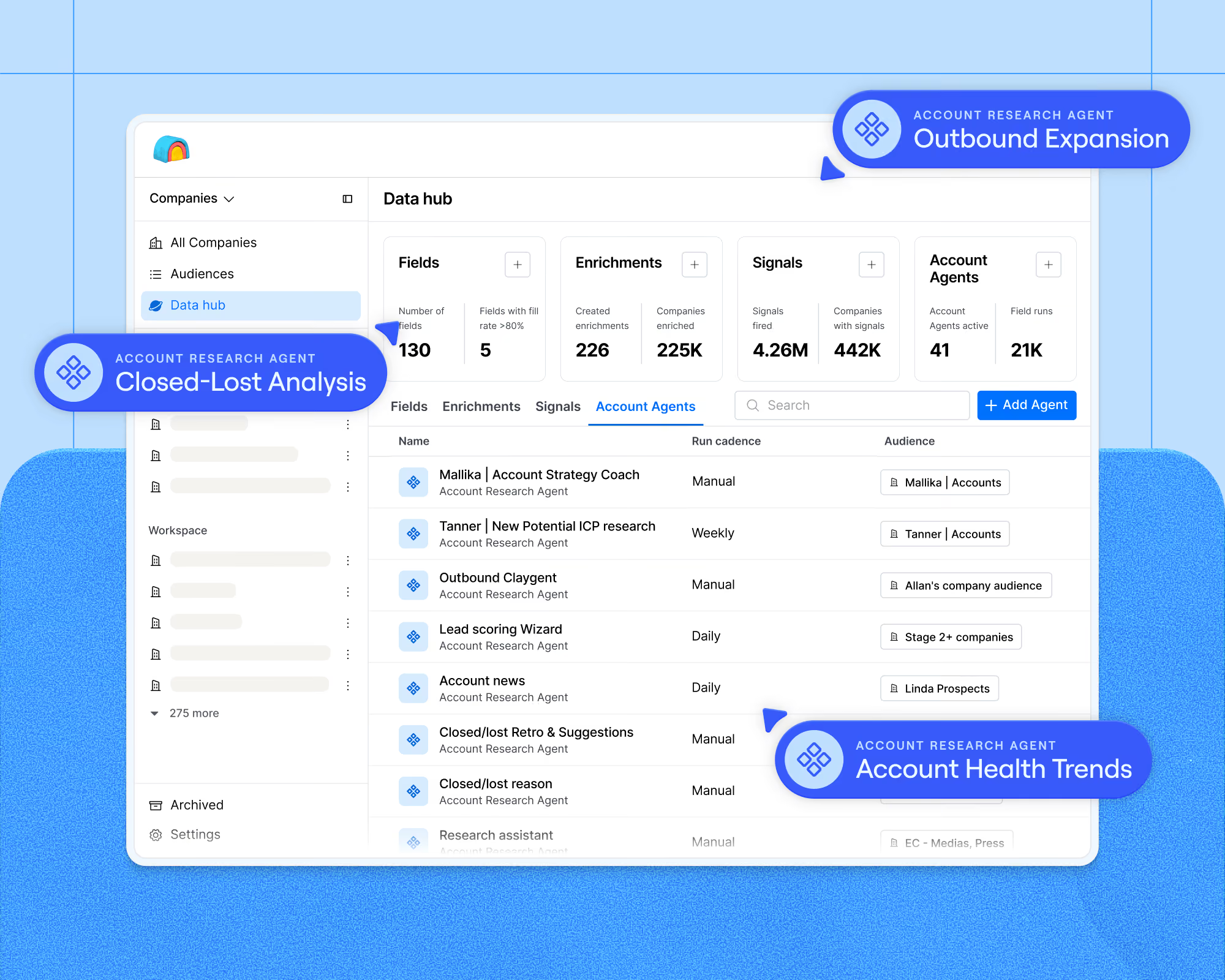
The digital parts of this campaign including list building, contact enrichment, research, landing page population, ad audience syncing, and sequence triggers were all handled inside Clay. The first time you run this, there's real setup work. But once you've converted this into a reusable playbook, all the setup is done and you can just run the campaign. Future campaigns start from a working foundation, so your energy goes into the decisions that actually matter: who you're targeting, what you're saying, and what idea will get someone to open a box. The Clay part itself takes about 20 minutes.
A few specific pieces worth noting:
- Finding office addresses sounds straightforward but isn't. Large companies have dozens of offices. We used a Claygent to cross-reference each contact's listed location against the company's office locations, calculate estimated distance, and flag cases where something didn't add up. This mattered for the physical mailer (you can't send a package to the wrong city) but the methodology also illustrates something broader about how Clay handles the kind of messy, multi-step research that used to require a human analyst.
- Data validation before sending covered three things: email deliverability, phone number accuracy, and office location confidence. We didn't send packages to contacts where we had low confidence on the address. When a package didn't arrive, we confirmed the correct address and send a replacement. By that point, the ice is already broken. Either way, we're building a relationship rather than starting cold. Perfect delivery accuracy isn't the thing that determines whether the campaign works.
- Ads audience building happened automatically. Once a contact's campaign status flipped to "Shipped," Clay pushed them into the relevant LinkedIn and Meta audiences. No manual export, no CSV upload. The list that drove the direct mail was the same list driving the ads.
The counter-narrative this campaign is trying to make
There's a version of "GTM AI" content that's mostly about tools. Which integrations you're using, which APIs you're calling, how many enrichment providers you've stacked. The tools matter, but that framing misses what's actually interesting.
What we built here is a campaign that reflects a considered point of view about how to treat prospects. The $20 clay kit was chosen because of what it represents rather than its cost. Expensive gifts create their own problems: compliance teams at large and publicly traded companies flag them, and when you send something valuable enough to make someone feel obligated, you fill your pipeline with meetings that were never going to close. People take the call out of guilt rather than fit, and you've just made your own job harder.
What we wanted was something with emotional value, not monetary value. Something connected to our brand, something you'd actually do with your family, something that leaves a good impression even if the timing is wrong. If someone takes a meeting because they're genuinely curious about what kind of company sends a clay kit with a personalized note and a landing page built specifically for them then that's the meeting worth having. The landing page, too, was meant to show each recipient that we'd done the work of understanding their business before asking for their time.
There's also a real argument here about what good outbound feels like from the other side. Even if someone doesn't convert, they should come away from the interaction with a positive impression of the company. It affects referrals, brand perception in the buying center, and whether you get a second chance six months later when the account is actually in-market.
The tools enabled all of this. But the tools didn't make the decisions about what to send, what to say, or how to structure the sequence. Those were human calls, informed by years of running these campaigns at scale. Clay made it possible to execute those decisions across 300 accounts without asking the team to repeat themselves 300 times.
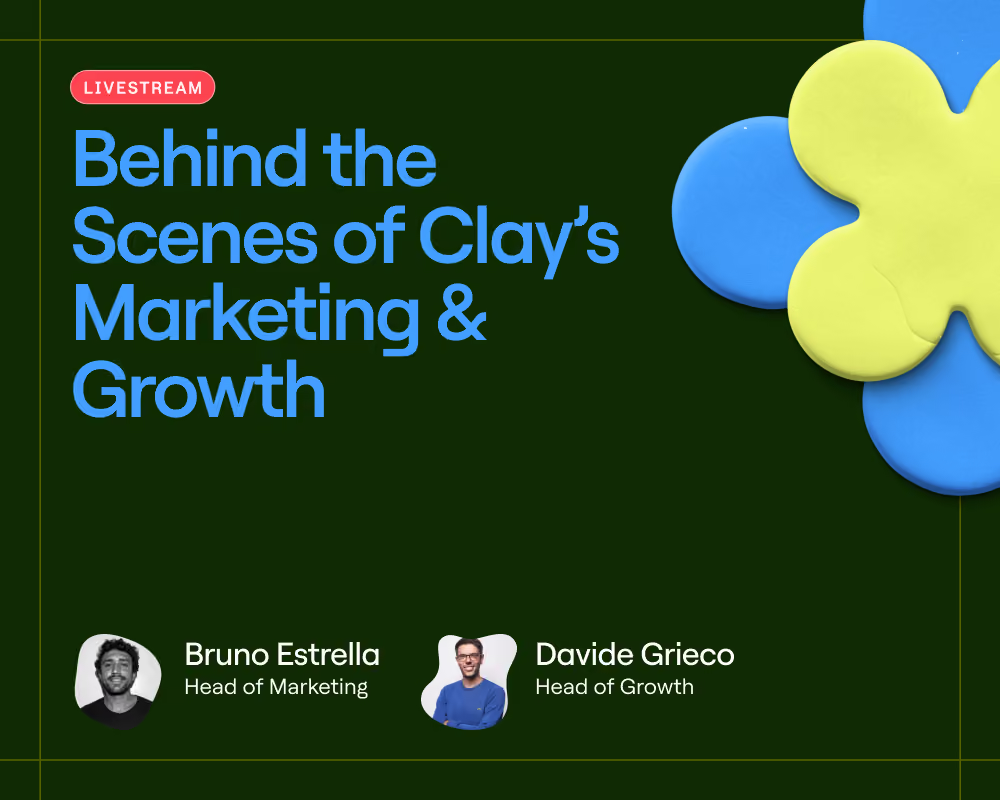
Want to see how this works in real-time? Watch Talia Schleifer, a growth lead at Clay who built 99% of this campaign, host a live workshop where she walks through the end-to-end flow inside Clay from account scoring to enrichment, landing page generation, ad syncing, and SDR handoff.
Frequently Asked Questions
How do you measure success with a Clay ABM campaign?
The post focuses on pipeline quality over volume metrics. The goal is meetings with accounts that are genuinely curious and in-fit, not meetings booked out of obligation. Downstream indicators include deal cycle length on warmed accounts and whether accounts that didn't convert still leave with a positive impression of the company.
How many accounts should you target in an ABM campaign run through Clay?
Clay's own campaign targeted 300 accounts, filtered from hundreds of thousands using three criteria: account fit rated "Good" or "Best," engagement score above "Passive," and potential contract value over $50K. The right number depends on your scoring thresholds, not an arbitrary list size.
How long does it take to build and run this kind of ABM campaign in Clay?
The first run requires real setup work to build the playbook. Once that foundation exists, the Clay portion of running a subsequent campaign takes about 20 minutes. The time investment shifts from tooling to the decisions that matter: who to target, what to say, and what creative will get someone to engage.
Does this ABM approach require a large team?
No. The campaign was built almost entirely by one growth lead (Talia Schleifer). Clay handled list building, enrichment, landing page population, ad audience syncing, and sequence triggers automatically. SDRs only needed to show up for the conversation itself.
.png)


.avif)


.png)




.avif)

.avif)











.avif)












.avif)