






































.avif)








Sales AI
Sales AI refers to the application of artificial intelligence technologies - such as machine learning, natural language processing, and predictive analytics - to streamline and enhance the sales process. By analyzing large volumes of data, AI for sales teams can identify high-intent prospects, prioritize leads, and recommend the most effective outreach strategies. Rather than replacing human sellers, these tools augment their capabilities, freeing reps from repetitive tasks so they can focus on building relationships and closing revenue.
Key Benefits of Sales AI
Integrating AI into sales workflows delivers measurable improvements across the entire pipeline. From prospecting to closing, these technologies help teams work smarter and respond faster to buyer signals.
- Efficiency: Automates time-consuming tasks like data entry, lead scoring, and follow-up scheduling so reps spend more time selling.
- Personalization: Analyzes prospect data to generate tailored messaging that resonates with each buyer's specific needs and pain points.
- Forecasting: Uses historical data and real-time signals to produce more accurate pipeline and revenue forecasts.
- Lead Prioritization: Scores and ranks prospects based on likelihood to convert, ensuring reps focus on the highest-value opportunities.
- Scalability: Enables small teams to manage larger pipelines without sacrificing the quality of their outreach.
How to Implement AI in Your Sales Process
Adopting AI sales tools effectively requires more than just purchasing software. Teams need a clear strategy, clean data, and a willingness to iterate. The following steps outline a practical path to getting value from AI across your sales organization.
- 1. Audit your current workflow: Map out your existing sales process from prospecting to close and identify the stages where reps spend the most time on manual, repetitive work.
- 2. Define clear objectives: Set specific goals for what you want AI to improve - whether that's response time, lead quality, conversion rates, or pipeline coverage.
- 3. Ensure data quality: Clean and centralize your CRM and enrichment data. AI models are only as good as the data they learn from, so removing duplicates and filling gaps is essential.
- 4. Start with a focused use case: Rather than overhauling everything at once, begin with a single high-impact area like lead scoring or automated email personalization.
- 5. Train your team: Provide hands-on training so reps understand how to interpret AI-generated insights and incorporate them into their daily routines.
- 6. Measure and iterate: Track performance against your defined objectives and refine your approach based on what the data reveals.
Sales AI vs. Traditional Sales Methods
Understanding the differences between AI-powered and traditional approaches helps teams decide where technology adds the most value.
- AI-powered sales leverages data and automation to identify patterns, score leads, and personalize outreach at scale. It excels at processing large datasets quickly and surfacing insights that would take humans hours to uncover. However, it requires quality data and thoughtful implementation to deliver results. This approach is ideal for teams managing high-volume pipelines or looking to scale personalized outreach without adding headcount.
- Traditional sales methods rely on human intuition, relationship-building, and manual research to identify and engage prospects. These methods shine in complex, high-touch deals where deep personal connections drive the buying decision. The trade-off is that they are harder to scale and more susceptible to inconsistency. This approach works best for teams with a small number of strategic accounts that demand a highly consultative selling motion.
Tools and Technologies for Sales AI
The landscape of AI sales tools continues to evolve rapidly. Modern platforms combine multiple capabilities - from data enrichment to conversation intelligence - into unified workflows. Choosing the right stack depends on your team's size, sales motion, and existing infrastructure.
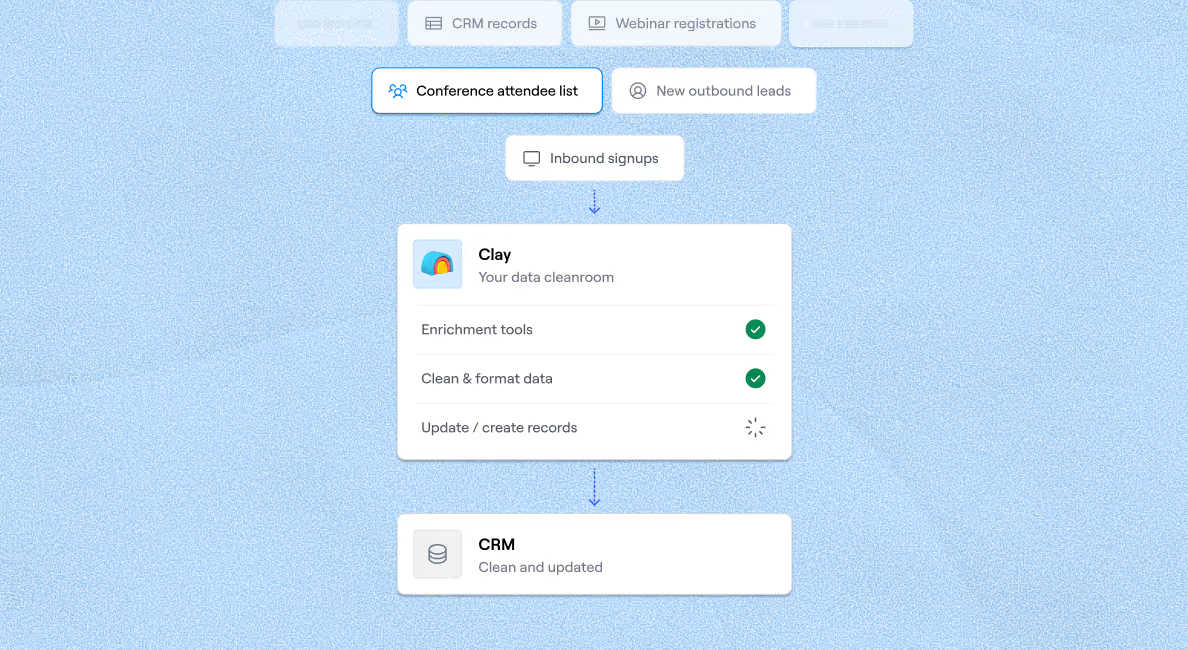
- Enrichment and Prospecting: Platforms like Clay that aggregate data from dozens of providers and use AI to automate research, helping teams build targeted prospect lists without manual effort.
- Conversation Intelligence: Tools that record, transcribe, and analyze sales calls to surface coaching opportunities and track deal momentum.
- Predictive Analytics: Software that uses historical win/loss data to forecast outcomes and recommend next-best actions for each deal.
- Outreach Automation: Systems that use AI to optimize send times, personalize email content, and manage multi-channel sequences for sales and marketing teams.
Challenges and Solutions in Sales AI
One of the biggest obstacles teams face when adopting AI is poor data quality. If your CRM is filled with outdated contacts and incomplete records, even the most sophisticated models will produce unreliable outputs. Resistance to change is another common barrier - reps may distrust AI recommendations or see new tools as a threat rather than an asset.
Addressing these challenges starts with investing in data hygiene before rolling out any new technology. Pairing AI tools with enrichment platforms helps keep records current and comprehensive. On the adoption side, involving reps early in the evaluation process and demonstrating quick wins builds trust. When teams see AI handling their busywork while they close more deals, skepticism fades quickly.
Frequently Asked Questions about Sales AI
Will AI replace salespeople?
No. AI is designed to augment human sellers, not replace them. It handles data-heavy tasks like lead scoring, research, and follow-up scheduling, which frees reps to focus on the strategic and relationship-driven aspects of selling that require a human touch.
How can small sales teams benefit from AI?
Small teams often benefit the most from AI because it acts as a force multiplier. With the right tools, a team of five can prospect, personalize, and follow up at a scale that would otherwise require a much larger headcount - leveling the playing field against bigger competitors.
What should I look for when evaluating AI for sales and marketing?
Focus on tools that integrate with your existing CRM and tech stack, offer transparent data sourcing, and provide actionable outputs rather than just dashboards. The best platforms make it easy to go from insight to action without requiring reps to switch between multiple systems.
Other terms
Canary Releases
A canary release is a deployment strategy where new software is rolled out to a small user group first, minimizing risk before a full release.
Shipping Solutions
Shipping solutions are services or software that streamline the logistics of getting products to customers, from label printing to final delivery.
Lead Qualification
Lead qualification is the process of determining which prospects are most likely to become paying customers based on predefined criteria.
Outbound Sales
Outbound sales is when reps proactively contact potential customers through cold calls or emails to generate leads and build a sales pipeline.
Marketing Operations
Marketing Operations (MOps) is the engine of a marketing team, managing the technology, processes, and people to run campaigns effectively.
Mid-Market
Mid-market companies are businesses larger than small businesses but smaller than large enterprises, often defined by revenue or employee size.
Marketo
Marketo is a marketing automation platform used by B2B marketers to manage lead generation, nurturing, email marketing, and analytics.
Business Development Representative
Learn about business development representative, including skills and qualifications for BDRs, & roles and responsibilities of a BDR.
Buying Criteria
Buying criteria are the specific requirements and standards a customer uses to evaluate products or services before making a decision.
Behavioral Analytics
Learn about behavioral analytics, including implementing behavioral analytics successfully, & key metrics in behavioral analytics.
Marketing Qualified Lead (MQL)
A Marketing Qualified Lead (MQL) is a prospect who has shown interest based on marketing efforts but isn't yet ready for a sales conversation.
Sales Enablement
Sales enablement provides sales teams with the necessary tools, content, and information to help them sell more effectively and efficiently.
Regression Testing
Regression testing ensures that new code changes don’t negatively impact existing features. It's a key step to maintain software quality after updates.
Consultative Selling
Consultative selling is an approach where salespeople act as expert advisors, diagnosing customer needs to provide the most suitable solutions.
Site Retargeting
Site retargeting is a marketing strategy that shows ads to people who have previously visited your website but left without converting.
Sales Enablement Content
Sales enablement content refers to the materials and tools that empower your sales team to engage prospects and close deals more efficiently.
NoSQL
NoSQL ("Not only SQL") databases offer a flexible alternative to relational models, excelling at managing large and unstructured data sets.
Knowledge Base
A knowledge base is a self-serve online library of information about a product, service, department, or topic.
Contact Discovery
Contact discovery is the process of finding accurate contact details for potential leads, including names, emails, phone numbers, and job titles.
Sales Territory
A sales territory is a specific group of customers or a geographic area that a salesperson or sales team is responsible for managing.
Product-Led Growth
Product-Led Growth (PLG) is a business strategy where the product itself drives user acquisition, conversion, and expansion.
Docker
Docker is a tool that packages applications and their dependencies into isolated environments called containers for easy deployment and scaling.
Sales Development Representative (SDR)
A Sales Development Representative (SDR) is a sales specialist who finds and qualifies new leads, building a pipeline for the sales team.
User Interaction
User interaction is any action a user takes within a digital interface, like clicking a button, scrolling a page, or filling out a form.
Messaging Strategy
A messaging strategy defines what your brand says, how it says it, and where it says it to connect effectively with your target audience.
Lead Generation
Lead generation is the process of identifying and cultivating potential customers for a business's products or services.
Customer Relationship Management Systems
A Customer Relationship Management (CRM) system is a tool that centralizes customer data to help manage interactions and nurture relationships.
Customer Acquisition Cost
Customer Acquisition Cost (CAC) is the total cost a business spends to gain a new customer. It includes all sales and marketing expenses.
Sales Enablement Technology
Sales enablement technology refers to software and tools that equip sales teams with the resources they need to close more deals efficiently.
Key Accounts
Key accounts are a company's most valuable customers, vital due to their significant revenue contribution and strategic importance for growth.
Buying Signal
A buying signal is any action from a prospect that indicates they are interested in making a purchase, helping sales teams prioritize leads.
Content Management System
A Content Management System (CMS) is software for creating, managing, and modifying website content without needing specialized technical skills.
Marketing Qualified Account
A Marketing Qualified Account (MQA) is a target company that has shown significant engagement, indicating it's ready for the sales team to pursue.
Marketing Qualified Opportunity
A Marketing Qualified Opportunity (MQO) is a lead vetted by marketing as a genuine sales opportunity, ready for direct sales follow-up.
B2B Sales
Learn about B2B sales, including key strategies for B2B success, types of B2B sales models, & B2B vs. B2C sales: understanding the differences.
Email Personalization
Email personalization uses subscriber data—like their name, interests, or past behavior—to create highly relevant and targeted email campaigns.
Marketing Automation Platform
A marketing automation platform is software that automates marketing actions. It helps manage tasks like email campaigns and lead nurturing.
Total Addressable Market (TAM)
Total Addressable Market (TAM) represents the maximum revenue a company can earn by selling its product or service in a specific market.
Customer Buying Signals
Customer buying signals are the actions, behaviors, or statements a prospect makes that indicate they are moving towards a purchase decision.
Progressive Web Apps
Progressive Web Apps (PWAs) are websites that look and feel like native mobile apps, offering features like offline access and push notifications.
Feature Flags
Feature flags let you remotely control features in your app without new code. This enables safe testing, gradual rollouts, and quick rollbacks.
Buying Intent
Buying intent is the collection of online cues and behaviors that signal a prospect is actively researching and moving toward a purchase decision.
Sales Dashboard
A sales dashboard is a visual tool that centralizes and displays key sales data, metrics, and KPIs to help teams track performance and goals.
Dark Funnel
The Dark Funnel describes customer buying activities that are untrackable by companies, such as private chats and word-of-mouth referrals.
Firmographics
Firmographics are descriptive attributes of organizations, used to segment companies by characteristics like industry, size, and location.
Sales Methodology
A sales methodology is the framework that guides how your sales team approaches the entire sales process, from prospecting to closing deals.
Applicant Tracking System
An Applicant Tracking System (ATS) is a software application that manages your entire hiring and recruitment process from a single dashboard.
Account
An account is a company or organization that you're targeting for sales. It can be a prospective, current, or even a past customer.
Account Executive
An Account Executive (AE) is a sales professional responsible for closing new business deals and managing existing client relationships to drive revenue.
End of Quarter
“End of Quarter” (EOQ) refers to the final weeks of a business quarter when sales teams rush to meet quotas, often leading to a flurry of deals.
SAM
Serviceable Addressable Market (SAM) is the portion of the market your business can realistically serve with its current products and sales channels.
Expansion Revenue
Expansion revenue is the extra money a business makes from its current customers via upgrades, new products, or additional services.
B2B Data Erosion
Learn about B2B data erosion, including causes of B2B data decay, strategies to combat data erosion, & measuring the impact of data erosion.
Chatbots
Chatbots are AI-powered programs that simulate human conversation. They interact with users via text or voice, typically for customer support.
Rollback Procedures
Rollback procedures are a set of steps to restore a system to a previous, stable version after a failed update, ensuring minimal disruption.
Lead Generation Software
Lead generation software helps businesses automate finding and capturing potential customers' contact information to build sales pipelines.
Lead Scrape
Lead scraping is the process of automatically extracting contact information and other relevant data about potential customers from online sources.
Sales Demo
A sales demo is a presentation where a sales rep shows a prospect how a product or service works and solves their specific problems.
Demand
Demand is the economic principle describing a consumer's desire and willingness to purchase a specific good or service at a particular price.
Enterprise
An enterprise is a large-scale organization, often a corporation, defined by its complex structure and substantial number of employees.
Cold Email
A cold email is an initial outreach sent to a potential customer with whom you've had no prior contact, aiming to introduce your business.
Email Marketing
Email marketing is a digital strategy where businesses send targeted emails to prospects and customers to build relationships and drive sales.
Net Revenue Retention (NRR)
Net Revenue Retention (NRR) is the percentage of recurring revenue kept from existing customers, including upsells, downgrades, and churn.
Account Development Representative
An Account Development Representative (ADR) identifies and qualifies new business opportunities, creating a pipeline for account executives.
Single Sign-On (SSO)
Single Sign-On (SSO) is an authentication method allowing users to access multiple applications with one set of login credentials.
Predictive Lead Generation
Predictive lead generation uses data and AI to find prospects most likely to buy, helping teams focus their efforts on high-value leads.
Elevator Pitch
An elevator pitch is a short, memorable summary of what you do, designed to be delivered in the time it takes to ride an elevator.
GTM
A go-to-market (GTM) strategy is an action plan that outlines how a company will reach target customers and achieve a competitive advantage.
Gamification
Gamification applies game mechanics like points, badges, and leaderboards to non-game activities to boost engagement and motivate users.
SFDC
SFDC stands for Salesforce Dot Com, a popular cloud-based CRM platform that helps companies manage their customer interactions and data.
Sales Lead
A sales lead is a potential customer—an individual or organization that has shown interest in your company's products or services.
Employee Engagement
Employee engagement is the emotional commitment an employee has to their organization, motivating them to contribute to the company's success.
Enterprise Resource Planning
Enterprise Resource Planning (ERP) is a system of integrated software that businesses use to manage and automate their core day-to-day processes.
Account-Based Sales
Account-Based Sales (ABS) is a focused B2B strategy where sales and marketing teams treat high-value accounts as individual markets of one.
Data Appending
Data appending is the process of adding new data fields to your existing database records to enrich and complete your information.
Salesforce Administrator
A Salesforce Administrator is a certified professional who manages and customizes the Salesforce platform to meet a company's specific business needs.
Firmographic Data
Firmographic data is information used to classify firms. It includes attributes like industry, employee count, location, and annual revenue.
SEO
SEO, or Search Engine Optimization, is increasing the quantity and quality of traffic to your website through organic search results.
Sales Acceleration
Sales acceleration refers to strategies and technologies designed to speed up the sales cycle, enabling reps to close more deals, faster.
Monthly Recurring Revenue (MRR)
Monthly Recurring Revenue (MRR) is the predictable, recurring income a business expects to receive each month from all active subscriptions.
System of Record
A System of Record (SoR) is the authoritative data source for a specific type of data. It acts as the single source of truth for an organization.
Video Selling
Video selling uses personalized video messages to engage prospects, build rapport, and guide them through the sales funnel to close more deals.
Consumer Relationship Management
Consumer Relationship Management (CRM) is a strategy for managing all of a company's relationships and interactions with its customers.
Content Rights Management
Content Rights Management involves controlling the use and distribution of copyrighted digital media to protect intellectual property.
Mobile Compatibility
Mobile compatibility ensures your site or app works flawlessly on mobile devices, like smartphones and tablets, for a seamless user experience.
Account-Based Everything
Account-Based Everything (ABE) is a strategy aligning sales, marketing, and success teams to focus on a specific set of high-value accounts.
B2B Data
Learn about B2B data, including sources and types of B2B data, leveraging B2B data for sales success, & ensuring the accuracy of B2B data.
Sales Coaching
Sales coaching is a process where managers help reps improve their skills and performance through personalized feedback, training, and guidance.
Simple Object Access Protocol Application Programming Interface
A Simple Object Access Protocol (SOAP) API is a web service that uses XML to exchange structured information between different applications.
Sales Development
Sales development is the process of identifying and qualifying potential customers to create a pipeline of sales-ready leads for closers.
Sales Prospecting
Want to improve sales prospecting? Clay helps find & qualify leads faster with automated research and multi-source data. ✓ Try Clay free for 14 days!
Microservices
Microservices is an architecture where apps are built as a collection of small, independent services that communicate with each other over APIs.
Sales Calls
A sales call is a real-time conversation between a salesperson and a prospect, aiming to persuade them to purchase a product or service.
Digital Advertising
Digital advertising is the practice of delivering promotional content to users through various online and digital channels like social media or search engines.
Sales and Marketing Analytics
Sales and marketing analytics involves measuring and analyzing performance data to maximize effectiveness and optimize return on investment (ROI).
Enrichment
Enrichment is the process of adding third-party data to your existing customer profiles to get a more complete picture of your leads.
Single Page Applications
A Single Page Application (SPA) is a web app that interacts with the user by dynamically rewriting the current page rather than loading new pages.
Affiliate Marketing
Affiliate marketing is a performance-based model where affiliates earn a commission for promoting another company’s products or services.
Lead Qualification Process
The lead qualification process is how you determine which prospects are most likely to become customers by evaluating them against specific criteria.
Sales Partnerships
Sales partnerships are strategic alliances where two companies co-sell products to expand their reach, generate new leads, and increase revenue.