


Before Brex, a funded startup could still get turned down for a corporate card. Banks wanted a long credit history or a personal guarantee from the founder, and a two-year-old company usually had neither, even one sitting on a fresh round of venture money. Henrique Dubugras and Pedro Franceschi started Brex in 2017 to fix that, underwriting a company on its real cash position and business performance instead of its founder’s personal credit. Fast forward, and more than 30,000 businesses run their spending on Brex, from seed-stage teams to public companies like Sonos and Robinhood.
Brex’s outbound operation has quietly turned into one of the more advanced go-to-market motions anywhere. Michael Tai, a Senior Growth Product Manager at Brex, leads a large part of it. After stints in consulting at Oliver Wyman, strategy and product at Next Insurance, and a GM role at DoorDash Retail, he landed at Brex to take the company’s automated outbound program from one to two.
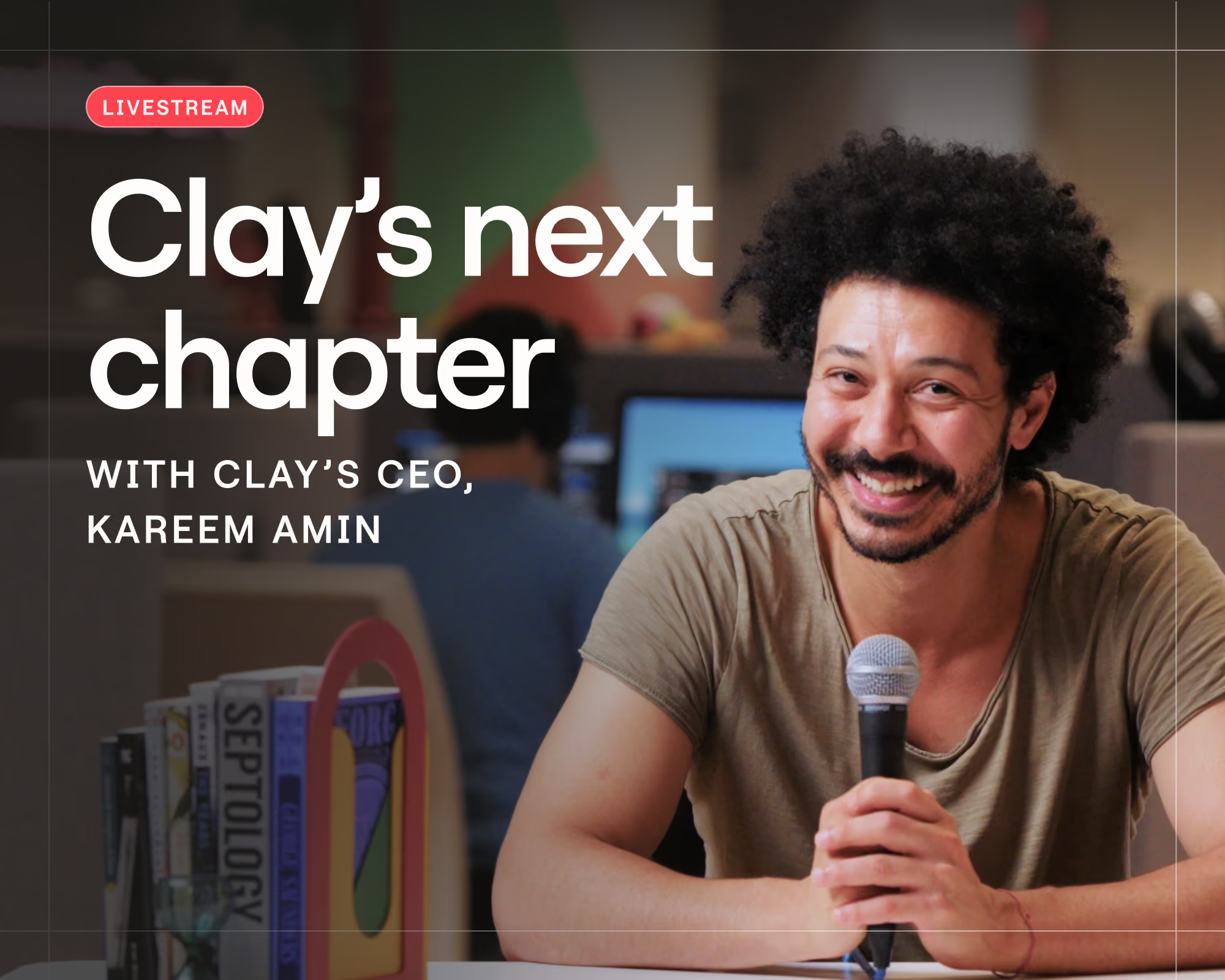
He swung by Clay HQ to chat with Isaac Fishman, our Strategic Account Manager, talking through how Brex built that system and where he thinks go-to-market is heading in 2027 (and beyond in 2036). Watch the full livestream with Michael:
Top 1% is our interview series, sitting down with the growth marketers behind some of the world’s leading companies to see how they actually run. Register to catch the sessions ahead.
Why the Brex growth team reaches for Clay
Brex’s go-to-market has scaled quickly; that almost always comes with a tax. When a go-to-market org grows, productivity tends to flatten or even slip. New reps need training and coaching, and the team digs deeper into its addressable market and starts hitting thinner accounts.
Michael has seen the opposite at Brex, partially due to their tooling: “What we’ve seen as we’ve scaled our go-to-market motion is the pipeline generation efficiency has actually gone up rather than stayed the same or gone down,” Michael says. “Part of that is the technology, the book management and automated outbound. Another part of it is the improvement in operations that the team has made over the years... We’re seeing pretty outstanding impact from both.”
A few things stand out to him about Clay:
- Why it stuck: “Clay is really easy to use. There’s a reason why it’s emerged as a market leader.”
- It does multiple jobs at once: “We mainly use Clay for data enrichment and workflow orchestration.”
- It keeps the team unblocked: “The ability to let multiple users collaborate, the ability to iterate without code, stuff like that is great for growth teams that want to move fast.”
5 lessons on building Brex’s AI-era go-to-market motion
Michael’s team sits at the center of a web of partners across marketing operations, rev ops, business systems, and data science. It started in 2024 as a cross-functional tiger team under the CEO, with members on loan from other groups, and was formalized into a standing growth engineering org as the value proved out.
In growing the team, Michael has found that the operation set the ceiling on what the technology could do. “The technology amplifies what already exists,” he says, so the work became maturing the team and the systems in step rather than counting on the software to fix the operation. The lessons ahead go beyond the tool stack to how you assemble a team and an operation built for the greatest go-to-market impact.
1. Nail the problem first, and the AI implementation second
The reflex when a company decides to “do AI” is to start with the model or the tool. Michael thinks that gets the difficulty backwards, and that the hard work sits much earlier.
“The core of the product mindset is to be problem-first. It’s to understand your customers and the problems that they face and be able to quantify that in a meaningful way and then to test that,” he says. “For companies thinking about adopting AI, it’s not the AI part that’s hard; it’s the problem discovery and the problem definition part that’s hard.”
Spend longer than feels comfortable defining the problem and putting a number on it before anyone picks a tool. Once the opportunity is quantified and the definition is clear, the resourceful people on your team will find their way to the right AI solution or whatever else the job actually needs.
2. Aim for relevance, not personalization
Mass outbound has turned “personalized” into a synonym for dropping a first name into a template. Michael draws a sharper line. “It’s not so much personalized as it is relevant,” he says. “‘Personalized’ means it’s customized in some way. ‘Relevant’ means the person receiving it cares about it.”
Getting to relevant means going deep, and that changes what kind of game outbound is. The operations work Michael did earlier, driving down order cancellation rates at DoorDash or processing claims at Next, was a breadth game with a long tail that gets exponentially harder the further you chase it. Sales runs the other direction.
“Sales is not so much a long tail game; it’s a depth game,” he says. “For the account that you’re looking at, how deep can you go? How much can you learn about this person’s life, their experience, the pain they’re facing, and how accurately can you predict that and speak to it?”
The team leans on a framework Michael credits to a former marketing VP, who told him outbound works like marketing and splits into a few levers that matter in a fixed order:
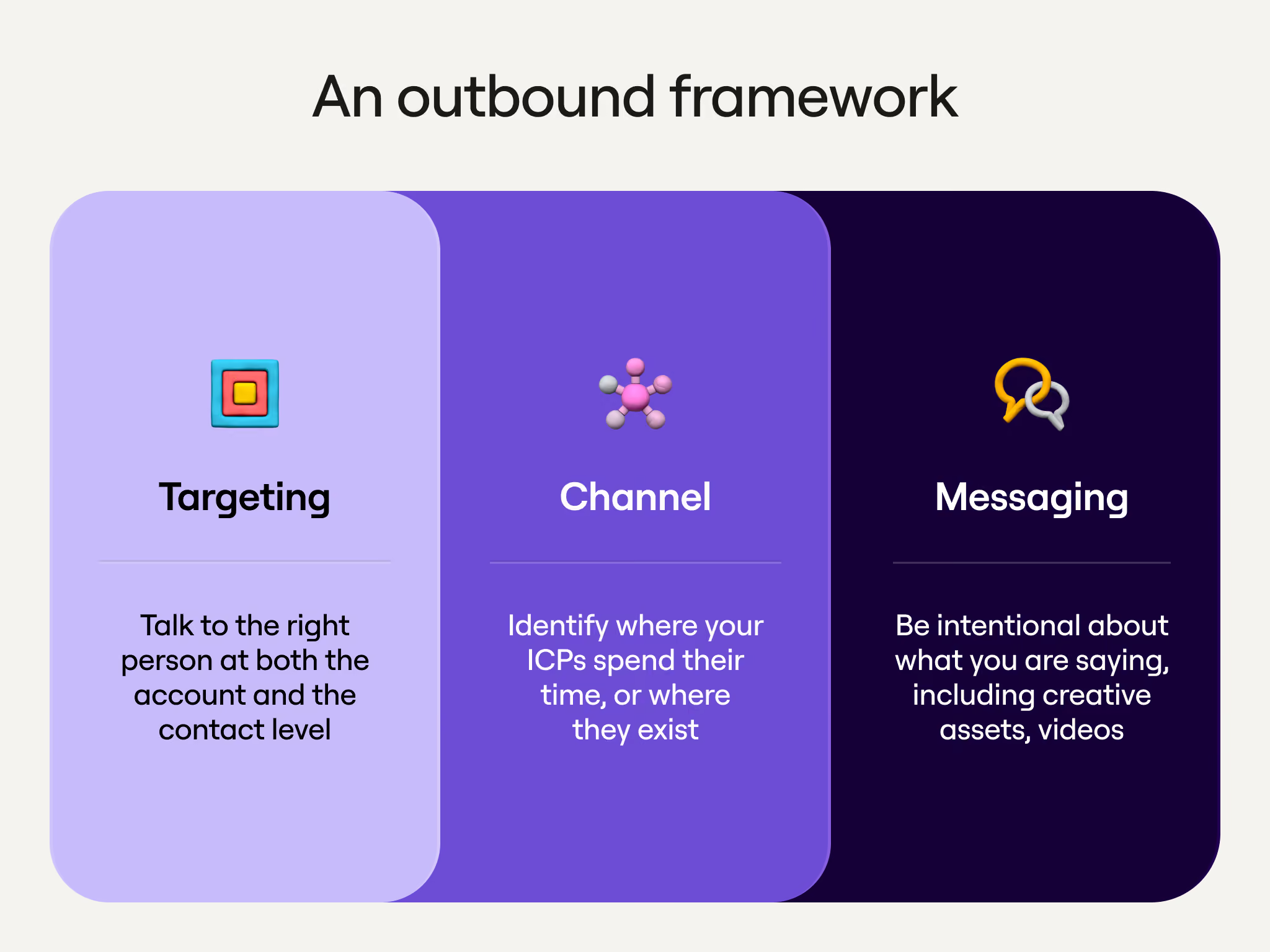
- Targeting leads. “If you’re talking to the wrong person, that’s the biggest thing. It doesn’t matter how you’re reaching out, it doesn’t matter whether your messaging is optimized. You have to be talking to the right person, and that goes at both the account and the contact level.”
- Channel comes next. “In sales the channel is relatively straightforward, but in marketing it’s a lot more complicated. Am I reaching out to them via TikTok versus Meta versus all sorts of different platforms? Where does this ICP spend their time, or where does this ICP exist?”
- Messaging, the actual words, comes last. “What are you saying? Or in the advertising world, the creative, the video, the asset.”
Get the target wrong, and the cleverest copy on the perfect channel still lands nowhere. That is why every experiment starts at the target, with two questions:
- “Are we talking to the right companies, companies that have real pain and that fit our product offering?”
- “Am I talking to the ideal people at that company?”
Once a segment shows a signal, the team moves downstream to tune channel and message.
3. Hire growth engineers who operate like forward-deployed engineers
The forward-deployed engineer, the embedded builder who sits with a customer and ships against their problem directly, started at Palantir. The model has spread fast since, and Brex landed in similar territory from the go-to-market side. The resemblance to an FDE has been surprising: embed with the internal teams, iterate with them quickly, build something that doesn’t scale, and do it enough times to find the pattern that’s worth platformizing.
When Michael hires growth engineers for this function, deep infrastructure chops are not the point. “We’re hiring for people with a bit of a broader skill set than the average engineer,” he says. “They really understand the business, understand the customer. They can talk to a bunch of cross-functionals on their own; they can talk to the customer on their own. They’re basically part engineer, part PM, part a little bit of every function.”
Of course, this model carries a real cost. It needs to be monitored with metrics like revenue per engineer, which should climb over time; if that number stays flat or drops, you’re just renting headcount.
“Engineers are very expensive. If you staff an engineer or two to a company for six months, that needs to generate a tremendous amount of value back. That’s really the bet companies are taking,” he says.
4. Run general and thesis-driven prospecting side by side
Book management comes down to one question: “Who should each rep spend their time on?” Brex gives reps two ways to answer it: general prospecting and thesis-driven prospecting.
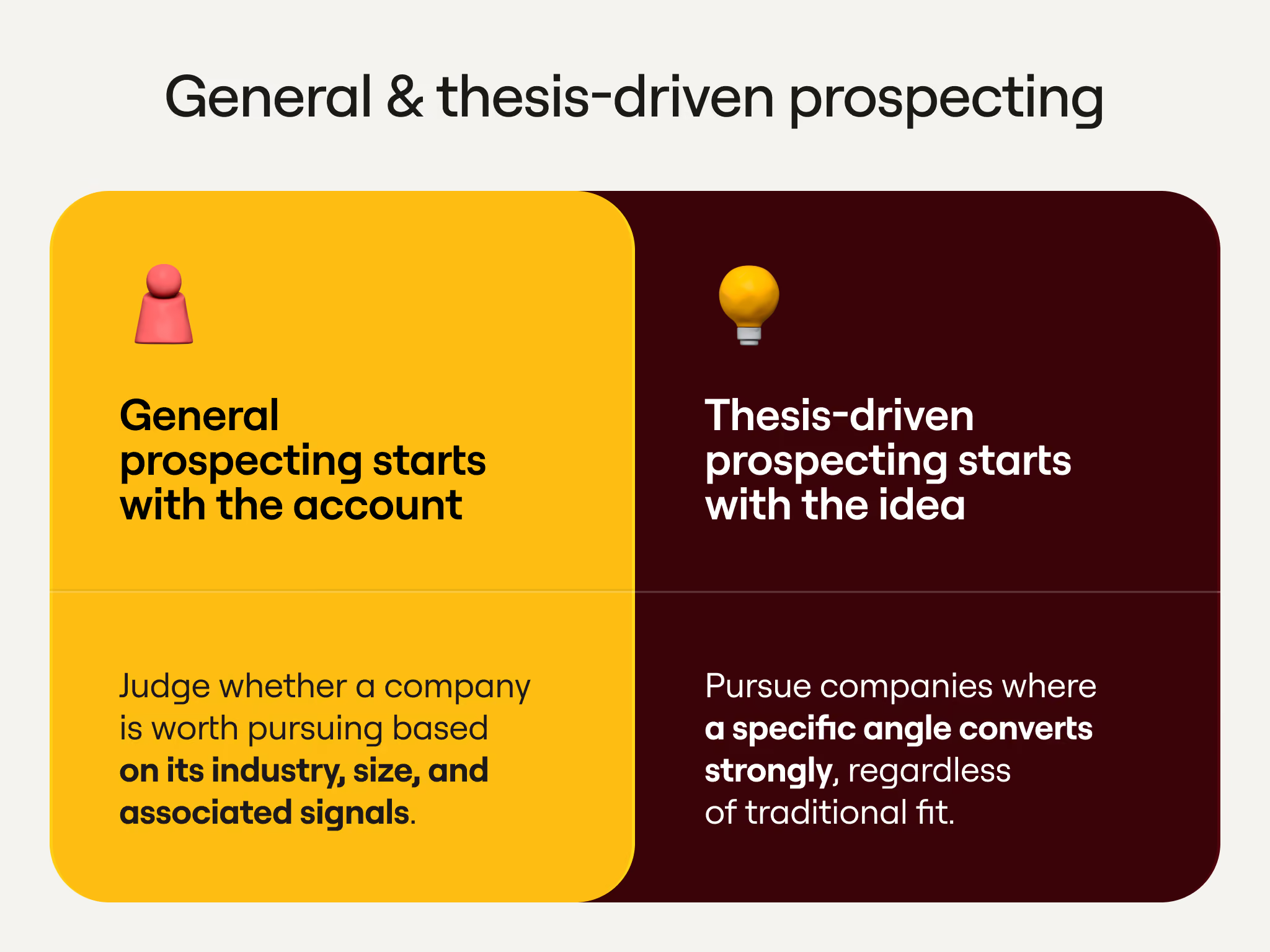
- General prospecting starts with the account. You look at a company’s visible traits, such as its industry and size, plus any signals associated with it, and judge whether it is worth pursuing. Brex runs this through a lead-scoring algorithm that automatically ranks accounts. “If you’re new or short on ideas, that’s a great place to go to get accounts,” Michael says.
- Thesis-driven prospecting starts with the idea. Here a rep has a specific angle about a set of companies, and if the angle is sharp enough, it converts so well that the usual question of fit matters less. Michael’s example is a LinkedIn message so relevant it books a meeting half the time, even when the person on the other end isn’t a textbook ICP. The tooling helps SDRs shape those theses and quickly search the account pool, so an idea becomes a live play sooner.
The two work together. The lead score gives newer reps a reliable starting list, and the thesis path gives experienced reps room to run an angle of their own.
5. Roll the tooling out to reps with intention
A sophisticated system is only as good as the reps who can actually use it, so Michael treats rollout seriously. The first principle is that the tooling serves the rep and never competes with them. “From day one we partnered with the go-to-market team in that the technology is at your service, the technology benefits you. There’s really never a case where it’s at odds,” he says.
Every month Michael spends 30 minutes with the incoming cohort of new hires, walking through what the team has built and how to get the most out of it, then leaves the door open on Slack and in a dedicated feedback channel. He treats the friction that surfaces as the point, since every growing pain is a piece of feedback he can build against. Over time, the knowledge stops living only with him.
“Once you build up an existing body of knowledge within the team, maybe within a manager or the more senior people on that team, the burden shifts to that team rather than to you,” he says. The result is a bench of internal champions who can carry the next person up the curve.
Michael’s predictions for GTM in 2027 and 2036
In the near term, Michael keeps coming back to the thing some of the industry skips, the role of the human. Most of the energy goes to what AI can automate, and the people in the workflow get treated as an afterthought. Brex’s thesis runs the other way:
“If you automate something with AI, it doesn’t get built better. It only gets better if your central growth team comes up, learns something and makes it better. But how do you create sort of like organic or living systems that get better on their own?” he says. “You can imagine an agent and a human working together where the human’s learning from the agent, that person’s getting smarter and testing more ideas, and the agent’s learning from the human and the system kind of improves in a decentralized way.”
Look out ten years, and he gets less certain, but he does make a prediction. The basics of go-to-market hold, understanding who to talk to and saying the best possible thing. What changes is the operating model around it.
“Go-to-market is one big human operation. How do you operate when you have coworkers that are essentially agents? When the technology plays a much, much bigger role?” he asks. His prediction is that the shift will be as large as the one computers brought. “When computers came along, the way people worked changed dramatically. Ten years from now, with AI, the way we work will be dramatically different.”
.png)

.avif)




.png)






.avif)





.avif)
















.avif)














.avif)