

































.avif)









The hard part of running account-based marketing (ABM) campaigns has always been timing: knowing which accounts on your aspirational list are actually shopping for what you sell right now. In the early 2010s, most companies couldn’t answer that with their own first-party data, and product usage data was scarce. The only real way to spot an in-market account was to buy signals from outside vendors, one feed at a time. For a decade, a 6sense score was the best thing available for answering the in-market question. 6sense pooled third-party buying signals, trained a model on them, and handed B2B marketers a score for each account.
But 6sense’s competitive edge has faded since then. The third-party intent data behind the score is no longer scarce. Intent feeds (like Bombora’s) are sold to any vendor that wants them, so having access to one no longer sets a team apart. 6sense’s third-party intent also tells you which company is researching, not which person, and its predictive model doesn’t let you see or set the weights behind a score. In 2026, there’s a better way to answer the in-market question: combine third-party intent with your own first-party data, and write the scoring rules yourself instead of relying on a score you can’t inspect.
You can do this with Clay. It’s best known as GTM infrastructure for data and outbound: its marketplace puts 200+ data and AI providers under one contract, and waterfall enrichment fills the gaps any single vendor leaves. Less widely known is that Clay has a marketing side built for account-based marketing. Clay for Marketing lets demand gen and marketing ops teams build target account lists in Audiences, track topic intent down to named people, write their own account and lead scoring, and run contact-level campaigns across ads, email, direct mail, and landing pages from the same data. Read on for a comparison of Clay vs 6sense, including how the two source intent and account data, how they score and prioritize accounts, how they run ads and campaigns, and what each costs to buy and implement.
Key takeaways: Clay vs 6sense
- Clay is GTM infrastructure: a data marketplace of 200+ providers, custom signals, scoring you define, and Workflows, Sequencer, and Ads to act on the results at the contact level. Clay for Marketing applies that to ABM: marketing teams tier target accounts and run contact-level campaigns across ads, email, direct mail, and landing pages from the same data. 6sense is an ABM and revenue intelligence platform built on its own Signalverse intent data and per-customer predictive models, with a native DSP for advertising.
- 6sense’s third-party intent and ad targeting identify companies, not people; its targetting operates at the account level, not the individual browser level. Clay’s Topic Intent can name the specific people researching a topic through Delivr and Intentsify, and Clay Ads targets individual contacts using hashed emails.
- 6sense trains a predictive model on your historical data and lets you tune 6QA thresholds, but it doesn’t expose or let you set the model’s weights. In Clay, you write the scoring logic yourself and can trace any score to the fields behind it.
- Clay publishes its pricing, with a free plan, Launch from $167/mo billed annually, and unlimited seats. 6sense pricing is quote-based, and its credits expire at the end of each contract period. Its free Sales Intelligence plan was discontinued on August 12, 2026.
What is Clay?
Clay is the infrastructure for getting the data you need, running agentic workflows, and launching GTM plays. For an ABM team, Clay is where your target account list lives, gets enriched, gets scored, and gets acted on. More than 500,000 GTM teams use it, including teams at Figma and Verkada.
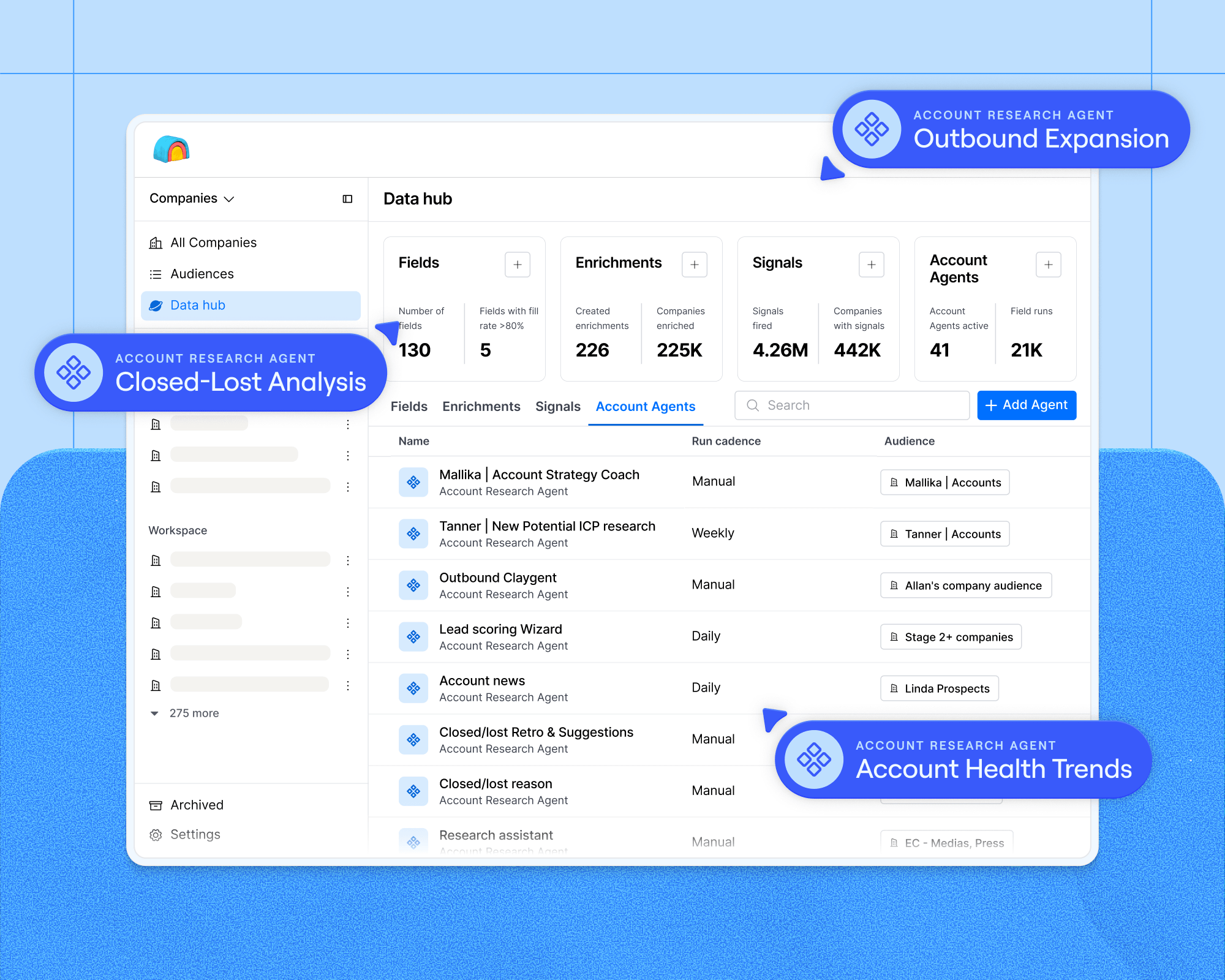
Founded in 2017, Clay isn’t built around one database. Its data marketplace puts 200+ data and AI vendors behind one contract, and waterfall enrichment queries them in sequence until a field comes back valid. This routinely triples coverage. Everything Clay knows about an account, whether it came from a provider or from your own CRM and warehouse, lives in Audiences, where segments update themselves as fields change. On top of that shared data, teams set up Signals to catch changes worth acting on, like a job change or a spike in topic intent. When a play needs research no provider offers, Claygent finds it on the open web. Research builds over time with Account Agents, which remember what they’ve learned about each account instead of starting from scratch. Plays run in Workflows, which score and route records however the team defines, and reach people through Sequencer for email or Ads for audiences on platforms like LinkedIn, Meta, and Google.
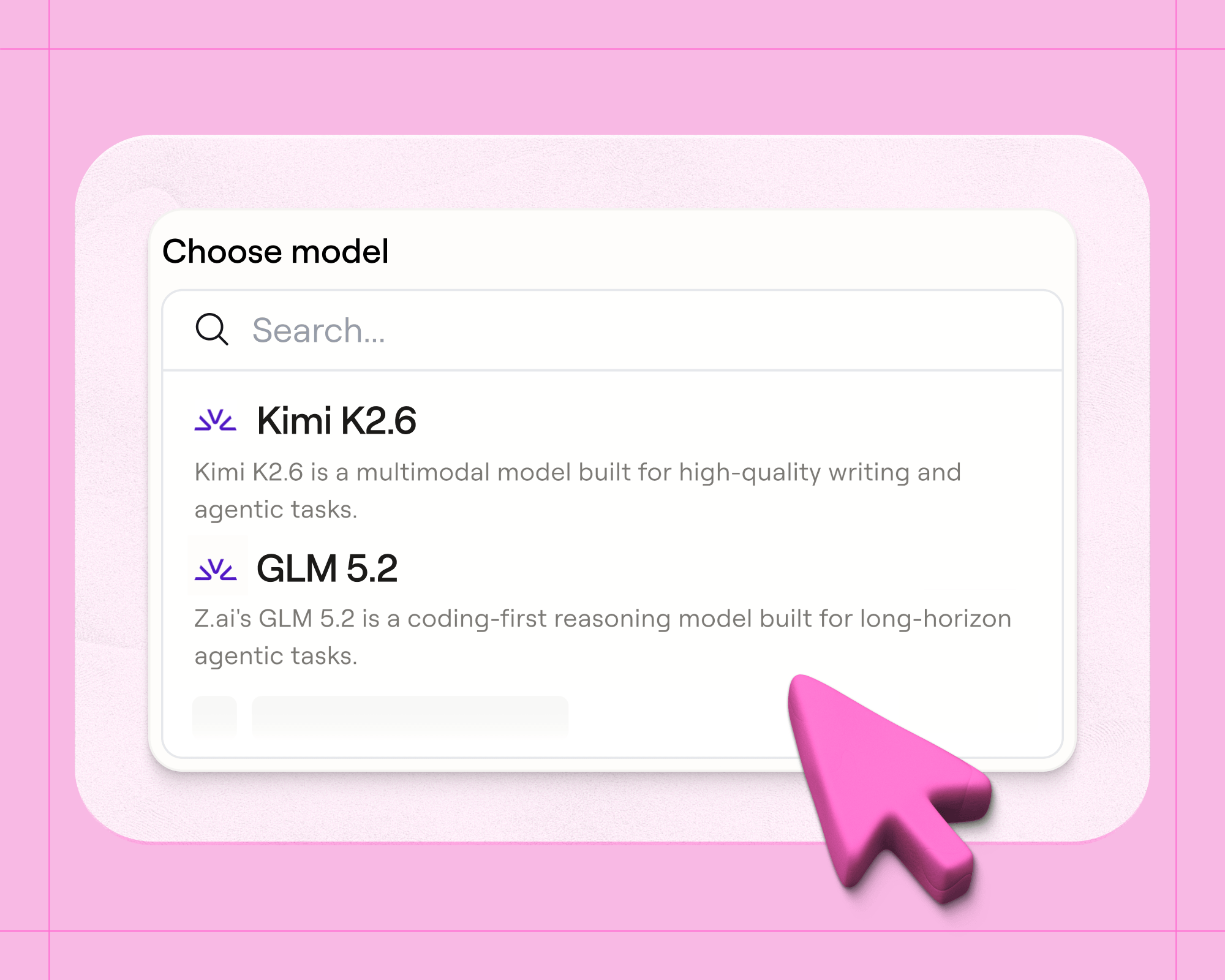
With Clay, you set up your own signals and scoring instead of picking from a preset menu. This is simpler than it sounds: Sculptor, Clay’s copilot, helps you build workflows and recommends enrichments from a plain-language description, and Clay University and the Slack community will help answer any questions you might have.
Key features in Clay:
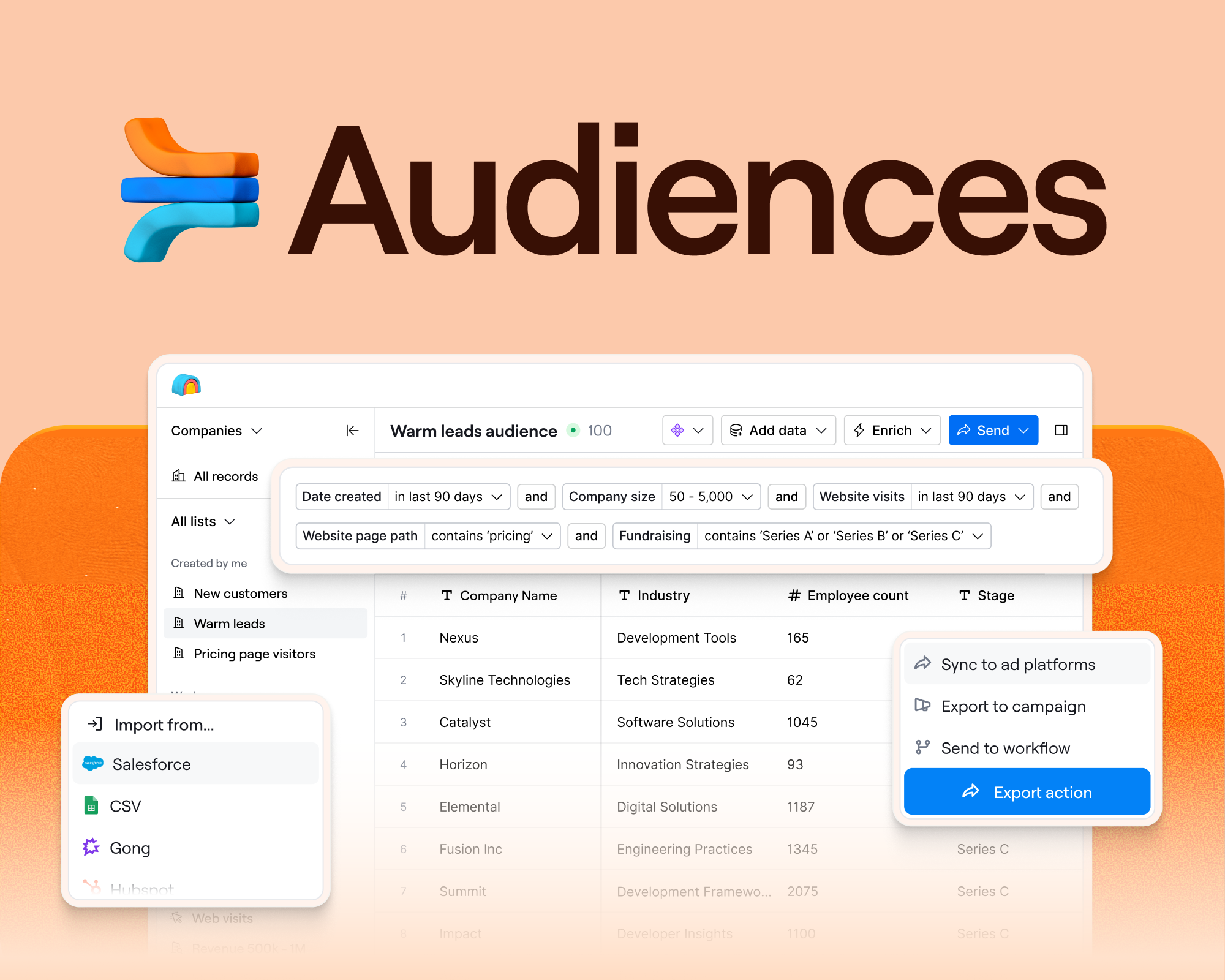
- Audiences, a shared data layer over your CRM, warehouse, and every provider, with self-updating segments
- Signals for custom triggers from any enrichment, including Topic Intent, web intent, job changes, and news
- Account and lead scoring written in formulas and AI formulas, so tiers and grades follow rules your team sets
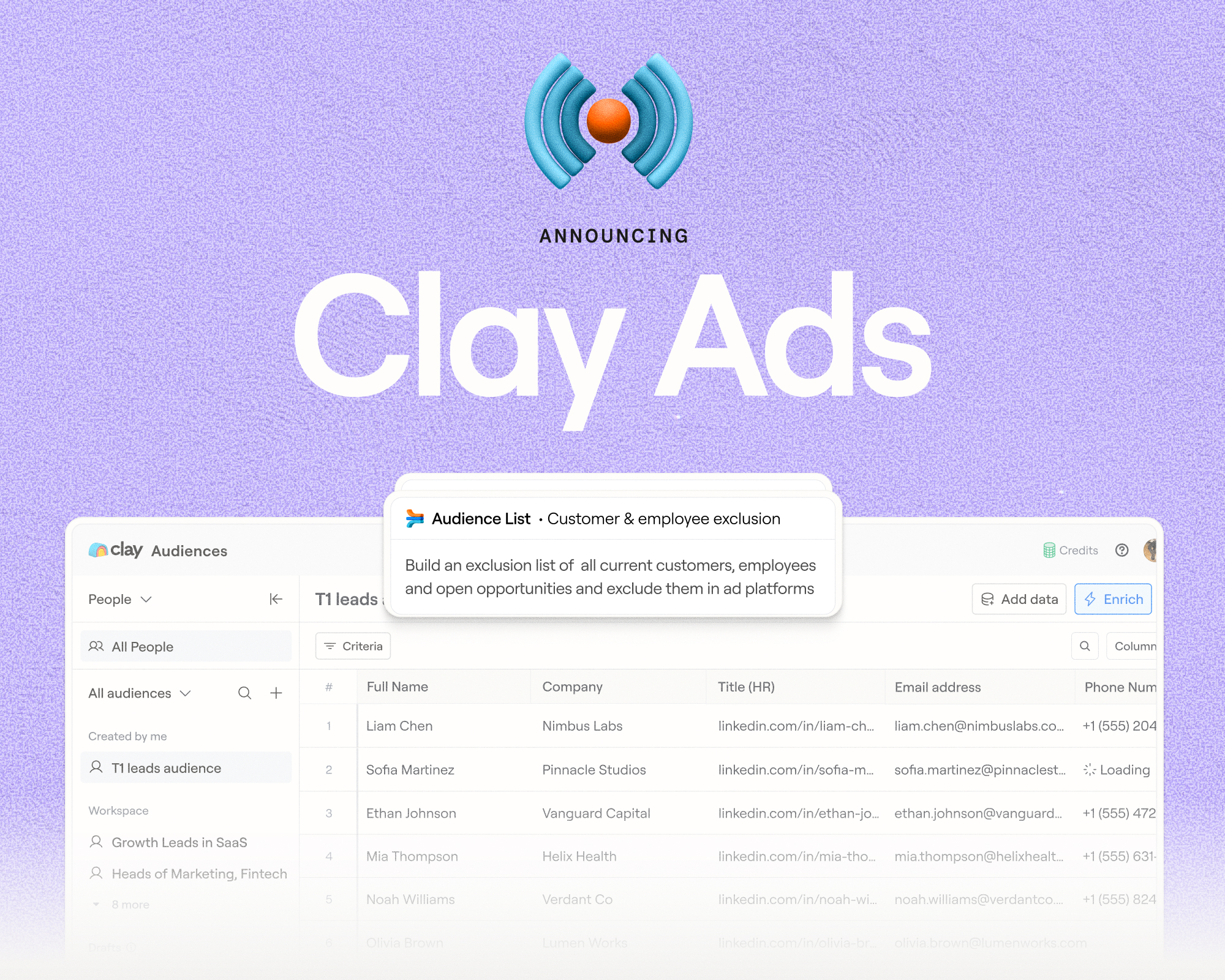
- Ads for always-on audiences synced to LinkedIn, Meta, Google, Bing, Reddit, and Vibe.co, with Enhanced Matching to raise match rates
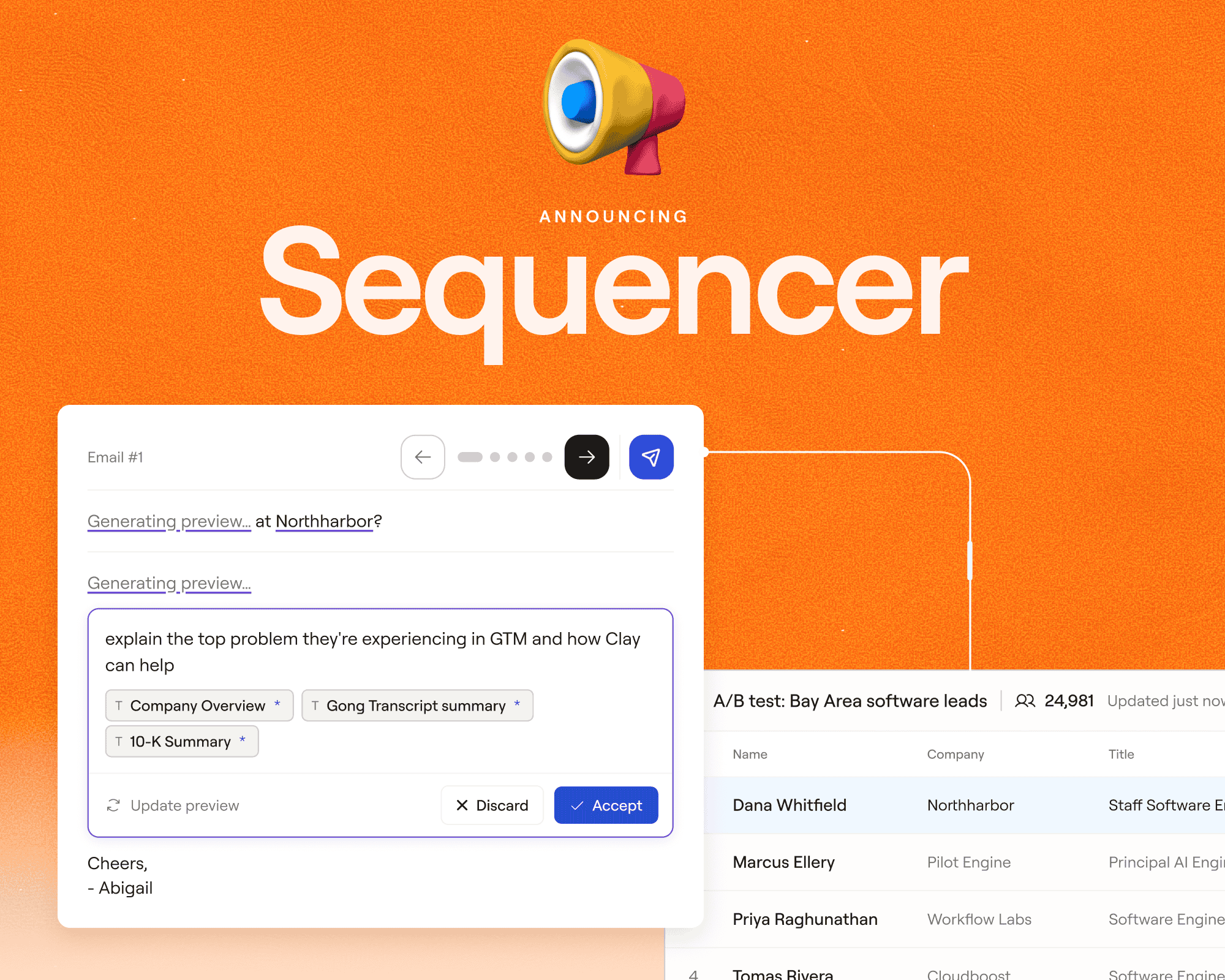
- Sequencer for cold email on lead lists that update as people qualify
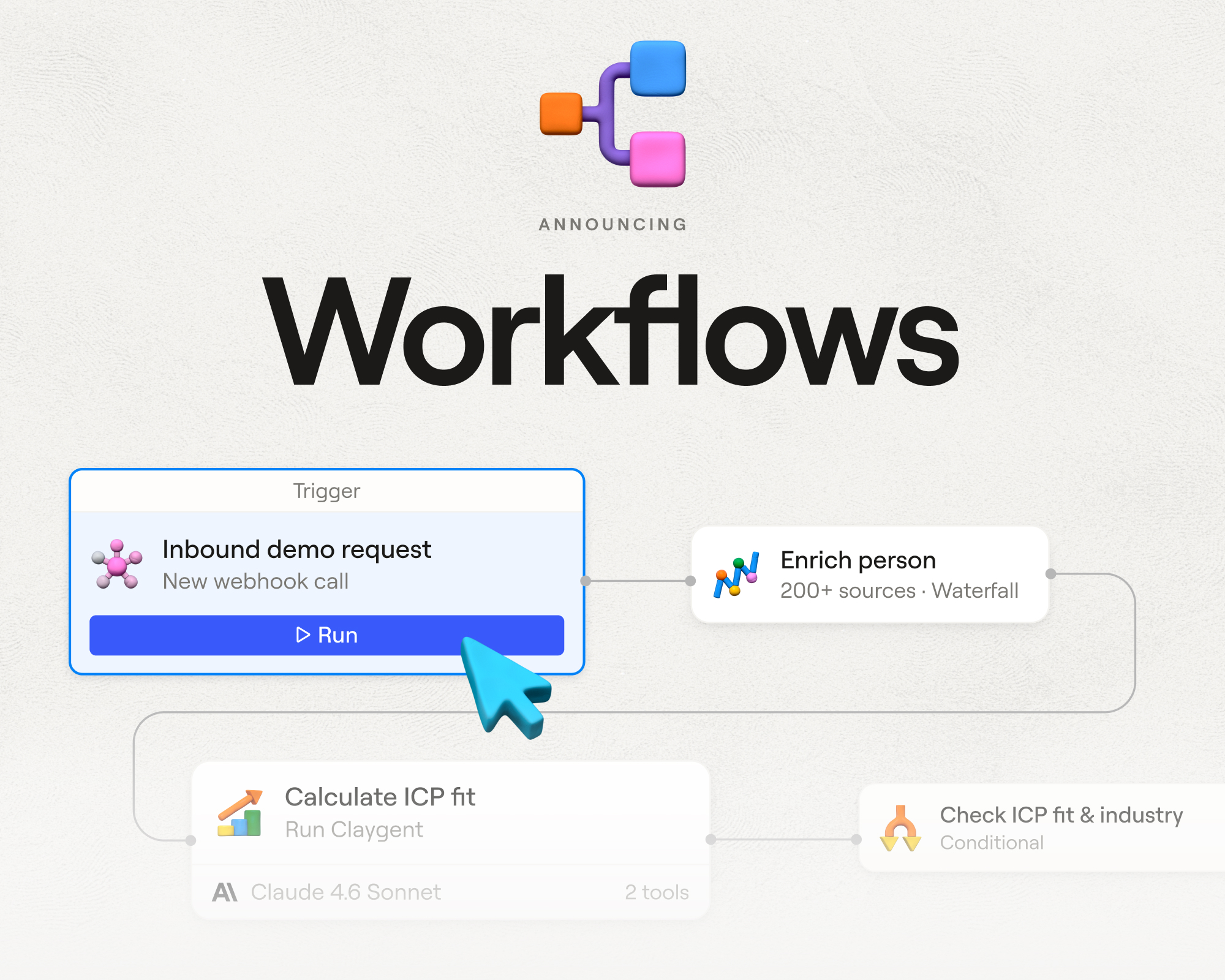
- Workflows for visual plays with conditional branches, code nodes, per-record traces, and no record limits
- Data marketplace with 200+ data and AI vendors on one contract
- Waterfall enrichment that queries providers in order until a valid result comes back
- Claygent research agents that return structured data from the open web
- Account Agents with persistent memory across every account in a segment
- Sculptor, a copilot that sets up workflows and enrichments in plain language
- Functions and AI formulas for logic you define once and reuse across plays
- Clay MCP for prospecting data inside reps’ AI assistants
- Agent plugin with a CLI and API for building workflows from a coding agent
What is Clay for Marketing?
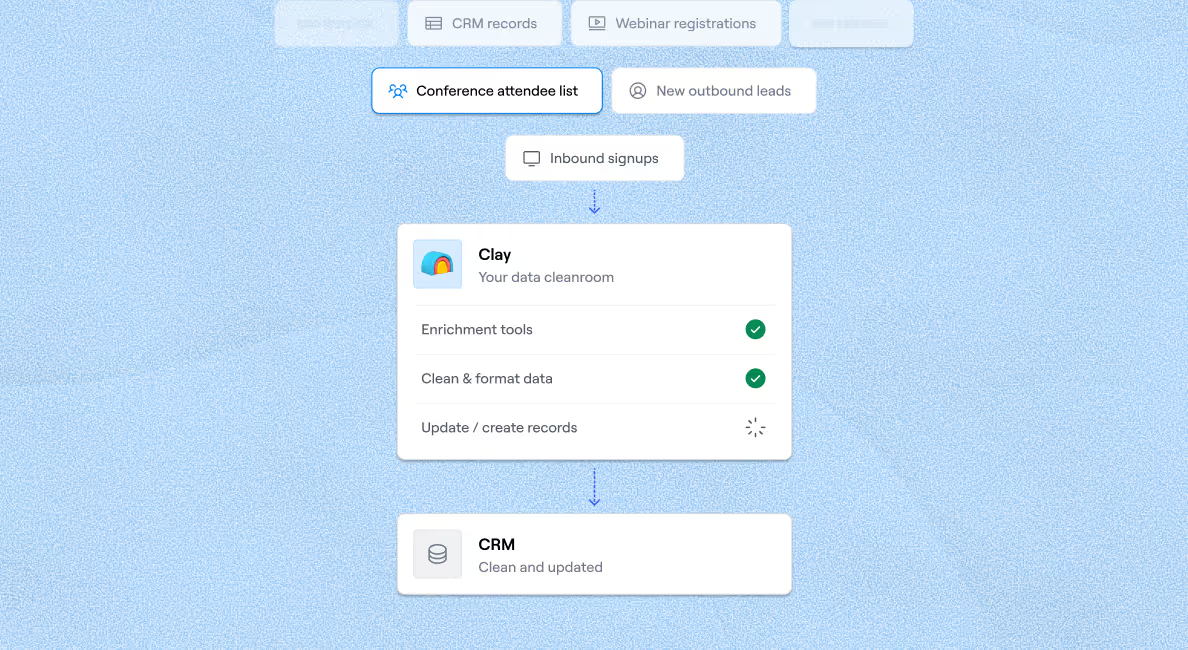
Clay for Marketing is the version of the platform built for demand gen and marketing ops teams, and account-based marketing is one of its main uses. A typical ABM setup in Clay starts with a target account list built from sources like Ocean.io, HG Insights, Google Maps, and Clay’s own company database. From there, accounts get tiered on the criteria that matter to your business, such as headcount by role, open job postings, tech stack, or compliance needs, and the contacts at each one get graded with AI formulas. Signals like product signups, Salesforce activity, ad engagement, and webinar attendance move accounts through awareness stages as they engage, and plays run against whichever tier and grade you choose, with high-touch steps like executive dinners handed to a person.
Verkada’s growth team is one example. It runs ABM campaigns on Clay across LinkedIn, email, and direct mail, with 600+ personalized landing pages auto-generated per campaign. Matching prospects to their LinkedIn profiles before targeting has also doubled its LinkedIn ad match rates.
What is 6sense?
6sense is an ABM and revenue intelligence platform that turns buying signals into account-level intelligence and pushes it into marketing and sales tools. More recently, it’s added AI agents to its offering. Its data hub, the Signalverse, collects buying signals at scale, combining keyword-level intent from B2B publisher content with partner intent from G2, TrustRadius, Bombora, PeerSpot, and Gartner. Web deanonymization matches anonymous website traffic to accounts, and B2B Buyer Data adds contact and company records with technographics.
On top of that data, 6sense sells two main products, one for each side of the revenue team:
- Revenue Marketing is the marketing product and where the ABM work happens: building target audiences, running multi-channel campaigns from a drag-and-drop canvas, buying ads through 6sense’s own DSP, and sending AI-written email.
- Sales Intelligence is the sales product that shows reps the same account context in a Chrome extension and their CRM.
Key 6sense features:
- Signalverse intent data with keyword-level intent plus partner topic intent
- B2B Buyer Data covering 481M+ buyer profiles, 75M+ companies, 98M+ direct dials, and 43K+ tracked technologies
- Predictive models for ideal customer profile (ICP) fit, buying stage, and contact fit and reach, trained on your own data
- 6sense Qualified Account (6QA) thresholds you configure per product and GTM segment
- Web deanonymization for anonymous site visitors
- Audience Builder with 80+ segmentation filters and syncs to LinkedIn, Meta, and Google Ads
- 6sense Advertising, a native B2B DSP for display, video, native, and connected TV, plus social and search syncs
- Intelligent Workflows for multi-channel plays from one canvas and for CRM and marketing automation platform (MAP) enrichment
- AI Email Agents that generate and reply to emails
- Sales Intelligence with a Chrome extension, Sales Copilot, alerts, and people search
- RevvyAI conversational intelligence and an MCP Server for AI agents
At a glance: Clay vs 6sense
Intent signals: companies or people
Intent is the reason 6sense exists, so this is likely the comparison factor your ABM team cares about most. To assess different providers, consider where the signal comes from, and whether it points to a specific person or only to a company. A signal that someone at a 40,000-person company is researching your category is useful for general awareness ads, but much less useful for a rep who has to pick a person to dial.
Clay
Clay’s Topic Intent checks three providers:
- Bombora scores companies against their own historical baseline
- Delivr names the individuals doing the research, not just their company
- Intentsify aggregates signals from several sources and also covers people
You describe the topics your buyers research in plain language, and every match comes back with the topic, the provider, a raw 0 to 100 score, and a Low, Medium, or High tier. This way, a rep can see which person showed intent on which topic and which provider reported it, rather than an unexplained account flag. Data refreshes weekly.
On top of that, Clay’s web intent identifies the companies visiting your site, at the account level, and Signals builds triggers from any of the 200+ enrichments or from a Claygent query, including social listening and first-party data like product usage or Gong transcripts.
6sense
6sense tracks intent at the keyword level, drawing on its own publisher network and layering in partner feeds from G2, TrustRadius, Bombora, PeerSpot, and Gartner. In practice, that means your team picks and maintains the keyword lists itself, and a keyword match only tells you that someone at a company searched for it, not who. On your own site, web deanonymization ties anonymous visits to accounts and combines them with CRM and MAP activity.
6sense’s third-party intent identifies companies, not the people inside them. Its ad targeting works the same way. Person-level signal comes mostly from first-party engagement by known contacts in your MAP and CRM, which its Contact Profile Fit and Contact Reach models score. In June 2026, 6sense added AI-Recommended Leads, which suggests CRM-ready contacts at accounts engaged by its ad campaigns.
The difference matters most if you’re selling into large accounts, which is usually the point of ABM. An account-level signal at a 40,000-person company tells your rep that someone there is researching, but not who, so they still have to guess which contact to call. A signal tied to a named person in a specific role can go into your sequence or ad audience right away.
Where the outreach data comes from
For ABM, you need company data (industry, headcount, tech stack, funding) to pick and tier your target accounts, and you need contact data (names, titles, emails, phone numbers) to reach the buying committee at each one. Where a platform gets that data, and what it does when a record is missing, determines how many of your target accounts you can reach, and how many sit on the list with no usable contact behind them.
Clay
Instead of maintaining one master file of companies and contacts, Clay connects you to Prospeo, People Data Labs, Hunter, HG Insights, PitchBook, and a couple hundred other providers through a single marketplace contract, and waterfall enrichment checks them one after another, in the order you set, until a field comes back valid. You pay only for results, and the marketplace includes regional specialists, like Firmable for Australia and NBS for Japan. Anthropic tripled its data enrichment coverage by layering providers this way.
Clay also has proprietary data: a native database of people, companies, and jobs you can source net-new accounts from. If you need a unique data point, like whether a company mentions SOC 2 on its website, Claygent researches it online and returns the answer as a column you can score on.
6sense
6sense’s data is its own: the Signalverse maps company and IP address identities at a scale few vendors match, and B2B Buyer Data adds a large proprietary database of buyer profiles, company records, direct dials, business emails, and technographics. The identity resolution behind web deanonymization ties web activity to CRM and MAP records on one account.
The tradeoff is the one every single-source dataset carries. Coverage ends where 6sense’s data ends. If a contact’s mobile number or email isn’t in the 6sense database, there is no second provider to try inside the platform, so that person stays out of reach no matter how strong the account’s intent score is.
Scoring: who decides what “in-market” means
A score is really a decision rule: someone has to decide that a Series C round matters more than a job posting, or that a pricing-page visit outweighs a whitepaper download. When looking at options for your next ABM platform, find out how that score gets decided and how fast you can change it when sales disagrees.
Clay
In Clay, your team writes the rule using lead-scoring formula columns that add points for attributes like company size or open roles, or assign grades based on combinations of criteria. For instance, Clay scores its own target accounts on fit, engagement, and likely deal size. Fit comes from third-party data, engagement from first-party activity over a rolling 90-day window, and likely deal size from the closest closed-won customers. You can use Clay’s formula generator to help you draft these scoring formulas from a plain-language description.
Because the logic is yours, the audit trail is, too. A rep who doubts a score can open the record and see the columns that produced it. Plus, if your ideal buyer changes, say you start selling to marketing leaders instead of sales leaders, ops can give that job title more points the same day instead of waiting for a model to retrain. Customers and prospects can also run on different rules in different segments.
ElevenLabs found that switching from static scoring to a multi-signal model in Clay delivered a 50% lift in sales-qualified leads.
6sense
6sense’s scoring is a predictive model trained on your own data: historical CRM, MAP, first-party, and third-party intent data, interpreted alongside the Signalverse. Each account gets an ICP fit and a buying stage from Target through Purchase, and accounts become 6QAs when they meet criteria you configure per product and GTM segment using predictive, keyword, engagement, and CRM filters.
The company doesn’t expose the internal model weights. If you want to know why an account received a particular score, that information isn’t available in-platform. 6sense separates transparency (the signals behind a score are visible on the account record) from explainability (the weights, which are not). In practice, that leaves marketing defending a number it didn’t build and can’t take apart. With Clay, the scoring rules are yours from the start: every point an account earns traces back to a field you chose, so sales and marketing are working from the same logic instead of debating a vendor’s.
From score to action: orchestration and agents
A flagged account, even one that’s a perfect fit, only matters if something happens next. That means enriching the buying committee, routing it to the right owner, and launching ads and email that match the account’s stage. It also means flagging moments when someone should step in, like an AE calling the VP directly or inviting them to an executive dinner. Both Clay and 6sense automate this, but they differ in what data the automation can act on and how much you can customize each step beyond the built-in options.
Clay
Workflows is a visual builder for full plays on the Audiences data layer. For example, you could build a workflow that runs the moment a contact at a tier-one account fills out a form:
- Research and qualify the contact
- Score them on fit and intent
- Route them to the account’s AE
- Send an executive dinner invitation on the AE’s behalf
- Enroll them in nurture ads on Meta and LinkedIn
Every record carries a run trace showing which step fired, so when a play misroutes someone, you can see why. Each step’s conditions can be a simple filter or custom code.
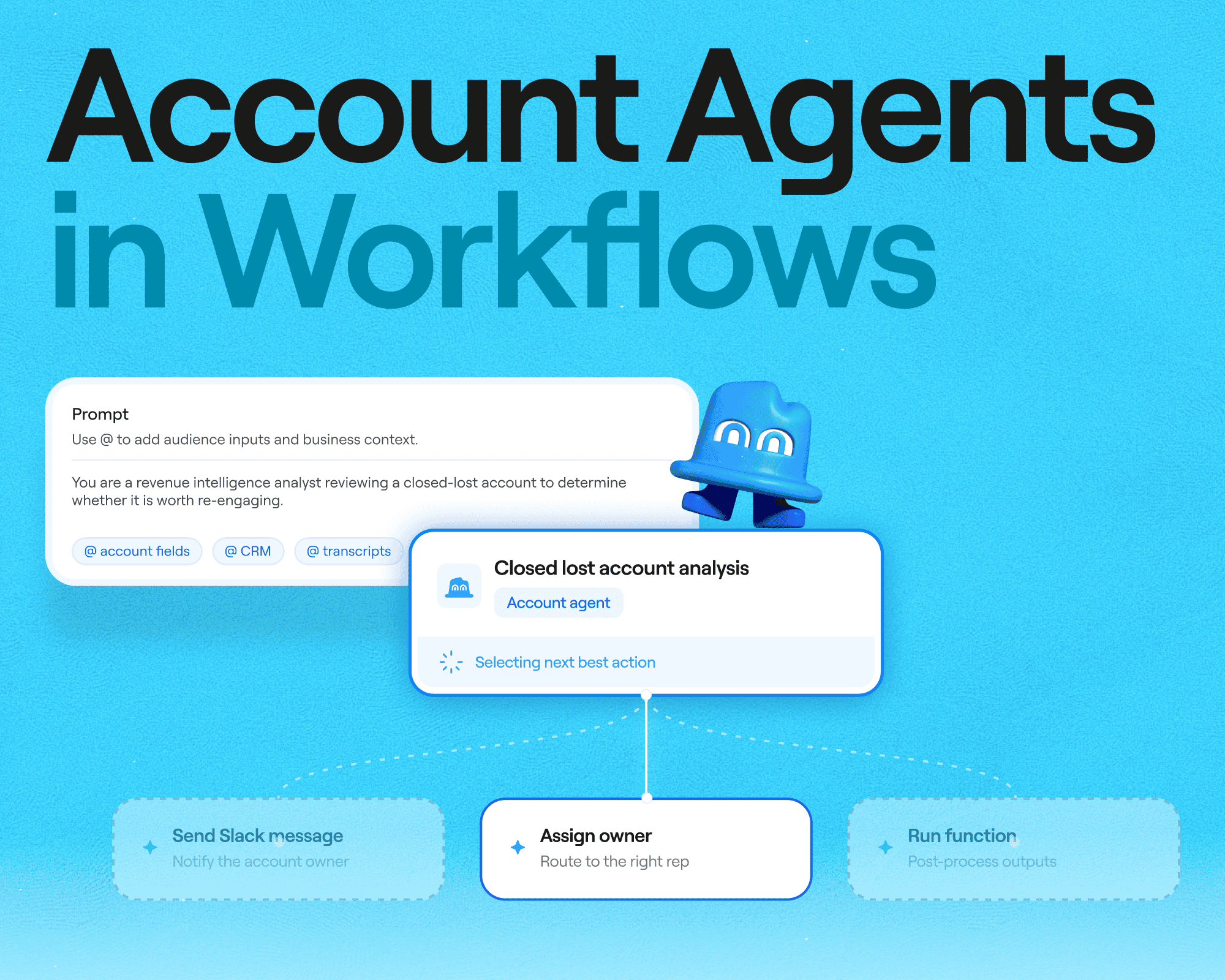
Account Agents extend this: they arrive at a signal already knowing the account’s past touches and calls, pick the next action from a set you’ve allowed, write the conclusion back to the account, and run the next step of the play. You can build all of it by describing the play to Sculptor or from a coding agent through the CLI and API.
6sense
Intelligent Workflows is 6sense’s version of an orchestration canvas: customers can drag and drop plays that trigger multi-channel campaigns as accounts change buying stages or enter a segment. AI Email Agents generate and reply to emails using buyer signals while Sales Alerts notify reps when accounts in their territory show signals. RevvyAI lets a marketer ask questions of the data and activate a keyword campaign, and the MCP Server brings 6QA status and campaign performance into tools like Claude and ChatGPT.
The difference comes down to what each system can act on. 6sense workflows trigger off 6sense’s own scores and segments and push into 6sense’s applications or a set list of integrations. Clay workflows can trigger off any field in your data layer, whether it came from a provider, your CRM, your product, or 6sense scores synced through your CRM. When a step needs logic the built-in options don’t cover, you can write it in code instead of waiting for the vendor to add it.
Ad targeting and channels
Ads let an ABM program reach the whole buying committee at once, both the people your reps are already talking to and the ones they haven’t reached yet. Both Clay and 6sense build ad audiences from account data and sync them to LinkedIn, Meta, and Google. They differ in which people inside the account the ads reach and which channels beyond those three you can use.
Clay
Clay Ads builds audiences from your CRM, warehouse, signals, or the marketplace and syncs them to LinkedIn, Meta, Google, Bing, Reddit, and Vibe.co for connected TV. Targeting happens at the contact level, so you decide which people at an account see an ad.
Ad platforms match poorly on work emails, so Enhanced Matching queries several providers and returns up to three hashed personal emails per contact. Match rates reach up to 95% on LinkedIn, 85% on Google, and 70% on Meta. Your audiences also update on their own, with full replacement syncs as often as every two days, so a closed-won account drops out of a prospecting campaign without anyone exporting a list.
Depthfirst’s LinkedIn match rate went from 65% with manually uploaded lists to 90%+ with audiences built in Clay, and on Google, where its customer lists previously didn’t match enough people to run ads at all, it now averages an 80% match rate with a 40% lower cost per lead.
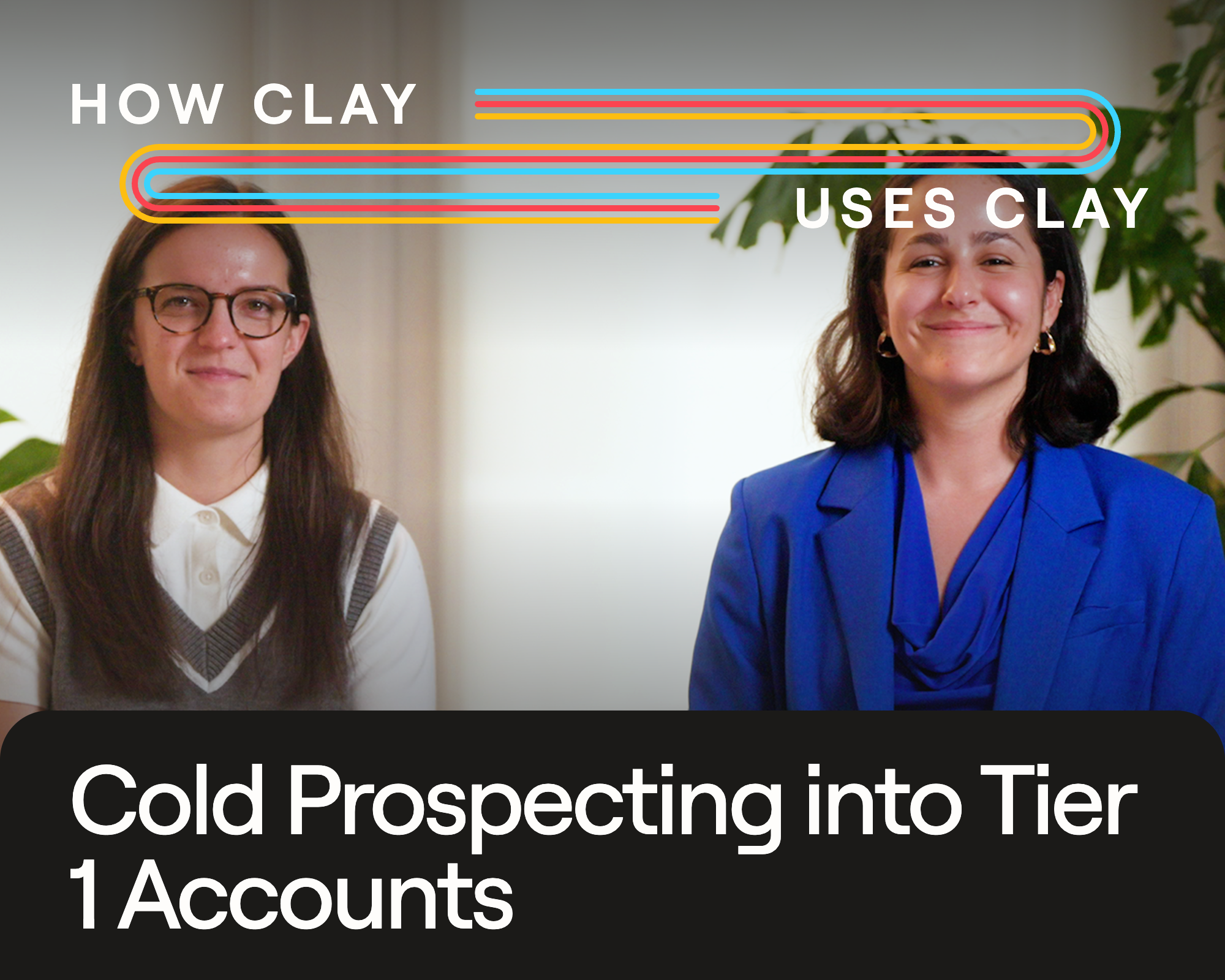
Watch How Clay uses Clay: Build Ad Audiences that Generate 30x Pipe: Spend. Clay’s growth team shows how it builds dynamic ad audiences from Audiences data and syncs them to LinkedIn and Meta.
6sense
6sense Advertising runs its own B2B demand-side platform (DSP) for display, native, video, and connected TV, and it also syncs segments to Google Ads, LinkedIn, and Meta. Audiences come from Audience Builder filters like buying stage and keyword research, so spend follows accounts as they move through stages.
What matters for you is who the ads reach. 6sense targets at the account level: it identifies companies by IP address and shows ads to whoever it associates with those companies. That works for putting display ads in front of an entire company through its DSP. On the channels both platforms share, though, Clay shows ads to the specific people you picked, while 6sense spreads them across the account. For ABM, that means your ad budget with Clay goes to the handful of people who make the buying decision, while 6sense spreads it across everyone at the company.
Pricing and how costs scale
It helps to know what an ABM platform costs before you get deep into an evaluation, and the pricing model matters as much as the price itself. Once you know whether you’re paying per seat, per credit, or per action, you can budget for how the bill will change as your team and your campaigns grow.
Clay
Clay’s pricing is public and usage-based, with unlimited seats on every plan. You pay for two things:
- Data credits buy provider data. They start at $0.05 each and get cheaper at higher volumes.
- Actions cover platform work, like running a workflow or syncing a record. They cost less than a cent each.
An enrichment that comes back empty costs nothing. Here’s an overview of the plans, billed annually:
Unused data credits roll over on Launch and Growth, up to twice your monthly amount, and Enterprise customers can carry 15% of the prior year’s credits into a renewal.
For ABM specifically, Topic Intent is available on any paid plan, and Clay Ads on Growth and Enterprise. Account Agents run on Launch and above. If you want a number before talking to anyone, the pricing calculator estimates the credits and actions your volume would need.
6sense
6sense doesn’t publish prices on its website. Its pricing page lists two Sales Intelligence packages, one with the predictive model and one without, and asks you to book a demo for either. Everything a marketing team would actually buy, including Revenue Marketing, Advertising, Intelligent Workflows, and the Predictive add-on, is quoted through sales, so you can’t budget for it without a sales conversation.
Your contract sets credits and groups them into pools by timeframe, and unused credits are lost at the end of each period, with expiry reminders starting 60 days out. The free Sales Intelligence plan ended on August 12, 2026, so there is no longer a no-cost way to try the platform before you buy.
Implementation and time to value
How quickly you get from a signed contract to a working play depends on how much the vendor has to learn about your business first. 6sense’s predictive model needs months of your historical data before it can produce reliable scores. Clay has no model to train, but someone on your team has to set up the signals and scoring.
Clay
With Clay, you can sign up for free or start a 14-day trial of a paid plan and import your CRM the same day. The work is in designing the plays, and Clay gives you tools for that:
- Sculptor builds workflows from a plain-language description of what you want
- Clay University offers structured courses, including one on ABM
- Enterprise plans add a dedicated growth strategist
When Clay’s growth team built its own ABM campaign, the first build took some setup work, and every run since takes about 20 minutes. Someone on your side does need to own the system, usually a marketing ops or GTM engineering role. If you don’t have that person yet, Clay experts and partners can build it with you.
6sense
6sense implementation is guided, and it takes longer. Setting up Predictive means working with a 6sense Product Consultant to define what counts as a relevant opportunity, classify your data with taxonomy models, sync the minimum required fields from your marketing automation platform, and place the 6sense web tag on your site.
6sense’s documentation puts predictive model setup at around four to eight weeks depending on data complexity and meeting cadence. Plus, its guide to predictive analytics recommends six to twelve months of historical outcomes to train on. It may take time for your team to build a model it trusts, and you should budget ops time to keep the data clean.
When to use Clay for ABM
Clay is the stronger choice when the problem with your current program is trust and control, not a lack of signals. You’ll recognize the situation if some of these apply:
- Sales never adopted the scores. If marketing bought an intent platform and your reps ignore its alerts or override its prioritization, the fix is scoring they can inspect. In Clay, reps see the specific signal behind a ranking rather than a number they have to take on faith.
- Marketing can’t prove its pipeline contribution. When every play runs from the same Audiences data, you can show which signals and which campaigns produced the opportunities, and adjust the scoring when the answer surprises you.
- Your SDRs still do manual research after an intent alert. A flag that says an account is hot doesn’t tell a rep who to call or what to say. Claygent and Account Agents do that research and draft the outreach, so the alert arrives with a name and a reason.
- You want to own your GTM logic. If your team would rather define what an in-market account looks like than accept a vendor’s model, Clay’s scoring is built from rules you write and can change whenever priorities shift.
- You need to target people, not accounts. Contact-level ad audiences and Topic Intent that names individuals matter when the buying committee is a handful of people inside a very large company.
- Your coverage is thin outside North America. Waterfall enrichment across regional providers fills gaps in EMEA, APJ, and APAC that a single database leaves open.
- You’re already consolidating vendors. If ZoomInfo, UserGems, LeadIQ, Clearbit, or Cognism are on the same cleanup list, one marketplace contract can replace several of them at once.
When to use 6sense for ABM
6sense fits when its advertising or its existing footprint matters more to you than control over the scoring:
- Programmatic display through its DSP is your main use case. 6sense’s native DSP buys display and connected TV inventory directly, and if that channel drives your program, it’s the reason to stay.
- You’re mid-contract with a mature ABM motion built on 6sense. If the program is working and nobody wants to disrupt it, the practical path is to keep 6sense’s scores and layer Clay’s enrichment and execution on top through your CRM.
- You need a marketer-friendly interface with no ops dependency. Basic tasks in 6sense don’t require anyone to build anything, which matters if your team has no marketing ops or GTM engineering capacity and no plans to add it.
- You rely on 6sense’s keyword intent history or its org-chart data. Its keyword-level intent is strongest in the US and Canada, and its account hierarchy data comes packaged in a single field, which Clay doesn’t replicate as one field.
Grow enterprise pipeline faster with ABM on Clay: book a demo
6sense tells you an account is hot. Clay tells you who at that account is buying, when to reach them, and what to do next. With Clay, marketing defines the signals that drive pipeline and can change the scoring in days instead of quarters, while campaigns target the buying committee instead of the whole account. Your reps get contact-level context they can act on, and both teams work the same list with data everyone trusts.
To see how that would work on your own target account list, book a demo. If you’d rather try it first, sign up for free and build your first account tier without a credit card.
Clay vs 6sense FAQ
Does Clay have intent data?
Yes. Clay’s Topic Intent signal queries Bombora, Delivr, and Intentsify and returns the topic, provider, score, and tier behind each match, with Delivr and Intentsify naming the specific people doing the research. Clay also identifies the companies visiting your website through web intent, and you can build custom signals from any enrichment or from your own first-party data.
Is 6sense scoring a black box?
6sense shows the signals behind a score on the account record, but it doesn’t expose the model’s weights or let you change them. You can only adjust the 6QA thresholds that sit on top of the model. In Clay, the score is a formula or agent your team wrote, so every input and weight is visible and editable.
Does 6sense offer a free plan?
No. 6sense discontinued its Sales Intelligence free plan on August 12, 2026. Clay’s free plan includes 100 data credits and 500 actions a month with unlimited seats, and paid plans start at $167/mo billed annually.
Can Clay run account-based ads?
Yes. Clay Ads builds audiences from your target account list and syncs them at the contact level to LinkedIn, Meta, Google, Bing, Reddit, and Vibe.co for connected TV, with match rates up to 95% on LinkedIn. Audiences update automatically as accounts change tier or stage, so your ads follow the same accounts that sales is working with.







.png)



.avif)













.avif)












.avif)